In short
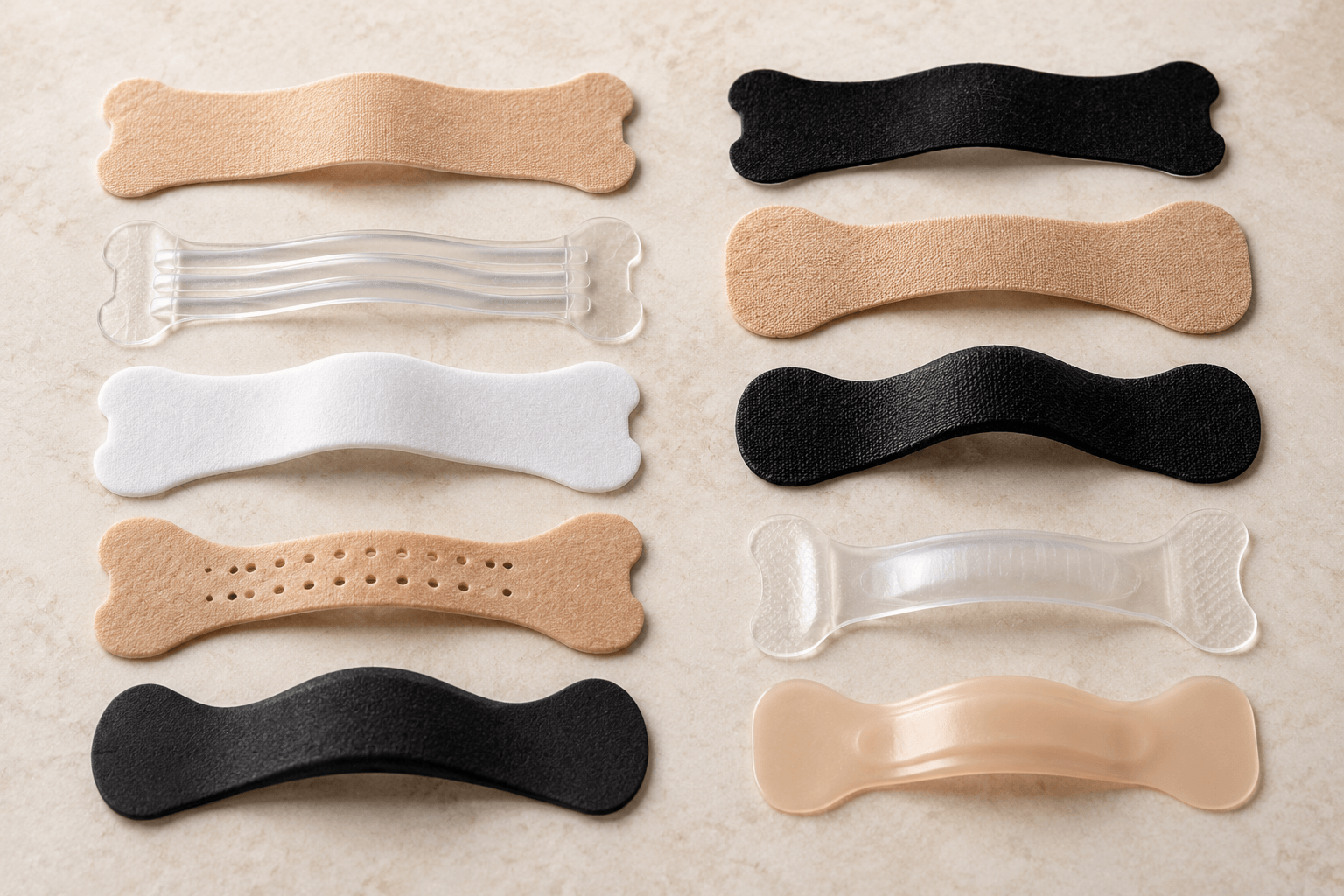
- A nasal strip is a springy adhesive band that lifts the sides of your nose and widens the nasal valve, the narrowest part of the airway near the nostrils.
- Controlled trials found strips reduced snoring frequency or loudness in habitual snorers and in people with chronic rhinitis, and a 2016 meta-analysis found nasal dilators improve nasal breathing.
- Strips help most when the front of your nose is the bottleneck, for example from congestion, a narrow nasal valve or a septum that bends near the nostrils.
- Strips are drug-free and simple to use. The main side effect is skin irritation, and Breathe Right recommends loosening the strip with warm water and peeling it off slowly.
- Strips pair well with mouth tape, as long as you can breathe comfortably through your nose with the strip on.
- Strips don't treat sleep apnea. Loud snoring with gasping, choking or pauses in breathing needs a doctor.
Nasal strips are one of the simplest ways to make breathing through your nose easier at night. A small springy band lifts the sides of your nose and opens the narrow passage just inside your nostrils, and in several trials that meant less snoring for people whose nose was part of the problem. This guide covers how they work, what the research found, who gets the most from them and how to use them well.
What a nasal strip is and how the spring band works
A nasal strip is an adhesive pad with flexible bands built into it. Breathe Right, the best-known brand, describes its bands as "spring-like." You stick the strip across your nose just above where the nostrils flare out, and the bands try to straighten back to their original shape. As they do, they gently lift the sides of your nose outward.
That lift happens at the nasal valve, near the front of the nose. A 2019 study of nasal dilators describes the nasal valve area as the narrowest point of the upper airway. Cleveland Clinic describes the nasal valve in two parts. The internal valve is the passageway in the middle of your nose, and the external valve sits at the bottom, near the nostrils. When this area is narrow or the side walls are soft, it can feel like you're breathing through a straw.
The effect is measurable. In a 1997 randomized, double-blind, placebo-controlled study of 53 athletes, researchers used acoustic rhinometry, a way of mapping the inside of the nose with sound, and found the strip significantly increased nasal valve area at rest in every group they measured. The authors of a 2016 meta-analysis also point out why a small change matters. They cite earlier work showing that when the cross-sectional area of the nasal cavity increases by 10%, nasal airflow increases by about 21%.
A strip contains no medicine. It works purely by holding the front of the nose open for as long as you wear it. For a closer look at the mechanics, see how nasal strips work, and when they help most.
What nasal strips are good for
Strips are useful whenever the front of your nose is what's holding your breathing back. That covers more situations than most people expect.
Snoring that seems linked to your nose is a good reason to try one. If you snore more when you have a cold, during allergy season or when your nose feels tight lying down, a strip is a sensible first thing to try. The research on this is covered in the next section.
Congestion from colds and allergies is another. A strip won't clear mucus or calm swelling, but it widens the opening so the air that can get through moves more easily. If allergies are your main trigger, nasal strips for allergies goes into the trials in people with nighttime congestion. For a wider set of options on rough nights, see how to sleep with a stuffy nose.
A narrow or weak nasal valve is where strips fit most directly. Cleveland Clinic lists breathing strips among the ways to manage nasal valve collapse without surgery and says they may help you breathe easier and sleep better at night. Our guide to nasal valve collapse covers the symptoms, such as nostrils that pinch in when you breathe in hard.
Many people also simply like the feeling of a more open nose, whether they're trying to breathe through it more at night or during easy exercise. If you're working toward nasal breathing during sleep, a strip can make that first step more comfortable.
What the research found
Research: moderate (what this means)Nasal strips have been tested in several placebo-controlled trials and pooled in a 2016 meta-analysis. Here is what that research shows, starting with the positive results.
Strips reduced snoring in several trials
A 2000 randomized, placebo-controlled trial in the European Respiratory Journal tested strips in 12 people with chronic rhinitis who snored but didn't have sleep apnea. Each was recorded overnight in a sleep lab. Snoring frequency was 173 snores an hour with the real strip compared with 258 with a placebo strip, a significant drop. The authors concluded the results support the idea that Breathe Right is effective in reducing the amount of snoring in people with chronic rhinitis.
A 1998 sleep lab study of 30 habitual snorers found strips lowered peak snoring loudness through the night, especially in lighter sleep. On the second night with a strip, peak loudness was lower than at baseline in 22 of the 30. The benefit showed up most clearly in snorers without sleep apnea. Participants also rated their sleep quality as better on a questionnaire, and the authors described the strip as a safe and easily applied way to reduce peak snoring loudness, especially in mild habitual snorers.
Strips widen the nose, including in people with a deviated septum
A 1998 study in Laryngoscope tested an external nasal dilator in three groups: 28 people whose septal deviation narrowed the nasal valve area, 33 people with congested nasal lining and 51 people with healthy noses. The dilator increased the narrowest cross-sectional area of the nose and lowered nasal resistance in all three groups, and the effect was largest in the septal deviation group. The authors called it an effective, nonsurgical approach for septal deviation that obstructs the nasal valve area.
The 2016 meta-analysis in Pulmonary Medicine, which pooled 14 studies of internal and external nasal dilators, reached the same broad conclusion: nasal dilators have demonstrated improved nasal breathing.
Some people with nighttime congestion felt they slept better
In a 2018 double-blind trial, 59 people with chronic nighttime congestion and trouble sleeping used a Breathe Right clear strip, a prototype strip or a placebo strip without springs for two weeks. Both real strips beat the placebo on satisfaction with sleep at day 7, and the Breathe Right strip also beat the placebo on a sleep problems score at day 7. All strips were well tolerated. Do nasal strips improve sleep? walks through each sleep study in detail.
The limits
The research also has clear limits, and they're worth knowing so you can set fair expectations.
Strips don't help sleep apnea. The 2016 meta-analysis found no significant change in the apnea-hypopnea index, lowest oxygen level or snoring index in people with obstructive sleep apnea, and 12 of its 14 studies showed no significant change in the apnea-hypopnea index. The authors explain that the nose generally isn't where the airway closes during apneas. Breathe Right's own FAQ says its strips are not intended to treat sleep apnea.
Results on snoring are mixed across studies. In the 2000 trial, the strip lowered how often people snored but not how loud they were. A 2001 Norwegian study of 18 heavy snorers with nighttime nasal blockage found the strip clearly widened their noses, yet snoring duration and loudness didn't change. Only a subgroup of 6 people with severe morning nasal blockage saw objective benefits, in their oxygen levels during sleep.
Sleep quality results are mixed too. Two larger double-blind trials published in 2019, with 140 and 130 participants, found real strips no better than placebo strips on sleep problems or feeling unrefreshed in the morning. Both groups improved from where they started, and the authors suggested a strong placebo effect. That trial and the 2018 one were funded by GlaxoSmithKline Consumer Healthcare, which the papers name as the maker of Breathe Right.
Most of the studies are small, and several measured only a night or two. Taken together, the evidence supports strips as a reliable way to open the front of the nose, with a reasonable chance of quieter snoring when your nose is part of the problem.
Who gets the most out of nasal strips
The pattern in the research is consistent. Strips help most when the front of the nose really is the bottleneck.
That includes people whose nose feels tight or blocked at night, especially lying down. Cleveland Clinic notes that breathing trouble from nasal valve collapse may get worse when you're lying down and lists snoring at night among its symptoms. It also includes people with chronic rhinitis who snore, the group in the 2000 trial, and habitual snorers without sleep apnea, the group that did best in the 1998 study.
People with a septum that bends near the nostrils are good candidates too, based on the 1998 Laryngoscope results. Nasal strips and a deviated septum explains why the location of the bend matters.
The 2001 study adds a useful detail. The people who benefited objectively were the ones with the most blocked noses in the morning. If you wake up with a stuffy nose and a dry mouth, you're more likely to notice a difference than someone whose nose is already wide open.
If you're not sure how well you breathe through your nose, our two-minute nose test is a simple way to check. Try it with and without a strip and see whether it feels easier.
Who they won't help much
A strip works on the outside of the front of your nose, so it has nothing to work on when the blockage is somewhere else.
Swelling deep inside the nose is one example. In the 1998 Laryngoscope study, people whose blockage came from congested nasal lining did show measurable widening with the dilator, but they didn't feel any more open. Snoring that comes from the throat or soft palate is another. The 2016 meta-analysis lists the soft palate and throat among the areas more likely to collapse during sleep apnea, and a strip on your nose doesn't reach them.
If your nose is already wide, a strip may have little to add. In the 2001 study, the 12 people with roomier noses got no objective benefit.
None of this means you should give up after one night. In the 1998 snoring study, 17 of the 30 participants needed some time to get used to the strip, after which they reported breathing easily and sleeping well. Give it several nights with good placement before you decide. Why nasal strips don't work for some people goes through the common reasons and what to try next.
If you snore loudly and someone has heard you gasp, choke or stop breathing in your sleep, see a doctor rather than relying on a strip. Snoring vs. sleep apnea explains the difference.
How to apply a nasal strip well
Clean skin and good placement help a strip stay on and do its job. Breathe Right's instructions come down to a few steps.
- Wash and dry your nose. Breathe Right says the adhesive won't stick properly to wet, oily or moisturized skin.
- Pick the right size. Strips come in different sizes and sensitivity levels. Breathe Right suggests the large size for adults and small/medium for children and smaller faces, and says not to cut a strip to fit because that can stop it working.
- Place it right above where your nose flares out, centered so both ends sit evenly on each side.
- Rub the strip gently to secure it, then take a deep breath through your nose.
Breathe Right says strips may be used daily, but not for more than 12 hours a day, and each one is single use, so use a fresh strip if one comes off. If you put on night cream, apply it after the strip and keep it away from the area under the adhesive.
For the full walkthrough, including why placement matters so much, see how to apply nasal strips.
Skin tips
The most common downside of nasal strips is the skin under them. Breathe Right lists redness, irritation, pain, peeling or bleeding as possible reactions at the strip site, and rash, itching or swelling as possible allergic reactions. Its advice is to stop using the strips if any of these happen.
How you take the strip off matters. Breathe Right recommends washing your face with warm water for 10 seconds, then gently and slowly lifting each side of the strip. It also suggests taking the strip off while washing your face or in the shower.
A few other habits help. Don't put a strip over sores, sunburn or skin that's already irritated, which Breathe Right also advises against. If your nose is still red from the night before, give it a night off. Breathe Right suggests its clear strips for dry or sensitive skin, because they are easier to remove.
If you have a latex allergy, check the box before you buy. Breathe Right says its package is sealed with natural rubber latex and that people with a latex allergy shouldn't use its strips. More detail is in nasal strip skin irritation.
Nasal strips with mouth tape
Nasal strips and mouth tape work well as a pair. The strip makes breathing through your nose easier, and the tape keeps your lips closed so your nose is where the air goes. If you've tried mouth tape and found nose breathing felt a bit hard, adding a strip is a natural next step.
The order matters. Put the strip on first and check that you can breathe comfortably through your nose with your mouth closed for a few minutes. If that feels easy, add the tape. If your nose still feels blocked with a strip on, leave the tape off that night. Mouth tape vs. nasal strips compares the two, and how to start mouth taping covers the first few nights.
Check this first. Skip mouth tape and see a doctor if you snore loudly, wake up gasping, have been told you stop breathing in your sleep, or can't breathe comfortably through your nose. More on safety
If you want to try nasal strips, our pick is TitanAir Nasal Strips.
There's no research on strips and mouth tape used together, so treat the combination the same way you'd treat either one alone. Stop if you wake up short of breath or anxious, and read is mouth taping safe? before you begin.
Strips vs. internal dilators
Internal nasal dilators do the same job from the other side. Instead of lifting the nose from the outside, they sit just inside the nostrils and hold them open. Cleveland Clinic lists both as nonsurgical options for nasal valve collapse.
A 2019 study compared a strip with an internal dilator in 41 people who snore. Both reduced the time spent snoring and improved sleep quality. The internal dilator worked for more of the participants. It was an open study without a placebo, so it's a helpful pointer rather than the final word.
Strips are often the easier place to start, since there's nothing inside your nose and you'll know within a few nights whether they suit you. If a strip doesn't stick well or doesn't do enough, an internal dilator is worth a try. Nasal strips vs. nasal dilators compares them in more depth.
Strips vs. nasal sprays
Strips and sprays work on different parts of the problem. A strip holds the front of the nose open from the outside, and Breathe Right describes its strips as drug-free. Sprays act on the lining inside the nose.
So the choice isn't either-or. A strip can sit alongside a saline or steroid spray while congestion settles, and it gives you something to reach for on nights when you'd rather not use a medicine. Ask a pharmacist about the spray itself. Nasal strips vs. nasal sprays covers each type of spray, and if you've been relying on a decongestant spray to get to sleep, read decongestant spray rebound first.
Nasal strips for exercise
The authors of the 1997 study above noted that strips had become popular with athletes, which is why they tested them in athletes. Along with the wider nasal valve at rest, the 30 athletes who exercised on a bike had lower perceived exertion, heart rate, ventilation and oxygen use during submaximal exercise with the real strip than with a placebo.
Later research hasn't confirmed a performance boost. A 2021 meta-analysis of strips during exercise in healthy people found no significant difference in maximal oxygen uptake, heart rate or perceived exertion. So the honest picture is that a strip can make nose breathing feel easier while you train, but it won't make you fitter or faster on its own. If you like how it feels on easy runs or rides, there's little downside. Breathe Right's FAQ also describes sport versions designed to stay on through sweat. More in nasal strips for exercise.
A note on pregnancy
If your nose is stuffy during pregnancy, a drug-free option can be appealing. Strips contain no medicine, but it's still worth talking to your midwife or doctor before trying them, as you would with anything new during pregnancy. Mention any latex allergy or skin sensitivity too. Nasal strips during pregnancy covers the small amount of research there is.
If you start snoring loudly during pregnancy, or someone notices you gasping or pausing in your breathing at night, raise it with your midwife or doctor. A strip isn't a treatment for that.
The short version
Nasal strips are simple to use and contain no medicine. They reliably widen the front of the nose, and in several trials they reduced snoring for people whose nose was part of the problem. They don't treat sleep apnea, and they can't reach blockages deeper in the nose or throat. If your nose feels tight at night, a strip is one of the easiest things to try, and a few nights will tell you whether it's for you.
Common questions
Do nasal strips actually work?
They do what they're designed to do, which is widen the front of the nose. Studies measuring the inside of the nose found strips increased the nasal valve area, and a 2016 meta-analysis concluded that nasal dilators improve nasal breathing. How much that helps you depends on whether the front of your nose is where you're blocked.
Do nasal strips help with snoring?
For some people, yes. A placebo-controlled trial in people with chronic rhinitis found strips cut snoring frequency from 258 to 173 snores an hour, and a study of 30 habitual snorers found lower peak snoring loudness. Strips work best when snoring is linked to a narrow or congested nose.
Can you wear nasal strips every night?
Breathe Right says its strips may be used daily, for up to 12 hours a day, with a fresh strip each time. Apply to clean, dry skin and remove gently with warm water. Stop if you get a rash or irritation.
Where do you put a nasal strip?
Just above where your nostrils flare out, centered across the nose. That's where the bands can lift the sides of the nose. Wash and dry the skin first so the adhesive holds.
Can you use nasal strips and mouth tape together?
Yes, many people do. The strip makes nose breathing easier and the tape keeps your lips closed. Only add tape once you can breathe comfortably through your nose with the strip on.
Do nasal strips help sleep apnea?
No. A 2016 meta-analysis of 14 studies found nasal dilators improve nasal breathing but don't improve obstructive sleep apnea, and Breathe Right says its strips are not intended to treat it. See a doctor if you snore loudly and gasp or stop breathing in your sleep.
Are nasal strips or internal nasal dilators better?
Both can help. In a study of 41 people who snore, both reduced snoring time and improved sleep quality, and the internal dilator worked for more people. Strips are often easier to start with because nothing goes inside your nose.
Can kids use nasal strips?
Breathe Right says its strips are for adults and children over 5, with the small/medium size suggested for children, and that children under 5 shouldn't use them. Parents are advised to help young children put them on and take them off.
Sources
- Breathe Right FAQs
- Effect of the external nasal dilator Breathe Right on snoring
- External nasal dilation reduces snoring in chronic rhinitis patients: a randomized controlled trial
- Dichotomous physiological effects of nocturnal external nasal dilation in heavy snorers: the answer to a rhinologic controversy?
- Nasal Dilators (Breathe Right Strips and NoZovent) for Snoring and OSA: A Systematic Review and Meta-Analysis
- Effects of nasal dilator strips on subjective measures of sleep in subjects with chronic nocturnal nasal congestion: a randomized, placebo-controlled trial
- Sleep Quality and Congestion with Breathe Right Nasal Strips: Two Randomized Controlled Trials
- Physiologic effects of an external nasal dilator
- Role of the external nasal dilator in the management of nasal obstruction
- Internal and external nasal dilatator in patients who snore: a comparison in clinical practice
- Does the external nasal dilator strip help in sports activity? A systematic review and meta-analysis
- Nasal valve collapse
Last checked October 3, 2026. This content is for informational and educational purposes only and is not medical advice. It is not intended to diagnose, treat, cure or prevent any disease or health condition. Talk to a qualified healthcare provider about your health.