In short
- Pregnancy rhinitis is nasal congestion that starts during pregnancy, lasts at least six weeks and clears up after delivery.
- A small 1996 trial in pregnant women with nighttime congestion found a spring-loaded nasal strip made breathing easier than a placebo strip.
- Reviews of pregnancy rhinitis list nasal dilator strips as a safe, drug-free option that can help most at night, alongside saline rinses.
- A 2022 study of 54 pregnant women who snored found strips didn't change breathing events during sleep or snoring, so they aren't a fix for sleep-disordered breathing.
- Check with your midwife or doctor before trying anything new, and before taking any decongestant.
Nasal strips are a drug-free option for pregnancy congestion that's worth asking your midwife or doctor about. A small placebo-controlled trial found they made breathing at night feel easier for pregnant women with congestion, and reviews of pregnancy rhinitis list them as a safe, mechanical way to open the nose. They aren't a treatment for snoring or breathing problems during sleep.
What is pregnancy rhinitis?
Pregnancy rhinitis is a stuffy or blocked nose caused by pregnancy itself, not by a cold or allergies. A 2025 review in the journal Life defines it as congestion that begins during pregnancy, lasts at least six consecutive weeks, isn't linked to an infection or allergy, and clears up completely within two weeks after the birth.
It's common. A 2005 review put it at about one in five pregnant women, and the 2025 review says estimates generally range between 9% and 39%, depending on how it's defined. Cleveland Clinic says it usually happens in the third trimester, and that congestion is usually worse at night, which can make sleep difficult.
Because a cold, allergies or a sinus infection can look similar, it's worth mentioning a blocked nose to your midwife or doctor rather than assuming it's pregnancy rhinitis.
Why is your nose stuffy at night during pregnancy?
Pregnancy hormones are the main suspect behind a stuffy nose at night. Cleveland Clinic explains that the nose has receptors that respond to hormones like estrogen, and in some people higher hormone levels widen the blood vessels in the nose and increase mucus. The 2025 review adds that progesterone also relaxes blood vessels in the upper airway, and that the extra blood volume of pregnancy can add to the swelling.
That helps explain why nights are often the worst part. The 2025 review says airflow resistance is particularly noticeable when lying down, as blood pools more in the head and neck, which links pregnancy rhinitis to nighttime breathing difficulty and snoring. It also notes that most cases don't respond to antihistamines, which fits the idea that the cause is hormonal rather than allergic.
Do nasal strips help pregnancy congestion?
Research: limited (what this means)Nasal strips can make a stuffy nose feel easier in pregnancy, based on the two studies that have tested them directly, which measured different things.
The first was a 1996 double-blind trial in the Journal of Reproductive Medicine. Pregnant women with nighttime nasal congestion that wasn't due to allergies or a cold were randomly given either a spring-loaded nasal strip or a placebo version without the spring. Of 160 women screened, 24 completed the study. Responses to 8 of 10 diary questions about breathing and sleep favoured the real strip, and those women rated their overall ease of breathing through the night more favourably. The authors concluded that the drug-free dilator improved ease of breathing in pregnancy-related nighttime congestion.
The second was a 2022 study in the Journal of Clinical Sleep Medicine. It included 54 pregnant women with a BMI of 27 or higher who snored at least three nights a week, and each did a home sleep test one night without a nasal strip and one night with. The strips made no significant difference to breathing events during sleep, which averaged 5.30 an hour without a strip and 4.80 with one. Snoring and oxygen measures didn't change either, and neither did scores on a nasal obstruction questionnaire. Of the 39 women who answered the sleep questions, 28% said their sleep quality had improved with the strip and about two-thirds said it hadn't changed.
Put together, the evidence is small but points in a sensible direction. A strip can make your nose feel more open at night, which is what the 1996 trial measured. It shouldn't be expected to change snoring or breathing during sleep, which is what the 2022 study measured.
Can nasal strips help during labour?
Nasal strips may make labour more comfortable, according to the one trial that looked at this. In a 2005 study in the American Journal of Rhinology, 150 first-time mothers in active labour were randomly given either a spring-loaded nasal strip or a placebo strip to wear throughout labour. The strip made no difference to the course of labour or to the baby's wellbeing, and length of hospital stay was the same in both groups. Satisfaction was significantly higher among the women wearing the real strip, and the authors concluded that strips may make labour more comfortable by easing breathing.
That's a single study, and it measured satisfaction rather than any medical outcome. If you'd like to try one, ask your midwife or the team at your birth unit first.
Are nasal strips safe to use while pregnant?
Strips work mechanically and don't contain medicine. The 2005 review lists mechanical nasal dilators alongside saline rinses and exercise as safe, general ways to relieve congestion in pregnancy. The 2025 review lists nasal dilator strips as safe and beneficial at night, saying they work by widening the nasal valve area and lowering the resistance to breathing in. A 2014 review of external nasal dilators described them as simple, noninvasive, painless and affordable, with minimal risk to the user.
Side effects are usually about the skin. In the 2022 study, two participants reported side effects linked to the strips, including skin irritation. Breathe Right also says not to put a strip over sores, sunburned or irritated skin, and that people with a latex allergy shouldn't use its strips because the package is sealed with natural rubber latex.
Even for a drug-free product, it's sensible to check with your midwife or doctor first, especially if you have any skin condition or a latex allergy.
How do you get the most out of a nasal strip?
To get the most out of a nasal strip, pay attention to the small details that decide whether it stays on and does its job. Breathe Right's instructions say the adhesive won't stick properly to wet, oily or moisturised skin, so wash and dry your nose before bed and keep moisturiser off the spot where the strip goes. The strip goes just above the point where your nostrils flare out, and you rub it gently to secure it.
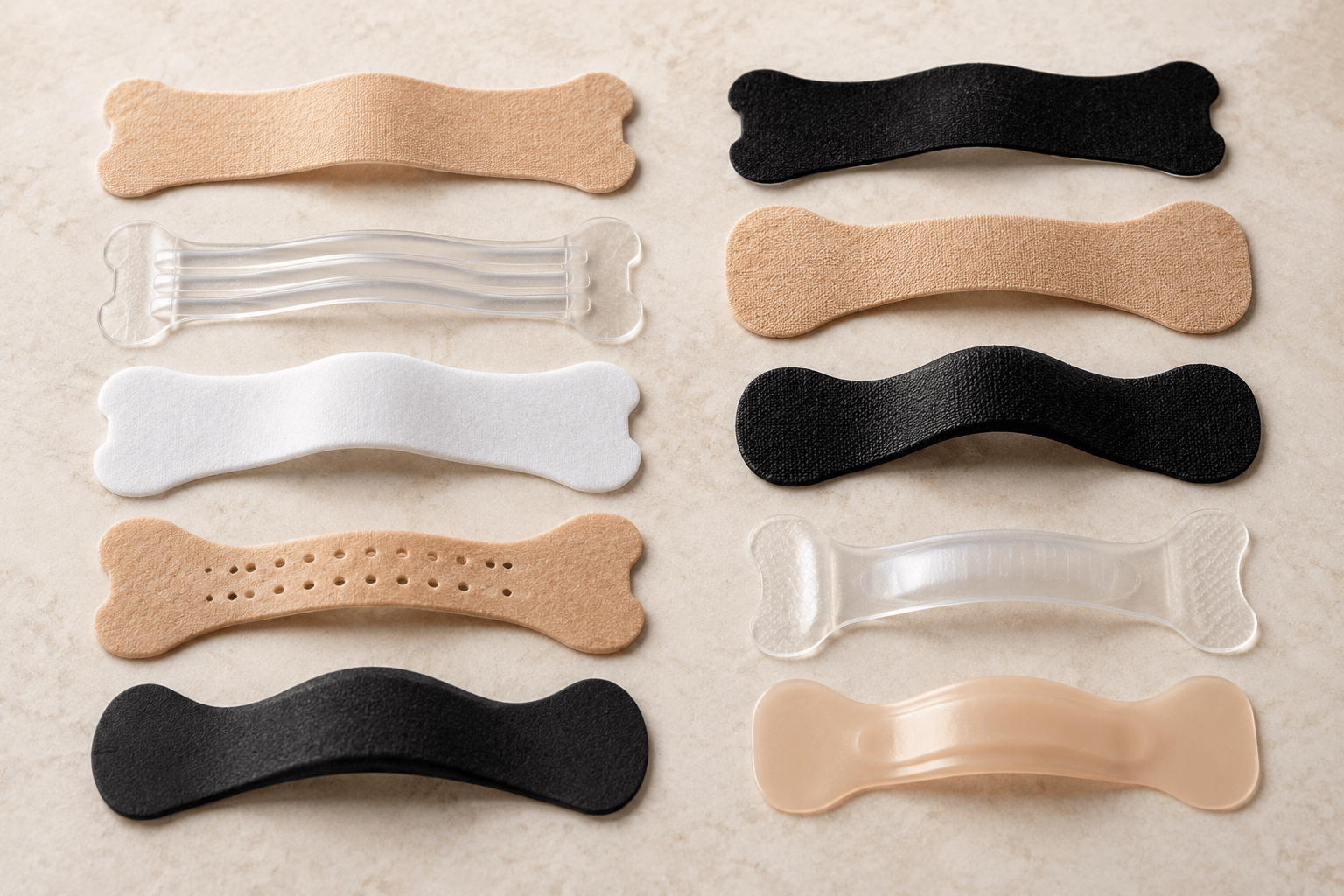
Size matters too. Breathe Right recommends its small/medium size for children and smaller faces and the large size for adults, and says not to cut a strip to fit, because that can stop it working. If your skin has become drier or more sensitive in pregnancy, the brand suggests its clear strips, which it says are easier to remove. To take a strip off, wash your face with warm water for about 10 seconds and peel it slowly from each side. Each strip is single use, and the company says not to wear one for more than 12 hours a day.
Our guide on how to apply nasal strips walks through placement step by step, and how nasal strips work explains what they can and can't open.
What else can help a stuffy nose in pregnancy?
Strips tend to work best as part of a simple bedtime routine. Cleveland Clinic suggests saline nasal rinses with a neti pot or rinse bottle, and sleeping slightly upright. It also mentions drinking plenty of water and exercising, since blood flow helps reduce swelling in the nose, and recommends asking your provider how much exercise is right for you. The 2025 review adds humidifying the air, particularly in cold seasons or air-conditioned rooms, and says plain saline, isotonic or hypertonic, is the recommended rinse in pregnancy, since the safety of additives such as xylitol or essential oils isn't well established.
Our guides on how to sleep with a stuffy nose and how to use a saline rinse cover technique and safe water. You can find more on strips in our nasal strips topic hub.
Be careful with medicines. Cleveland Clinic advises asking your provider before using oral decongestants during pregnancy, because some studies have shown they can be harmful to a fetus, especially in the first trimester. It also warns that decongestant sprays used for longer than a few days can cause rebound congestion. The 2005 review makes the same point, saying decongestant sprays should be limited to a few days' use. The NHS says it isn't clear whether any type of decongestant is safe in pregnancy, and advises using them only if a healthcare professional tells you to.
When should you talk to your midwife or doctor?
Talk to your midwife or doctor before starting any medicine for congestion, and whenever a blocked nose is affecting your daily life or sleep. Cleveland Clinic says your provider can check there isn't another cause, like allergies, and suggest ways to clear your nose.
Snoring is worth mentioning too. The 2025 review says the share of women who snore habitually rises from about 7 to 11% in the first trimester to 16 to 25% in the third, and that women with moderate to severe nasal blockage in pregnancy are more likely to develop symptoms of sleep-disordered breathing, including snoring and broken sleep.
If you start snoring loudly, or someone notices you gasping, choking or pausing in your breathing while you sleep, mention it at your next appointment or sooner. A nasal strip isn't a treatment for that, and the 2022 study suggests it doesn't change those breathing measures.
Common questions
Are nasal strips safe during pregnancy?
Strips don't contain medicine, and reviews of pregnancy rhinitis describe mechanical nasal dilators as a safe way to relieve congestion. One major brand's packaging contains natural rubber latex, and some people get skin irritation, so check the box and ask your midwife or doctor if you're unsure.
What nasal strips are safe during pregnancy?
Plain nasal strips work mechanically and contain no medicine, and a 2025 review of pregnancy rhinitis lists nasal dilator strips as safe and helpful at night. Check the box for latex, since one major brand says its package is sealed with natural rubber latex, and choose a size that fits rather than cutting a strip down. If you have a skin condition or allergy, ask your midwife or doctor first.
Do nasal strips help pregnancy snoring?
The best study so far says probably not much. In a 2022 study of 54 pregnant women who snored, strips didn't change breathing events during sleep or the amount of snoring. If you snore loudly, or someone notices you gasp or stop breathing in your sleep, tell your midwife or doctor.
When does pregnancy congestion go away?
Cleveland Clinic says pregnancy rhinitis usually happens in the third trimester and can last until two weeks after delivery. A 2025 review defines it as resolving completely within two weeks postpartum.
Can I wear a nasal strip every night while pregnant?
Breathe Right says its strips can be used daily for up to 12 hours a day, with a fresh strip each time, and to stop if a rash or skin irritation appears. Mention it to your midwife or doctor so they know what you're using.
Can a nasal strip help during labour?
One trial looked at this. Among 150 first-time mothers in active labour, those given a real strip reported significantly higher satisfaction than those given a placebo strip, and the strip didn't change the course of labour. It's one study, so ask your care team what they're comfortable with.
What kind of saline rinse is best in pregnancy?
A 2025 review says plain saline, either isotonic or hypertonic, is the recommended option in pregnancy. Some rinses contain additives such as xylitol or essential oils, and the review notes their safety in pregnancy isn't well established.
Sources
- Managing pregnancy-related nocturnal nasal congestion. The external nasal dilator
- Impact of nasal dilator strips on measures of sleep-disordered breathing in pregnancy
- Special considerations in the treatment of pregnancy rhinitis
- Pregnancy Rhinitis: Pathophysiological Mechanisms, Diagnostic Challenges, and Management Strategies: A Narrative Review
- Pregnancy rhinitis
- Breathe Right FAQs
- The effects of an external nasal dilator on labor
- External nasal dilators: definition, background, and current uses
- Decongestants
About this article
- Research
- 9 published sources, listed above.
- Evidence
- Limited. How we rate it
- Last checked
- October 10, 2026
- Funding
- Paid partner of Titan Recovery. Their ads are labeled.
- Found an error?
- Tell us. We log fixes on the corrections page.
* This content is for informational and educational purposes only and is not medical advice. It is not intended to diagnose, treat, cure or prevent any disease or health condition. Talk to a qualified healthcare provider about your health.