In short
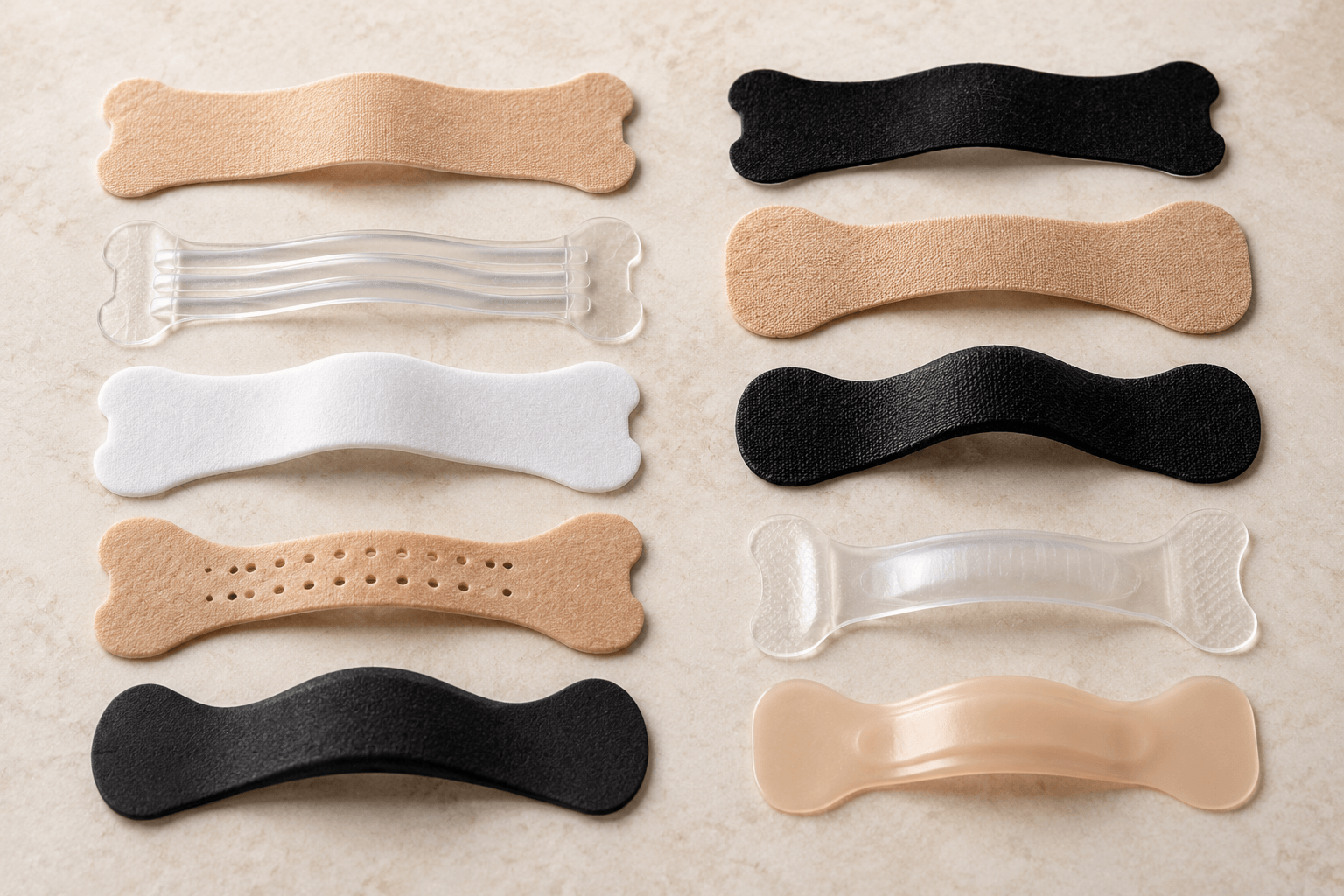
- A nasal strip is a flexible band with spring-like bands inside. As they try to straighten, they lift the sides of your nose and widen the passage just inside the nostrils.
- Lab studies found strips widen the narrowest part of the nose and lower nasal resistance, in healthy noses as well as blocked ones.
- Controlled studies found strips reduced snoring in habitual snorers and in people with chronic rhinitis, and one sleep study measured 39% lower nasal resistance during sleep.
- Strips are drug-free and were well tolerated in the trials. The main things to watch are skin irritation and a latex-sealed package.
- A 2016 meta-analysis found nasal dilators improve nasal breathing but don't improve obstructive sleep apnea.
- Strips pair well with mouth tape: the strip keeps the nose open, the tape keeps the mouth closed.
A nasal strip is a flexible band that sticks across the bridge of your nose. As it tries to straighten back out, it pulls the sides of your nose outward a little, which widens the passage and makes breathing through your nose easier. It's drug-free, it starts working the moment it's on, and the research behind it is more encouraging than many people expect.
How do nasal strips work?
Breathe Right describes its strips as having flexible, spring-like bands that stick to the area right above the flare of each nostril. As the bands try to return to their original flat shape, they gently lift the sides of the nose. That lifting is the whole mechanism. There's no medicine in the strip.
The part of the nose being lifted matters. A 2018 trial paper explains that by pulling outward on the entrance of the nose, a strip increases the cross-sectional area of the nasal valve region and the volume inside the front of the nose, which reduces resistance to airflow. Cleveland Clinic describes the nasal valve as a passageway that runs from the middle of your nose to the bottom, near the nostrils.
How noticeable? A 2016 meta-analysis on nasal dilators notes that when the nasal cavity's cross-sectional area increases by 10%, nasal airflow increases by 21%. Widening a narrow spot even slightly lets a lot more air through.
Do nasal strips work?
Research: moderate (what this means)The measurements of the nose itself are consistent. In a 1997 randomized, double-blind, placebo-controlled study of 53 athletes, a strip significantly increased nasal valve area at rest in every group measured. A 1998 study in Laryngoscope tested an external nasal dilator in people with healthy noses, people with a deviated septum and people with congested nasal lining. The dilator widened the narrowest part of the nose and lowered nasal resistance significantly in all three groups.
The snoring studies are encouraging too. A 1998 sleep lab study recorded 30 habitual snorers overnight. Peak snoring loudness dropped across the night, and on the second night with the strip it was lower than baseline in 22 of the 30. The snorers who benefited most were those without sleep apnea. In a randomized, placebo-controlled trial of people with chronic rhinitis, snoring frequency dropped from about 258 to 173 snores an hour with a nasal strip.
Strips also seem to work during sleep, not only while you're awake in a clinic. A 2019 study measured nasal resistance in sleeping participants with chronic nighttime congestion and found it was 39.1% lower with the strip on. The same study saw about 11 minutes less time awake after falling asleep and about 37% fewer spontaneous arousals, which the authors called preliminary data that a larger study should confirm. That study didn't see a change in snoring, though its authors note that earlier studies of the original Breathe Right strip all showed reductions in snoring frequency or intensity.
A 2016 meta-analysis summed it up: nasal dilators improve nasal breathing, but they don't improve obstructive sleep apnea. For more on how strips affect the night as a whole, see do nasal strips improve sleep.
Who do nasal strips help most?
People whose nose feels tight or narrow, especially lying down, tend to notice the biggest difference. Cleveland Clinic lists trouble breathing that gets worse when lying down, mouth breathing during the day and snoring at night among the symptoms of nasal valve collapse, and it names breathing strips as a nonsurgical option that may help you breathe easier and sleep better. Our guide to nasal valve collapse goes into that in more detail.
Strips are also a good fit if you have:
- Mild congestion from a cold or allergies. See nasal strips for allergies.
- A deviated septum that narrows the front of the nose. See nasal strips and a deviated septum.
- Snoring that seems to come from the nose rather than the throat.
- A plan to start mouth tape and some trouble breathing through your nose at first.
They're useful outside bed as well. In the 1997 athlete study, strips lowered perceived exertion, heart rate and oxygen use during submaximal exercise compared with a placebo strip. Our guide to nasal strips for exercise covers that research.
How do you get the best result from a nasal strip?
Most disappointing experiences with strips come from how they're put on. Breathe Right's instructions are simple, and following them closely makes a real difference:
- Wash and dry your nose. The adhesive won't stick properly to wet, oily or moisturized skin.
- Pick the right size. Breathe Right recommends small/medium for children and smaller faces, and large for adults. Don't cut a strip to make it fit, because that stops it working.
- Place it right above where your nose flares out, so the bands sit over the sides they're meant to lift.
- Press down the ends and rub gently. Slight lifting at the edges is normal as it opens your nose.
- In the morning, wash your face with warm water for about 10 seconds, then lift each side slowly. You can also take it off in the shower.
Give it more than one night. In the 1998 snoring study, 17 of the 30 participants needed some time to get used to the strip, and after that they reported that they could breathe easily and slept well. Our step-by-step guide on how to apply nasal strips covers placement and removal in more detail.
Are nasal strips safe to use every night?
For most adults, they're a low-risk option. In the 1998 snoring study, no adverse events were seen apart from one person who briefly felt the urge to sneeze after the first strip, and the authors described strips as safe and easily applied. The 2018 and 2019 trials also reported that the strips were well tolerated.
Breathe Right says its strips may be used daily, for no more than 12 hours a day, with a fresh strip each time. It says not to use them on children under 5, on sores, sunburned or irritated skin, or if you have a latex allergy, because the package is sealed with natural rubber latex. Redness or irritation where the strip sat is the most common complaint, and it usually comes down to how the strip is removed. Nasal strip skin irritation has the fixes.
What nasal strips won't do
Nasal strips open the front of your nose. They won't clear a sinus infection or shrink swollen tissue deeper inside, and they don't treat sleep apnea. The 2016 meta-analysis explains why: during apneas, the airway usually collapses further back, in the throat and around the soft palate, rather than in the nose. If you snore loudly or stop breathing in your sleep, talk to a doctor.
If a strip doesn't seem to do much for you, why nasal strips sometimes don't work goes through the common reasons and what to try next.
How do strips compare with other ways to open your nose?
Strips work from the outside. Internal nasal dilators sit inside the nostrils and press outward instead, and Cleveland Clinic lists both as nonsurgical options for nasal valve collapse. Some people prefer the feel of one over the other, and nasal strips vs nasal dilators compares them side by side.
Sprays work on a different part of the problem, the lining of the nose. Nasal strips vs nasal spray explains when each makes sense. Because a strip has no drug in it, it's easy to combine with other approaches. You can browse everything we've written on the subject in our nasal strips topic.
Using nasal strips and mouth tape together
Plenty of people use both. The strip holds the nose open and the tape keeps the mouth closed, so breathing through your nose is both easy and the only option. Put the strip on first, take a few breaths through your nose with your mouth closed, and only add tape once that feels comfortable. Our two-minute nose test is a quick way to check, and mouth tape vs nasal strips explains how the two differ.
If you want to try nasal strips, our pick is TitanAir Nasal Strips.
Common questions
Do nasal strips really work for snoring?
For many people, yes. Controlled studies found that nasal strips reduced snoring, especially when snoring is linked to a narrow or congested nose. In one study of 30 habitual snorers, peak snoring loudness dropped in 22 of them. Strips did not improve sleep apnea.
How quickly do nasal strips work?
Right away. The strip starts lifting the sides of your nose as soon as it's pressed on. Some people need a few nights to get used to the feel: in one study, 17 of 30 snorers needed a period of adjustment, and after that they reported breathing easily and sleeping well.
Can I use nasal strips every night?
Many people do. Breathe Right says its strips may be used daily for up to 12 hours a day. Apply to clean, dry skin, use a fresh strip each night and remove it gently in the morning. Stop if your skin gets irritated.
Do nasal strips work if my nose isn't congested?
They still widen the nose. A 1998 study found an external nasal dilator increased the narrowest cross-sectional area of the nose and lowered nasal resistance in people with healthy noses, as well as in people with nasal blockage.
Who shouldn't use nasal strips?
Breathe Right says its strips aren't for children under 5 or for people with a latex allergy, because the package is sealed with natural rubber latex. Don't put a strip over sores, sunburn or irritated skin.
Can I use nasal strips and mouth tape together?
Yes. Many people use both: the strip makes breathing through the nose easier and the tape reminds you to keep your mouth closed. Check that you can breathe comfortably through your nose before you add tape.
Do nasal dilators work?
For opening the nose, yes. A 2016 meta-analysis covering both internal dilators, which sit inside the nostrils, and external strips found that nasal dilators improve nasal breathing. It also found they don't improve obstructive sleep apnea, apart from a slight drop in one apnea measure with internal dilators.
Do nasal strips help when working out?
They open the nose during exercise, but the performance results are mixed. A 1997 study of athletes found strips lowered perceived exertion and heart rate during moderate exercise compared with a placebo strip, while a 2020 meta-analysis of 19 studies found no difference in maximal oxygen uptake, heart rate or perceived effort in healthy people.
Sources
- Effect of the external nasal dilator Breathe Right on snoring
- External nasal dilation reduces snoring in chronic rhinitis patients: a randomized controlled trial
- Nasal Dilators (Breathe Right Strips and NoZovent) for Snoring and OSA: A Systematic Review and Meta-Analysis
- Effects of nasal dilator strips on subjective measures of sleep in subjects with chronic nocturnal nasal congestion: a randomized, placebo-controlled trial
- Objective and Subjective Effects of a Prototype Nasal Dilator Strip on Sleep in Subjects with Chronic Nocturnal Nasal Congestion
- Role of the external nasal dilator in the management of nasal obstruction
- Physiologic effects of an external nasal dilator
- Breathe Right FAQs
- Nasal valve collapse
- Does the external nasal dilator strip help in sports activity? A systematic review and meta-analysis
About this article
- Research
- 10 published sources, listed above.
- Evidence
- Moderate. How we rate it
- Last checked
- October 10, 2026
- Funding
- Paid partner of Titan Recovery. Their ads are labeled.
- Found an error?
- Tell us. We log fixes on the corrections page.
* This content is for informational and educational purposes only and is not medical advice. It is not intended to diagnose, treat, cure or prevent any disease or health condition. Talk to a qualified healthcare provider about your health.