In short
- Nasal strips stick to the outside of the nose and lift it open. Internal dilators sit just inside the nostrils and hold them open.
- In a study of 41 people who snore, both reduced snoring time and improved sleep quality. The internal dilator worked for more people.
- In lab studies, both devices widened the narrowest part of the nose and lowered resistance, with internal dilators often lowering it further.
- A 2016 meta-analysis found nasal dilators of both kinds improve nasal breathing but don't improve obstructive sleep apnea.
- Strips are the easier place to start and leave nothing inside the nose. If a strip doesn't do enough, an internal dilator is the natural next thing to try.
If your nose feels narrow or blocked at night, there are two simple, drug-free things to try: a strip on the outside of your nose, or a small dilator that sits just inside it. Both have studies showing they open the nose and can cut down on snoring. Which suits you best mostly comes down to your nose and what you find comfortable.
How do nasal strips and internal dilators compare?
This table compares nasal strips and internal nasal dilators on what each does, how it works, what the research shows and who it suits best.
| Nasal strips | Internal dilators | |
|---|---|---|
| What it does | Widens the narrowest part of the nose from outside | Holds the nostrils open from inside |
| How it works | A springy band lifts the side walls of the nose | A soft cone or ring sits just inside the nostrils |
| What research shows | Cut snoring time in a 2019 study of 41 snorers | Cut snoring time in the same study and worked for more people |
| Peak nasal airflow in 30 people | About 102 litres a minute, from about 66 | About 139 litres a minute, from about 66 |
| Evidence rating | Moderate | Moderate |
| Best for | An easy first try with nothing inside the nose | People a strip doesn't help enough |
How does each one work?
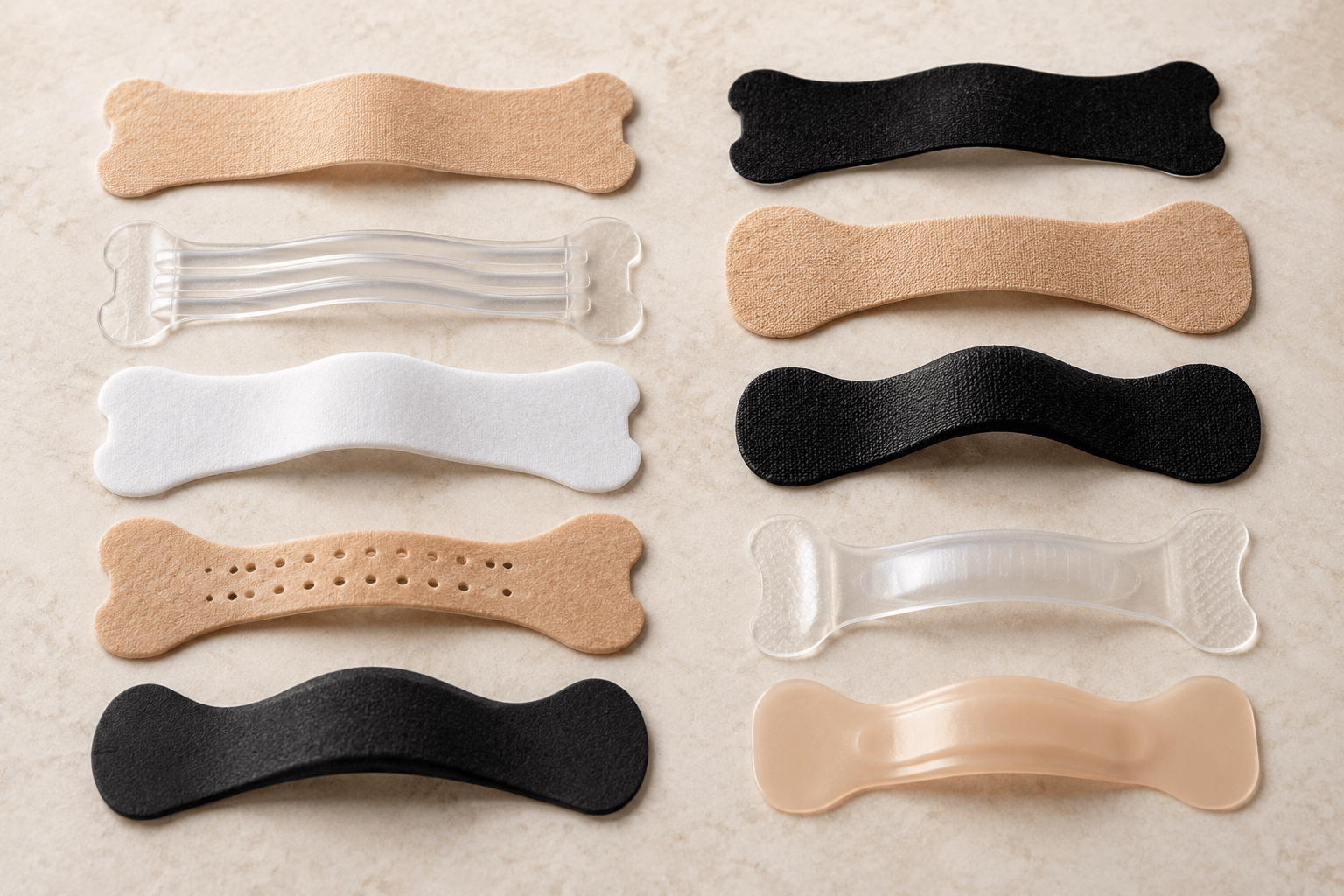
A nasal strip is a flexible band with adhesive on the back. You stick it across the bridge of your nose, and as it tries to straighten out, it pulls the sides of your nose outward. That widens the narrowest part of the nasal passage, just inside the nostrils.
An internal dilator is a small soft piece, often silicone or plastic, that sits just inside the nostrils and holds them open from the inside. Some look like two small cones joined by a bridge, others like a soft ring.
A 2025 review of nasal valve problems in Frontiers in Surgery sums up the difference neatly. Strips are springy and lift the side walls of the nose to widen the valve angle, while internal dilators sit in one or both nostrils to stop them collapsing. It describes both as simple to use and generally well tolerated. The review notes they're mostly used during sleep, since they're noticeable.
What did the research find?
Research: moderate (what this means)A 2019 clinical study compared the two in 41 people who snore. Snoring time was recorded at home with a smartphone app, one night with no device, one night with an internal dilator and one night with a Breathe Right strip. Both devices significantly reduced the share of the night spent snoring, and there was no significant difference between them on that measure. The internal dilator worked for more of the participants and led to better sleep quality scores than the strip. People who rated their sleep as better also tended to rate the device they'd used more highly.
Lab studies point the same way. A 2004 study in Rhinology tested a Breathe Right strip and a Nozovent internal dilator in 27 healthy adults. Both increased the narrowest cross-section of the nasal valve and lowered nasal resistance, and the internal dilator lowered resistance more. A 2014 review of external nasal dilators describes another comparison in 30 people who felt their nose was blocked during sleep: peak airflow through the nose went from about 66 litres a minute with no device to about 102 with a strip and about 139 with an internal dilator.
A 2016 systematic review and meta-analysis looked at nasal dilators more broadly. It found they improve nasal breathing, but they don't improve obstructive sleep apnea. If you snore loudly or someone has noticed pauses in your breathing, a dilator isn't a fix, and you should see a doctor.
These studies are small, and the 2019 snoring study was open-label, with each device tried for one night. Its authors said the results should be confirmed with stronger designs. Even so, the overall picture is consistent: both devices open the nose, and internal dilators often open it a bit more.
Which nasal dilator is best for you?
For most people, a nasal strip is the best dilator to start with. There's nothing inside your nose, it's easy to put on and take off, and you can tell within a night or two whether it makes breathing easier. It may not stick well on oily skin, and some people find the adhesive irritating.
An internal dilator can work better for some people, as the 2019 study suggests, but it takes some getting used to, and it needs the right size and regular cleaning.
If one doesn't help, try the other. Noses vary a lot, and the narrow spot isn't in the same place for everyone. Our two-minute nose test is a quick way to get a feel for how open your nose is before you start.
How do you get a good fit?
A good fit matters because fit is where most early disappointments come from, with either device.
For strips, Breathe Right says the adhesive won't stick properly to wet, oily or moisturised skin, so wash and dry your nose first. The strip goes just above the point where your nostrils flare out, and you rub it gently to secure it. The company recommends its large size for adults and small/medium for children and smaller faces, and says not to cut a strip to fit, since that can stop it working. If you have dry or sensitive skin, it suggests clear strips, which it says are easier to remove. How to apply nasal strips walks through placement step by step.
Are they safe?
Yes, nasal strips and internal dilators are both low-risk for most adults. The 2014 review described external nasal dilators as simple, noninvasive, painless and affordable, with minimal risk to the user, and the 2025 review called strips and internal dilators generally well tolerated.
The main issues with strips are skin and allergy. Breathe Right says its strips shouldn't be used by children under 5 or people with a latex allergy, because the package is sealed with natural rubber latex, and shouldn't go over sores, sunburned or irritated skin. It also says not to wear a strip for more than 12 hours a day, and to use a fresh one each time.
Can you pair nasal dilators with mouth tape?
Yes, nasal dilators pair well with mouth tape, because opening the nose and keeping the mouth closed go together. If your mouth falls open at night even when your nose is clear, read how to start mouth taping, and mouth tape vs. nasal strips explains how the two fit together.
Check this first. Skip mouth tape and see a doctor if you snore loudly, wake up gasping, have been told you stop breathing in your sleep, or can't breathe comfortably through your nose. More on safety
If you want to try nasal strips, our pick is TitanAir Nasal Strips.
Read next
- How nasal strips work, and when they help most
- What is nasal valve collapse, and can nasal strips help?
- Why do I breathe through my mouth at night?
- All our nasal strip guides
Common questions
Do internal nasal dilators work better than strips?
For some people. In one study of 41 snorers, both helped, but the internal dilator worked for more people and led to better sleep quality. In a lab study of 27 healthy adults, an internal dilator lowered nasal resistance more than a strip. Noses vary, so it's worth trying both.
Can nasal strips or dilators treat sleep apnea?
No. A 2016 meta-analysis found nasal dilators improve nasal breathing but don't improve the measures used to diagnose and track obstructive sleep apnea.
Can I use a nasal strip with mouth tape?
Yes. Many people use a strip or dilator to keep the nose open and tape to keep the mouth closed. Only tape your mouth if you can breathe comfortably through your nose.
How quickly can I tell whether one works?
Often within a night or two. In the 2019 comparison of a strip and an internal dilator, each device was tested for a single night and both reduced snoring time compared with a night without either.
Are nasal strips and dilators safe?
A 2014 review described external nasal dilators as simple, noninvasive and low risk, and a 2025 review called strips and internal dilators generally well tolerated. Breathe Right says its strips aren't for children under 5 or people with a latex allergy, and shouldn't go over sore or irritated skin.
Which is better if my nostrils collapse when I breathe in?
Both are designed for that. A 2025 review explains that strips lift the side walls of the nose while internal dilators sit inside the nostril to stop it collapsing. If your nostrils visibly cave in, see an ENT doctor as well, since nasal valve collapse sometimes needs more than a device.
Are nasal dilators good?
They can be, especially if your nose feels narrow or blocked at night. Studies show both internal dilators and strips widen the nasal passage and lower nasal resistance, and a 2019 study of 41 snorers found both cut the share of the night spent snoring. A 2016 meta-analysis found they improve nasal breathing but don't improve obstructive sleep apnea.
Sources
- Internal and external nasal dilatator in patients who snore: a comparison in clinical practice
- Nasal Dilators (Breathe Right Strips and NoZovent) for Snoring and OSA: A Systematic Review and Meta-Analysis
- External nasal dilators: definition, background, and current uses
- Effects of the nasal strip and dilator on nasal breathing: a study with healthy subjects
- Nasal valve obstruction: a comprehensive analysis of the current literature and proposal of a management algorithm
- Breathe Right FAQs
About this article
- Research
- 6 published sources, listed above.
- Evidence
- Moderate. How we rate it
- Last checked
- October 10, 2026
- Funding
- Paid partner of Titan Recovery. Their ads are labeled.
- Found an error?
- Tell us. We log fixes on the corrections page.
* This content is for informational and educational purposes only and is not medical advice. It is not intended to diagnose, treat, cure or prevent any disease or health condition. Talk to a qualified healthcare provider about your health.