In short
- Nasal valve collapse is a narrowing of the airway at the front of the nose that makes it harder to breathe through one or both nostrils. An ENT doctor can confirm it.
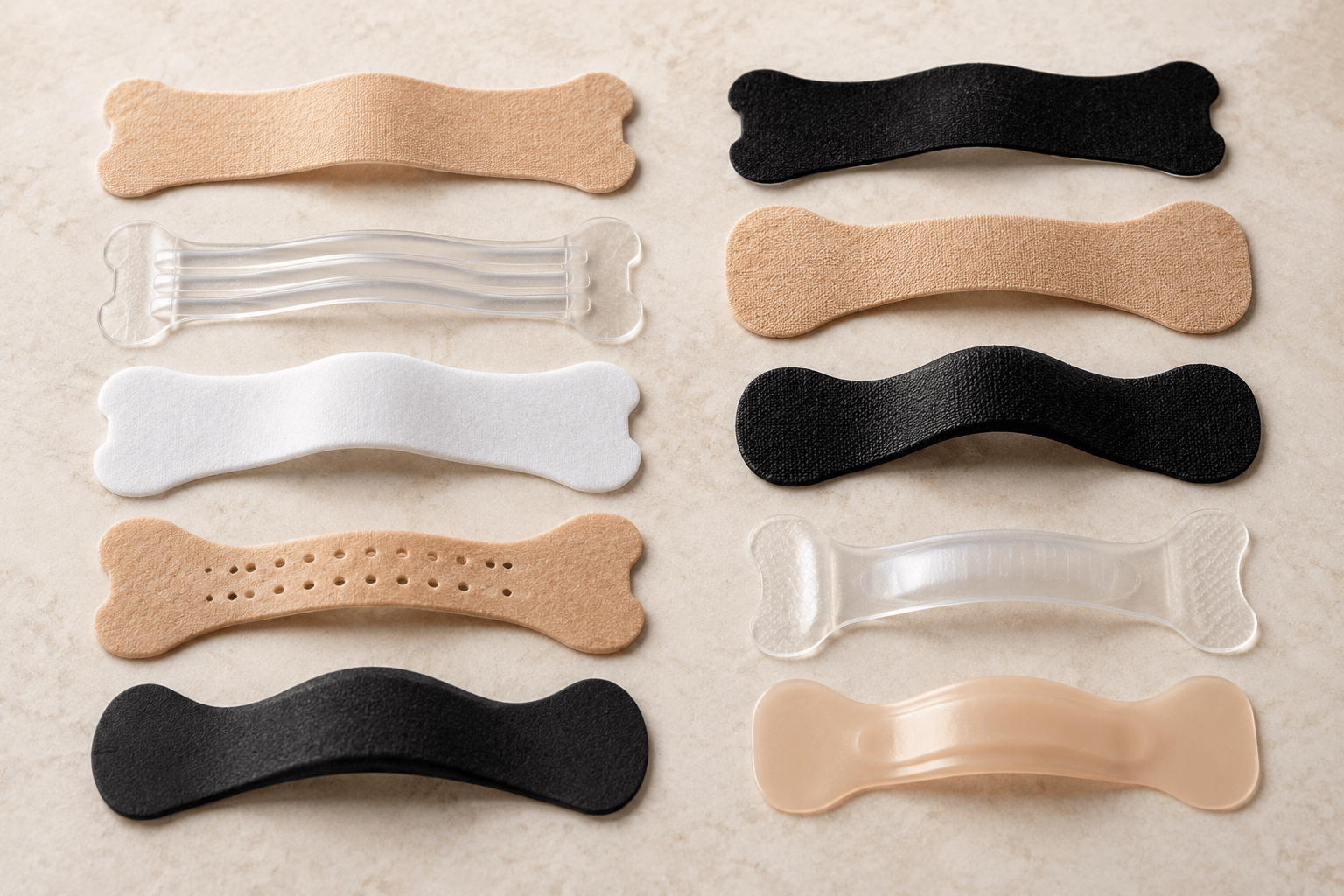
- Cleveland Clinic lists breathing strips and internal dilators as ways to manage symptoms without surgery, and says they may help you breathe and sleep more easily.
- Strips act right where the valve is. In small studies of people with a narrowed valve after nose surgery or a crooked septum, a strip widened the valve and lowered resistance.
- Strips and dilators hold the valve open while you wear them. They don't repair the weakened tissue, and many people with significant collapse need surgery.
- Cleveland Clinic lists deviated septum, nose shape, previous nose surgery, aging and injury as risk factors.
Nasal valve collapse is a narrowing of the airway near the front of the nose that makes breathing through it harder. An ear, nose and throat (ENT) doctor can confirm it with an exam. Nasal strips and internal dilators are a drug-free way some people manage symptoms, since they hold the valve open, but they don't repair the weakened tissue, and significant collapse often needs surgery.
What is the nasal valve?
The nasal valve is the narrow section of airway near the front of your nose. Researchers who study nasal airflow describe it as the most important site of nasal obstruction. Cleveland Clinic describes two parts. The internal nasal valve is the passageway further inside, and it's where collapse happens most often. The external nasal valve is at the bottom of the nose, near the nostrils.
When the side walls of the nose are weak, they can be pulled inward as you breathe in. A 2025 review from Stanford surgeons calls this lateral wall insufficiency, a dynamic collapse of the nasal side walls at the internal and external valves, and describes it as a common cause of blocked nasal breathing. External valve collapse is easier to spot, since Cleveland Clinic notes it can make one or both nostrils visibly collapse when you breathe in.
Static and dynamic collapse: what's the difference?
Doctors often split nasal valve problems into two kinds. A 2025 review in Frontiers in Surgery describes static obstruction as a valve that's structurally narrow at rest and stays narrow however you breathe, usually because of something fixed, such as a crooked front part of the septum or the shape of the cartilage. Dynamic obstruction is a valve that's wide enough during gentle breathing but narrows more and more as you breathe in harder, because the soft side walls can't resist the suction.
The same review says nasal valve problems are much more common in high, narrow noses, and that thinning of the side wall, often from ageing, can point to external valve trouble. Knowing which type you have matters, because it shapes what kind of support or surgery a doctor might suggest.
What are the symptoms?
Cleveland Clinic lists these signs of nasal valve collapse:
- Trouble breathing through the nose, which may get worse during exercise or when lying down.
- Mouth breathing during the day and snoring at night.
- A stuffy nose that doesn't improve.
- A nose that looks thinner or uneven in places, especially when the external valve has collapsed.
Because several of these overlap with allergies, colds and a crooked septum, the symptoms alone don't tell you the cause. If your nose feels blocked on one side most of the time, deviated septum symptoms covers another common reason. Our two-minute nose test can help you describe how your nose feels, though it can't diagnose anything.
What causes it?
Nasal valve collapse has several causes, and Cleveland Clinic lists the risk factors. Most people with nasal valve collapse also have a deviated septum, which splits the valve into two unequal parts and can lead to collapse on one or both sides. Some people are born with features that raise the risk, such as narrow nostrils or a nose that projects further from the face. Collapse can also follow nose surgery, though slight narrowing is much more common than severe collapse in that case. The tissue supporting the valve can weaken with age, and injury to the nose can weaken it too.
How is nasal valve collapse diagnosed?
A doctor, usually an ENT specialist, will ask about your symptoms and may use a short questionnaire called the NOSE scale to rate how blocked you feel. They'll look inside your nose, sometimes with a thin camera called an endoscope. One simple check is the Cottle maneuver, in which the provider gently pulls your cheek to the side to widen the valve and see whether breathing gets easier.
Diagnosis isn't always clear-cut. The 2025 Frontiers in Surgery review noted a lack of consensus among specialists on diagnostic criteria and treatment for nasal valve obstruction, and said the Cottle maneuver isn't very specific on its own. It also reports weak agreement among a panel of surgeons that adult nasal strips can be useful for confirming the problem. So if you've tried strips, tell your doctor whether they made a clear difference.
Can nasal strips help?
Research: limited (what this means)Nasal strips can help with nasal valve collapse because they act on exactly the area involved, and that's the main reason they're worth discussing. In a 1997 placebo-controlled study of 53 athletes, a Breathe Right strip significantly increased nasal valve area at rest. A 2004 study of 27 healthy adults found that both a strip and an internal dilator increased the narrowest cross-section of the nasal valve and lowered nasal resistance, with the internal dilator lowering resistance more. A 2011 study measuring the nose with sound waves also found a strip widened the valve region.
There's also some research in people whose valve is actually narrowed. A 1997 study in the American Journal of Rhinology measured 26 nasal passages that were blocked after rhinoplasty. Their narrowest point averaged 0.34 square centimetres, much smaller than in healthy noses, and a strip widened it to 0.64. The authors concluded that external dilation is an effective approach in managing nasal valve obstruction. A 1998 study in Laryngoscope found a strip widened the nose and lowered resistance in people with a deviated septum near the valve, with a larger effect than in healthy noses, and called it an effective nonsurgical approach for that kind of blockage.
These are small, older studies that measured airflow on the day rather than long-term outcomes, so the evidence rating stays limited. Cleveland Clinic lists breathing strips and internal dilators as ways to manage nasal valve collapse without surgery, and says they may help you breathe and sleep more easily. The Frontiers in Surgery review describes them as simple to use and generally well tolerated, and says they're mostly worn during sleep. A strip works only while you wear it.
How do you get the most from strips or dilators?
To get the most from strips or dilators, get the placement and skin prep right. Breathe Right says its strips go just above the point where the nostrils flare out, and that the adhesive won't stick properly to wet, oily or moisturised skin, so wash and dry your nose first and rub the strip gently to secure it. It recommends the large size for adults, says not to cut a strip to make it fit, and says not to wear one for more than 12 hours a day. How to apply nasal strips has step-by-step placement.
If a strip doesn't do enough, an internal dilator is worth trying. The 2025 review explains that strips lift the side walls to widen the internal valve angle, while internal dilators sit inside the nostril to stop it collapsing, and in the 2004 study the internal dilator lowered resistance more than the strip. Nasal strips vs. nasal dilators compares them, and nasal strips and a deviated septum covers what to expect if your septum is also crooked. You'll find more in our nasal strips topic hub.
If swollen tissue inside the nose is adding to the blockage, the 2025 review says a steroid spray may help with that part. Ask your doctor before starting one.
Does nasal valve collapse get worse?
Nasal valve collapse doesn't get worse in every case, but it can. Cleveland Clinic explains that collapse happens because the structures supporting the nasal passages have weakened, and that without treatment to reinforce weak areas, they can continue to fall. That's one reason to get a proper diagnosis rather than relying on strips indefinitely without knowing what's going on.
When does surgery come up?
Cleveland Clinic says nasal valve collapse often requires surgery, though a provider may suggest managing mild symptoms without it first. Options include grafts of cartilage, often from the ear or rib, that widen the valve, implants that support the cartilage, and suture techniques that lift the valve upward and outward. Most of these are outpatient procedures. When a deviated septum or enlarged turbinates are part of the problem, septoplasty or turbinate reduction may be needed too. Cleveland Clinic says most people report their symptoms improved after nasal valve surgery.
The 2025 Frontiers in Surgery review noted that for many people who have both a deviated septum and nasal valve obstruction, septoplasty alone gives enough relief, while others stay blocked unless the valve is also treated. It reports septoplasty failure rates of between 19% and 50% in the literature, and says one of the most common reasons people still feel blocked afterwards is that the valve problem wasn't recognised beforehand. If you're being assessed for septum surgery, it's worth asking whether your nasal valve has been checked too.
When should you see a doctor?
See a healthcare provider if your nose stays stuffy and doesn't get better, or if you have trouble breathing through it. Cleveland Clinic suggests asking how severe the collapse is, whether you'll need surgery and which type, and what the risks and recovery look like. If you snore loudly, gasp or choke during sleep, or someone has noticed pauses in your breathing, mention it. Those signs need a sleep evaluation, and strips don't treat sleep apnea.
Common questions
How do I know if I have nasal valve collapse?
Only an exam can tell you. A doctor may ask about your symptoms using a questionnaire, look inside your nose and gently pull your cheek to the side to see whether widening the valve helps. This is called the Cottle maneuver.
Can nasal strips fix nasal valve collapse?
No. Strips hold the nasal valve open while you wear them. Cleveland Clinic lists them as a way to manage symptoms without surgery and says they may help you breathe and sleep more easily, but they don't strengthen the tissue that's collapsing.
Is nasal valve collapse the same as a deviated septum?
No, but they often go together. Cleveland Clinic says most people with nasal valve collapse also have a deviated septum, which divides the valve into two unequal parts.
Can nasal dilators help with a deviated septum?
They can make breathing easier when the crooked part of the septum sits near the front of the nose. A 1998 study in Laryngoscope found a strip widened the nose and lowered resistance in people with a deviated septum near the nasal valve, with a larger effect than in healthy noses. Dilators don't straighten the septum and only work while you wear them.
Does nasal valve collapse cause snoring?
Cleveland Clinic lists mouth breathing during the day and snoring at night among its symptoms. Loud snoring with gasping or pauses in breathing needs a separate medical check for sleep apnea.
Does nasal valve collapse get worse over time?
Not always, but it can. Cleveland Clinic says that without treatment to reinforce weak areas, the supporting structures can continue to fall. Your doctor can tell you how severe yours is.
Is it worth telling my doctor how I breathe with a nasal strip?
Yes. A 2025 review reports weak agreement among a panel of surgeons that adult nasal strips can be useful for confirming nasal valve obstruction. Noticing whether a strip makes a clear difference is useful information to bring to your appointment.
Do steroid nasal sprays help nasal valve collapse?
They don't change the valve itself. A 2025 review says that if swollen inferior turbinates are a big part of the blockage, a steroid spray may help with that part. Ask your doctor whether it applies to you.
Sources
- Nasal valve collapse
- Evaluation and Management of Lateral Wall Insufficiency
- Nasal valve obstruction: a comprehensive analysis of the current literature and proposal of a management algorithm
- Acoustic rhinometry: impact of external nasal dilator on the two first notches of the rhinogram
- Effects of the nasal strip and dilator on nasal breathing: a study with healthy subjects
- Physiologic effects of an external nasal dilator
- Acoustic rhinometric assessment of the nasal valve
- Role of the external nasal dilator in the management of nasal obstruction
- Breathe Right FAQs
About this article
- Research
- 9 published sources, listed above.
- Evidence
- Limited. How we rate it
- Last checked
- October 10, 2026
- Funding
- Paid partner of Titan Recovery. Their ads are labeled.
- Found an error?
- Tell us. We log fixes on the corrections page.
* This content is for informational and educational purposes only and is not medical advice. It is not intended to diagnose, treat, cure or prevent any disease or health condition. Talk to a qualified healthcare provider about your health.