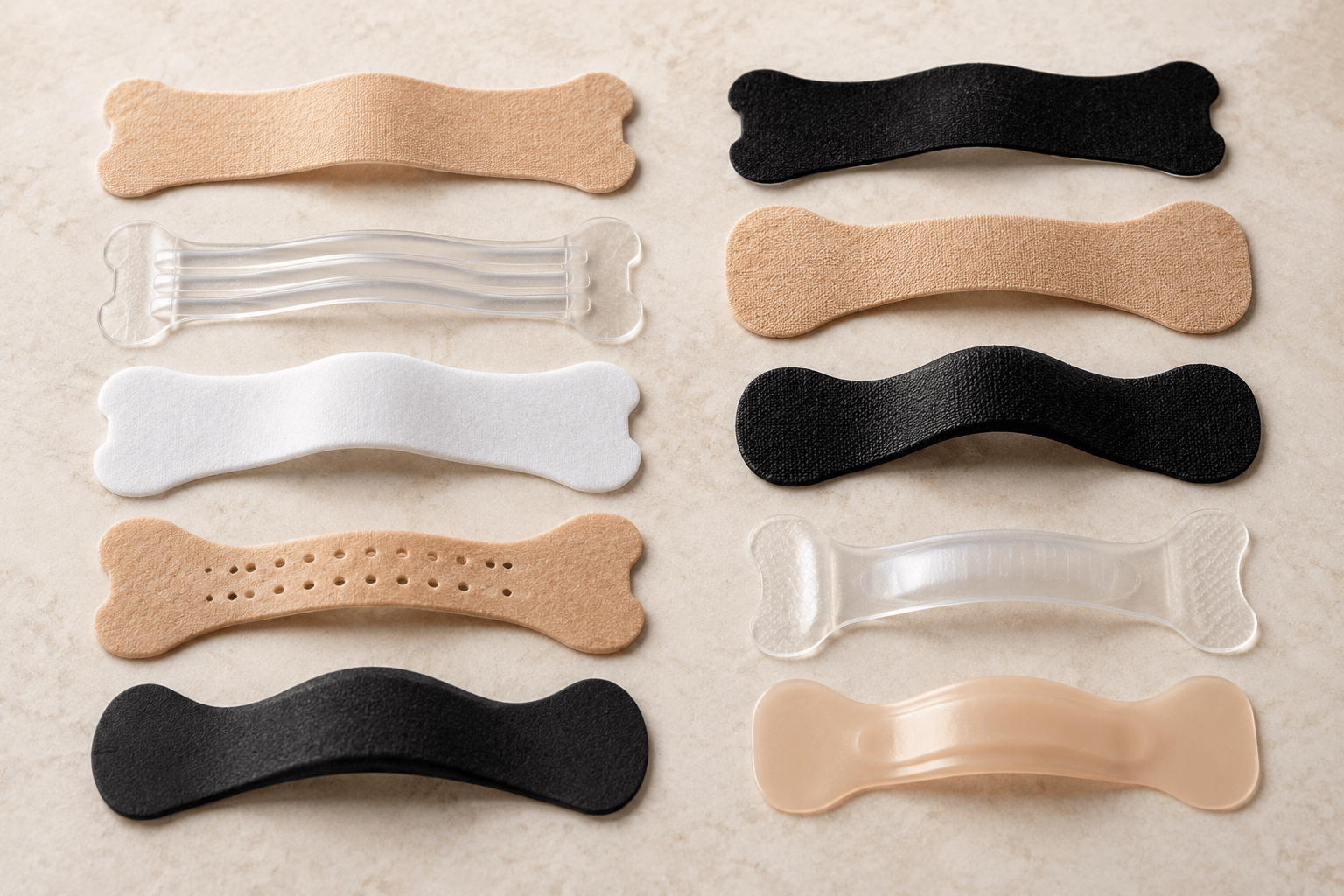
In short
- Start with the basics: a clean, dry nose, the right size, and the strip placed just above where the nostrils flare. Breathe Right says the adhesive won't stick properly to wet, oily or moisturised skin.
- Give it a few nights. In a 1998 study of 30 snorers, 17 needed some time to get used to the strip before they reported breathing easily and sleeping well.
- Strips widen the front of the nose. They help most when that's the tight spot, and in a 1998 study the effect was largest in people with a crooked septum near the nasal valve.
- If swelling further back is the problem, a saline or steroid spray can work alongside the strip. If the strip still does too little, an internal dilator lowered nasal resistance more in a lab study.
- Blockage on one side, constant congestion, or snoring with gasping or pauses are reasons to see a doctor.
When a nasal strip seems to do nothing, the cause is often something you can change. It may be how the strip is put on, skin that won't hold the adhesive, the wrong size, or judging it after a single night. Less often, the blockage sits somewhere a strip can't reach, and then there are good next steps. Here's how to work through it, starting with the easy fixes.
Is the strip in the right place?
Research: limited (what this means)Nasal strip placement is the first thing to check. A strip works by pulling the sides of the nose outward to widen the nasal valve, the narrow section just inside the nostrils. Breathe Right says its strips should sit just above the point where the nose flares out, and that you should rub the strip gently after applying it so it stays secure.
A 2004 study in Rhinology measured 27 healthy adults with a Breathe Right strip and found it increased the narrowest cross-section of the nasal valve and lowered nasal resistance. So a well-placed strip does open the nose. How to apply nasal strips has step-by-step placement.
Is your skin stopping it from sticking?
Your skin can stop a nasal strip from sticking, and a strip that lifts off during the night can't do much. Breathe Right says the adhesive won't stick properly to wet, oily or moisturised skin, so wash and dry your nose before you put the strip on, and keep moisturiser off that area. If your skin is dry or sensitive, the company suggests its clear strips, which it says are easier to remove.
Taking strips off gently helps you keep wearing them. Breathe Right recommends washing your face with warm water for about 10 seconds and then lifting each side slowly, or removing the strip in the shower. Each strip is single use, and the company says not to wear one for more than 12 hours a day. If your skin gets irritated, nasal strips and skin irritation has more on what helps.
Are you using the right size?
The right strip size matters, because size affects how well a strip can lift your nose. Breathe Right recommends its small/medium size for children and smaller faces and its large size for adults, and says not to cut a strip to make it fit, because that can stop it working at all. The brand also sells Extra Strength versions alongside its originals.
Have you given it a few nights?
Give a nasal strip a few nights, because one night isn't a fair test. In a 1998 study of 30 habitual snorers in a sleep lab, 17 needed a period of time to get used to the strip before they reported breathing easily, sleeping well and waking refreshed. By the second treatment night, peak snoring intensity had dropped in 22 of the 30.
If the first night feels strange, try it for most of a week before deciding.
What part of the nose does a strip open?
A strip works on the front of the nose, so it helps most when that's where your nose is tight. A 2007 study of 89 people with nasal blockage found a strip widened the front 3 cm of the nose more than a decongestant spray did, but had no effect further back. Even so, the strip and the spray gave comparable gains in airflow and in how blocked people felt.
A 1998 study in Laryngoscope shows who tends to benefit most. A strip widened the nose and lowered resistance in all three groups tested, and the effect was largest in people with a crooked septum near the nasal valve. People whose blockage came from a swollen nasal lining measured better with the strip but didn't clearly feel more open.
That points to a practical fix. If your nose feels stuffy rather than narrow, as it can with a cold or allergies, pair the strip with something that works on the lining. A 2000 lab study found the effects of a strip and a decongestant spray added together. Decongestant sprays are only meant for a few days at a time, so nasal strips vs. nasal sprays covers saline and steroid options for longer use.
Is your nose already open enough?
If your nose is already open enough, a strip may not change much, because strips help most when there's narrowing to fix. In the 2000 study, measured in 20 healthy adults, only 9 showed a clear drop in nasal resistance with the strip during normal breathing, and those 9 had tighter noses to begin with. The authors concluded strips may be more effective in people with high resting nasal resistance.
A 2001 Norwegian study found a similar split in 18 heavy snorers who reported nighttime nasal blockage. The real strip clearly widened their noses compared with a placebo strip. In the 6 with severe nasal blockage in the morning, oxygen levels during sleep improved with the strip. In the other 12, whose noses were wider to begin with, there was no objective benefit. Our two-minute nose test is a rough way to check how well you breathe through your nose with your mouth closed.
Why might your snoring not change?
Your snoring might not change with a strip because a blocked nose and snoring aren't always the same problem. A 2016 meta-analysis of nasal dilator studies points out that in people with sleep apnea, the nose generally isn't the site of obstruction during apneas. The areas more likely to collapse are further down, including the soft palate and the throat, which a strip doesn't reach.
The research reflects this. In the 1998 study, a strip reduced peak snoring intensity across the night, mostly in light sleep, while intensity stayed almost unchanged in deep and REM sleep. The benefit was clearest in snorers without sleep apnea. In the 2001 study, snoring duration and loudness didn't change even though noses were wider.
A strip also doesn't keep your mouth shut. If your mouth falls open during sleep out of habit, a wider nose won't change that on its own. Some people pair a strip with mouth tape for this reason, and mouth tape vs. nasal strips explains how the two fit together. Only tape your mouth if you can breathe comfortably through your nose.
Check this first. Skip mouth tape and see a doctor if you snore loudly, wake up gasping, have been told you stop breathing in your sleep, or can't breathe comfortably through your nose. More on safety
If you want to try nasal strips, our pick is TitanAir Nasal Strips.
Could expectations be part of it?
Expectations can be part of how strips seem to work, sometimes in both directions. In two 2019 trials with 140 and 130 people with chronic nighttime congestion, both the real and placebo strip groups improved on sleep quality questionnaires, and the researchers suggested a strong placebo effect, so the real strips didn't come out ahead on the main measures. In the second trial, the real strip did do better than placebo on some congestion questions at day 7, including sinus congestion.
The practical lesson is to judge a strip on something specific, such as whether you can breathe through your nose with your mouth closed, rather than on one night's general feeling.
What should you try next?
An internal dilator is the natural next step if you've sorted out the strip's fit and given it a week. In the 2004 study, an internal dilator lowered nasal resistance more than the strip did. Nasal strips vs. nasal dilators compares them.
If one side of your nose is always worse, a structural cause is more likely. Cleveland Clinic notes that breathing strips can help manage the symptoms of nasal valve collapse, but many people need surgery, especially when they have other structural problems like a deviated septum. Nasal strips and a deviated septum and nasal valve collapse go into more detail, and the nasal strips topic hub collects the rest of our guides.
When is it time to see a doctor?
See a doctor if your nose is blocked most of the time, if the blockage is always on one side, or if nothing you try at home makes a difference. Cleveland Clinic advises seeing a healthcare provider for a stuffy nose that doesn't get better or for trouble breathing. If you snore loudly, gasp in your sleep, or someone has noticed pauses in your breathing, get checked for sleep apnea. Nasal strips don't treat it.
Common questions
Why do nasal strips work for my partner but not for me?
Strips widen the front of the nose. If your nose is narrow there, a strip can help a lot. If your blockage is further back, or your nose is already quite open at the front, you may notice less. Fit and placement also vary from person to person.
Why won't my nasal strip stay on?
Usually it's the skin. Breathe Right says the adhesive won't stick properly to wet, oily or moisturised skin, so wash and dry your nose before applying, put the strip just above where the nostrils flare, and rub it gently to secure it.
How long should I try nasal strips before giving up?
Give it a few nights. In one study of 30 snorers, 17 needed some time to get used to the strip before they reported breathing easily and sleeping well.
Can I cut a nasal strip to fit a smaller nose?
No. Breathe Right says cutting a strip can stop it working at all. It recommends its small/medium size for children and smaller faces and its large size for adults.
Do nasal strips and dilators work with a deviated septum?
Often, at least partly. In a 1998 study, an external nasal dilator widened the nose and lowered resistance in people with a crooked septum near the nasal valve, with a larger effect than in healthy noses. It can't straighten the septum, and Cleveland Clinic notes that many people with nasal valve collapse need surgery, especially if they also have structural problems like a deviated septum.
Is an internal nasal dilator better than a strip?
For some people. In a study of 27 healthy adults, an internal dilator reduced nasal resistance more than a strip. Comfort and fit vary, so it's worth trying if a strip doesn't do enough for you.
Can I use a nasal strip with a nasal spray?
Yes. A strip contains no medicine, and in a 2000 lab study the effects of a strip and a decongestant spray added together. Follow the label on any spray, since decongestant sprays are only meant for a few days at a time.
Sources
- Effects of the nasal strip and dilator on nasal breathing: a study with healthy subjects
- Dichotomous physiological effects of nocturnal external nasal dilation in heavy snorers: the answer to a rhinologic controversy?
- Nasal Dilators (Breathe Right Strips and NoZovent) for Snoring and OSA: A Systematic Review and Meta-Analysis
- Nasal valve collapse
- Effect of the external nasal dilator Breathe Right on snoring
- Sleep Quality and Congestion with Breathe Right Nasal Strips: Two Randomized Controlled Trials
- Breathe Right FAQs
- Effects of an external nasal dilator strip (ENDS) compared to xylometazolin nasal spray
- Role of the external nasal dilator in the management of nasal obstruction
- Nasal airflow dynamics: mechanisms and responses associated with an external nasal dilator strip
About this article
- Research
- 10 published sources, listed above.
- Evidence
- Limited. How we rate it
- Last checked
- October 10, 2026
- Funding
- Paid partner of Titan Recovery. Their ads are labeled.
- Found an error?
- Tell us. We log fixes on the corrections page.
* This content is for informational and educational purposes only and is not medical advice. It is not intended to diagnose, treat, cure or prevent any disease or health condition. Talk to a qualified healthcare provider about your health.