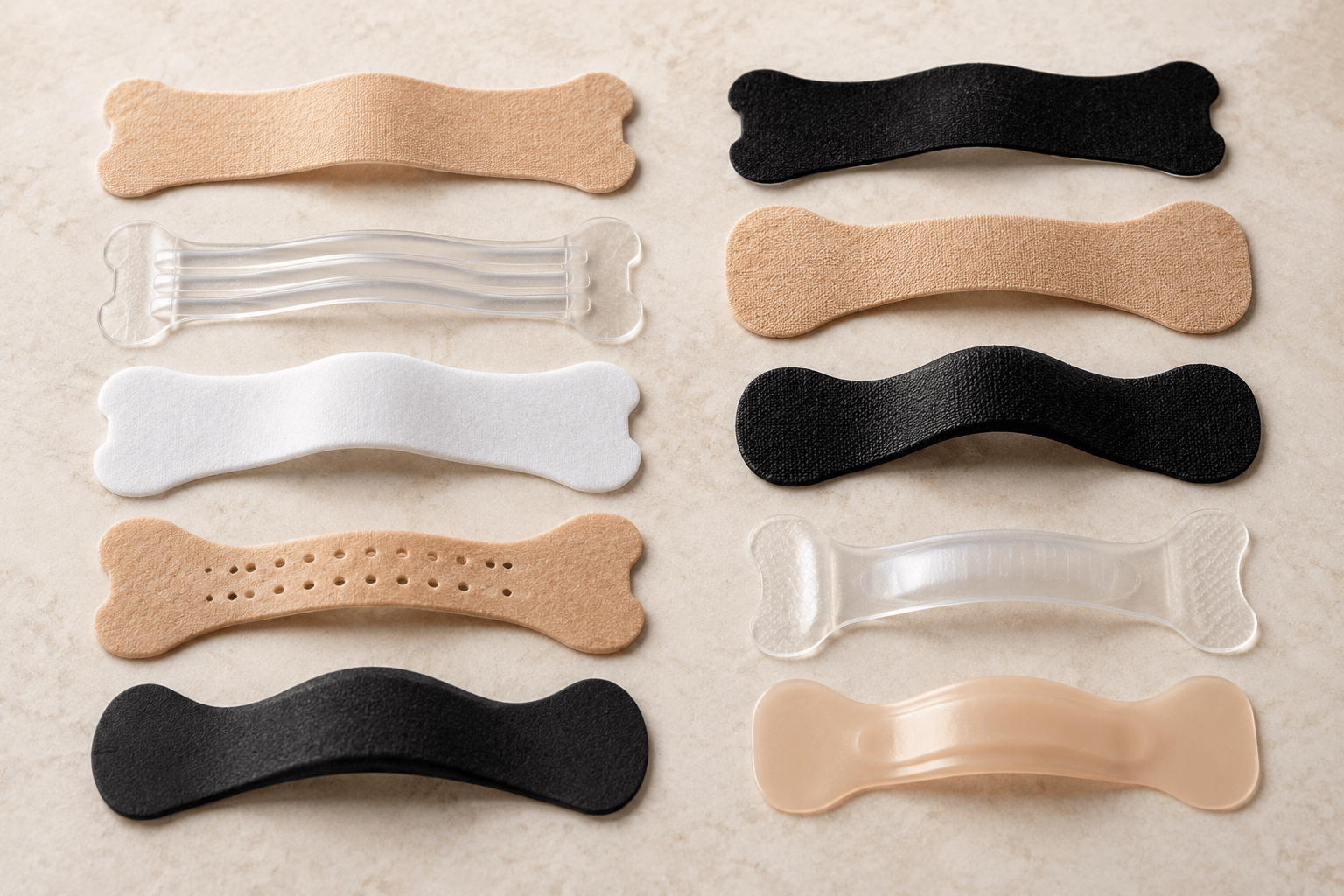
In short
- Breathe Right says its Extra Strength Tan strip has an added band for 50% more strength than its tan original, and its Extra Strength Clear is 50% stronger than the original clear.
- Both work the same way, by lifting the sides of the nose. Breathe Right says all its strips work the same way.
- A 2019 study of a strip with improved spring force measured 39.1% lower nasal resistance during sleep, and a 2018 trial found the original clear strip improved some sleep measures compared with placebo.
- We found no published study comparing Breathe Right's extra strength and original strips head to head.
- Original strips come in small/medium and large. Clear strips use a non-porous material that Breathe Right suggests for dry or sensitive skin.
Extra strength nasal strips pull harder on the sides of your nose than regular ones. Breathe Right says its extra strength strips are 50% stronger than its originals. If a regular strip leaves your nose still feeling tight, extra strength is the natural next step; if your skin is sensitive or your nose is small, the original is usually the better place to start.
What makes a strip extra strength?
Extra strength strips differ from regular ones in the bands. Breathe Right says each of its strips has flexible, spring-like bands that stick just above the flare of each nostril. As the bands try to straighten back to their original shape, they lift the sides of the nose.
An extra strength strip has more spring. Breathe Right describes its Extra Strength Tan as its best-selling tan strip with an added band for 50% more strength. It describes its Extra Strength Clear as 50% stronger than its original clear strip. Breathe Right doesn't say exactly how the 50% is measured, so read it as a description of pulling force rather than a promise of 50% more airflow.
Breathe Right is clear that the mechanism doesn't change. Its products page says that whichever strip you choose, they all work the same way.
What does the research say about stronger strips?
Research: limited (what this means)There's good evidence that strips work, and a small amount on stronger spring force specifically. We didn't find any published study comparing Breathe Right's extra strength strip with its original head to head.
The closest is a 2019 exploratory study funded by GlaxoSmithKline Consumer Healthcare. It tested a prototype strip described as having improved spring forces in people with chronic nighttime nasal congestion. Measured while they were asleep, nasal resistance was 39.1% lower with the strip on than without it. Over 28 nights, participants reported easier breathing, better sleep quality and less daytime sleepiness. The authors called the data preliminary and said a larger study should confirm it. The paper doesn't say the prototype is the same product as the extra strength strip sold today, so we can't make that link.
Regular strength has its own evidence. A 2018 randomized, double-blind trial compared the original Breathe Right clear strip, a prototype strip and a placebo strip without springs over two weeks. The original clear strip did better than placebo on some measures, including symptoms on waking and sleep problems at day 7. All the strips were well tolerated.
So the honest picture is this. Strips at regular strength have controlled evidence behind them. A stronger spring has shown promising results in one exploratory study. Whether extra strength beats regular for you is something you'll find out by trying both.
Who might do better with extra strength?
Breathe Right positions its extra strength strips for people who want more. Its Extra Strength Tan page asks if you need stronger relief from nasal congestion and says it's the strip for you. Its strip finder quiz starts by asking how congested you feel: mild, moderate or severe.
Based on that, extra strength is worth trying if:
- A regular strip helps a little but your nose still feels tight at night.
- Your congestion feels heavier, for example during allergy season.
- You want a scented strip. Breathe Right says its Lavender Scented and Menthol Scented strips are as strong as its extra strength strips.
If a regular strip isn't doing much at all, check the basics before switching. Placement and skin prep make a big difference, and why nasal strips sometimes don't work runs through the common reasons.
Who might do better with regular strips?
A few things point toward starting with the original.
Size is one. Breathe Right lists both small/medium and large sizes for its Original Tan and Original Clear strips, and it recommends small/medium for children and smaller faces. Its extra strength product pages list pack counts but don't list separate sizes. If a large strip overhangs your nose, a small/medium original may fit better. Breathe Right says not to cut a strip to make it smaller, because that can stop it working.
Skin is another. Breathe Right explains that its tan strips use a more porous material: once the strip is out of the pack and exposed to air, the adhesive becomes tacky and glue-like. Clear strips work the other way, with a non-porous material that keeps air away from the adhesive and makes the strip easier to remove after use. Breathe Right describes the clear material as hypoallergenic. On the other side, it describes its Extra Strength Tan as breathable and form-fitting and made to stay put, no matter the activity. It suggests clear strips for dry or sensitive skin. Both Original Clear and Extra Strength Clear use that material. Its strip finder also notes that some of its recommendations may not suit sensitive skin. Nasal strip skin irritation covers gentle removal if your skin is reacting.
Children are the third. Breathe Right says its strips are safe for children over 5 and suggests the small/medium size for a child's face. See nasal strips for kids.
How do you switch between strengths?
Switching between strengths works best as a simple trial. Use one type for several nights before judging it, since a 1998 sleep lab study found that 17 of 30 snorers needed some time to get used to wearing a strip. Then try the other for the same stretch and see which leaves you breathing more easily and waking more comfortably.
The usage rules are the same for both. Breathe Right says its strips may be used daily for no more than 12 hours a day, each one single use. Don't use them over sores, sunburn or irritated skin, or if you have a latex allergy, because the package is sealed with natural rubber latex. How long you can wear a nasal strip covers timing in more detail.
Can you pair either strength with mouth tape?
Whichever strength you use, a strip and mouth tape work well together. The strip opens your nose and the tape keeps your mouth closed. Put the strip on first, breathe through your nose for a minute with your mouth shut, and only add tape if that feels easy. Our nose test is a quick way to check.
Check this first. Skip mouth tape and see a doctor if you snore loudly, wake up gasping, have been told you stop breathing in your sleep, or can't breathe comfortably through your nose. More on safety
If you want to try nasal strips, our pick is TitanAir Nasal Strips.
No strength of strip treats sleep apnea. Breathe Right says its strips are not intended to treat sleep apnea and that you should see a doctor if you suspect your snoring is a sign of something serious.
Read next
- How nasal strips work, and when they help most
- Nasal strips vs nasal dilators
- Do nasal strips improve sleep?
Common questions
What's the difference between extra strength and regular nasal strips?
The spring force. Breathe Right says its Extra Strength Tan has an added band for 50% more strength than the tan original, and its Extra Strength Clear is 50% stronger than the original clear. Both lift the sides of the nose in the same way.
Are extra strength nasal strips better?
Not automatically. They pull harder, which Breathe Right positions for people who need stronger relief from congestion. We found no study comparing them head to head with the originals, and the original clear strip has its own placebo-controlled evidence.
Do extra strength strips come in small sizes?
Breathe Right lists small/medium and large sizes for its Original Tan and Original Clear. Its extra strength product pages list pack counts but not separate sizes, so check the box if you have a smaller nose.
Are scented nasal strips extra strength?
Yes, according to Breathe Right. It describes its Lavender Scented and Menthol Scented strips as just as strong as its extra strength strips.
Which nasal strip is best for sensitive skin?
Breathe Right suggests its clear strips for dry or sensitive skin, because the non-porous material makes them easier to remove. Both Original Clear and Extra Strength Clear use it.
Can I wear extra strength strips every night?
Breathe Right says its strips may be used daily for up to 12 hours a day, with a fresh strip each time. Stop if you get a rash or skin irritation.
Sources
- Breathe Right products
- Breathe Right Extra Strength Tan
- Breathe Right Extra Strength Clear
- Breathe Right Original Clear
- Breathe Right FAQs
- Objective and Subjective Effects of a Prototype Nasal Dilator Strip on Sleep in Subjects with Chronic Nocturnal Nasal Congestion
- Effects of nasal dilator strips on subjective measures of sleep in subjects with chronic nocturnal nasal congestion: a randomized, placebo-controlled trial
- Effect of the external nasal dilator Breathe Right on snoring
About this article
- Research
- 8 published sources, listed above.
- Evidence
- Limited. How we rate it
- Last checked
- October 4, 2026
- Funding
- Paid partner of Titan Recovery. Their ads are labeled.
- Found an error?
- Tell us. We log fixes on the corrections page.
* This content is for informational and educational purposes only and is not medical advice. It is not intended to diagnose, treat, cure or prevent any disease or health condition. Talk to a qualified healthcare provider about your health.