In short
- People in several studies reported sleeping better with nasal strips, and a 2018 placebo-controlled trial found strips beat a placebo strip on satisfaction with sleep.
- A 2019 sleep study found nasal resistance during sleep was 39.1% lower with a strip, with about 37% fewer spontaneous arousals and about 11 minutes less time awake.
- Strips help most when a narrow or congested nose is what disturbs your sleep. Two larger 2019 trials found real and placebo strips performed about the same, so results vary.
- Some people need a few nights to get used to a strip, so give it a fair trial of a week or two.
- A 2016 meta-analysis found nasal dilators improve nasal breathing but don't improve obstructive sleep apnea.
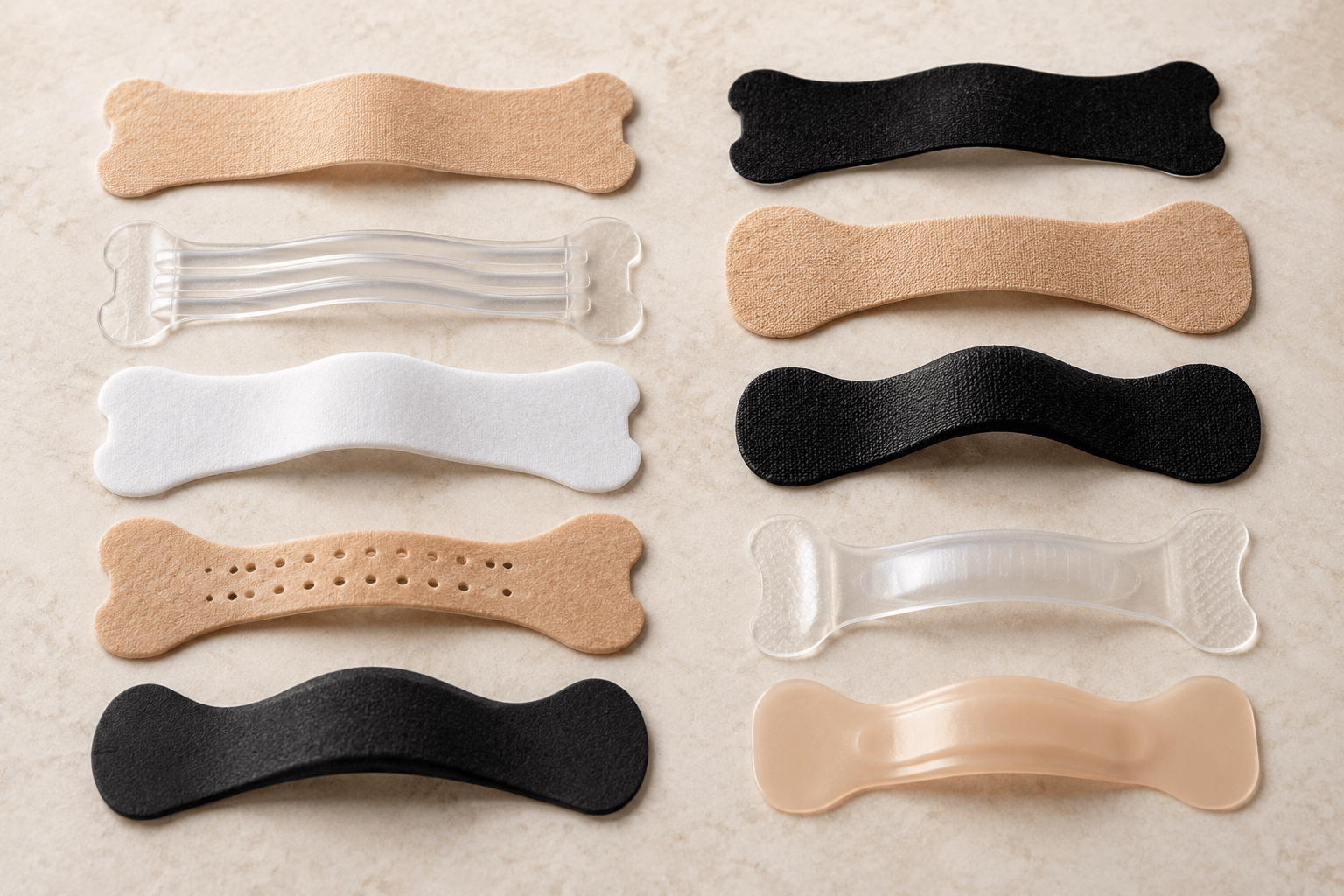
Nasal strips can help you sleep better if a narrow or congested nose is what disturbs your nights. People in several studies reported better sleep with a strip, a placebo-controlled trial backed that up, and a detailed sleep study recorded lower nasal resistance and fewer arousals. Not every trial found a difference, so the people who gain most are those whose nose is the problem.
What do studies mean by "sleep quality"?
Research: limited (what this means)Nasal strip studies have measured sleep in two ways. Some ask people how they slept, using questionnaires about things like satisfaction with sleep or feeling refreshed in the morning. Others use polysomnography, an overnight sleep lab recording of brain waves, breathing and oxygen levels that shows sleep stages and how often you wake.
These two methods often disagree in strip research. People tend to report feeling better, while the lab recordings stay much the same. Keep that split in mind as you read the studies below.
What did the sleep lab studies find?
A 1998 study recorded 30 habitual snorers overnight with and without a Breathe Right strip. Peak snoring loudness dropped, mainly in lighter sleep. Sleep architecture, meaning the pattern of sleep stages through the night, remained almost unchanged. Participants still rated their sleep quality as better on a questionnaire.
A 2000 randomized, placebo-controlled trial tested strips on 12 people with chronic rhinitis who snored but didn't have sleep apnea. Snoring frequency fell from 258 to 173 snores per hour compared with placebo. The strip had no effect on sleep quality, on how often people were briefly roused from sleep, or on snoring loudness.
A 2019 exploratory study is the most detailed. Seventy people with chronic nighttime congestion and difficulty sleeping used a newer strip with stronger springs every night for 28 days. Most sleep lab measures were similar with and without the strip. Median time awake after first falling asleep was about 11 minutes lower, and the spontaneous arousal rate fell by about 37%. In a separate phase, nasal resistance during sleep was 39.1% lower with the strip. The authors described these as preliminary data and said a larger study was needed.
What did people report about their own sleep?
Self-reported results are more positive, but the placebo-controlled ones are mixed.
In the 2019 exploratory study, participants reported less daytime sleepiness, easier breathing, better sleep quality, staying asleep more easily and feeling more refreshed in the morning. The authors describe it as a small, open-label, uncontrolled study with no placebo strip, so expectation could account for some of the improvement.
A 2018 double-blind trial did use a placebo strip, one without springs. Among 59 people with chronic nasal congestion and sleep difficulties, both a Breathe Right clear strip and a prototype strip beat placebo on satisfaction with sleep at day 7. The Breathe Right strip also beat placebo on a sleep problems score at day 7.
Two larger double-blind trials published in 2019, with 140 and 130 participants, found the opposite. Over 14 nights, real strips were no better than placebo strips on sleep problems or on feeling tired and unrefreshed in the morning. Both groups improved from baseline. The authors pointed to a strong placebo effect as a likely reason.
All three of the recent papers were sponsored by GlaxoSmithKline Consumer Healthcare, the company the papers name as the maker of Breathe Right strips.
Why can a strip make nights easier?
The clearest effect of a strip is on the nose itself. In the 2019 exploratory study, nasal resistance measured while people were asleep was 39.1% lower with the strip than without it. The 2016 meta-analysis also notes that when the cross-sectional area of the nasal cavity increases by 10%, nasal airflow increases by 21%, so a modest widening at the front of the nose can make a real difference to how hard you have to work to breathe.
The authors of the 2019 study suggested that this lower resistance could be how strips ease sleep-related symptoms, by reducing the number of times people wake in the night. That fits with what they recorded: less time awake after first falling asleep and fewer spontaneous arousals. It's a reasonable explanation, though they were clear that a larger study is needed to confirm it.
So who might sleep better with a strip?
People whose nose is narrow or congested are the clearest group likely to sleep better with a strip. Strips widen the front of the nose and lower nasal resistance, and a 2016 meta-analysis found nasal dilators improve nasal breathing. If a narrow or congested nose is what wakes you, a strip is a simple, drug-free way to make nights easier. How nasal strips work covers the mechanics.
You're more likely to notice a difference if your nose feels tight lying down, or if you snore when you're congested. Cleveland Clinic lists trouble breathing that gets worse when lying down, and snoring at night, among the symptoms of nasal valve collapse, and says breathing strips may help you breathe easier and sleep better. If your nose feels clear and open at night, there's less for a strip to fix.
For congestion that comes and goes, a strip works well alongside other approaches. How to sleep with a stuffy nose goes through them, and nasal strips for allergies covers allergy season in particular.
How can you tell if a strip is helping your sleep?
You can tell if a strip is helping your sleep by copying the trials, which give a useful template. The placebo-controlled ones ran for 14 nights and asked people about things like satisfaction with sleep, sleep problems and feeling tired or unrefreshed in the morning. You can track the same things at home.
- Spend a few nights without a strip and jot down how you slept, how easily you breathed through your nose and how you felt on waking.
- Use a strip every night for the next two weeks, putting it on at bedtime.
- Keep the same notes, and if you share a bed, ask your partner whether your snoring has changed.
- Compare the two stretches at the end.
Don't judge on the first night alone. In the 1998 snoring study, 17 of 30 participants needed some time to get used to the strip. After that, they said they could breathe easily, slept well and felt rested the next morning.
How do you get a good night with a strip?
A strip can only help if it stays put and sits in the right place. Breathe Right's instructions are to wash and dry your nose first, because the adhesive won't stick properly to wet, oily or moisturized skin. Place the strip right above where your nose flares out and rub it gently to secure it. Strips come in different sizes, and Breathe Right recommends the large size for adults and the small/medium size for smaller faces.
Breathe Right says strips can be used daily for up to 12 hours, with a fresh strip each night. In the morning, wet the strip with warm water for about 10 seconds and lift each side slowly. Our guide on how to apply nasal strips has the step-by-step version, and if your skin gets sore, see nasal strip skin irritation.
If you've tried a strip properly and your nose still feels blocked, why nasal strips sometimes don't work goes through the likely reasons.
What don't strips do for sleep?
The same 2016 meta-analysis found that nasal dilators don't improve obstructive sleep apnea. Twelve of the fourteen studies it reviewed showed no significant change in the apnea-hypopnea index, the main measure of how often breathing stops or becomes shallow during sleep. If you snore loudly, gasp or choke at night, or someone has seen you stop breathing, see a doctor rather than relying on a strip.
Can you pair a strip with mouth tape?
A strip and mouth tape do different jobs. The strip makes nasal breathing easier, and the tape keeps your mouth closed so you stay on nasal breathing through the night. Many people find the combination works well, as long as they can breathe comfortably through the nose with the strip on. Our two-minute nose test is a simple way to check before you add tape, and mouth tape vs nasal strips explains how the two compare. There's more on strips in our nasal strips topic.
Check this first. Skip mouth tape and see a doctor if you snore loudly, wake up gasping, have been told you stop breathing in your sleep, or can't breathe comfortably through your nose. More on safety
If you want to try nasal strips, our pick is TitanAir Nasal Strips.
Common questions
Do nasal strips help you sleep better?
Many people report sleeping better with them, and a 2018 placebo-controlled trial supported that for people with chronic nighttime congestion. Two later trials found no difference from a placebo strip, and most sleep lab measures didn't change, so the benefit is clearest when your nose is what keeps you up.
Do nasal strips help you stay asleep?
One exploratory 2019 study of 70 people with chronic nighttime congestion found less time awake after falling asleep and fewer spontaneous arousals with a strip, but the authors called the data preliminary and asked for a larger study.
How long should I try nasal strips before deciding?
At least a week or two. The placebo-controlled trials ran for 14 nights, and in a 1998 study 17 of 30 snorers needed some time to get used to the strip before they reported breathing easily and sleeping well.
Will a nasal strip wake me up or keep me awake?
Most people adjust quickly. The strips were well tolerated in the trials, and in the 1998 study the only reaction noted was one person who briefly felt like sneezing after the first strip. If the feel bothers you, check the size and placement before giving up.
Do nasal strips help you sleep with a cold or allergies?
They can make breathing through a congested nose feel easier. The trials that tested sleep were all in people with chronic nighttime congestion, most of it from rhinitis or colds. A strip doesn't treat the cause, so it works best alongside whatever you use for the congestion itself.
Are nasal strips good for sleep apnea?
No. A 2016 meta-analysis found nasal dilators improve nasal breathing but don't improve the measures used to diagnose and track obstructive sleep apnea. If you snore loudly or stop breathing in your sleep, see a doctor.
Are nasal strips good for snoring?
They can be, especially when a congested nose is behind the snoring. In a 2000 placebo-controlled trial of people with chronic rhinitis who snored but didn't have sleep apnea, snoring frequency fell from 258 to 173 snores per hour with a real strip, though loudness didn't change. A 1998 study of 30 habitual snorers also recorded lower peak snoring loudness with a strip.
Are nasal strips good for you?
For most people they're a simple, drug-free way to breathe more easily through the nose at night. The strips were well tolerated in the trials, and Breathe Right says they can be used daily for up to 12 hours. They help most when a narrow or congested nose is the problem, and they don't treat sleep apnea.
Sources
- Effect of the external nasal dilator Breathe Right on snoring
- External nasal dilation reduces snoring in chronic rhinitis patients: a randomized controlled trial
- Effects of nasal dilator strips on subjective measures of sleep in subjects with chronic nocturnal nasal congestion: a randomized, placebo-controlled trial
- Objective and Subjective Effects of a Prototype Nasal Dilator Strip on Sleep in Subjects with Chronic Nocturnal Nasal Congestion
- Sleep Quality and Congestion with Breathe Right Nasal Strips: Two Randomized Controlled Trials
- Nasal Dilators (Breathe Right Strips and NoZovent) for Snoring and OSA: A Systematic Review and Meta-Analysis
- Breathe Right FAQs
- Nasal valve collapse
About this article
- Research
- 8 published sources, listed above.
- Evidence
- Limited. How we rate it
- Last checked
- October 10, 2026
- Funding
- Paid partner of Titan Recovery. Their ads are labeled.
- Found an error?
- Tell us. We log fixes on the corrections page.
* This content is for informational and educational purposes only and is not medical advice. It is not intended to diagnose, treat, cure or prevent any disease or health condition. Talk to a qualified healthcare provider about your health.