In short
- Strips were well tolerated in the clinical trials, and most skin irritation comes down to how a strip is put on and taken off.
- Breathe Right lists redness, irritation, pain, peeling or bleeding as possible reactions at the strip site, and says to stop using the strips if they happen.
- Wet the strip with warm water first, then peel it slowly, low and close to the skin, instead of pulling it straight up.
- Clinical guidance on medical adhesives says rapid, vertical pulling puts more force on the skin than slow, horizontal removal.
- Don't put a strip over sores, sunburn or skin that's already irritated, and don't wear one for more than 12 hours a day.
- Breathe Right suggests its clear strips for dry or sensitive skin, because the material makes them easier to remove.
- Redness that lasts well after removal, a rash, itching or swelling are signs to stop and let the skin recover.
Most people wear nasal strips without skin trouble, and when irritation happens it's usually fixable. The two things you control are how you take a strip off and whether you put one on skin that's already sore. Wet the strip with warm water and peel it slowly, low and close to the skin. If you get a rash, itching or swelling, or redness that won't settle, stop using strips.
How common is skin irritation from nasal strips?
Research: limited (what this means)Skin irritation from nasal strips isn't common, according to the clinical trials. In a 1998 sleep lab study of 30 habitual snorers, the only reaction recorded was one person who briefly felt like sneezing after the first strip, and the authors called the strip safe and easily applied. A 2018 trial that gave 59 people strips nightly for two weeks reported that all the strips were well tolerated.
Still, few studies count skin reactions in detail. Breathe Right's own guidance says an application site reaction may occur, such as redness, irritation, pain, peeling or bleeding, and that rash, itching and swelling are also possible. In a 2022 study where 54 pregnant women wore a nasal strip for one night, two participants reported side effects linked to the strip, including skin irritation.
These are small studies, so they don't tell us exactly how often irritation happens with months of nightly use. What we can say is that it happens to some people, and most of the advice for avoiding it comes from the wider research on medical adhesives.
What causes the irritation?
Skin irritation from nasal strips comes from the adhesive, and nurses and doctors have a name for skin damage from adhesives: medical adhesive-related skin injury, or MARSI. A 2019 consensus paper describes it as redness or other skin damage, such as skin tears, erosion or blisters, that lasts 30 minutes or more after an adhesive is removed.
A 2025 article in the Journal of Wound, Ostomy, and Continence Nursing lists the kinds of reactions that fall under that label. They include skin stripping, tension blisters, skin tears, irritant contact dermatitis and allergic contact dermatitis. The author points out that the specific reaction matters, because each one is prevented and treated differently.
Breathe Right's guidance makes a similar split. It lists application site reactions such as redness, peeling or bleeding separately from hypersensitivity reactions such as rash, itching and swelling.
How do you remove a nasal strip gently?
Breathe Right recommends washing your face with warm water for 10 seconds and then gently lifting each side of the strip. It also suggests taking the strip off while washing your face or in the shower.
A 2025 evidence summary on preventing adhesive skin injury gives more detail on technique. Its recommendations include moistening the skin well before removal, loosening the edges first, and pressing down on the skin with one hand while the other lifts the adhesive. It advises keeping the adhesive at a low angle to the skin as you peel, with a finger supporting the skin along the line you're peeling. It also says to avoid rapid, vertical pulling, which puts more force on the skin than slow, horizontal removal close to the skin surface.
Put together for a nasal strip, that looks like this:
- Wet the strip with warm water for about 10 seconds, or wait until you're in the shower.
- Lift one end of the strip with a fingernail.
- Hold the skin next to it steady with a finger from your other hand.
- Peel the strip slowly back over itself, keeping it low and close to your skin, toward the middle of your nose.
- Repeat from the other side.
The same evidence summary lists mineral oil or petroleum jelly as alternatives to adhesive removers in some cases. Breathe Right's instructions only call for warm water, so start there.
How can you prevent irritation in the first place?
The best way to prevent irritation is to never put a strip on damaged skin. Breathe Right says not to use its strips over sores, sunburned or irritated skin. If your nose is still red from last night, skip a night or two.
Keep to the wear limit. Breathe Right says not to wear a strip for more than 12 hours a day, and each strip is single use, so don't reapply one that's come off.
Look after the skin between uses. The 2025 evidence summary lists dry skin and prolonged moisture as risk factors for adhesive skin injury, and recommends keeping skin clean with gentle cleansers and avoiding rubbing dry skin. Just remember that a strip needs clean, dry skin to stick, so apply any moisturizer after you've taken the strip off in the morning rather than right before bed. Our guide on how nasal strips work covers placement.
Which strip is gentlest on your skin?
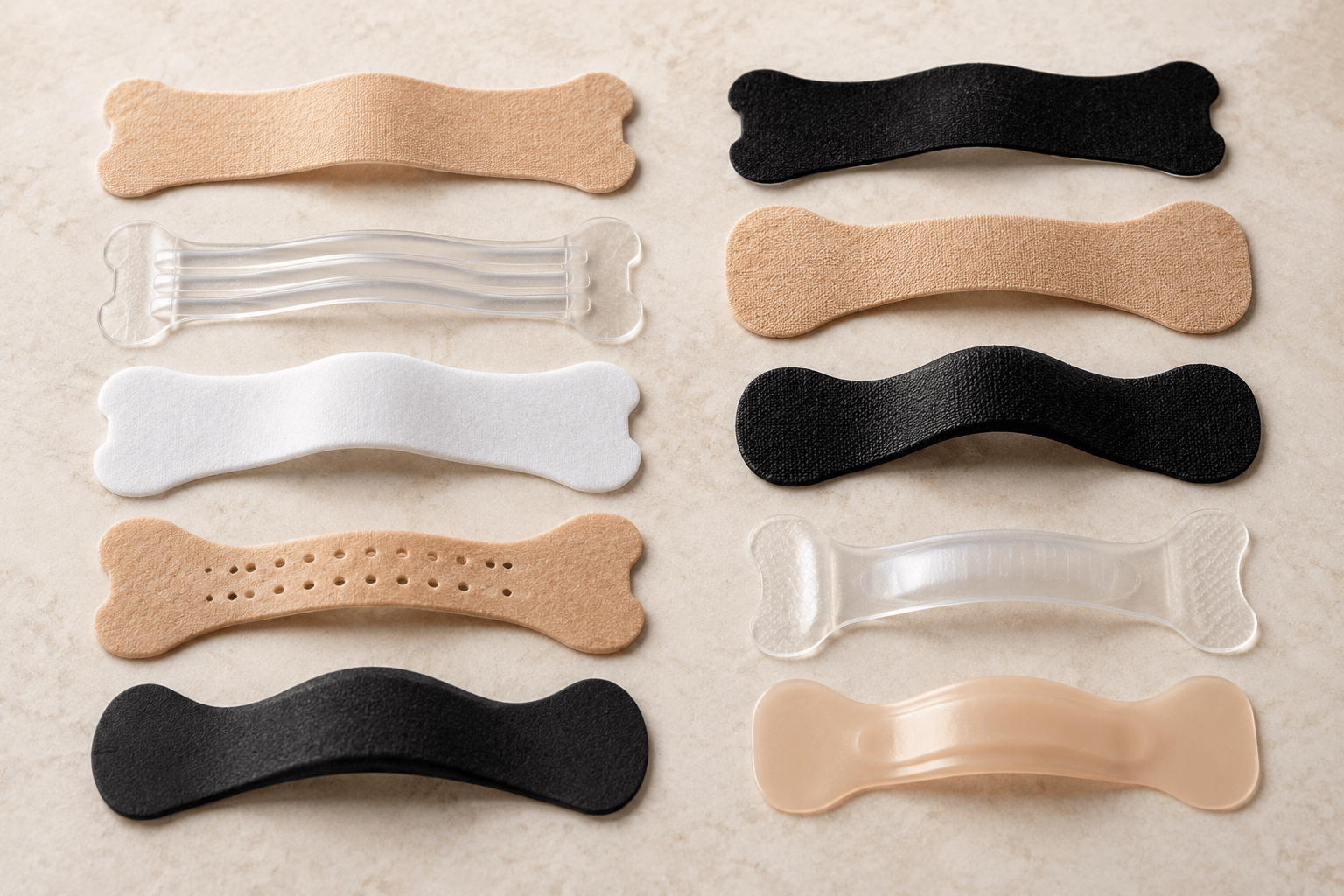
Breathe Right suggests its clear strips for dry or sensitive skin, and explains why. Its tan strips use a more porous material, and the adhesive becomes tacky once it's exposed to air. The clear strips use a non-porous material that keeps air away from the adhesive, which Breathe Right says makes them easier to remove after use.
Size is worth checking too. Breathe Right recommends the large size for adults and small/medium for children and smaller faces, and says not to cut strips to fit, since that can stop them working.
If you have a latex allergy, note that Breathe Right says its package is sealed with natural rubber latex and people with a latex allergy shouldn't use its strips.
How do you place a nasal strip without irritating your skin?
The 2025 evidence summary on medical adhesives gives several application tips that suit a nasal strip well. It recommends avoiding products that dry the skin out, such as alcohol, applying the adhesive only to dry skin, laying it on without stretching it, and pressing it down gently without creases.
In practice:
- Wash your nose with a gentle cleanser rather than an alcohol wipe, then dry it well.
- Lay the strip on right above where your nose flares out, without pulling the ends to stretch it.
- Smooth it down with a fingertip so it sits flat.
The same evidence summary notes that research on adhesive skin injury has focused on groups with more fragile skin, including older adults. If your skin tears or bruises easily, be especially patient with removal.
Is redness after removal a problem?
Redness after removal usually isn't a problem, because a brief pink mark where the strip sat isn't the same as an injury. The 2019 consensus paper defines adhesive skin injury as redness or other skin damage that lasts 30 minutes or more after the adhesive comes off. A mark that fades well before then is a reason to keep using good technique. Redness that hangs around, comes back night after night, or comes with peeling, soreness or a rash is a sign to take a break.
If you're helping a child use strips, Breathe Right says they're for children over 5 and suggests that parents help young children put them on and take them off. The same gentle removal steps apply.
When should you stop using nasal strips?
Stop using nasal strips if you get a rash, itching, swelling, bleeding or peeling, or if redness keeps coming back night after night. Breathe Right says to discontinue use if a reaction like this happens. If the skin doesn't settle after a few days without strips, or it blisters, see a doctor or pharmacist.
If you use mouth tape too, the same principles apply to the skin around your lips. Mouth tape skin irritation covers that side.
If strips don't suit your skin, there are other options. Nasal strips vs nasal dilators compares strips with dilators that sit inside the nostrils. If you mainly need strips because your nose is blocked at night, how to unblock your nose before bed may help too. Our two-minute nose test can help you work out how much your nose needs the help, and the nasal strips topic has the rest of our guides.
If you want to try nasal strips, our pick is TitanAir Nasal Strips.
Common questions
Why do nasal strips hurt my skin?
Removing a strip quickly can pull at the skin, and clinical guidance on adhesives says fast, vertical pulling puts more force on the skin than slow, horizontal removal. Some people also react to the adhesive itself, which can cause a rash, itching or swelling. Breathe Right says to stop using the strips if a reaction happens.
How do you get a nasal strip off without it hurting?
Wet it with warm water for about 10 seconds, or take it off in the shower, then lift one end and peel it slowly back over itself, keeping it low and close to the skin. Hold the skin beside it steady with a finger as you go.
Can I put a nasal strip on irritated skin?
No. Breathe Right says not to use its strips over sores, sunburned or irritated skin. Give the area time to recover first.
Which nasal strips are best for sensitive skin?
Breathe Right suggests its clear strips for dry or sensitive skin. It says the clear material is non-porous, which makes the strip easier to remove after use than its more porous tan strips.
Is a red mark after removing a strip normal?
A mark that fades quickly isn't what clinicians count as an adhesive skin injury. Their definition describes redness or other damage that lasts 30 minutes or more after removal. If yours lasts that long, or keeps coming back, take a break and look at how you're removing the strip.
Can I use oil to remove a nasal strip?
A 2025 clinical evidence summary on medical adhesives lists mineral oil or petroleum jelly as alternatives to adhesive removers in some cases. Breathe Right's instructions call for warm water, so start with that.
How do you place a nasal strip?
Wash your nose with a gentle cleanser, dry it well, then lay the strip right above where your nose flares out without stretching it. Smooth it down so it sits flat. Breathe Right says not to cut strips to fit, and recommends the large size for adults.
Sources
- Breathe Right FAQs
- Summary of the best evidence for the prevention and management of medical adhesive-related skin injuries in patients with tracheal intubation
- What is MARSI?
- Peristomal medical adhesive-related skin injury: results of an international consensus meeting
- Impact of nasal dilator strips on measures of sleep-disordered breathing in pregnancy
- Effect of the external nasal dilator Breathe Right on snoring
- Effects of nasal dilator strips on subjective measures of sleep in subjects with chronic nocturnal nasal congestion: a randomized, placebo-controlled trial
About this article
- Research
- 7 published sources, listed above.
- Evidence
- Limited. How we rate it
- Last checked
- October 10, 2026
- Funding
- Paid partner of Titan Recovery. Their ads are labeled.
- Found an error?
- Tell us. We log fixes on the corrections page.
* This content is for informational and educational purposes only and is not medical advice. It is not intended to diagnose, treat, cure or prevent any disease or health condition. Talk to a qualified healthcare provider about your health.