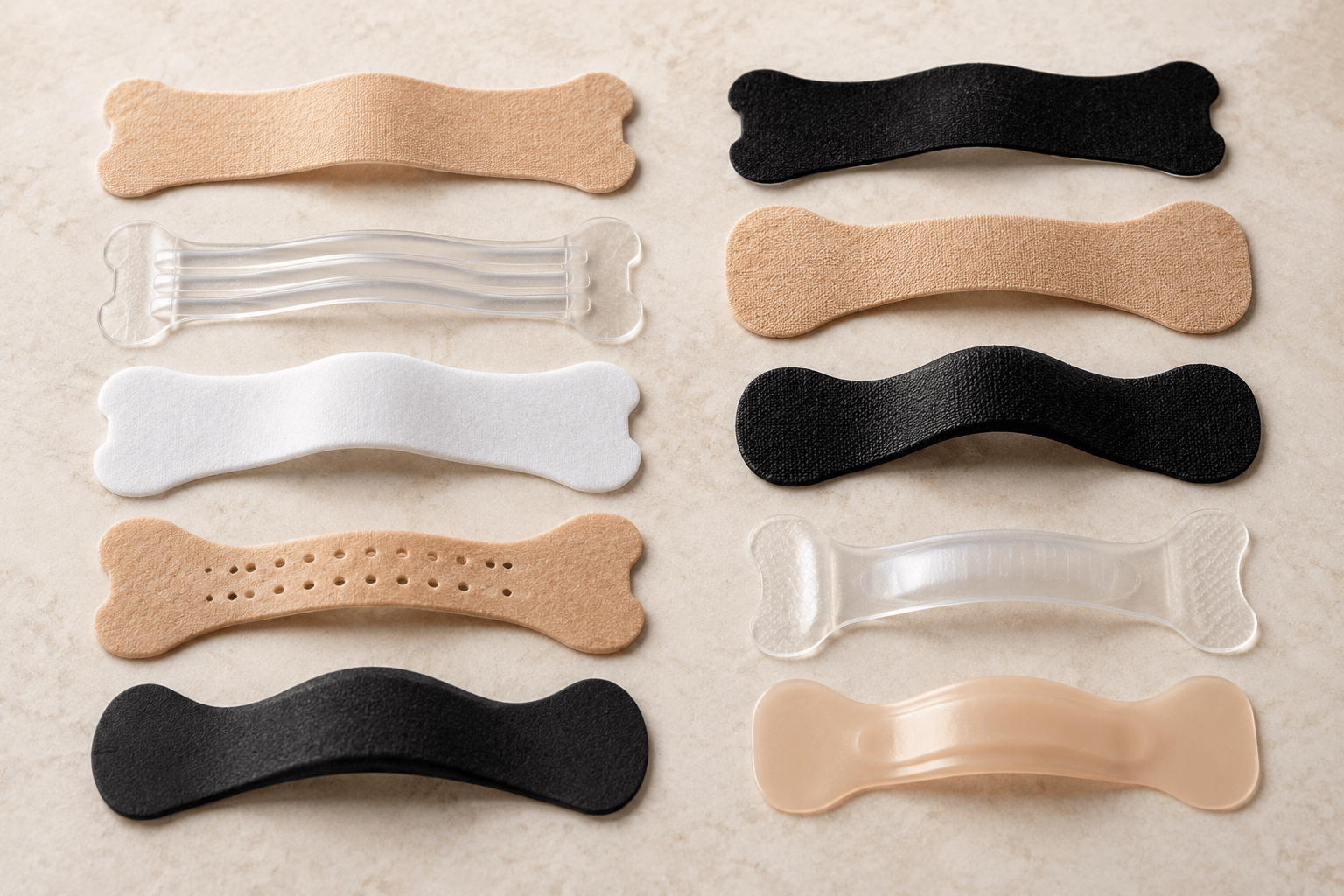
In short
- Breathe Right says its nasal strips may be used every day, for no more than 12 hours a day.
- Each strip is single use. Breathe Right says the adhesive isn't designed to be used more than once, so use a fresh strip each time.
- A full night of sleep fits comfortably inside the 12-hour limit, and Breathe Right describes its Original Tan strip as giving up to 12 hours of continuous relief.
- In clinical trials, people wore strips nightly for two to four weeks, and a 2018 trial reported the strips were well tolerated.
- Stop using strips if you get a rash or skin irritation, and remove each one slowly after wetting it with warm water.
You can wear a nasal strip for up to 12 hours a day, every day, according to Breathe Right. That comfortably covers a full night of sleep. Each strip is single use, though, so once it comes off, it goes in the bin and you start the next night with a fresh one.
What does the 12-hour limit mean in practice?
Breathe Right's FAQ says its strips may be used on a daily basis but not for more than 12 hours per day. For most people that simply means putting the strip on at bedtime and taking it off in the morning. Eight or nine hours of sleep sits well inside the limit, with room to spare if you put it on while reading in bed.
The limit is per day, not per strip. If you also wear strips for a run or a workout, add that time to your night. Breathe Right's product pages describe its strips as useful for sleep, exercise and congestion during the day, and the 12-hour rule covers all of it.
A simple routine keeps you well inside the limit. Put the strip on as part of getting ready for bed, after you've washed your face and before any night cream goes on. Take it off in the morning shower or at the sink with warm water. If you nap in the afternoon with a strip on, count that time as well, and use a fresh strip for it.
Does a strip keep working all night?
Research: limited (what this means)A strip keeps working all night, according to the manufacturer. Breathe Right describes its Original Tan strip as giving up to 12 hours of continuous relief. The strip works mechanically: its spring-like bands keep trying to straighten, which keeps lifting the sides of your nose for as long as it stays stuck down.
Sleep research points the same way. In a 2019 study, people with chronic nighttime congestion wore a strip with improved spring force at bedtime for 28 days. Measured while they were asleep, nasal resistance was 39.1% lower with the strip on than without it. The authors described this as exploratory work that a larger study should confirm.
No published study we found tested how a strip performs hour by hour across the night, or compared wearing one for six hours versus twelve. So the honest answer is that the 12-hour figure comes from the manufacturer, and the sleep studies support the idea that a strip is still doing its job while you're asleep.
Is it safe to wear nasal strips every night?
For most adults, nightly use is what strips are designed for. Breathe Right says they may be used daily. In clinical trials, people have worn them every night for weeks. A 2018 randomized, placebo-controlled trial had participants use strips nightly for two weeks and reported that all strips were well tolerated. The 2019 study ran for 28 nights.
An older 1998 sleep lab study of 30 habitual snorers saw no adverse events apart from one person who briefly felt the urge to sneeze after the first strip. The authors called the strip safe and easily applied.
The main thing to watch is your skin. Breathe Right lists redness, irritation, pain, peeling and bleeding as possible reactions where the strip sits, along with rash, itching and swelling, and says to stop using the strips if they happen. It also says not to put a strip over sores, sunburn or irritated skin. If your nose gets sore, take a few nights off. Nasal strip skin irritation has more on preventing it.
Why can't you reuse a nasal strip?
Breathe Right says plainly that each strip is for single use only and that the adhesive isn't designed to be used multiple times. Its instruction is to not reapply and to use a fresh strip instead.
Breathe Right describes the strip's bands as sticking to the area right above the flare of each nostril and lifting the sides of the nose from there, so the strip depends on a firm hold.
The same goes for a strip that comes off partway through the night. Don't press it back on. Use a new one if you want to keep wearing a strip until morning.
What if your strip falls off before morning?
A strip that won't last the night usually comes down to skin prep. Breathe Right says the adhesive won't stick properly to wet, oily or moisturized skin, so:
- Wash your nose and dry it completely before you apply the strip.
- Keep moisturizer and night cream off the area where the strip goes.
- Place the strip right above where your nose flares out and rub it gently to secure it.
A 2025 evidence summary on medical adhesives adds that tape should be applied to dry skin and pressed down gently without stretching it. Our guide on how to apply nasal strips walks through placement step by step.
Give it a few nights, too. In the 1998 study, 17 of the 30 snorers needed some time to get used to the strip. After that, they said they could breathe easily, slept well and felt rested in the morning.
How should you take a strip off after a long wear?
Take a strip off slowly after a long wear. Breathe Right recommends washing your face with warm water for 10 seconds, then gently lifting each side of the strip. Taking it off in the shower works too. Its advice is short: never rip it off.
The 2025 adhesive evidence summary backs this up. It recommends loosening the edges first, supporting the skin with one hand while the other lifts, and keeping the adhesive at a low angle to the skin. It advises against rapid, vertical pulling, which puts more force on the skin than slow removal close to the surface.
Do nasal strips expire?
Nasal strips do expire. Breathe Right prints an expiration date on the outer box of every strip product. If you've had a pack for a while, check the date before you rely on it.
Can you wear a strip with mouth tape?
You can wear a nasal strip with mouth tape, and the timing is the same: strip on at bedtime, both off in the morning. Put the strip on first, breathe through your nose with your mouth closed for a minute, and only add tape if that feels easy. Our two-minute nose test is a quick check, and mouth tape vs nasal strips explains how the two work together.
Check this first. Skip mouth tape and see a doctor if you snore loudly, wake up gasping, have been told you stop breathing in your sleep, or can't breathe comfortably through your nose. More on safety
If you want to try nasal strips, our pick is TitanAir Nasal Strips.
Strips help the front of your nose and don't treat sleep apnea. A 2016 meta-analysis found nasal dilators improve nasal breathing but not sleep apnea outcomes, so if you snore loudly or someone has heard you stop breathing, see a doctor. Snoring vs sleep apnea explains the difference.
Read next
- How nasal strips work, and when they help most
- Extra strength vs. regular nasal strips
- Why nasal strips sometimes don't work
Common questions
Can I wear a nasal strip all night?
Yes. Breathe Right's limit is 12 hours a day, which covers a normal night's sleep. Put the strip on at bedtime and take it off when you get up.
Can I reuse a nasal strip?
No. Breathe Right says its strips are for single use only and the adhesive isn't designed to be used more than once. If a strip comes off, use a fresh one rather than pressing the old one back on.
Can I wear nasal strips all day?
Not around the clock. Breathe Right says its strips may be used daily but for no more than 12 hours per day in total. If you wear a strip for a workout and again at night, keep the combined time within that limit, and use a new strip each time.
How long does it take for a nasal strip to work?
Breathe Right says its strips work instantly, giving relief you can feel right away, because the spring-like bands start lifting the sides of the nose as soon as the strip is on. Some people need a few nights to get used to the feel of one. In a 1998 study, 17 of 30 snorers needed some time to adjust, after which they said they could breathe easily and slept well.
How do you wear a nasal strip?
Wash your nose and dry it completely, then place the strip just above where your nostrils flare out and rub it gently to secure it. Breathe Right says the adhesive won't stick properly to wet, oily or moisturized skin, so keep night cream off that area. To take it off, wet it with warm water and peel it slowly from each side.
Is it safe to use nasal strips every night?
Breathe Right says its strips may be used daily. Trials have had people wear them nightly for two to four weeks. Stop if your skin gets red, sore or irritated, and give it time to heal.
Do nasal strips expire?
Yes. Breathe Right prints an expiration date on the outer box of every strip product, so check it before using an old pack.
What should I do if my nasal strip falls off in the night?
Use a new strip if you want to keep wearing one. Breathe Right says not to reapply a used strip. Next time, make sure your nose is washed and completely dry before you put it on, since the adhesive won't hold on oily or moisturized skin.
Sources
- Breathe Right FAQs
- Breathe Right Original Tan
- Effects of nasal dilator strips on subjective measures of sleep in subjects with chronic nocturnal nasal congestion: a randomized, placebo-controlled trial
- Objective and Subjective Effects of a Prototype Nasal Dilator Strip on Sleep in Subjects with Chronic Nocturnal Nasal Congestion
- Effect of the external nasal dilator Breathe Right on snoring
- Summary of the best evidence for the prevention and management of medical adhesive-related skin injuries in patients with tracheal intubation
- Nasal Dilators (Breathe Right Strips and NoZovent) for Snoring and OSA: A Systematic Review and Meta-Analysis
About this article
- Research
- 7 published sources, listed above.
- Evidence
- Limited. How we rate it
- Last checked
- October 10, 2026
- Funding
- Paid partner of Titan Recovery. Their ads are labeled.
- Found an error?
- Tell us. We log fixes on the corrections page.
* This content is for informational and educational purposes only and is not medical advice. It is not intended to diagnose, treat, cure or prevent any disease or health condition. Talk to a qualified healthcare provider about your health.