In short
- Nasal strips mechanically widen the front of the nose. Sprays act on the lining inside it, so the two work on different parts of the problem and can be used together.
- In a 2007 study of 89 people with nasal blockage, a strip improved airflow and the feeling of a blocked nose about as much as a decongestant spray did.
- A strip contains no medicine, so it doesn't carry the rebound risk of decongestant sprays, which the NHS says shouldn't be used for more than 5 days at a time.
- Steroid nasal sprays take several days to become fully effective and are meant for daily use, according to the AAAAI.
- A 2018 Cochrane review found low-quality evidence that saline irrigation may reduce allergy symptoms.
Nasal strips and nasal sprays tackle nighttime congestion from opposite sides, which is why they often work well together. A strip pulls the outside of the nose open and contains no medicine, and in a head-to-head study it improved airflow about as much as a decongestant spray. Sprays act on the lining inside the nose. Which one to reach for depends on what's blocking you, how long it's lasted, and whether you want something for tonight or something to use every day.
How do nasal strips and nasal sprays compare?
This table compares a nasal strip with saline, steroid and decongestant sprays on how each works, what the research and guidance say, and who it suits best.
| Nasal strip | Saline spray | Steroid spray | Decongestant spray | |
|---|---|---|---|---|
| How it works | Lifts the sides of the nose and widens the front | Rinses the lining with salt water | Calms inflammation in the lining | Shrinks swollen blood vessels |
| Medicine in it | None | None | Yes | Yes |
| What research shows | Matched a decongestant spray on airflow in a 2007 study of 89 people | May reduce allergy symptoms (2018 Cochrane review, low-quality evidence) | Takes several days to become fully effective (AAAAI) | Clears the nose quickly |
| How long to use | Daily, up to 12 hours a day (Breathe Right) | Before bed, alongside a strip | Daily | No more than 5 days at a time (NHS) |
| Best for | A tight front of the nose, every night | Allergies, rinsing before a strip | Allergy season, used daily | Short-term relief only |
How do strips and sprays work differently?
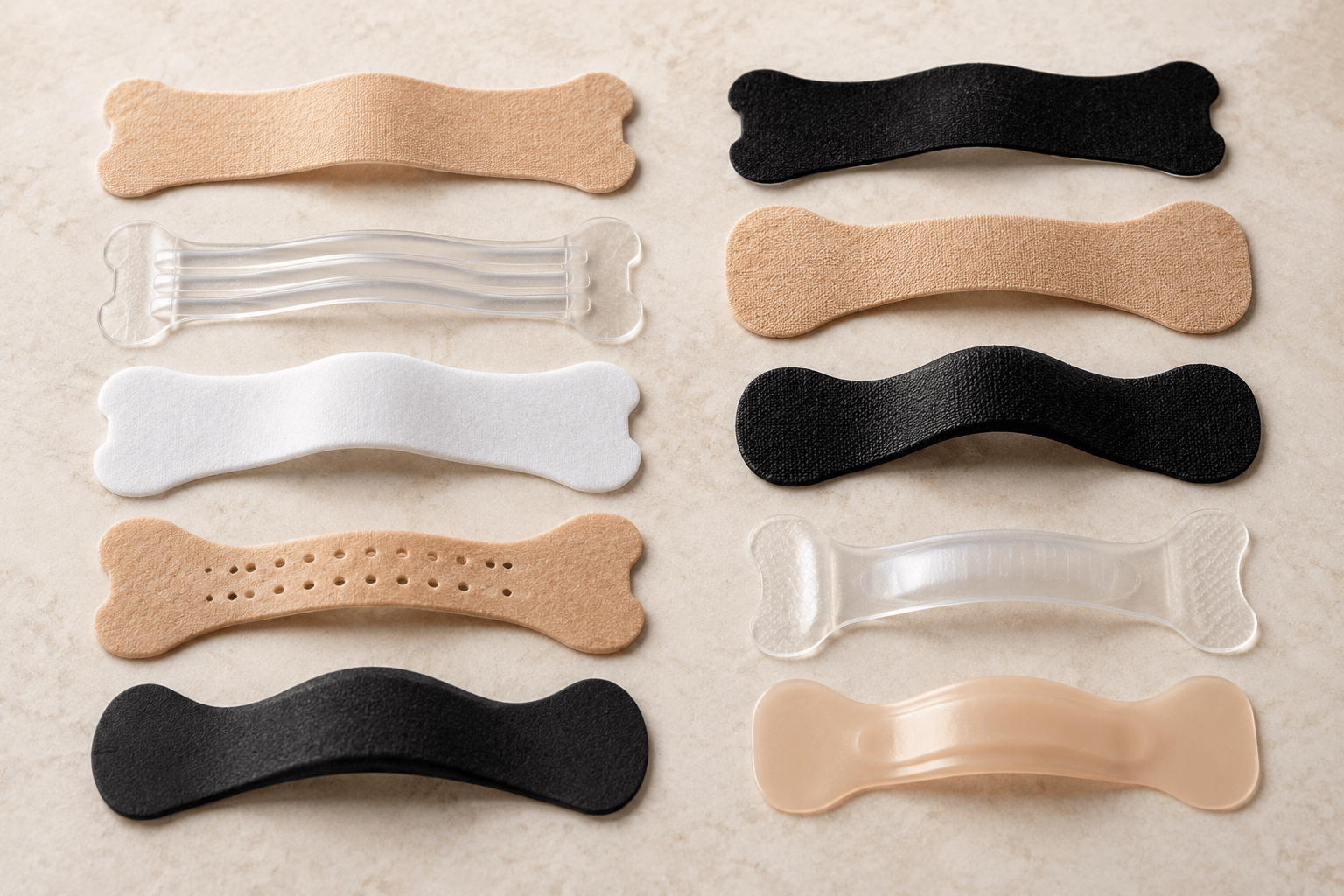
Research: limited (what this means)A nasal strip is a springy band that lifts the sides of the nose and widens the nasal valve near the nostrils. A 2016 meta-analysis found that nasal dilators improve nasal breathing. A strip doesn't change the swollen lining or the mucus further inside, so it helps most when the front of the nose is the tight spot. How nasal strips work has the details.
Sprays work on the lining itself, and the three common types work in very different ways. The direct comparisons we found measured airflow rather than sleep, so much of the comparison below is about how each one works and what the guidance says about using it.
Has anyone compared a strip with a decongestant spray?
Yes, a nasal strip has been compared with a decongestant spray. A 2007 study in the European Archives of Oto-Rhino-Laryngology compared a Breathe Right strip with a xylometazoline decongestant spray in 89 people with nasal blockage. The two gave comparable improvements in peak nasal airflow and in how blocked people said their nose felt.
They got there in different ways. The strip widened the front 3 cm of the nose significantly more than the spray did, but had no effect further back. The spray worked on the deeper part of the nose, where the strip didn't reach. The authors started from the point that decongestant drops carry a real risk of overuse and side effects, and concluded that a strip may be an alternative to decongestant sprays for nasal blockage.
An older study helps explain who notices the difference most. In a 1998 study in Laryngoscope, a strip widened the narrowest part of the nose and lowered resistance in all three groups tested: people with healthy noses, people with a crooked septum near the nasal valve, and people whose blockage came from a swollen nasal lining. The effect was largest in the septum group, and the authors called the strip an effective nonsurgical approach for that kind of blockage. People whose blockage came from swelling also measured better with a strip, though they didn't clearly feel more open.
Can you use a strip and a spray together?
You can use a nasal strip and a spray together, and there's some reason to think the effects add up. A 2000 study in the European Respiratory Journal measured nasal resistance in 20 healthy adults with a strip, a placebo strip and no strip, before and after an oxymetazoline decongestant. The effects of the decongestant and the strip were additive. The authors also found the strip helped most in people whose nose had higher resistance to begin with.
That fits how they work. A spray shrinks or calms the lining further inside, and a strip holds the front of the nose open. Because a strip contains no medicine, it doesn't interact with any spray. The NHS advises against using more than one decongestant medicine at the same time, such as two sprays or a spray plus tablets, but a strip isn't a medicine, so that warning doesn't apply to it.
How do saline sprays and rinses compare?
Saline sprays and rinses use salt water. Saline rinses the inside of the nose and contains no drug. A 2018 Cochrane review looked at 14 studies with 747 participants who had allergic rhinitis, using saline delivered by sprays, squeeze bottles and other methods. It found that saline irrigation may reduce symptoms compared with no saline for up to three months, in both adults and children, with no reported adverse effects. The reviewers rated the evidence low or very low quality, and the studies were generally small.
Saline is gentle enough to use before bed, and it pairs naturally with a strip: rinse first, dry your nose, then put the strip on. Breathe Right notes that its strips won't stick properly to wet or oily skin, so the drying step matters. Our guide on how to use a saline rinse covers technique and safe water.
How do steroid nasal sprays compare?
Steroid sprays reduce inflammation inside the nose. The American Academy of Allergy, Asthma & Immunology says they are used mainly for allergic rhinitis, and also for nonallergic rhinitis and nasal polyps. They take several days to become fully effective, so daily use is recommended. For seasonal allergies, the AAAAI suggests starting one to two weeks before pollen season.
That slow build-up is the main difference from a strip. A strip works the night you put it on, while a steroid spray is a daily treatment that works over time. That makes the two a sensible pairing during allergy season, with the strip covering the first nights while the spray builds up. The AAAAI lists dryness, burning, stinging and nosebleeds as common side effects. Ask a pharmacist or doctor whether one suits you, and see nasal strips for allergies for more on that combination.
Why do decongestant sprays come with a rebound warning?
Decongestant sprays shrink swollen blood vessels in the nose and can clear it quickly. Cleveland Clinic names oxymetazoline and phenylephrine as common active ingredients. The problem is what happens with repeated use.
The NHS says decongestant nasal sprays and drops should not be used for more than 5 days at a time, because using them for too long can make your stuffiness worse. Cleveland Clinic notes that package labels usually set the limit at three days. This rebound effect is called rhinitis medicamentosa. According to StatPearls, a clinical reference on the NCBI Bookshelf, it typically develops after 5 to 7 days of use.
Once rebound congestion sets in, it can take a while to settle. Cleveland Clinic says it may take anywhere from a few days to several weeks for the nose to feel unblocked after weaning off the sprays. It recommends cutting down gradually rather than stopping abruptly, with a provider's help, and options such as steroid nasal sprays or saline. Decongestant spray rebound goes into more depth.
Decongestants aren't suitable for everyone. The NHS says they should not be given to children under 6, and that people with conditions such as high blood pressure, diabetes, glaucoma or heart problems should get advice before using them.
Where does a strip fit?
A nasal strip fits in as the option you can use every night without worrying about rebound. Breathe Right says its strips can be used daily, for up to 12 hours a day, with a fresh strip each time. That makes a strip a reasonable choice for nights when you'd otherwise reach for a decongestant just to fall asleep, or alongside a saline or steroid spray while the underlying congestion settles.
A strip has limits too. It can't open swelling deeper in the nose, and a 2016 meta-analysis found nasal dilators don't improve obstructive sleep apnea. For other ways to clear your nose at bedtime, see how to unblock your nose before bed. If you're not sure how well your nose works at baseline, our two-minute nose test is a simple place to start, and the nasal strips topic hub collects our other guides.
When should you see a doctor?
See a doctor if congestion lasts for weeks, if you find you can't stop using a decongestant spray, or if one side of your nose is always blocked. Snoring with gasping, choking or pauses in breathing needs a medical check, whatever you use for your nose.
If you want to try nasal strips, our pick is TitanAir Nasal Strips.
Common questions
Is a nasal strip better than a nasal spray?
They do different jobs. A strip holds the front of the nose open without any medicine. A spray works on the lining of the nose, either by rinsing it, calming inflammation or shrinking swollen blood vessels. Many people do well using a strip at night alongside a saline or steroid spray.
Does a nasal strip work as well as a decongestant spray?
For the front of the nose, it can. In a 2007 study of 89 people, a strip and a xylometazoline spray gave comparable gains in nasal airflow and in how blocked people felt. The strip widened the front 3 cm of the nose more than the spray, while the spray worked further back.
How long can I use a decongestant nasal spray?
The NHS says no more than 5 days at a time, and Cleveland Clinic says package labels usually set the limit at three days. Using them longer can cause rebound congestion, where your nose gets more blocked.
Can I use a nasal strip and a nasal spray together?
Yes. A strip has no medicine in it, so it doesn't interact with a spray, and a 2000 lab study found the effects of a strip and a decongestant added together. Ask a pharmacist about the spray itself, especially if you have high blood pressure or take other medicines.
Can a nasal strip help me cut back on decongestant spray?
It can be one part of a plan. The authors of the 2007 comparison suggested strips may be an alternative to decongestant sprays for nasal blockage. If you've been using a spray for longer than the label allows, see a doctor, since Cleveland Clinic recommends weaning off gradually with their help.
Why does my nose feel more blocked after using a decongestant spray for a while?
That may be rebound congestion, also called rhinitis medicamentosa. Cleveland Clinic says it can take anywhere from a few days to several weeks for the nose to feel unblocked after weaning off the sprays.
Sources
- Decongestants
- Rhinitis medicamentosa
- Rhinitis Medicamentosa
- Nasal steroids defined
- Saline irrigation for allergic rhinitis
- Nasal Dilators (Breathe Right Strips and NoZovent) for Snoring and OSA: A Systematic Review and Meta-Analysis
- Effects of an external nasal dilator strip (ENDS) compared to xylometazolin nasal spray
- Nasal airflow dynamics: mechanisms and responses associated with an external nasal dilator strip
- Role of the external nasal dilator in the management of nasal obstruction
- Breathe Right FAQs
About this article
- Research
- 10 published sources, listed above.
- Evidence
- Limited. How we rate it
- Last checked
- October 3, 2026
- Funding
- Paid partner of Titan Recovery. Their ads are labeled.
- Found an error?
- Tell us. We log fixes on the corrections page.
* This content is for informational and educational purposes only and is not medical advice. It is not intended to diagnose, treat, cure or prevent any disease or health condition. Talk to a qualified healthcare provider about your health.