In short
- The springy bands do the work, so look for a strip with enough lift to open the sides of your nose.
- An adhesive that grips clean, dry skin all night and comes off gently with warm water matters as much as the spring.
- Pick a size that fits your nose and never cut a strip to fit, because one maker says cutting can stop it working.
- Good packaging states where the strip goes, how long you can wear it and who shouldn't use it.
- Give any strip a few nights. In a 1998 study, 17 of 30 snorers needed time to get used to the strip before they slept well with it.
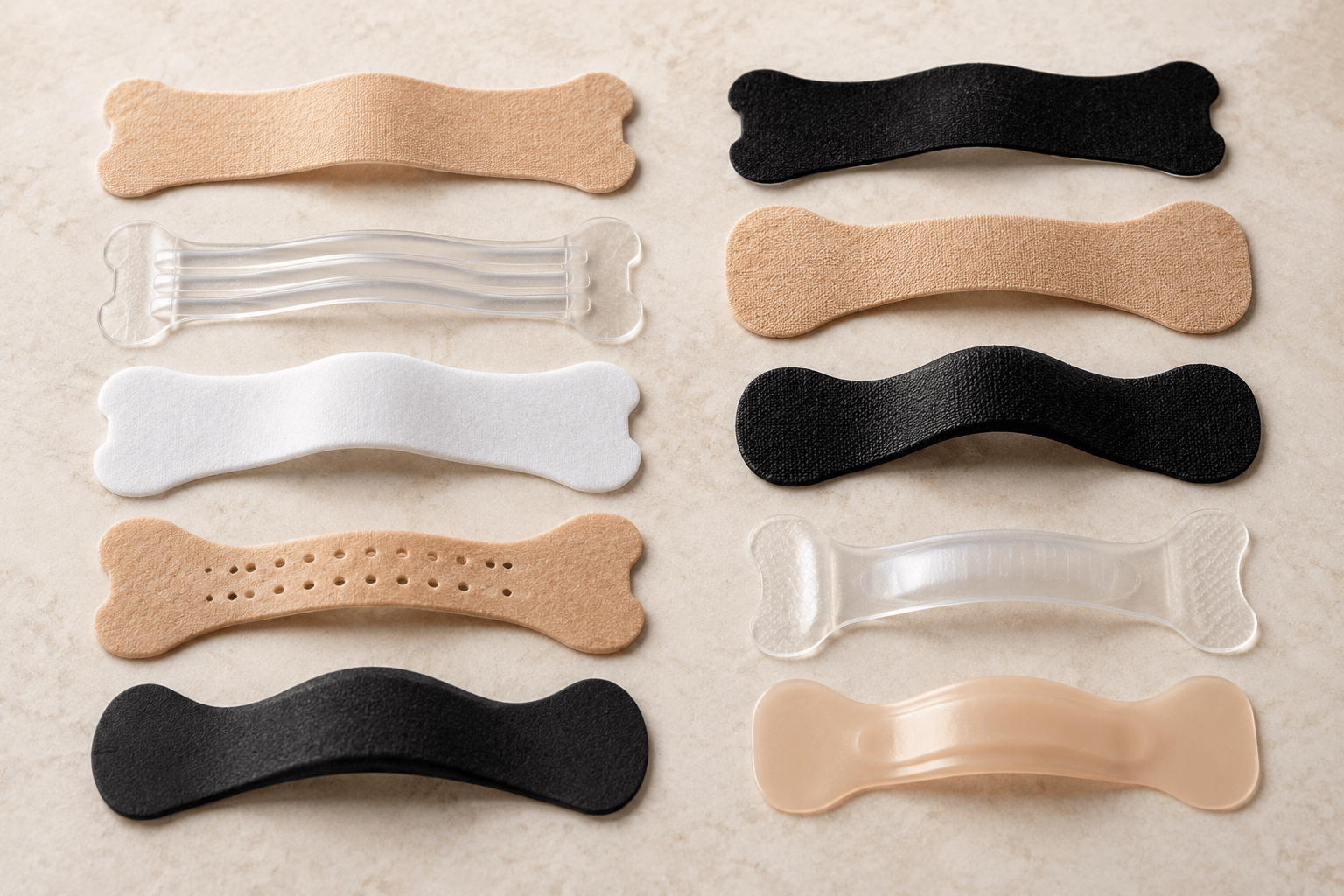
A good nasal strip has springy bands that actually lift the sides of your nose, an adhesive that holds until morning and lets go gently, and a size that fits your face. After that, look for clear instructions and a fair chance to try it for more than one night. Below are the eight things worth checking before you buy, followed by the strip we recommend.
What the strip itself has to do well
Research: moderate (what this means)Every nasal strip works the same basic way. A 2014 review describes an external nasal dilator as a strip of adhesive tape with two parallel layers of plastic that acts like a spring, running from one side of the nose to the other to keep the sides from collapsing as you breathe in. The research behind that design is encouraging. A 1998 study found an external dilator widened the narrowest part of the nose and lowered nasal resistance in healthy noses, congested noses and noses with a deviated septum.
So the question when you shop isn't whether strips can work. It's whether a particular strip does its job well on your nose, night after night. If you want the background first, how nasal strips work covers the mechanism and the studies.
Spring bands with enough lift
The bands are the part doing the work, so check them first. A 2019 study tested a strip with improved spring forces in people with chronic nighttime congestion and found nasal resistance during sleep was 39.1% lower with the strip on than without it. A strip with weak bands has less to pull with. If you're deciding between standard and stronger versions, extra strength vs regular nasal strips explains who tends to need more lift.
An adhesive that lasts the night
A strip that lets go at 2am does nothing for the rest of the night. Adhesive needs clean skin to grip, and one major strip maker's FAQ says its adhesive won't stick properly to wet, oily or moisturized skin. Look for a maker that tells you exactly how to prep your skin, then wash and dry your nose before every application. Face cream goes on after the strip, not under it.
Gentle removal and skin comfort
You'll peel a strip off the same patch of skin every morning, so how it comes off matters as much as how it sticks. The usual advice is to wet the strip with warm water first and lift it slowly rather than ripping it. One maker's FAQ suggests about 10 seconds of warm water before you lift each side, says to stop using strips if a rash or irritation appears, and says not to put a strip over sores, sunburn or irritated skin. If your skin is on the sensitive side, nasal strip skin irritation covers what helps.
The right size for your nose
A strip only works when its bands sit over the sides of the nose they're meant to lift. Many strips come in more than one size. One maker recommends small/medium for children and smaller faces and large for adults, and says cutting a strip to make it fit can ruin it and stop it working at all. If a strip overhangs onto your cheeks or stops short of the sides of your nose, try the other size.
No drugs, nothing absorbed
A nasal strip is a mechanical device. The 1998 sleep lab study described the strip it tested as drug-free, and it opens the nose by lifting the sides outward. Decongestants and nasal sprays work differently, by reducing swelling inside the nose, according to the NHS. Because a strip has nothing in it to absorb, it's easy to use alongside the other things you already do at night. Nasal strips vs nasal spray explains when each makes sense.
Details that make a strip easier to live with
Clear instructions and a stated wear limit
Good packaging tells you where the strip goes, how long you can wear it and who shouldn't use it. One major maker says its strips may be used daily but for no more than 12 hours a day, that each strip is single use, and that they aren't for children under 5. It also says its package is sealed with natural rubber latex, so people with a latex allergy shouldn't use that product. If a box doesn't answer these questions, keep looking.
A fair trial period
Strips can take a few nights to feel normal. In the 1998 sleep lab study of 30 habitual snorers, 17 needed some time to get used to the strip, and after that they said they could breathe easily, slept well and felt recovered in the morning. A brand that offers a guarantee gives you room to wear the strip for a couple of weeks instead of judging it on night one. If it still isn't doing much, why nasal strips don't work goes through the common reasons.
Made to work with mouth tape
If you plan to tape your mouth, the strip is the first half of your routine. The Sleep Foundation says mouth tape shouldn't be used by people with chronic nasal congestion or difficulty breathing through the nose, so a strip that keeps your nose open is a natural partner. Put the strip on first, check that nose breathing feels easy with our two-minute nose test, and only then add tape. Mouth tape vs nasal strips explains how the two fit together.
Check this first. Skip mouth tape and see a doctor if you snore loudly, wake up gasping, have been told you stop breathing in your sleep, or can't breathe comfortably through your nose. More on safety
What a strip won't do
A nasal strip opens the front of your nose. A 2016 meta-analysis found nasal dilators improve nasal breathing but don't improve obstructive sleep apnea, because the airway in apnea usually narrows further back, around the throat and soft palate. A strip is a good tool for a narrow or stuffy nose. If you snore loudly, wake up gasping or feel sleepy through the day, talk to a doctor before you buy anything. If a strip opens your nose but your snoring carries on, how to stop snoring covers other causes and fixes.
Our pick (paid partner)
Our pick is TitanAir Nasal Strips from Titan Recovery. This is our recommendation, not the result of testing or ranking products ourselves.
Here is how TitanAir lines up with the list above, based on what Titan says about it. Titan describes the strips as drug-free external nasal dilators with flexible spring-loaded bands that lift the nasal passages open, and says the adhesive is skin-safe, stays put and leaves no residue. Its instructions cover the details that matter: wash and dry your nose and skip moisturizer, place the strip just above the flare of your nostrils on the soft part of the nose, and in the morning loosen it with warm water and peel slowly from the ends inward.
Titan says the strips are third-party lab-tested and PFAS-free, and that they're designed to pair with Titan Mouth Tape. They come with a 30-night guarantee, which gives you time to get used to them, and in 30, 90, 180 or 360-night supplies with free US shipping.
Read next
- How to put on a nasal strip the right way
- How nasal strips work, and when they help most
- Everything we've written on nasal strips
Common questions
What nasal strips should I buy?
Buy a strip with springy bands that give real lift, an adhesive that holds all night and releases cleanly, and a size that fits your nose. Clear instructions with a wear limit and a guarantee or trial period are worth having too, since many people need a few nights to get used to a strip. Our pick is TitanAir Nasal Strips.
Are stronger nasal strips better?
Not for everyone. More spring force means more lift, and a 2019 study of a strip with improved spring forces found nasal resistance during sleep was 39.1% lower with the strip on. If a standard strip feels comfortable and opens your nose, you may not need more.
Do nasal strips have drugs in them?
No. Nasal strips are mechanical devices that open the nose by lifting the sides outward. There's nothing absorbed into the body, which makes them easy to use alongside other things you do at night.
How do I know what size nasal strip to buy?
One major strip maker recommends small/medium for children and smaller faces and large for adults. The bands should reach the sides of your nose without overhanging onto your cheeks.
Can I use nasal strips if I'm allergic to latex?
Check the packaging. One major strip maker says its package is sealed with natural rubber latex and that people with latex allergies shouldn't use its strips. Look for a clear statement on the box before you buy.
Can I use nasal strips with mouth tape?
Yes, and many people do. Put the strip on first, make sure breathing through your nose feels easy with your mouth closed, then add the tape.
Sources
- External nasal dilators: definition, background, and current uses
- Role of the external nasal dilator in the management of nasal obstruction
- Objective and Subjective Effects of a Prototype Nasal Dilator Strip on Sleep in Subjects with Chronic Nocturnal Nasal Congestion
- Effect of the external nasal dilator Breathe Right on snoring
- Nasal Dilators (Breathe Right Strips and NoZovent) for Snoring and OSA: A Systematic Review and Meta-Analysis
- Breathe Right FAQs
- Snoring
- Mouth taping for sleep: does it work?
- TitanAir Nasal Strips
About this article
- Research
- 9 published sources, listed above.
- Evidence
- Moderate. How we rate it
- Last checked
- October 10, 2026
- Funding
- Paid partner of Titan Recovery. Their ads are labeled.
- Found an error?
- Tell us. We log fixes on the corrections page.
* This content is for informational and educational purposes only and is not medical advice. It is not intended to diagnose, treat, cure or prevent any disease or health condition. Talk to a qualified healthcare provider about your health.