In short
- A strip for a stuffy nose needs firm spring bands, because the lift is what lowers resistance in the nose.
- In a 2019 study of people with chronic nighttime congestion, nasal resistance during sleep was 39.1% lower with a strip on.
- Strips are drug-free, so they work alongside saline rinses, a humidifier and a raised pillow.
- Measurements can improve before you feel it: in a 1998 study, congested noses opened with a strip even when people didn't sense the change.
- Congestion that lasts beyond about 10 days of a cold, or snoring with gasping or daytime sleepiness, is a reason to see a doctor.
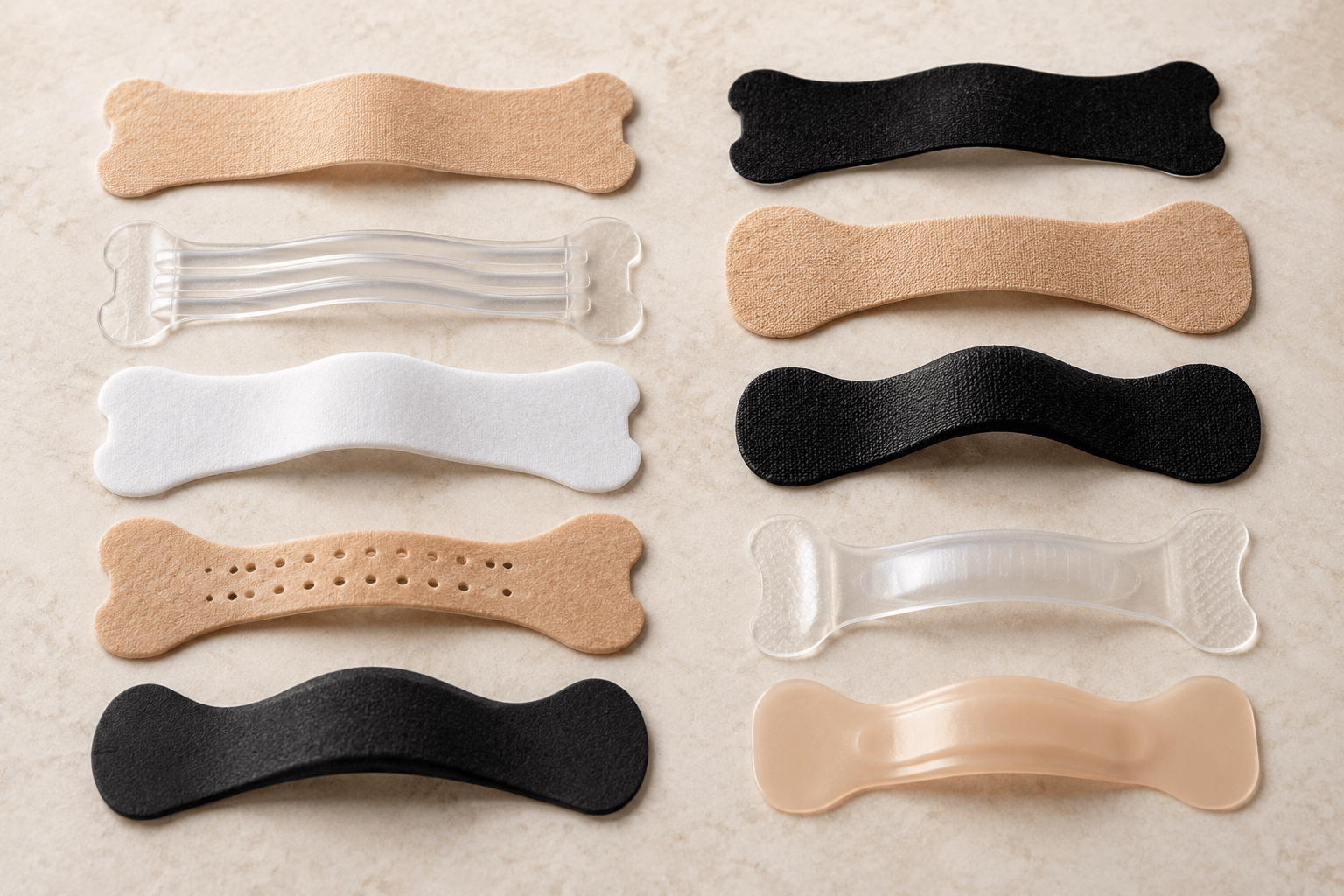
The best nasal strip for a stuffy nose at night has firm spring bands, sits right on the narrowest part of your nose and stays stuck until morning. Strips are drug-free, so they pair well with the other things that ease nighttime congestion, like a saline rinse and a raised pillow. Below is what matters most when congestion is the reason you're shopping, followed by the strip we recommend.
Why does a stuffy nose get worse at night?
Congestion often feels worse the moment your head hits the pillow, and there's a reason for that. A 2021 meta-analysis of nine studies found that lying down raises nasal resistance and lowers nasal airflow. Cleveland Clinic adds that mucus doesn't drain as well without gravity, and that dust, pet dander and other allergens in the bedroom can keep a nose irritated overnight. Why is my nose stuffy at night goes through the causes in more detail.
A nasal strip works on the front of the nose, where the airway is narrowest. Cleveland Clinic describes this area, the nasal valve, as the passageway that runs from the middle of your nose to the bottom. Lift its sides outward and more air gets through, even when the lining inside is swollen.
What matters in a strip for congestion?
Research: moderate (what this means)Spring bands with real lift
The bands are what open your nose, so they matter most when you're blocked. A 2019 study tested a strip with improved spring forces in people with chronic nighttime congestion and found nasal resistance during sleep was 39.1% lower with the strip on than without it. In the study's 28-night phase, people also rated their ease of breathing, sleep quality and how refreshed they felt in the morning as better. If a standard strip doesn't open you up enough, extra strength vs regular nasal strips explains when more lift helps.
Placement over the nasal valve
A strip only helps congestion if it sits where the airway pinches. In a 1997 randomized, placebo-controlled study of 53 athletes, a strip applied across the nasal valve significantly increased nasal valve area at rest in every group measured. One major strip maker's instructions put the strip right above where your nose flares out. Placed too high, on the bony bridge, the bands have nothing soft to lift. How to apply nasal strips shows the spot.
An adhesive that holds through a stuffy night
Congested nights can mean a runny nose, tissues and a bit of sweat, all of which work against the adhesive. One major strip maker says its adhesive won't stick properly to wet, oily or moisturized skin, so wash and dry your nose before every application. A strip that lets go at 2am leaves you breathing through your mouth for the rest of the night.
Benefits you may measure before you feel
Swollen nasal lining can mask what a strip is doing. A 1998 study found an external dilator widened the narrowest part of the nose and lowered resistance in people with congestion, people with a deviated septum and people with healthy noses. In the congestion group, though, the measured opening didn't come with a matching sense of easier breathing. So give a strip a few nights rather than judging it on how it feels in the first minute.
Nothing to absorb, so it stacks with other remedies
A strip is a mechanical device with no drug in it, which means it works alongside sprays, rinses and allergy medicine. That matters because medicated sprays have limits. The NHS says decongestant sprays and drops shouldn't be used for more than 5 days at a time, because longer use can make stuffiness worse. A strip has no such limit beyond the label's daily wear time. Decongestant spray rebound explains why sprays can backfire.
A strip you'll wear night after night
Congestion from allergies or a long cold can last weeks, so comfort and consistency matter. In a 2018 placebo-controlled trial, people with chronic nighttime congestion who used real strips nightly for two weeks reported more satisfaction with their sleep at day 7 than those using placebo strips. Results aren't uniform: two larger 2019 trials found no clear difference from placebo strips on sleep questionnaires, with both groups improving. All strips in the 2018 trial were well tolerated, and the measured effect on airflow is the more consistent finding across studies.
What should you pair with your strip?
Clear the nose before bed
A strip works better on a nose that's already as clear as you can get it. The Sleep Foundation suggests a saline rinse once or twice a day, a warm shower or steam before bed, and sleeping with your head raised on a wedge or an extra pillow. If you rinse, the FDA says to use only distilled, sterile or previously boiled water, never straight tap water. How to use a saline rinse walks through it.
Keep the bedroom air kind to your nose
Cleveland Clinic suggests keeping pets out of the bedroom, changing sheets at least weekly and showering before bed to wash off outdoor allergens. A humidifier can ease dryness; the Sleep Foundation recommends clean, purified water and no more than 50% humidity to avoid mold. If allergies are your main trigger, nasal strips for allergies has a full bedtime routine.
Add mouth tape only on clear nights
Mouth tape and nasal strips make a natural pair, but congestion changes the order of operations. The Sleep Foundation says mouth tape shouldn't be used by people with chronic nasal congestion or difficulty breathing through the nose. On a stuffy night, wear the strip alone. Once your nose feels open with the strip on, try our two-minute nose test before adding tape.
Check this first. Skip mouth tape and see a doctor if you snore loudly, wake up gasping, have been told you stop breathing in your sleep, or can't breathe comfortably through your nose. More on safety
When does congestion need more than a strip?
A strip opens the front of the nose. It doesn't treat a cold, an allergy or a blockage further back. The NHS says to see a GP if cold symptoms don't improve after 10 days or get worse. If one side of your nose is always blocked, a doctor can check for a deviated septum or polyps.
Snoring often comes with congestion, and most of the time that's harmless. A 2016 meta-analysis found nasal dilators improve nasal breathing but don't improve obstructive sleep apnea. The NHS lists breathing that stops and starts, gasping or choking noises, loud snoring and feeling very tired during the day as signs of sleep apnoea. If those sound familiar, talk to a doctor before relying on any strip.
Our pick (paid partner)
Our pick for a stuffy nose is TitanAir Nasal Strips from Titan Recovery. This is our recommendation, not the result of testing or ranking products ourselves.
Titan says TitanAir strips are drug-free external nasal dilators with flexible spring-loaded bands that lift the nasal passages open, and that nothing is absorbed. Its instructions match what matters for congestion: wash and dry your nose and skip moisturizer, place the strip just above the flare of your nostrils on the soft part of the nose, and in the morning loosen it with warm water and peel slowly from the ends inward.
Titan says the strips are third-party lab-tested and PFAS-free and are designed to pair with Titan Mouth Tape for nights when your nose is clear. They come with a 30-night guarantee, which gives you time to see how they work through a congested stretch, and in 30, 90, 180 or 360-night supplies with free US shipping.
Read next
- How to sleep with a stuffy nose
- Nasal strip buying guide: 8 things to look for
- Everything we've written on nasal strips
Common questions
Do nasal strips help a stuffy nose at night?
They can. A strip lifts the sides of the nose and widens the nasal valve. A 2019 study in people with chronic nighttime congestion found nasal resistance during sleep was 39.1% lower with a strip on than without one.
Why is my nose more blocked when I lie down?
Lying flat changes how your nose behaves. A 2021 meta-analysis found that lying down raises nasal resistance and lowers nasal airflow, and Cleveland Clinic notes that mucus drains less well without gravity helping.
Can I use a nasal strip with a decongestant spray?
Yes. A strip has no drug in it, so it doesn't interact with medicines. The NHS says decongestant sprays and drops shouldn't be used for more than 5 days at a time, because longer use can make stuffiness worse, so a strip is a useful drug-free option for the nights after.
Should I use extra strength strips when I'm congested?
Many people do, because more spring force means more lift. If a standard strip feels comfortable and your nose opens, you may not need more. If you still feel blocked, a stronger strip is worth trying.
When should I see a doctor about a blocked nose?
The NHS says to see a GP if cold symptoms don't improve after 10 days or get worse. See a doctor too if one side of your nose is always blocked or if you snore with gasping, choking or daytime sleepiness.
What is a nasal dilator?
A nasal dilator is a device that widens the nasal passages so air flows through the nose more easily. A 2016 review of the research describes two kinds: external dilators such as nasal strips, which stick across the outside of the nose, and internal dilators worn inside the nose. A strip works by lifting the sides of the nose outward over the nasal valve, the narrowest part of the airway.
What are the benefits of nasal strips?
The main benefit is easier airflow through the nose with no drug involved. In a 1997 placebo-controlled study, a strip significantly widened the nasal valve at rest, and in a 2019 study of people with chronic nighttime congestion, nasal resistance during sleep was 39.1% lower with a strip on. People in that study also rated their ease of breathing and sleep quality as better over 28 nights.
How do you put on a nose strip?
Wash and dry your nose first, because one major strip maker says its adhesive won't stick properly to wet, oily or moisturized skin. Place the strip on the soft part of the nose just above where the nostrils flare, not on the bony bridge. In the morning, loosen it with warm water and peel slowly from the ends inward.
Sources
- Objective and Subjective Effects of a Prototype Nasal Dilator Strip on Sleep in Subjects with Chronic Nocturnal Nasal Congestion
- Role of the external nasal dilator in the management of nasal obstruction
- Effects of nasal dilator strips on subjective measures of sleep in subjects with chronic nocturnal nasal congestion: a randomized, placebo-controlled trial
- Sleep Quality and Congestion with Breathe Right Nasal Strips: Two Randomized Controlled Trials
- The Recumbent Position Affects Nasal Resistance: A Systematic Review and Meta-Analysis
- Physiologic effects of an external nasal dilator
- Nasal valve collapse
- Why does my nose get stuffy at night?
- Treatment for a blocked nose at night
- Decongestants
- Common cold
- Is rinsing your sinuses with neti pots safe?
- Breathe Right FAQs
- Sleep apnoea
- Nasal Dilators (Breathe Right Strips and NoZovent) for Snoring and OSA: A Systematic Review and Meta-Analysis
- Mouth taping for sleep: does it work?
- TitanAir Nasal Strips
About this article
- Research
- 17 published sources, listed above.
- Evidence
- Moderate. How we rate it
- Last checked
- October 10, 2026
- Funding
- Paid partner of Titan Recovery. Their ads are labeled.
- Found an error?
- Tell us. We log fixes on the corrections page.
* This content is for informational and educational purposes only and is not medical advice. It is not intended to diagnose, treat, cure or prevent any disease or health condition. Talk to a qualified healthcare provider about your health.