In short
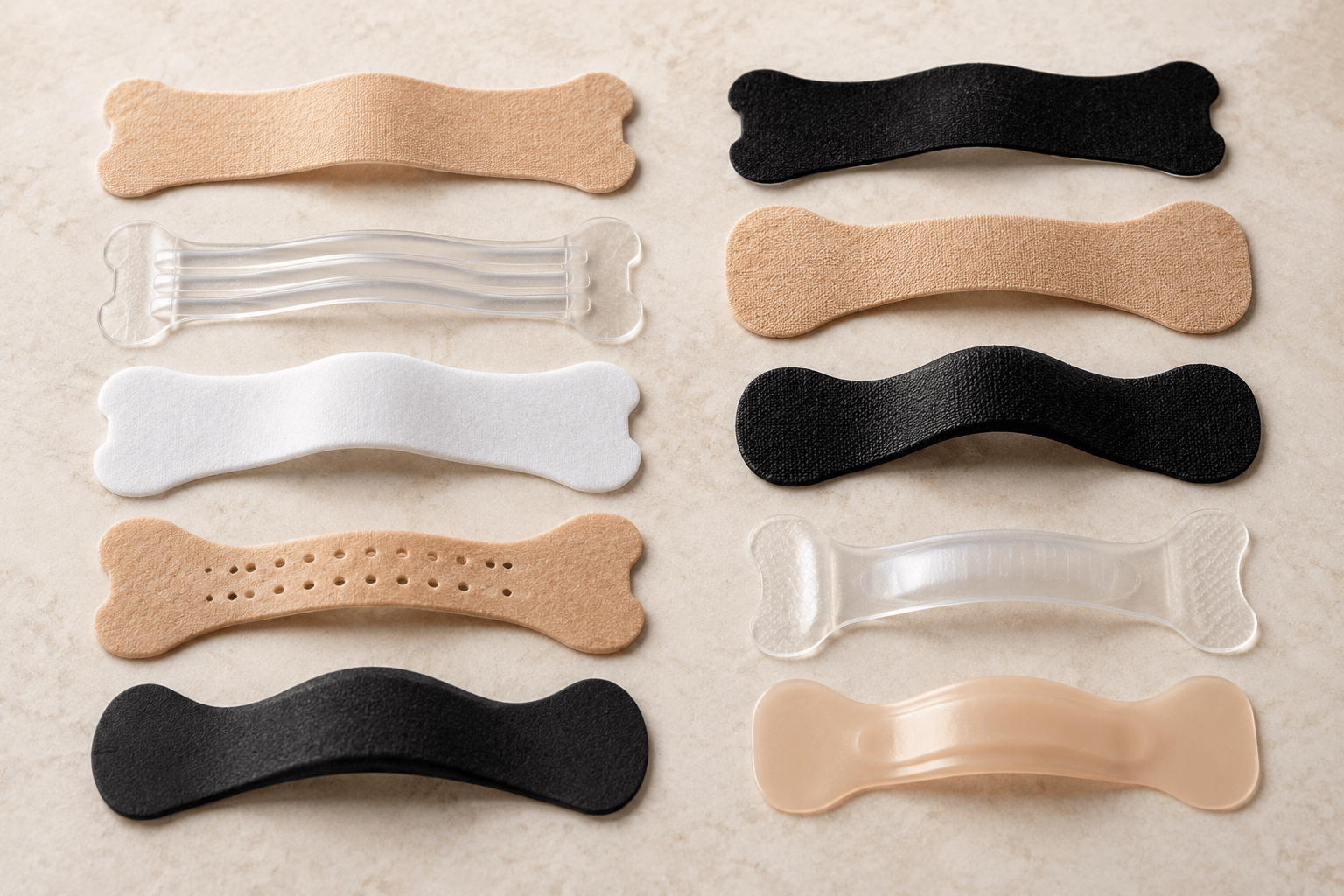
- External dilators, mainly spring-band strips, stick to the outside of the nose and lift its sides to widen the passage.
- Internal dilators, sold as clips, cones and stents, sit inside the nostrils and hold them open from within.
- Both families open the nose in lab studies, and both have reduced snoring in studies of people who snore.
- Nasal valves for sleep apnea and nasal implants are a different category that involves a doctor.
- No nasal dilator treats obstructive sleep apnea, because the airway in apnea usually narrows further back in the throat.
Nasal dilators come in two main families. External dilators, mostly nasal strips, stick to the outside of the nose and lift its sides, while internal dilators, sold as clips, cones and stents, sit just inside the nostrils and hold them open from within. Beyond those are devices that work differently, like nasal valves studied for sleep apnea and implants placed by a surgeon. Here's what each type does and what the research says about it.
How do nasal dilators work?
Research: moderate (what this means)All nasal dilators work by opening the same spot, the nasal valve. A 2026 meta-analysis describes nasal dilators as noninvasive, easy-to-use devices developed to reduce resistance to airflow and improve how open the nose is, rather than to treat sleep apnea. It explains that external dilators widen the nasal valve and steady the sides of the nostrils so they don't collapse as you breathe in, while internal dilators sit within the nostrils to support the nasal valve from inside. Cleveland Clinic describes the nasal valve as a passage running from the middle of the nose down toward the nostrils, and lists both kinds of dilator as nonsurgical options for nasal valve collapse.
Devices that work from outside the nose
Spring-band nasal strips
Spring-band nasal strips are the most familiar type. The 2025 review describes breathing strips as springy, lifting the side walls of the nose to widen the nasal valve once they're stuck on. A 2014 review defines an external nasal dilator as a strip of adhesive tape with two parallel layers of plastic that works like a spring, running from one side of the nose to the other to keep the sides from collapsing. In a 1998 study, an external dilator widened the narrowest part of the nose and lowered nasal resistance in healthy noses, congested noses and noses with a deviated septum. In a randomized, placebo-controlled trial of people with chronic rhinitis, a strip lowered snoring frequency from about 258 to 173 snores an hour. How nasal strips work covers the research in depth.
Other external designs
Not every external dilator is a single band across the bridge. The 2014 review describes a 2005 randomized crossover study in 12 healthy adults that tested two different external designs, a standard strip and side-strip dilators, against a placebo. Both increased the narrowest cross-section of the nose and reduced how congested people felt. The principle is the same either way: something on the outside pulls the sides of the nose outward.
What are internal nasal dilators?
Internal nasal dilators are small clips, springs or cones that sit just inside the nostrils and hold them open from within. A 2025 review of nasal valve problems says internal dilators are inserted into one or both nostrils to stop them collapsing. It describes them, along with strips, as simple to use and generally well tolerated, and notes they tend to be worn during sleep because they're noticeable. Cleveland Clinic says they press the cartilage outward to widen the nasal valve.
Nasal clips and springs
Nasal clips and springs are small devices that sit just inside the nostrils and hold them open. In a 2004 study of 27 healthy adults, both a strip and an internal dilator widened the narrowest part of the nasal valve and lowered nasal resistance, and the internal dilator lowered resistance more. A 2019 study of 41 people who snore found that both an internal dilator and a strip reduced the share of the night spent snoring, with the internal device working for more of the participants.
Nasal cones
Nasal cones are another kind of internal dilator that sits in the nostrils. The 2014 review describes a comparison in 30 people who felt their nose was blocked during sleep: peak airflow through the nose was about 66 litres a minute with no device, about 102 with a strip and about 139 with nasal cones. Design matters inside the nose too. A 2007 study cited in the 2025 review found one internal design barely changed peak airflow while a cone design raised it by about 25 litres a minute.
Nasal stents
Nasal stents are internal devices that hold the passage open. The 2026 meta-analysis summarizes a small study of 10 adults with sleep apnea and high nasal resistance in which decongestants plus nasal stents cut nasal resistance by about 73% and reduced arousals from sleep, but didn't change how severe the apnea was. The 2025 review cites a 2010 panel of surgeons that agreed strips, stents or cones can help some people with nasal valve obstruction.
Options that go beyond a dilator
Nasal valves for sleep apnea
Nasal valves for sleep apnea sit in the nostrils but aren't dilators at all. A 2009 study tested a device placed in the nostrils that adds resistance when you breathe out, as a treatment for obstructive sleep apnea. Apnea scores dropped on average, but the response varied from person to person, and the authors said more research was needed to find who it suits. This is a sleep apnea device, so it belongs in a conversation with a sleep doctor. Sleep apnea treatment options covers the wider picture.
Implants and surgery
Implants and surgery add support when the nose's own support is weak. Cleveland Clinic lists implants that support fallen cartilage, including a butterfly-shaped device and an injectable implant, alongside grafts and other procedures, and says many people with nasal valve collapse need surgery. The 2025 review notes that bioabsorbable implants carry a risk of complications, though data are limited. Our guide to nasal valve collapse explains when that route comes up.
Which type should you try first?
For most people, a nasal strip is the easiest type to try first. Nothing goes inside your nose, it takes seconds to put on, and you can tell within a few nights whether it helps. If strips don't stick to your skin or don't open your nose enough, an internal dilator is a reasonable next step, and nasal strips vs nasal dilators compares the two side by side. Our two-minute nose test helps you gauge how open your nose is before you start.
No dilator fixes sleep apnea. A 2016 meta-analysis found nasal dilators improve nasal breathing but don't improve obstructive sleep apnea, because the airway in apnea usually narrows further back, in the throat. The 2026 meta-analysis reached a similar view, adding that dilators may help as an add-on for people with mild symptoms or nasal congestion. If you snore loudly, gasp at night or feel sleepy all day, see a doctor first.
Our pick (paid partner)
For external nasal strips, our pick is TitanAir Nasal Strips from Titan Recovery. This is our recommendation, not the result of testing or ranking products ourselves.
TitanAir is a spring-band strip of the kind described above. Titan says the strips are drug-free external nasal dilators with flexible spring-loaded bands that lift the nasal passages open, and a skin-safe adhesive that stays put and leaves no residue. Titan's instructions are to apply the strip to clean, dry skin just above the flare of your nostrils, on the soft part of the nose, and to loosen it with warm water in the morning before peeling slowly from the ends inward. Titan says the strips are third-party lab-tested, PFAS-free and designed to pair with its mouth tape, and they come with a 30-night guarantee.
Read next
Common questions
What are the main types of nasal dilators?
There are two families. External dilators, mostly spring-band nasal strips, stick to the outside of the nose and lift its sides. Internal dilators, such as clips, cones and stents, sit inside the nostrils and hold them open from within.
Are internal nasal dilators better than nasal strips?
Some studies found internal dilators opened the nose more, and others found both reduced snoring. Strips are often the easier place to start because nothing goes inside the nose. If strips don't stick well or don't help, an internal dilator is worth trying.
Are nasal dilators safe?
A 2025 review describes strips and internal dilators as simple to use and generally well tolerated. Stop using any device that irritates your skin or the inside of your nose.
Do nasal dilators help sleep apnea?
No. A 2016 meta-analysis found nasal dilators improve nasal breathing but don't improve obstructive sleep apnea. If you have warning signs like gasping, breathing pauses or heavy daytime sleepiness, see a doctor.
Is a nasal valve device for sleep apnea the same as a nasal dilator?
No. Those devices sit in the nostrils and add resistance when you breathe out. They were studied as a sleep apnea treatment, not as a way to widen the nose, and they're something to discuss with a sleep doctor.
Sources
- External nasal dilators: definition, background, and current uses
- Clinical Effectiveness of Nasal Dilators in Sleep-Disordered Breathing: A Systematic Review and Meta-Analysis
- Nasal valve obstruction: a comprehensive analysis of the current literature and proposal of a management algorithm
- Role of the external nasal dilator in the management of nasal obstruction
- External nasal dilation reduces snoring in chronic rhinitis patients: a randomized controlled trial
- Effects of the nasal strip and dilator on nasal breathing: a study with healthy subjects
- Internal and external nasal dilatator in patients who snore: a comparison in clinical practice
- Nasal Dilators (Breathe Right Strips and NoZovent) for Snoring and OSA: A Systematic Review and Meta-Analysis
- A multicenter, prospective study of a novel nasal EPAP device in the treatment of obstructive sleep apnea: efficacy and 30-day adherence
- Nasal valve collapse
- TitanAir Nasal Strips
About this article
- Research
- 11 published sources, listed above.
- Evidence
- Moderate. How we rate it
- Last checked
- October 10, 2026
- Funding
- Paid partner of Titan Recovery. Their ads are labeled.
- Found an error?
- Tell us. We log fixes on the corrections page.
* This content is for informational and educational purposes only and is not medical advice. It is not intended to diagnose, treat, cure or prevent any disease or health condition. Talk to a qualified healthcare provider about your health.