In short
- Most nasal strip problems come from skin prep, placement or size, and all three are quick to fix.
- Put the strip just above the flare of the nostrils on clean, dry skin, not high on the bony bridge.
- Use a fresh strip each night, keep to the wear limit, and remove it slowly after wetting it with warm water.
- Give strips a week or two: in a 1998 study, 17 of 30 snorers needed time to get used to the strip.
- A strip opens the front of the nose. Snoring with gasping, choking or daytime sleepiness needs a doctor, not a stronger strip.
Most nasal strip mistakes happen in the first minute: putting the strip on oily or moisturized skin, placing it too high on the nose, or using the wrong size. The rest are habits, like reusing strips, ripping them off dry and giving up after one night. Each one has a simple fix, and getting them right is usually the difference between a strip that does little and one that opens your nose all night.
It's worth the effort, because a well-placed strip does real work. A 2014 review says numerous studies show external nasal dilators widen the nasal valve, lower nasal resistance and stop the sides of the nose collapsing as you breathe in, and describes them as simple, noninvasive and low risk. The mistakes below are the usual reasons a strip falls short of that.
Mistakes when you put it on
Research: moderate (what this means)Applying it over moisturizer or oily skin
Applying a strip over moisturizer or oily skin is the most common reason it lifts in the night. One major strip maker says its adhesive won't stick properly to wet, oily or moisturized skin, and Titan Recovery's instructions for its strips also say to skip moisturizer because oils stop the adhesive from gripping. The fix is to wash your nose with soap and water, dry it well, and apply face cream after the strip, or in the morning. If you shower at night, wait until your skin is fully dry, since damp skin causes the same problem as oily skin.
Placing it on the bony bridge
A strip lifts the soft sides of your nose, so it needs to sit over them. Cleveland Clinic describes the nasal valve as the passageway that runs from the middle of your nose to the bottom, and that's the area a strip is meant to open. One maker's instructions put the strip right above where your nose flares out. In a 1997 placebo-controlled study of 53 athletes, a strip applied across the nasal valve significantly increased nasal valve area at rest. Titan's instructions make the same point, placing its strip on the soft part of the nose rather than the bony bridge. If yours sits up near your eyes, slide it down. How to apply nasal strips shows the spot.
Using the wrong size, or cutting one down
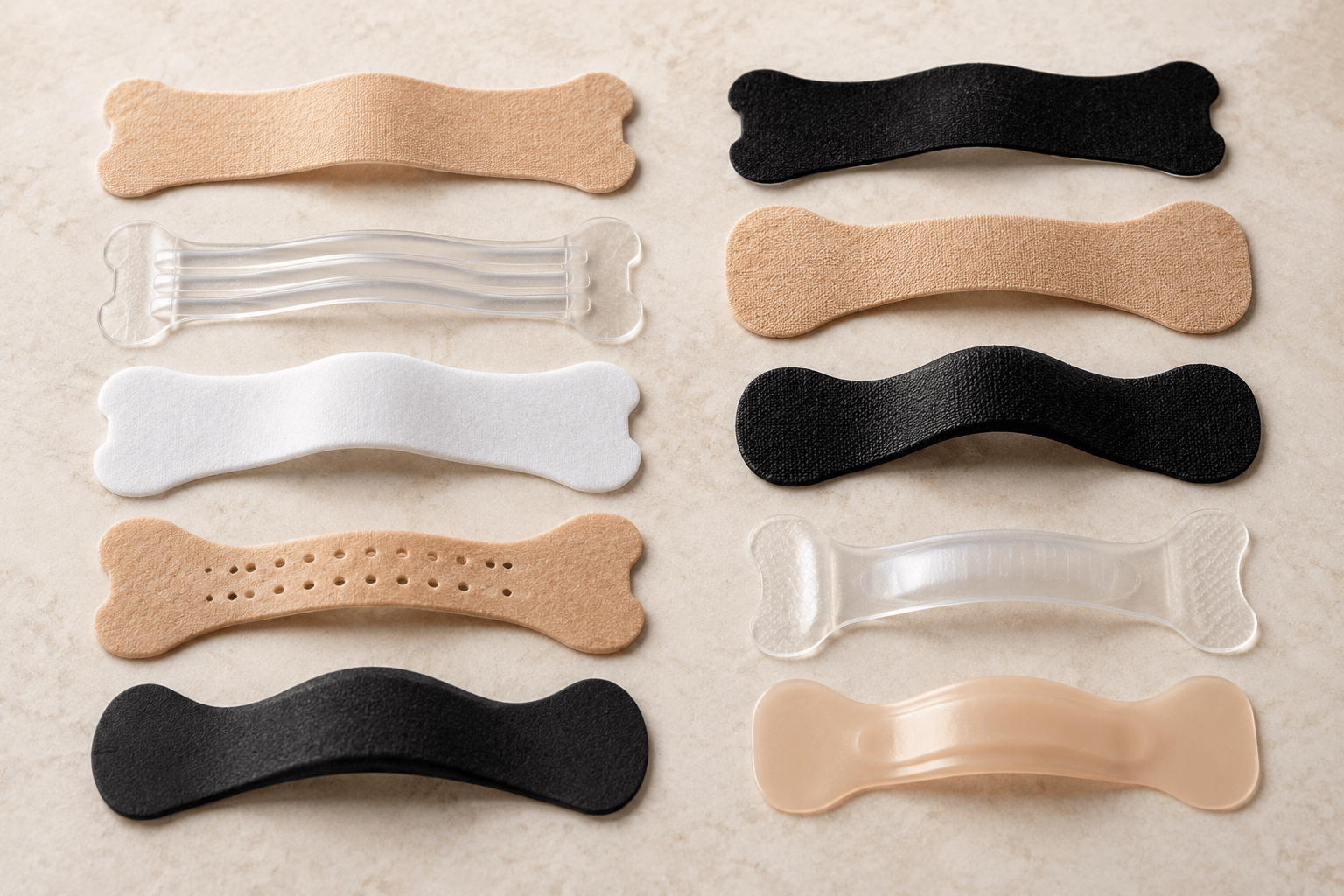
A strip that's too small won't reach the sides of your nose, and one that's too big runs onto your cheeks. One major maker recommends small/medium for children and smaller faces and large for adults, and says cutting a strip can ruin it and may stop it working at all. Switch sizes rather than trimming. The bands should reach the sides of your nose and stop there.
Skipping the press and rub
A strip laid on loosely can peel at the ends. One maker's instructions say to gently rub the strip to secure it once it's in place, and Titan's instructions say to press both ends down. Take a few seconds to do this, then breathe through your nose with your mouth closed to check that it feels open.
Mistakes during the night and the morning
Reusing yesterday's strip
Reusing yesterday's strip is tempting, but the adhesive isn't made for it. One major maker says each strip is for single use only and shouldn't be reapplied, and that its strips shouldn't be worn for more than 12 hours a day. A strip that loosens halfway through the night only helps for half of it, so use a fresh one each time. While you're at it, check the box: the same maker says its strips carry an expiration date on the outer box.
Ripping it off dry
Pulling a strip straight off dry skin is the fastest way to a sore nose. One maker suggests washing your face with warm water for about 10 seconds, then gently and slowly lifting each side, or taking it off in the shower. It also says to stop if a rash or irritation appears and not to put a strip over sores, sunburned or irritated skin. The maker lists redness, irritation, pain, peeling or bleeding as possible reactions at the application site, which is a good reason to take your time. Nasal strip skin irritation has more on gentle removal.
Judging it after one night
A strip opens your nose right away, but sleeping with one can take getting used to. In a 1998 sleep lab study of 30 habitual snorers, 17 needed some time to get used to the strip, and after that they said they could breathe easily, slept well and felt recovered in the morning. Feel can lag behind the measurements too: a 1998 study found a strip opened congested noses even when people didn't sense much change. The same study found peak snoring loudness on the second night with a strip was lower than baseline in 22 of the 30. Wear one nightly for a week or two before deciding. If it still isn't helping, why nasal strips don't work goes deeper.
Mistakes with the bigger picture
Adding mouth tape while your nose is still blocked
Strips and mouth tape work well together, but order matters. The Sleep Foundation says mouth tape shouldn't be used by people with chronic nasal congestion or difficulty breathing through the nose, and a 2025 systematic review noted that many mouth taping studies excluded people with nasal obstruction. Cleveland Clinic goes further and says tape shouldn't be used with nasal congestion, chronic allergies, a sinus infection or a deviated septum. Put the strip on first, check that nose breathing feels easy using our two-minute nose test, and only then add tape. The Sleep Foundation also suggests testing tape during the day first and folding over one corner so it's easy to remove. Nose breathing is worth the effort: a 2003 study in healthy adults found upper airway resistance during sleep was much higher when breathing through the mouth than through the nose. Mouth tape and nasal strips together covers the routine.
If you want a strip made for this pairing, ours is TitanAir from Titan Recovery, which Titan says is designed to pair with Titan Mouth Tape. This is our recommendation rather than the result of our own testing.
Check this first. Skip mouth tape and see a doctor if you snore loudly, wake up gasping, have been told you stop breathing in your sleep, or can't breathe comfortably through your nose. More on safety
Expecting a strip to fix every kind of snoring
A strip opens the front of the nose, and that helps when the nose is part of the problem. The NHS lists blocked or narrow nasal airways as one cause of snoring, with nasal dilators or strips as a treatment, but snoring can also come from the tongue partly blocking the throat or the mouth falling open, which the NHS says call for different devices. A 2016 meta-analysis found nasal dilators improve nasal breathing but don't improve obstructive sleep apnea. Pair the strip with other habits the NHS suggests, like sleeping on your side and going easy on alcohol. A 2003 study found most snorers without apnea snored less, and less loudly, on their side than on their back.
Don't ignore the warning signs. The NHS lists breathing that stops and starts, gasping, snorting or choking noises, loud snoring and feeling very tired during the day as symptoms of sleep apnoea. If any of those apply, see a doctor rather than reaching for a stronger strip. Snoring vs sleep apnea explains the difference.
Read next
- 12 tips for getting more out of nasal strips
- How nasal strips work, and when they help most
- Everything we've written on nasal strips
Common questions
What is the most common nasal strip mistake?
Putting it on skin that isn't clean and dry. One major strip maker says its adhesive won't stick properly to wet, oily or moisturized skin, so a strip on a freshly moisturized nose often lifts during the night.
Why doesn't my nasal strip seem to do anything?
Check placement first. The strip should sit just above where your nostrils flare out, on the soft part of the nose. Too high on the bony bridge, the bands have little to lift. Also try the other size, and give it a week or two.
Is it bad to sleep in a nasal strip every night?
No. One major strip maker says its strips may be used daily for up to 12 hours a day. Use a fresh strip each night and stop if a rash or irritation appears.
Can I cut a nasal strip to make it smaller?
No. One major strip maker says cutting a strip can ruin it and may stop it working at all. Buy a smaller size instead.
Should I use mouth tape with a nasal strip?
Many people do. Put the strip on first and only add mouth tape if breathing through your nose feels easy with your mouth closed. Skip tape on nights your nose is blocked.
Sources
- Breathe Right FAQs
- Physiologic effects of an external nasal dilator
- Nasal valve collapse
- Effect of the external nasal dilator Breathe Right on snoring
- Role of the external nasal dilator in the management of nasal obstruction
- Effect of nasal or oral breathing route on upper airway resistance during sleep
- Mouth taping for sleep: does it work?
- Breaking social media fads and uncovering the safety and efficacy of mouth taping in patients with mouth breathing, sleep disordered breathing, or obstructive sleep apnea: A systematic review
- Nasal Dilators (Breathe Right Strips and NoZovent) for Snoring and OSA: A Systematic Review and Meta-Analysis
- Is mouth tape safe to use while sleeping?
- Snoring
- Sleep apnoea
- Effects of body position on snoring in apneic and nonapneic snorers
- External nasal dilators: definition, background, and current uses
- TitanAir Nasal Strips
About this article
- Research
- 15 published sources, listed above.
- Evidence
- Moderate. How we rate it
- Last checked
- October 5, 2026
- Funding
- Paid partner of Titan Recovery. Their ads are labeled.
- Found an error?
- Tell us. We log fixes on the corrections page.
* This content is for informational and educational purposes only and is not medical advice. It is not intended to diagnose, treat, cure or prevent any disease or health condition. Talk to a qualified healthcare provider about your health.