In short
- Nasal strips and anti-snoring mouthpieces work on different parts of the airway. Strips open the front of the nose; mouthpieces bring the jaw or tongue forward to keep the throat open.
- The NHS matches the treatment to the cause: nasal dilators or strips for blocked or narrow nasal airways, and a mandibular advancement device when the tongue is partly blocking the throat.
- Controlled studies found nasal strips reduced snoring in habitual snorers and in people with chronic rhinitis. They're drug-free, start working right away and need no fitting.
- A 2015 guideline from two sleep medicine academies rated the evidence that oral appliances reduce primary snoring as high, and recommends a sleep physician diagnose snoring first.
- Mouthpieces can cause jaw discomfort, extra saliva and bite changes. Strips mainly carry a risk of skin irritation.
Nasal strips and anti-snoring mouthpieces both aim at snoring, but they work on different parts of the airway. A strip lifts the sides of your nose to open the front of the nasal passage. A mouthpiece holds your lower jaw or tongue forward so the back of the throat stays open. The better choice depends on where your snoring starts.
Why does snoring happen in different places?
The NHS explains that snoring comes from parts of the airway vibrating as you breathe: the tongue, mouth, throat or the airways in your nose. These parts relax and narrow when you're asleep. Cleveland Clinic describes the same thing, adding that the blockage can come from your anatomy or from something temporary like a cold.
That's why the NHS doesn't list one treatment for snoring. It matches each cause to a different fix:
- If your tongue is partly blocking the back of your throat, a device you wear in your mouth to bring your tongue forward, called a mandibular advancement device.
- If your mouth falls open when you're asleep, a chin strap, or a mouthpiece that makes you breathe through your nose.
- If the airways in your nose are blocked or narrow, nasal dilators or strips that hold your nose open, or decongestants and sprays.
So the question isn't really which product is better overall. It's which part of your airway is the problem.
How does each one work?
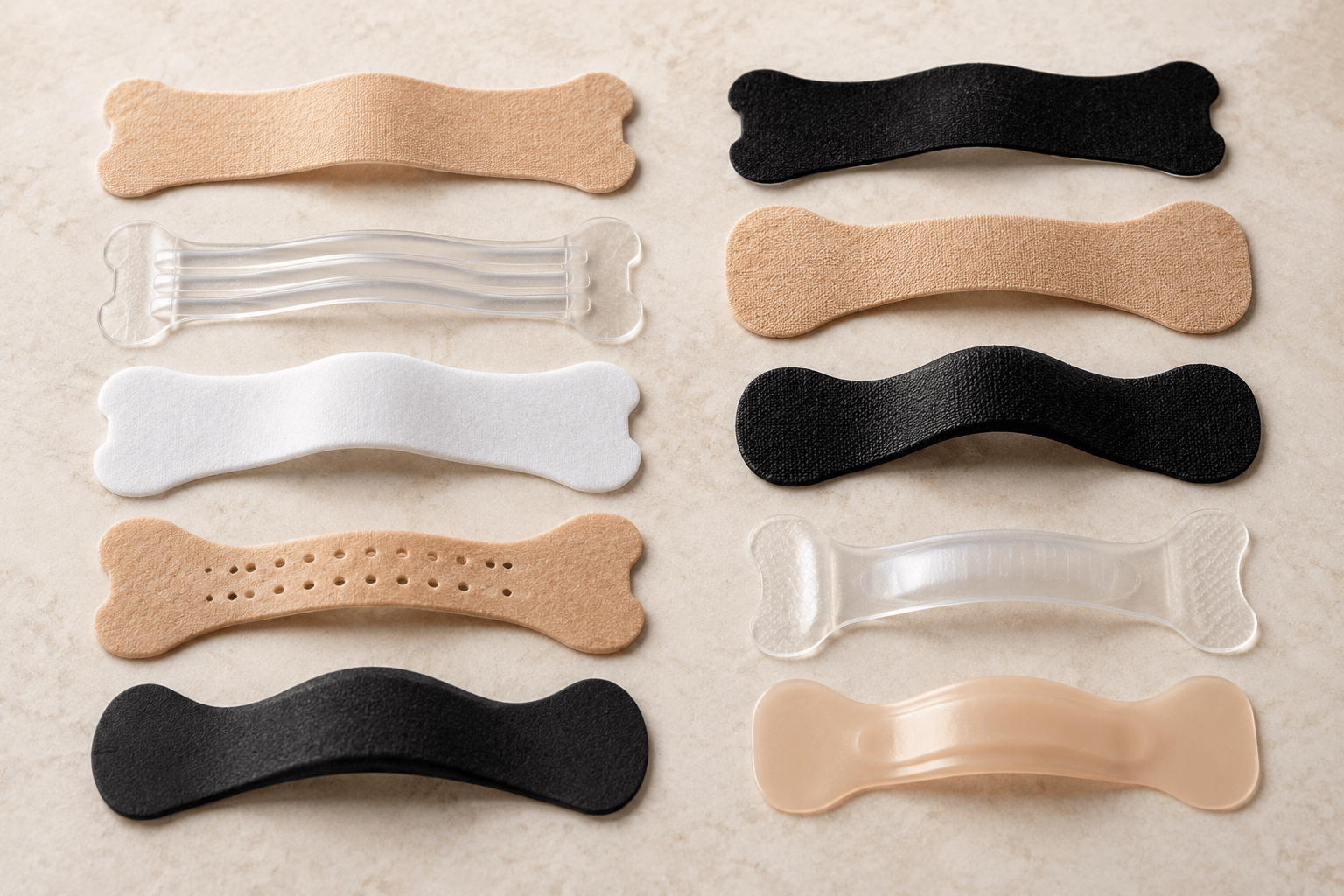
A nasal strip has flexible, spring-like bands inside an adhesive pad. Breathe Right says the bands stick right above the flare of each nostril, and as they try to straighten, they lift the sides of the nose. There's no drug in it and nothing goes inside your nose or mouth.
An anti-snoring mouthpiece, which sleep doctors call an oral appliance, goes inside your mouth. The American Academy of Sleep Medicine says it fits much like a sports mouth guard or orthodontic retainer. Most are mandibular repositioning devices, which move the lower jaw forward and down slightly. Others are tongue retaining devices that hold the tongue in place.
What does the research say about each?
Research: moderate (what this means)Nasal strips and mouthpieces both have encouraging evidence for snoring, measured in different ways.
For nasal strips, a 1998 sleep lab study recorded 30 habitual snorers overnight. Peak snoring loudness dropped across the night with the strip, and on the second night it was lower than baseline in 22 of the 30. Snorers without sleep apnea benefited most. In a randomized, placebo-controlled trial of people with chronic rhinitis, snoring frequency fell from about 258 to 173 snores an hour with a strip.
For oral appliances, a 2015 clinical practice guideline from the American Academy of Sleep Medicine and the American Academy of Dental Sleep Medicine rated the evidence that oral appliances reduce primary snoring in adults as high quality. It recommends that sleep physicians prescribe them, rather than no therapy, for adults who want treatment for snoring without sleep apnea.
The two haven't been tested head to head in any study we found, so there's no research saying one beats the other for snoring in general.
What about sleep apnea?
Sleep apnea is where nasal strips and mouthpieces differ most. A 2016 meta-analysis found that nasal dilators improve nasal breathing but don't improve obstructive sleep apnea. Breathe Right says the same: its strips are not intended to treat sleep apnea.
Oral appliances are an established sleep apnea treatment, but only after a diagnosis. The AASM says a sleep doctor must first diagnose sleep apnea with a sleep study or home test, and then a dentist fits the appliance. The 2015 guideline also says primary snoring should be diagnosed by a sleep physician, not a dentist, because snoring often comes with sleep apnea.
If you feel sleepy during the day, or your breathing stops and starts or you make gasping or choking noises in your sleep, the NHS says to see a GP. Snoring vs sleep apnea explains the warning signs.
How do they compare day to day?
Day to day, nasal strips are the simpler of the two. You put one on at bedtime and it starts working right away. Breathe Right says its strips may be used daily for up to 12 hours a day, each one single use. There's nothing to fit, and you can try one tonight.
Oral appliances take more setup. The AASM says you must be custom fitted for one to work properly, and it doesn't recommend over-the-counter devices as a treatment for snoring or sleep apnea. The 2015 guideline suggests a qualified dentist use a custom, titratable appliance for patients with sleep apnea. On the plus side, the AASM points out that appliances are small and easy to travel with.
Both take some getting used to. The AASM says most people need a few weeks to adjust to an oral appliance. In the 1998 strip study, 17 of the 30 snorers needed some time to get used to the strip, after which they said they could breathe easily and slept well.
What are the side effects of nasal strips and mouthpieces?
Nasal strips mostly affect the skin they sit on. Breathe Right lists redness, irritation, peeling and rash among possible reactions and says to stop if they happen. Its strips aren't for children under 5 or people with a latex allergy, because the package is sealed with natural rubber latex. Nasal strip skin irritation covers prevention.
Oral appliances mostly affect the teeth and jaw. The AASM lists excessive salivation, dry mouth, tooth and jaw discomfort and temporary bite changes as frequent but minor side effects. Less commonly, people get jaw pain, permanent changes to their bite or TMJ symptoms. The 2015 guideline adds gum problems and difficulty chewing in the morning, and recommends dental follow-up to catch problems early.
Who suits which?
A nasal strip makes sense if your nose often feels stuffy or narrow at night, if your snoring gets worse with a cold or allergies, or if you have a narrow nasal valve. Cleveland Clinic lists nasal strips among its snoring treatments, saying they can help keep your nasal passages open. Our guide to nasal valve collapse goes into that cause.
A mouthpiece makes more sense if your nose feels clear but you still snore, or if a doctor has found the sound comes from your throat. Oral appliances for snoring covers what fitting involves.
Some people find their snoring has more than one source. Because the two work in different places, using both is physically possible, but we didn't find research on the combination. If your mouthpiece was prescribed for sleep apnea, check with your dentist or sleep doctor before adding anything new.
Where does mouth tape fit in?
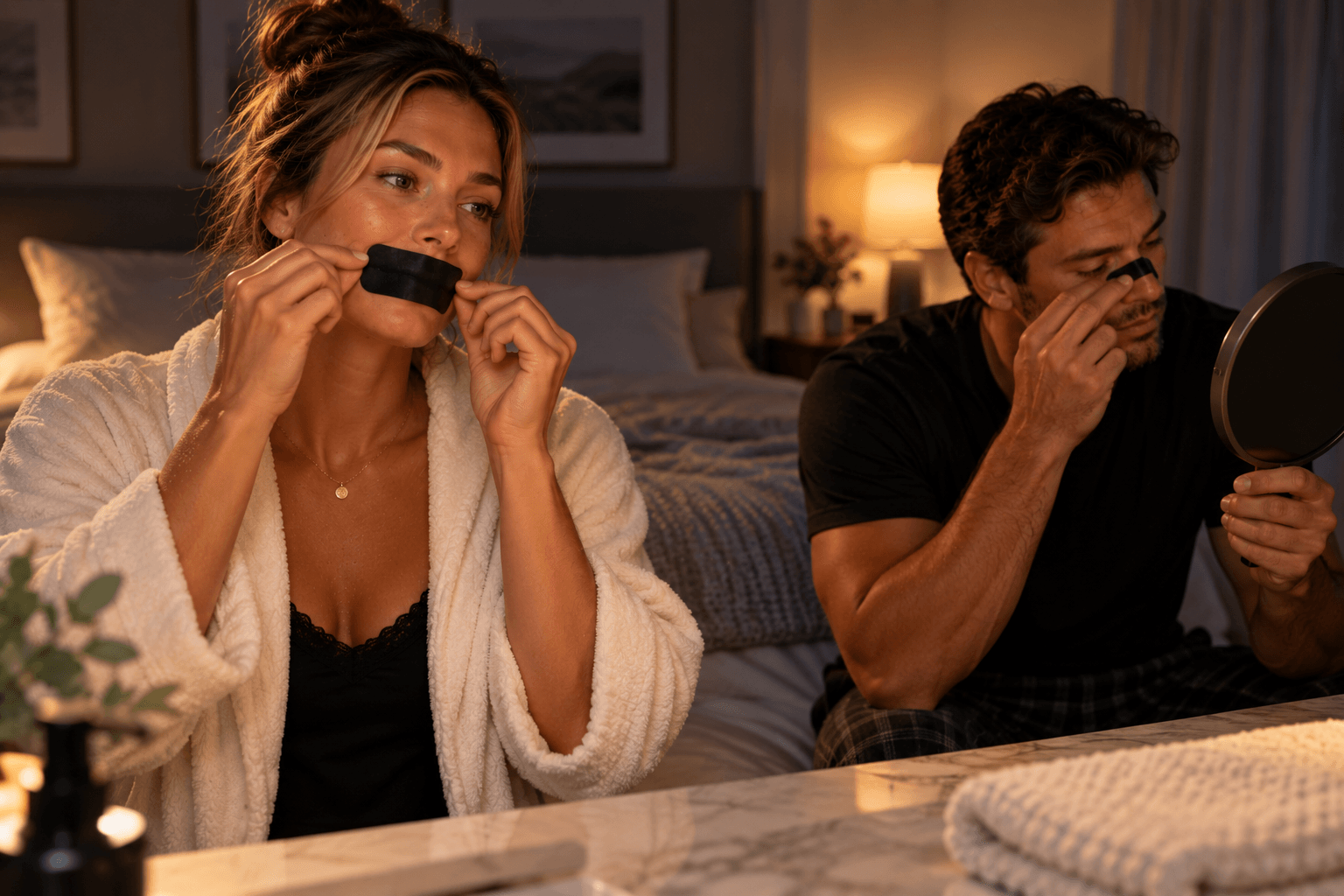
Mouth tape is aimed at a third cause on the NHS list, the mouth falling open during sleep, though the NHS itself names a chin strap or a vestibular shield for that. Many people pair it with a nasal strip, so the nose stays open and the mouth stays closed. Put the strip on first and only add tape if you can breathe comfortably through your nose. Mouth tape with a night guard covers using tape alongside something in your mouth.
Check this first. Skip mouth tape and see a doctor if you snore loudly, wake up gasping, have been told you stop breathing in your sleep, or can't breathe comfortably through your nose. More on safety
If you want to try nasal strips, our pick is TitanAir Nasal Strips.
Read next
Common questions
Which is better for snoring, nasal strips or a mouth guard?
It depends on where your snoring comes from. If your nose feels blocked or narrow, a strip targets that directly. If the sound comes from the throat or tongue, a mouthpiece that brings the jaw forward targets that. The NHS suggests matching the treatment to the cause.
Can I use a nasal strip and an anti-snoring mouthpiece together?
They work on different parts of the airway and don't get in each other's way physically. We didn't find studies testing the two together. If you're using a mouthpiece prescribed for sleep apnea, ask your dentist or sleep doctor before adding anything.
Are over-the-counter mouth guards for snoring any good?
The American Academy of Sleep Medicine says you must be custom fitted for an oral appliance for it to work properly, and it doesn't recommend over-the-counter devices as a treatment for snoring or sleep apnea.
Do nasal strips help sleep apnea?
No. A 2016 meta-analysis found nasal dilators improve nasal breathing but don't improve obstructive sleep apnea. Oral appliances fitted by a dentist are an established treatment for sleep apnea, prescribed after a diagnosis.
What are the side effects of an anti-snoring mouthpiece?
The American Academy of Sleep Medicine lists excessive salivation, dry mouth, tooth and jaw discomfort and temporary bite changes as frequent but minor side effects. Less often, people get jaw pain, lasting bite changes or TMJ symptoms.
How long does it take to get used to each one?
The AASM says most people take a few weeks to get used to sleeping with an oral appliance. With nasal strips, a 1998 study found 17 of 30 snorers needed some time to adjust, after which they said they breathed easily and slept well.
What are the side effects of nasal strips?
Nasal strips mainly affect the skin they sit on. Breathe Right lists redness, irritation, peeling and rash among possible reactions and says to stop using the strips if they happen. It also says its strips aren't for children under 5 or people with a latex allergy, because the package is sealed with natural rubber latex.
Sources
- Snoring
- Oral appliance therapy
- Clinical Practice Guideline for the Treatment of Obstructive Sleep Apnea and Snoring with Oral Appliance Therapy: An Update for 2015
- Snoring
- Effect of the external nasal dilator Breathe Right on snoring
- External nasal dilation reduces snoring in chronic rhinitis patients: a randomized controlled trial
- Nasal Dilators (Breathe Right Strips and NoZovent) for Snoring and OSA: A Systematic Review and Meta-Analysis
- Breathe Right FAQs
About this article
- Research
- 8 published sources, listed above.
- Evidence
- Moderate. How we rate it
- Last checked
- October 10, 2026
- Funding
- Paid partner of Titan Recovery. Their ads are labeled.
- Found an error?
- Tell us. We log fixes on the corrections page.
* This content is for informational and educational purposes only and is not medical advice. It is not intended to diagnose, treat, cure or prevent any disease or health condition. Talk to a qualified healthcare provider about your health.