In short
- A night guard sits over your teeth and mouth tape sits on your lips, so many people can wear both. No study has tested the combination.
- Night guards protect teeth from grinding. Mouth tape encourages nasal breathing. They do different jobs.
- Grinding has been linked with sleep apnea, and two small studies found that a standard night guard may worsen breathing in people who have it.
- If you grind and snore, especially with choking or gasping, see your dentist or doctor before adding mouth tape.
- Ask your dentist whether tape suits your guard, and make sure you can breathe easily through your nose with the guard in.
Often, yes. A night guard fits over your teeth and mouth tape sits on the outside of your closed lips, so the two work in different places and many people can wear both. The one thing to check first is snoring: teeth grinding and sleep apnea often go together, so if you snore as well as grind, talk to your dentist or doctor before you add tape.
No study has tested night guards and mouth tape together. Here's what's known about each, and how to combine them sensibly.
What do a night guard and mouth tape each do?
A night guard and mouth tape solve different problems. A night guard protects your teeth from grinding. Sleep Foundation describes mouthguards and night guards as devices used to reduce damage to the teeth and mouth from sleep bruxism, and says splints cover the teeth to form a barrier against grinding. Cleveland Clinic adds that a custom guard from a dentist can also place your jaw in a more favorable position to reduce strain on the jaw joint.
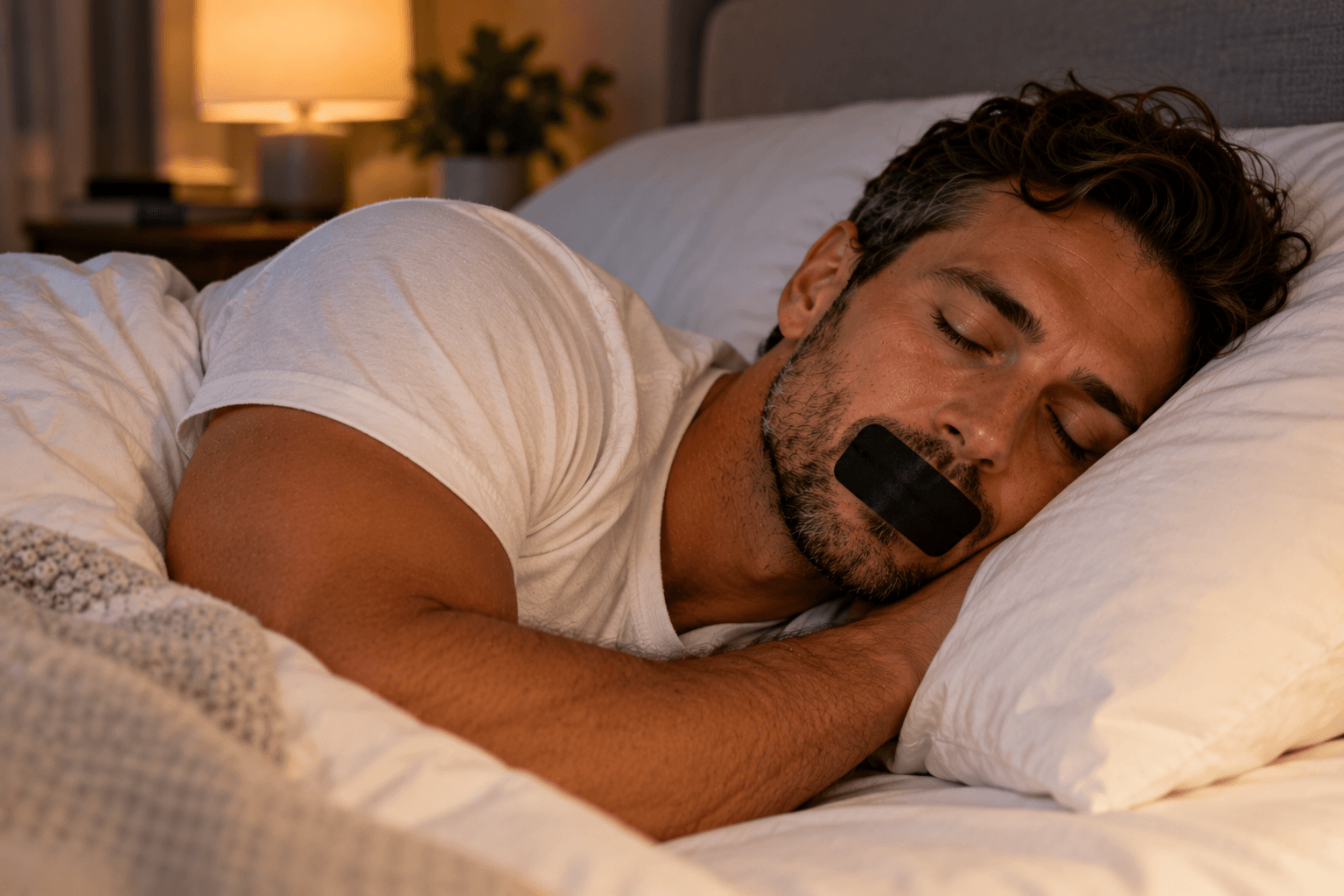
Mouth tape keeps your lips together so you breathe through your nose. Sleep Foundation describes it as a gentle reminder that nudges the body into nasal breathing during sleep. Neither one does the other's job, which is why some people want both.
Why might someone who grinds want to try mouth tape?
People who grind usually want to try mouth tape for the same reasons anyone tries it: a dry mouth in the morning, or snoring that starts when the mouth falls open. Sleep Foundation explains that during sleep, muscle relaxation can cause the mouth to fall open, especially when lying on the back.
Grinding itself is common. The American Academy of Sleep Medicine (AASM) says about 8% of young to middle-aged adults grind their teeth in their sleep, and the rate falls with age. It lists tooth pain, jaw muscle pain, worn teeth, sore gums and headaches among the signs. People who already sleep with a guard are used to a nightly routine, so adding a small strip of tape is a short step for them.
What does the research say about night guards, grinding and breathing?
Research: limited (what this means)There's no research on wearing mouth tape and a night guard together. What the research does show is a link between grinding and breathing during sleep, and that's the part worth understanding before you combine them.
The AASM says the cause of sleep bruxism is unclear but that it has been associated with stress, genetics, medications and sleep-disordered breathing. Cleveland Clinic says research has confirmed a correlation between sleep apnea and teeth grinding, meaning many people have both, though it's unclear which causes which.
Two small studies looked at standard night guards in people who already had sleep apnea. In a 2004 pilot study of 10 patients, the apnea-hypopnea index rose by more than 50% in five of them on the night they used a splint, and time spent snoring rose by 40%. The authors suggested dentists ask patients about snoring and sleep apnea before recommending a splint. A 2013 randomized crossover trial in 10 people with sleep apnea found a small rise in breathing events with the splint in, from 15.9 to 17.4 an hour on average, and called the effect small.
These studies were in people with diagnosed sleep apnea, not in people who simply grind. For most grinders, a guard is a standard, helpful treatment. But it does mean that snoring plus grinding deserves a proper look before you add anything else to your night.
How do you wear mouth tape with a night guard?
- Ask your dentist whether tape is fine with your guard, especially if it's a custom device or one that changes your jaw position.
- Put the guard in and close your lips. Breathe through your nose for a couple of minutes. If that feels easy and your lips meet comfortably, go ahead.
- Put a short strip of skin-safe tape over the middle of clean, dry lips. Fold over one corner so it's easy to remove, as Sleep Foundation suggests.
- Try it during the day first. Sleep Foundation recommends testing the tape while awake to make sure you can breathe easily through your nose.
- In the morning, peel the tape off first, slowly and close to the skin, then take out your guard. Our guide on how to take mouth tape off shows the gentle method.
If your nose feels tight with the guard in, a nasal strip may make nasal breathing easier. If it's properly blocked, skip the tape that night.
Check this first. Skip mouth tape and see a doctor if you snore loudly, wake up gasping, have been told you stop breathing in your sleep, or can't breathe comfortably through your nose. More on safety
When should you see a dentist or doctor first?
See a dentist or doctor first if you snore loudly as well as grind. The AASM says that when snoring is paired with choking, gasping or silent breathing pauses during sleep, it's a reliable indicator of sleep apnea. Mouth tape is not a treatment for sleep apnea, and Sleep Foundation says people with sleep apnea who aren't using CPAP shouldn't use it. Our page on snoring vs. sleep apnea explains the warning signs.
The AASM also notes that a sleep study can show whether another disorder, such as sleep apnea, is behind your sleep problems. Cleveland Clinic says it's time to see a healthcare provider if grinding symptoms don't go away or happen more often than not.
Sleep Foundation also lists other people who should skip mouth tape: anyone with a blocked nose from allergies, a deviated septum or a cold, people with asthma or COPD unless a doctor says otherwise, children unless under medical supervision, people with anxiety or panic disorders, and anyone at risk of vomiting during sleep. We don't recommend mouth tape for children.
Is a snoring mouthpiece the same as a night guard?
A snoring mouthpiece isn't the same as a night guard. Sleep Foundation explains that mandibular advancement devices hold the lower jaw forward and are commonly used to reduce chronic snoring, while a grinding guard mainly covers the teeth. If snoring is your main concern, our guides to oral appliances for snoring and nasal strips vs. a mouth guard compare the options.
What else helps with teeth grinding?
A guard protects your teeth, but it isn't the only tool. Cleveland Clinic lists stress reduction, such as meditation, exercise and cognitive behavioral therapy, as a way to ease grinding. It also says cutting back on caffeine and alcohol can help if they play a part, and that quitting smoking can help you stop grinding and sleep better. The AASM notes that relaxation training and biofeedback may help too.
On the guard itself, the AASM says some can be molded at home by boiling the device and biting down, but that most often you'll need a dentist for a proper fit. Cleveland Clinic's advice for adults who get a guard is to wear it regularly. Mouth tape doesn't replace any of this. It simply adds nasal breathing to a night routine you may already have.
Read next
Common questions
Can I wear mouth tape and a mouth guard at the same time?
Many people can. The guard covers your teeth and the tape sits on the outside of your lips, so they don't touch. Put the guard in first, check you can breathe easily through your nose, then apply the tape. Ask your dentist first, especially if you snore.
Does mouth tape help with teeth grinding?
There's no evidence that it does. Night guards protect your teeth from grinding, and stress management and cutting back on alcohol, caffeine and smoking can help too. Mouth tape is about keeping your mouth closed so you breathe through your nose.
Is teeth grinding linked to sleep apnea?
Yes. Cleveland Clinic says research has confirmed a correlation between sleep apnea and teeth grinding, though it's unclear which causes which. The American Academy of Sleep Medicine lists sleep-disordered breathing among the things associated with sleep bruxism.
Can a night guard make snoring worse?
In some people with sleep apnea, it may. In a 2004 pilot study of 10 people with sleep apnea, time spent snoring rose by 40% on the night they wore a standard splint. That's why dentists are encouraged to ask about snoring before recommending one.
Should I tape my mouth if I grind my teeth and snore?
Not before checking with a doctor. Snoring together with grinding can point to sleep apnea, and mouth tape isn't a treatment for it. A sleep study can show what's going on.
Is mouth tape or a mouth guard better for snoring?
They work in different ways, so it depends on why you snore. Mouth tape keeps your lips closed so you breathe through your nose, while Sleep Foundation says mandibular advancement devices hold the lower jaw forward and are commonly used to reduce chronic snoring. A guard made for grinding mainly covers the teeth, so ask your dentist which type of device suits you.
Sources
- Bruxism (teeth grinding): symptoms, causes and treatment
- Bruxism
- Bruxism: teeth grinding at night
- Aggravation of respiratory disturbances by the use of an occlusal splint in apneic patients: a pilot study
- Effects of occlusal stabilization splints on obstructive sleep apnea: a randomized controlled trial
- Mouth taping for sleep: does it work?
- Is it more than a snore? Recognizing sleep apnea warning signs
About this article
- Research
- 7 published sources, listed above.
- Evidence
- Limited. How we rate it
- Last checked
- October 10, 2026
- Funding
- Paid partner of Titan Recovery. Their ads are labeled.
- Found an error?
- Tell us. We log fixes on the corrections page.
* This content is for informational and educational purposes only and is not medical advice. It is not intended to diagnose, treat, cure or prevent any disease or health condition. Talk to a qualified healthcare provider about your health.