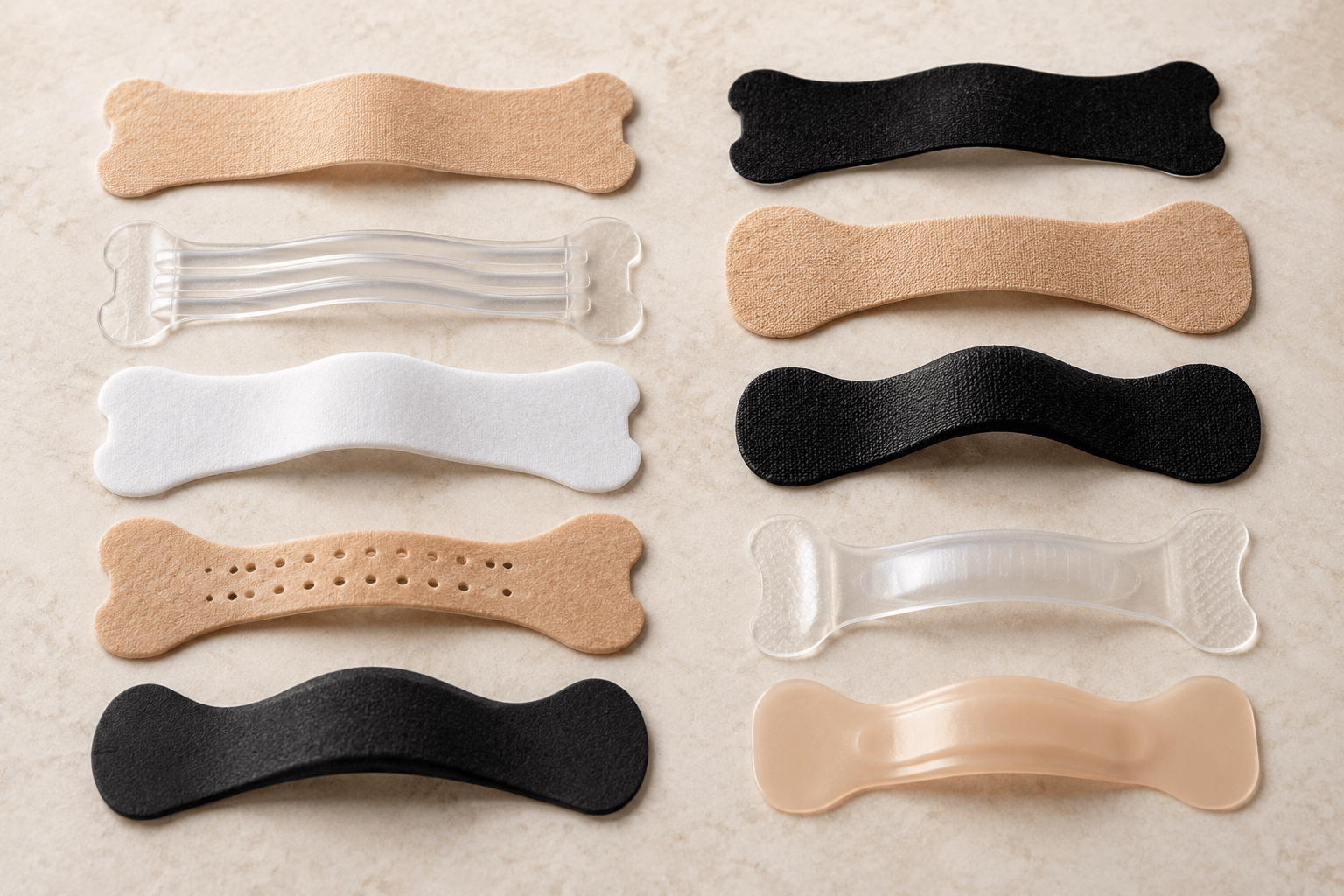
In short
- Nasal strips are Class I medical devices under 21 CFR 874.3900, a regulation published on March 8, 1999.
- FDA's 510(k) database shows the first Breathe Right clearance, K921220, was decided on October 7, 1993.
- In a 2019 study, nasal resistance during sleep was 39.1% lower with a nasal strip than without one.
- A 2000 randomized trial of 12 people with chronic rhinitis found snoring frequency was 173 snores an hour with the strip against 258 with a placebo strip.
- A 2016 meta-analysis of 147 patients found nasal dilators did not change the apnea-hypopnea index in people with sleep apnea.
- A 2020 meta-analysis found nasal strips showed no improvement in VO2max, heart rate or perceived exertion during exercise in healthy people.
Nasal strips have been studied for about 30 years, and the most consistent finding is that they open the nasal valve and lower resistance to airflow through the nose. Results for snoring and sleep are positive in some groups and flat in others, and they don't treat sleep apnea. The facts below give each figure with its population, year and source, grouped by airflow, snoring, sleep, regulation, history and limits.
Research: moderate (what this means)What did the key nasal strip studies find?
This table summarizes the main nasal strip studies on this page, with who took part, what was measured and the headline result.
| Study (year, journal) | Who took part (n) | What was measured | Result |
|---|---|---|---|
| 2004, Rhinology | 27 healthy adults | Nasal valve area and resistance | Larger nasal valve area, lower nasal resistance |
| 2019, Advances in Therapy | Adults with chronic nighttime congestion | Nasal resistance during sleep | 39.1% lower with a prototype strip |
| 2000, European Respiratory Journal | 12 people with chronic rhinitis | Snoring frequency, randomized vs placebo strip | 173 snores an hour against 258 with placebo |
| 1998, European Journal of Medical Research | 30 habitual snorers | Maximum snoring intensity | Fell in 22 of 30 |
| 2001, American Journal of Rhinology | 18 heavy snorers with nasal obstruction | Snoring duration and intensity | No change |
| 2016 meta-analysis, Pulmonary Medicine | 147 patients with sleep apnea, 14 studies | Apnea-hypopnea index | 28.7 to 27.4 an hour, not significant |
| 2020 meta-analysis, European Archives of Oto-Rhino-Laryngology | 19 studies of healthy people exercising | VO2max, heart rate, perceived exertion | No improvement |
How do nasal strips change airflow and nasal resistance?
A 2004 study in Rhinology found that the Breathe Right strip increased the minimum cross-sectional area of the nasal valve and lowered nasal resistance in 27 healthy adults.
The same 2004 study found the internal Nozovent dilator lowered nasal resistance significantly more than the Breathe Right strip.
A 1997 randomized, placebo-controlled study in The Laryngoscope used acoustic rhinometry in 53 athletes and found the strip significantly increased nasal valve area at rest.
In the 1997 study, 30 athletes exercised on a cycle ergometer, and the strip lowered submaximal heart rate, ventilation, oxygen use and perceived exertion compared with a placebo.
A 1999 study in the Canadian Journal of Applied Physiology of 9 healthy adults found resting nasal resistance on breathing in fell from 0.33 to 0.22 kPa/L/s with a nasal strip.
In the same 1999 study, the strip delayed the switch from nose-only to mouth and nose breathing during exercise, with the time to switching up 15.2% and the peak nasal airflow reached before switching up 14.9%.
A 2014 review in the International Journal of General Medicine said external nasal dilators are simple, noninvasive and affordable and carry minimum risk, and that most studies have small samples and focus on exercise.
A 2019 study in Advances in Therapy found median nasal resistance during sleep was 39.1% lower with a prototype strip than without one, at 1.34 against 2.20 cmH2O/l/s.
In the 2019 study, the spontaneous arousal rate during sleep fell by about 37% with the strip, and the study was funded by GlaxoSmithKline Consumer Healthcare.
Do nasal strips reduce snoring?
A 2000 randomized, placebo-controlled trial in the European Respiratory Journal found 12 people with chronic rhinitis snored 173 times an hour with a Breathe Right strip and 258 times an hour with a placebo strip.
The same 2000 trial found the strip had no effect on sleep quality or snoring loudness.
A 1998 study in the European Journal of Medical Research found maximum snoring intensity fell on the second night with a strip in 22 of 30 people with habitual snoring.
In the 1998 study, 17 of 30 people needed some time to get used to the strip, and the only side effect reported was a brief urge to sneeze in one person.
A 2001 randomized trial in the American Journal of Rhinology of 18 heavy snorers with nasal obstruction found snoring duration and intensity stayed the same with the strip.
Do nasal strips help sleep and congestion?
A 2019 study in Advances in Therapy of 70 adults with chronic nighttime congestion reported easier breathing, better sleep quality and feeling more refreshed after 28 nights with a prototype strip.
A 2018 randomized trial of 59 adults with chronic nasal congestion found the clear Breathe Right strip improved satisfaction with sleep at day 7 compared with a placebo strip.
A 1996 trial in the Journal of Reproductive Medicine found 8 of 10 diary questions favored a spring-loaded strip over a placebo in 24 pregnant women with nighttime nasal congestion.
Of 160 pregnant women screened for the 1996 trial, 34 were enrolled and 24 completed it, 12 with the real strip and 12 with a placebo.
The two 2019 Breathe Right trials in Advances in Therapy, with 270 people in total, reported the strips were well tolerated.
How are nasal strips regulated?
Under 21 CFR 874.3900, an external nasal dilator is defined as layers of material with a spring and a skin adhesive that act with a pulling action to open the nostrils.
21 CFR 874.3900 classes nasal dilators as Class I devices under general controls, exempt from premarket notification subject to the limits in 21 CFR 874.9.
The nasal dilator regulation was published in the Federal Register on March 8, 1999, at 64 FR 10949.
FDA's openFDA database listed 20 510(k) records under the nasal dilator product code LWF when we checked in October 2026.
When was the nasal strip invented?
US patent 5,476,091 for an adhesively mounted dilator, naming Bruce C. Johnson as inventor, was granted on December 19, 1995.
FDA's 510(k) database shows Breathe Right, submitted by CNS, Inc., was received on March 13, 1992 and found substantially equivalent on October 7, 1993, under clearance K921220.
FDA cleared further Breathe Right Nasal Strip 510(k)s on October 20, 1995, February 27, 1996 and May 30, 1996, according to openFDA records.
PharmaTimes reported on October 10, 2006 that GlaxoSmithKline was buying CNS, the Minnesota maker of Breathe Right, for $566 million in a cash deal.
What can't nasal strips do?
A 2016 meta-analysis in Pulmonary Medicine of 14 studies found the apnea-hypopnea index in 147 patients went from 28.7 to 27.4 events an hour with nasal dilators, a change that was not significant.
The 2016 meta-analysis concluded that nasal dilators have improved nasal breathing but have not shown improvement in sleep apnea outcomes, apart from a mild drop in the apnea index with internal dilators.
A 2026 meta-analysis in Cureus of 17 studies and 496 participants found no significant difference in apnea-hypopnea index or snoring index with nasal dilators, and said they may help as an add-on in people with mild symptoms or nasal congestion.
The 2026 Cureus review searched four databases up to January 2024 and screened 290 records to reach its 17 studies.
Two randomized trials published in 2019 in Advances in Therapy, with 140 and 130 people, found Breathe Right strips did not beat placebo strips on sleep quality measures, possibly because of a strong placebo effect.
A 2020 meta-analysis in the European Archives of Oto-Rhino-Laryngology of 19 studies found nasal strips showed no improvement in VO2max, heart rate or perceived exertion during exercise in healthy people.
Nasal strips are not a treatment for sleep apnea. Our guide to why nasal strips don't work for some people covers who tends to benefit.
How we compiled this page
We checked every fact on this page against the original study abstract, regulation, FDA database record, patent record or news report on the date shown at the top. Drafting was AI-assisted and reviewed by our editorial team, as described in our editorial policy. If a figure changes or we got something wrong, we'll correct it.
Read next
Common questions
Do nasal strips really open the nose?
Yes. A 2004 study of 27 healthy people found the strip increased the narrowest area of the nasal valve and lowered nasal resistance, and a 2019 study found resistance during sleep was 39.1% lower with a strip.
Do nasal strips reduce snoring?
In some groups. A 2000 randomized trial in 12 people with chronic rhinitis found fewer snores an hour with the strip than with a placebo, and a 1998 study found peak snoring intensity fell in 22 of 30 habitual snorers. A 2001 trial in 18 heavy snorers found no change in snoring duration or intensity.
Are nasal strips FDA approved?
They're regulated as Class I nasal dilators under 21 CFR 874.3900, which today are exempt from premarket notification subject to limits. Breathe Right went through 510(k) clearance in 1993, before that rule existed.
Do nasal strips help sleep apnea?
No. A 2016 meta-analysis found no significant change in the apnea-hypopnea index, lowest oxygen level or snoring index in people with sleep apnea using nasal dilators. Sleep apnea needs a doctor's care.
Who invented the nasal strip?
US patent 5,476,091, granted on December 19, 1995, names Bruce C. Johnson as inventor of an adhesively mounted dilator for outer wall tissues.
Do nasal strips help athletes?
A 1997 study of athletes found the strip increased nasal valve area at rest. A 2020 meta-analysis of 19 studies found no improvement in VO2max, heart rate or perceived exertion during exercise.
Sources
- 21 CFR 874.3900: Nasal dilator
- 510(k) premarket notification K921220: Breathe Right
- 510(k) records for product code LWF (nasal dilator)
- US5476091A: Dilator for anatomical outer wall tissues which is adhesively mounted
- GSK puts $566 million on the nose to buy CNS
- Physiologic effects of an external nasal dilator
- Nasal dilator strips delay the onset of oral route breathing during exercise
- Effects of the nasal strip and dilator on nasal breathing: a study with healthy subjects
- Objective and subjective effects of a prototype nasal dilator strip on sleep in subjects with chronic nocturnal nasal congestion
- Effect of the external nasal dilator Breathe Right on snoring
- External nasal dilation reduces snoring in chronic rhinitis patients: a randomized controlled trial
- Dichotomous physiological effects of nocturnal external nasal dilation in heavy snorers: the answer to a rhinologic controversy?
- External nasal dilators: definition, background, and current uses
- Managing pregnancy-related nocturnal nasal congestion: the external nasal dilator
- Effects of nasal dilator strips on subjective measures of sleep in subjects with chronic nocturnal nasal congestion: a randomized, placebo-controlled trial
- Sleep quality and congestion with Breathe Right nasal strips: two randomized controlled trials
- Nasal dilators (Breathe Right strips and NoZovent) for snoring and OSA: a systematic review and meta-analysis
- Clinical effectiveness of nasal dilators in sleep-disordered breathing: a systematic review and meta-analysis
- Does the external nasal dilator strip help in sports activity? A systematic review and meta-analysis
About this article
- Research
- 19 published sources, listed above.
- Evidence
- Moderate. How we rate it
- Last checked
- October 10, 2026
- Funding
- Paid partner of Titan Recovery. Their ads are labeled.
- Found an error?
- Tell us. We log fixes on the corrections page.
* This content is for informational and educational purposes only and is not medical advice. It is not intended to diagnose, treat, cure or prevent any disease or health condition. Talk to a qualified healthcare provider about your health.