In short
- Snoring products work on different causes, so the best match depends on whether your mouth falls open, your nose is blocked, your tongue falls back or you snore mainly on your back.
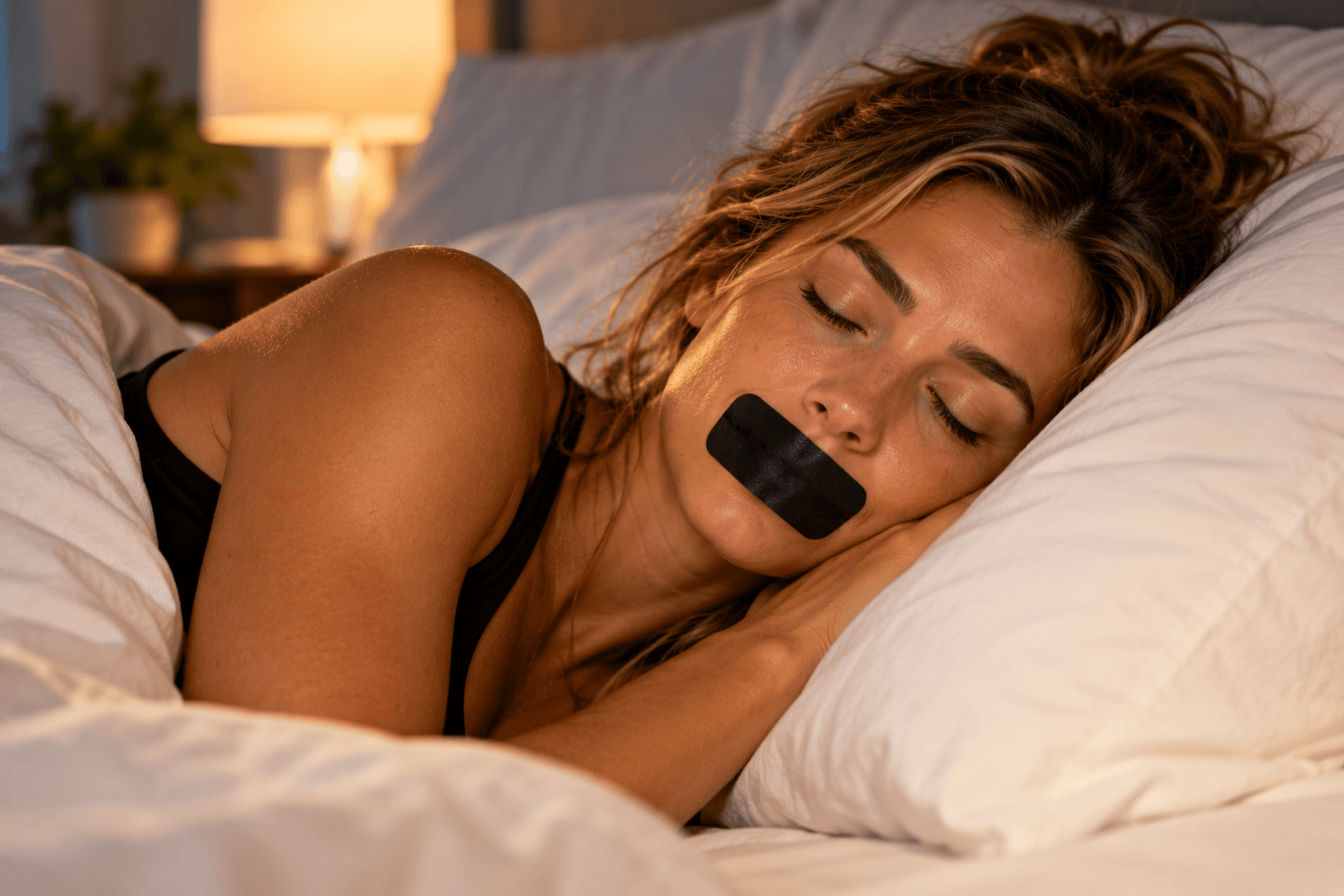
- Mouth tape suits snoring from an open mouth, and small studies found snoring dropped by about half or more in mouth breathers.
- Nasal strips and internal dilators suit a blocked or narrow nose, and pairing a strip with tape covers both the nose and the mouth.
- A mouthpiece that moves the lower jaw forward has the strongest evidence for snoring, and a 2015 guideline recommends one for snoring without sleep apnea.
- None of these products is a substitute for a sleep apnea check if your snoring comes with gasping, choking or breathing pauses.
Mouth tape is the simplest option for snoring that comes from sleeping with your mouth open, and small studies in mouth breathers with mild sleep apnea found it cut snoring by about half or more. Other products work on other causes: strips, dilators and sprays on the nose, mouthpieces on the jaw and tongue, and pillows on sleep position. The right choice depends on where your snoring starts.
Start with where your snoring comes from
The NHS matches snoring treatments to their cause. For a mouth that falls open during sleep, it suggests a chin strap or a mouth device that keeps you breathing through your nose. For a blocked or narrow nose, it suggests nasal dilators or strips, or decongestants and sprays. For a tongue that partly blocks the back of the throat, it suggests a device that brings the lower jaw forward. It also suggests sleeping on your side, with a special pillow or bed wedge if needed.
Many people have more than one cause, which is why products are often paired. Our nose test is a quick way to check whether your nose is clear enough for mouth tape. If someone shares your bed, ask whether your mouth hangs open while you snore and whether it's worse on your back. Those two answers point you toward the right section below.
Products for a mouth that falls open
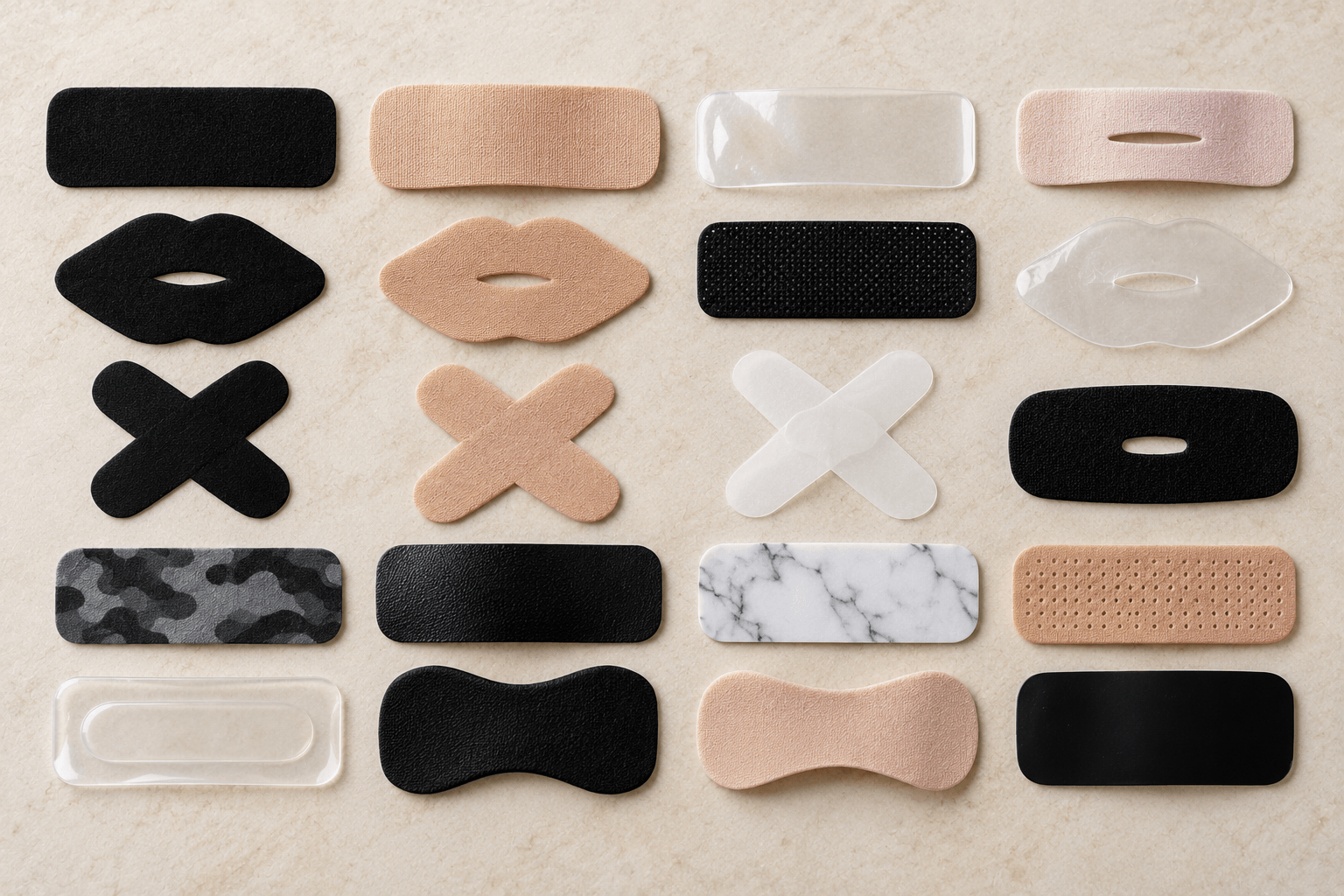
Mouth tape
How it works: a strip of skin-safe tape over the lips keeps your mouth closed, so you breathe through your nose.
Who it suits: adults who snore with their mouths open and can breathe comfortably through their noses.
Evidence: in a 2022 study of 20 mouth breathers with mild sleep apnea, 13 cut their snoring index by at least half after a week of taping. A 2015 pilot using a porous mouth patch in 30 people found the median snoring index fell from 146.7 to 40.0 an hour. A 2025 review found that all three studies measuring the snoring index reported a significant drop, though one used a chin strap, and it rated the studies as poor quality. That makes tape promising rather than proven. Sleep Foundation says tape shouldn't be used by people with untreated sleep apnea, chronic nasal congestion or difficulty breathing through the nose. Our article on whether mouth tape helps snoring has the details.
Research: limited (what this means)Chin straps
How it works: a fabric strap around the head and chin holds the jaw closed.
Who it suits: people whose mouths fall open. SleepApnea.org says a chin strap is one way many CPAP users reduce mouth breathing.
Evidence: mixed. A 2014 study in 26 adults with sleep apnea found a chin strap alone didn't improve snoring or breathing measures, though the 2025 review listed another study where a chin strap reduced snoring. A strap holds the jaw, while tape keeps the lips themselves together. Our comparison of mouth tape vs. chin strap goes further.
Products for a blocked or narrow nose
Nasal strips
How it works: an adhesive strip with springs sits across the nose and pulls the nostrils open, which US regulations describe as decreasing airway resistance and increasing nasal airflow.
Who it suits: people with a blocked or narrow nose, the cause the NHS matches them to.
Evidence: in a 2000 randomized trial in 12 people with chronic rhinitis, snoring frequency was 173 snores an hour with a real strip and 258 with a placebo strip. A German snoring guideline says internal or external nasal dilators should be tried when breathing is impaired at the nasal valve. Strips are easy to combine with tape. Read more in how nasal strips work.
Internal nasal dilators
How it works: a small plastic or metal device sits inside the nostrils and pushes them open.
Who it suits: the same people as strips, especially anyone whose skin doesn't like adhesive.
Evidence: a 2019 open study in 41 snorers compared an internal dilator with a nasal strip, and both reduced snoring time and improved sleep quality ratings. The internal device worked for more people in that study. There was no placebo group. Our guide to nasal strips vs. nasal dilators compares them.
Nasal sprays
How it works: the NHS describes decongestants and nasal sprays as ways to reduce swelling inside the nose.
Who it suits: people whose snoring flares with a cold or congestion.
Evidence: the German guideline says short-term decongestant use can be considered, mainly as a test of whether opening the nose helps. The NHS says decongestant sprays shouldn't be used for more than 5 days at a time, because longer use can make stuffiness worse. Cleveland Clinic calls this rebound congestion.
Products for the jaw and tongue
Mandibular advancement devices
How it works: a mouthpiece holds the lower jaw forward, which the NHS says brings the tongue forward. In the US, these intraoral snoring devices are regulated as Class II medical devices.
Who it suits: people whose tongue partly blocks the back of the throat. The German guideline says the lower jaw needs enough mobility to be moved forward.
Evidence: the strongest of any product here. A 2015 guideline from the American Academy of Sleep Medicine and the American Academy of Dental Sleep Medicine recommends oral appliances, rather than no therapy, for adults who want treatment for snoring without sleep apnea. The German guideline says fitting should involve dental and sleep medicine experts and that long-term use can affect the bite. See oral appliances for snoring.
Tongue-retaining devices
How it works: a mouth device holds the tongue forward. The version tested in the study below used suction.
Who it suits: people whose tongue partly blocks the back of the throat, the same cause the NHS matches to jaw devices.
Evidence: limited. A 2008 randomized crossover study of a non-custom device found the snoring index fell from 214.7 to 132.9 an hour with the suction version, and 54% of participants said they'd keep using it.
Products for sleep position
Positional pillows and wedges
How it works: pillows, wedges or wearables discourage back sleeping or raise the head.
Who it suits: people who snore mainly on their backs. The German guideline says avoiding the back should be offered for snoring linked to that position, and the NHS suggests taping or stitching a tennis ball to the back of your sleepwear.
Evidence: a 2017 randomized trial in 22 snorers found a pillow that shifts head position reduced the snoring index, though one author worked for a company that distributes anti-snoring products. A 2024 systematic review of 9 studies found positional products and raising the head of the bed improved snoring, but called for larger controlled trials. Our guide to anti-snoring pillows covers the options.
Can you combine snoring products?
The causes of snoring often overlap. A strip opens the nose and tape keeps the mouth closed, so pairing them covers both ends of the same breathing route, and tape works best when the nose is clear. Side sleeping can be added to either. Our article on using mouth tape and nasal strips together explains how.
Check this first. Skip mouth tape and see a doctor if you snore loudly, wake up gasping, have been told you stop breathing in your sleep, or can't breathe comfortably through your nose. More on safety
When does snoring need a doctor?
None of these products is a sleep apnea treatment. The American Academy of Sleep Medicine says snoring is likely to be a sign of sleep apnea when it comes with silent breathing pauses and choking or gasping sounds, and that people with sleep apnea often have daytime sleepiness. If that sounds familiar, get checked before buying anything. Snoring vs. sleep apnea explains the difference.
Our pick (paid partner)
For snoring linked to the nose or an open mouth, our pick is the Titan Sleep System from Titan Recovery, which pairs TitanAir Nasal Strips with Titan Mouth Tape. This is our recommendation, not the result of testing or ranking products ourselves.
Titan says the strips are drug-free with spring-loaded bands and are designed to pair with its bamboo silk mouth tape. Titan says both are third-party tested and PFAS-free, and they come with a 30-night guarantee.
Read next
Common questions
Is mouth tape better than a chin strap for snoring?
They target the same problem, a mouth that falls open. A 2014 study in 26 adults with sleep apnea found a chin strap alone didn't improve snoring, while small studies of mouth tape and mouth patches in mouth breathers with mild sleep apnea found large drops in snoring.
Is mouth tape better than nasal strips?
They do different jobs. Tape keeps the lips closed, and strips lift the sides of the nose to open the airway. The NHS matches strips to a blocked or narrow nose, and many people use both together.
Which anti-snoring product has the most evidence?
A mouthpiece that holds the lower jaw forward. A 2015 guideline from two sleep and dental medicine groups recommends oral appliances, rather than no therapy, for adults who want treatment for snoring without sleep apnea.
Can I use a nasal spray every night for snoring?
Not a decongestant spray. The NHS says decongestant sprays shouldn't be used for more than 5 days at a time because longer use can make stuffiness worse.
Do anti-snoring pillows work?
Some help if you snore mainly on your back. A small randomized trial found a pillow that shifts head position reduced snoring, and a 2024 review said positional products are promising but need more trials.
Can I combine snoring products?
Often, yes. Nasal strips and mouth tape are commonly paired because they work on different ends of the airway. Ask a dentist or doctor before combining anything with a mouthpiece.
Do tongue devices work for snoring?
They can help some people whose tongue partly blocks the back of the throat. In a 2008 randomized crossover study of a non-custom tongue-retaining device, the snoring index fell from 214.7 to 132.9 an hour with the suction version, and 54% of participants said they'd keep using it. The evidence is limited, and mouthpieces that hold the lower jaw forward have more research behind them.
Sources
- Snoring
- The diagnosis and treatment of snoring in adults
- The impact of mouth-taping in mouth-breathers with mild obstructive sleep apnea: a preliminary study
- Novel porous oral patches for patients with mild obstructive sleep apnea and mouth breathing: a pilot study
- Breaking social media fads and uncovering the safety and efficacy of mouth taping in patients with mouth breathing, sleep disordered breathing, or obstructive sleep apnea: a systematic review
- The efficacy of a chinstrap in treating sleep disordered breathing and snoring
- External nasal dilation reduces snoring in chronic rhinitis patients: a randomized controlled trial
- Internal and external nasal dilatator in patients who snore: a comparison in clinical practice
- 21 CFR 874.3900: Nasal dilator
- Decongestants
- Rhinitis medicamentosa
- Clinical practice guideline for the treatment of obstructive sleep apnea and snoring with oral appliance therapy: an update for 2015
- 21 CFR 872.5570: Intraoral devices for snoring and intraoral devices for snoring and obstructive sleep apnea
- A randomized, controlled, crossover study of a noncustomized tongue retaining device for sleep disordered breathing
- The effect on snoring of using a pillow to change the head position
- The potential effect of changing patient position on snoring: a systematic review
- How to prevent mouth breathing on CPAP
- Obstructive sleep apnea
- Mouth taping for sleep: does it work?
- Titan Sleep System (Nasal Strips + Mouth Tape)
About this article
- Research
- 20 published sources, listed above.
- Evidence
- Limited. How we rate it
- Last checked
- October 10, 2026
- Funding
- Paid partner of Titan Recovery. Their ads are labeled.
- Found an error?
- Tell us. We log fixes on the corrections page.
* This content is for informational and educational purposes only and is not medical advice. It is not intended to diagnose, treat, cure or prevent any disease or health condition. Talk to a qualified healthcare provider about your health.