In short
- Snoring happens when the tissues of your mouth, throat or nose vibrate because they relax and narrow during sleep, and the best fix depends on what's narrowing them.
- In a 2003 study, most snorers without sleep apnea snored less on their side, and a 2020 meta-analysis linked alcohol with worse snoring.
- The NHS matches a blocked or narrow nose with nasal strips or dilators, and a mouth that falls open with something that keeps it closed.
- Weight, smoking, sleeping pills, lack of sleep and anatomy such as a long soft palate or a deviated septum can all play a part.
- Snoring with gasping, choking, pauses in breathing or daytime sleepiness can be sleep apnea and needs a doctor.
Most snoring comes down to a few causes: sleeping on your back, alcohol in the evening, a blocked or narrow nose, a mouth that falls open, and extra weight around the neck. Each one has a matching fix, which is why it pays to work out your likely reason before you buy anything. First, though, rule out sleep apnea, because no home fix treats it.
Check for sleep apnea first
Research: limited (what this means)The NHS explains that snoring happens when your tongue, mouth, throat or the airways in your nose vibrate as you breathe, because these parts relax and narrow during sleep. Sometimes the cause is obstructive sleep apnea, where the airway becomes temporarily blocked.
The American Academy of Sleep Medicine (AASM) says snoring paired with choking, gasping or silent pauses in breathing is a strong sign of sleep apnea, and that daytime sleepiness, morning headaches and unrefreshing sleep are other warning signs. The NHS says to see a GP if you feel sleepy during the day, your breathing stops and starts while you sleep, or you make gasping or choking noises. If any of that fits, read snoring vs. sleep apnea and book an appointment before trying the fixes below.
Reasons linked to how you sleep
You sleep on your back
Lying on your back lets your tongue relax toward the back of your throat and partly block your airway, Cleveland Clinic explains. In a 2003 study of 72 habitual snorers, most of those without sleep apnea snored less, in both time and loudness, when they lay on their side.
What to try: the NHS suggests taping or stitching a tennis ball to the back of your sleepwear, or using a special pillow or bed wedge to keep you on your side. More ideas in sleep position and snoring.
You had a drink in the evening
Alcohol relaxes the muscles that keep your upper airway open. A 2020 meta-analysis of 13 studies with 279 people found alcohol was associated with worse snoring, more breathing interruptions and lower oxygen levels in people prone to snoring. A Cleveland Clinic sleep specialist describes alcohol at night as something that makes your airway more floppy.
What to try: notice whether you snore more on nights you drink, and leave a gap of several hours before bed. See why alcohol makes snoring worse.
You're short on sleep
Cleveland Clinic lists lack of sleep alongside alcohol and sedatives as things that can relax the muscles in your upper airway once you finally drift off. That relaxation limits airflow and can lead to snoring.
What to try: a regular schedule with enough time in bed. The National Heart, Lung, and Blood Institute lists 7 to 8 hours a day for adults, and notes that lost sleep adds up: losing 2 hours a night leaves you with a 14-hour sleep debt after a week.
You take sleeping pills or sedatives
The NHS says sleeping pills can sometimes cause snoring, and Cleveland Clinic includes sedatives among the things that relax the airway muscles.
What to try: if you take something to help you sleep, ask your doctor or pharmacist whether it could be playing a part. Don't stop a prescribed medicine on your own.
Your mouth falls open
Some people's mouths drop open once they're asleep, so they breathe through the mouth instead of the nose. The NHS lists a mouth that falls open as a cause of snoring in its own right and suggests a chin strap or a mouthpiece that encourages nose breathing.
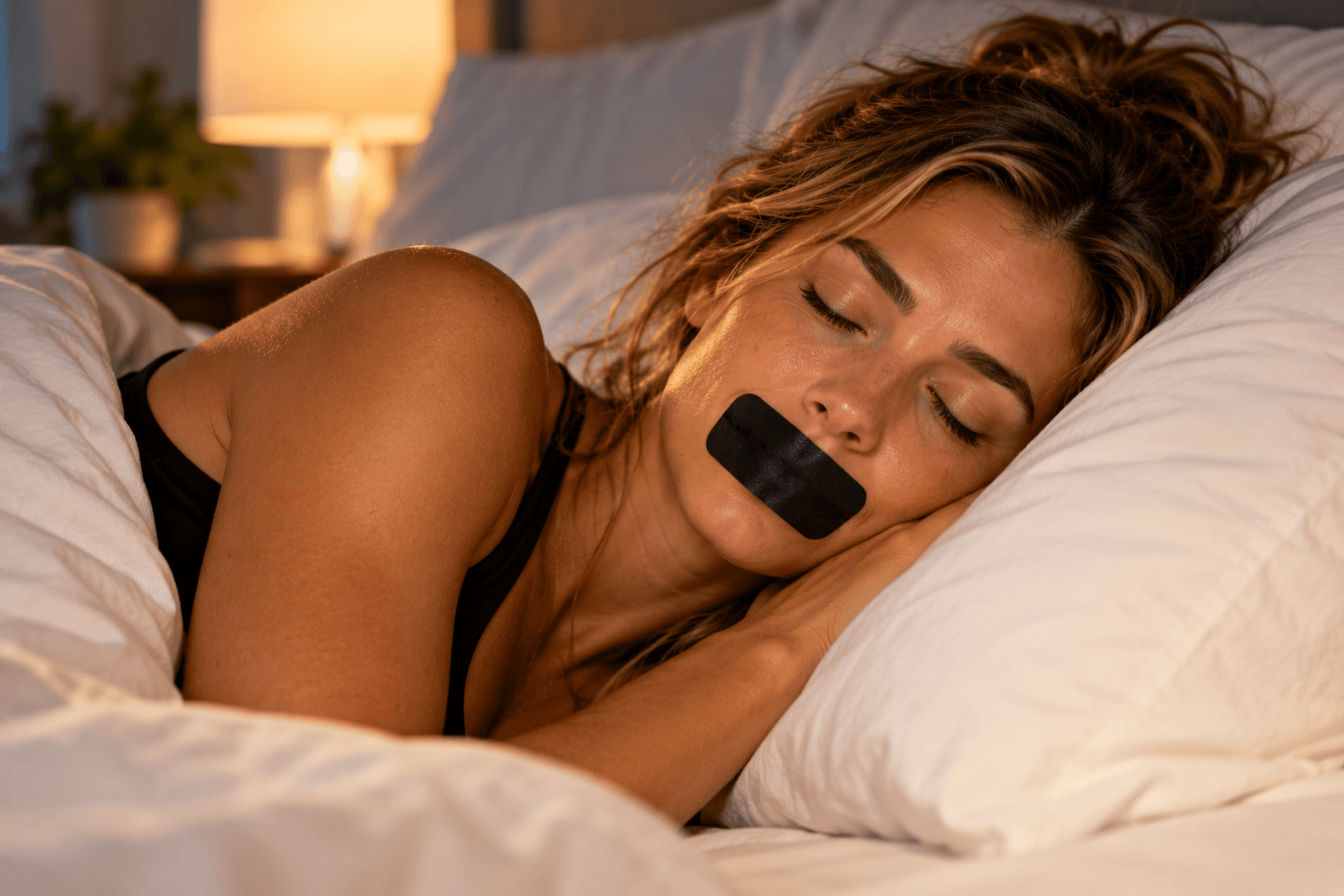
What to try: mouth tape is the simplest version of that idea, as long as your nose is clear. A small 2022 study of mouth breathers with mild sleep apnea found snoring roughly halved after a week of taping (the research). A 2025 systematic review noted the studies are small and flagged a serious risk for anyone taping with a blocked nose, so take the nose test and read our safety page before your first night.
Our pick here is the Titan Sleep System, which pairs Titan's bamboo silk mouth tape with TitanAir nasal strips, so it covers a mouth that falls open and a nose that needs help at the same time. Titan says the strips use flexible spring-loaded bands and are designed to pair with the tape, and that every batch is third-party tested and certified PFAS-free.
Check this first. Skip mouth tape and see a doctor if you snore loudly, wake up gasping, have been told you stop breathing in your sleep, or can't breathe comfortably through your nose. More on safety
Reasons linked to your nose and throat
Your nose is blocked by a cold or allergies
Cleveland Clinic says partly blocked nasal passages make you work harder to pull air through, which can draw together the soft tissue in your throat and cause snoring. The AASM notes that congestion from a cold or allergies can make you snore, and Cleveland Clinic says snoring can come and go with allergy season or a sinus infection.
What to try: the NHS suggests nasal strips or dilators, or decongestants and nasal sprays to reduce swelling. In a small randomized trial of 12 people with chronic rhinitis, snoring dropped from about 258 to 173 snores an hour with a real nasal strip compared with a placebo strip, though loudness didn't change.
Something in your nose narrows the airway
Cleveland Clinic names a deviated septum, the wall between your nostrils, and nasal polyps, which are inflammatory growths, as causes of the kind of blockage that leads to snoring. These don't clear up on their own the way a cold does.
What to try: nasal strips can help with airflow in the meantime, but an ear, nose and throat doctor can tell you whether treatment makes sense. Cleveland Clinic lists septoplasty, surgery to straighten the septum, among snoring treatments. Read deviated septum symptoms for the signs to watch for.
Your soft palate, uvula or tonsils are on the large side
If the roof of your mouth is longer or softer than usual, or your uvula is longer, the opening from your nose to your throat can be narrower, Cleveland Clinic explains. Enlarged tonsils, adenoids or a large tongue can also restrict airflow.
What to try: when the tongue falls back and blocks the throat, the NHS suggests a mouthpiece that brings the tongue forward. The AASM says these should be custom fitted to work properly. Ask your doctor or dentist whether this suits your snoring.
Reasons linked to your health and habits
You're carrying extra weight
Cleveland Clinic says snoring and sleep-related breathing problems are more common in people with overweight or obesity, and the National Heart, Lung, and Blood Institute explains that fat deposits in the neck can block the upper airway. In a small 1995 study of men who snored heavily, those who lost at least 3 kg went from about 320 to 176 snores an hour.
What to try: in that study, the three men who lost an average of 7.6 kg almost stopped snoring, while men who gained weight saw no improvement. Even a modest loss may be worth aiming for.
You smoke
The NHS says you're more likely to snore if you smoke, and the National Heart, Lung, and Blood Institute says smoking can cause inflammation in your upper airway, which affects breathing.
What to try: cutting down or quitting, which may help your nose and throat as well as your snoring.
Some factors you can't change also play a part. The AASM says snoring appears to run in families and becomes more common as you get older, and Cleveland Clinic adds that hormone changes in pregnancy can contribute. Those are good reasons to stack the fixes you can control. For more on the nose side of things, browse our nasal breathing hub.
Read next
- 13 snoring remedies, ordered by the evidence
- 10 snoring myths, and what's actually true
- 6 reasons to pair mouth tape with nasal strips
Common questions
Why do I suddenly snore when I didn't before?
A new cold, allergy season, weight gain, more evening alcohol or a new medicine can all start snoring. Cleveland Clinic says snoring can be occasional, during allergy season or a sinus infection, or a regular thing. If it comes with gasping or daytime sleepiness, see a doctor.
Why do I snore when I sleep on my back?
Lying on your back lets your tongue relax toward the back of your throat and partly block the airway, Cleveland Clinic explains. In a 2003 study, most snorers without sleep apnea snored less, and more quietly, on their side.
Can a blocked nose make you snore?
Yes. Cleveland Clinic says partly blocked nasal passages make you work harder to move air, which can pull the soft tissue in your throat together. Nasal strips lowered snoring frequency in a small trial of people with chronic rhinitis.
Is snoring genetic?
It can run in families. Cleveland Clinic says you're more likely to snore if a biological parent snores, and the AASM says snoring appears to run in families and becomes more common with age.
How do I know which cause applies to me?
Notice when you snore. Snoring mostly on your back, after drinking or during allergy season points to that cause. A doctor can examine your nose, mouth and throat, and the NHS says it helps to bring someone who can describe your snoring.
Can mouth tape cause snoring?
In the research so far, mouth tape has been linked to less snoring, not more. A small 2022 study of mouth breathers with mild sleep apnea found snoring roughly halved after a week of taping. If you still snore with tape on, look at other causes, such as sleeping on your back, which the NHS lists among the reasons people snore.
Do nasal strips have side effects?
Side effects are mostly limited to the skin. A 2014 review describes external nasal dilators as simple, noninvasive and painless, with minimum risk to the user. One major strip maker says redness, irritation, peeling or a rash can occur where the strip sits, and to stop using strips if that happens.
Sources
- Snoring
- Snoring: causes, treatment and prevention
- Why do I snore? 5 possible causes
- Snoring
- Is it more than a snore? Recognizing sleep apnea warning signs
- Effects of body position on snoring in apneic and nonapneic snorers
- Impact of alcohol consumption on snoring and sleep apnea: a systematic review and meta-analysis
- Sleep apnea: causes and risk factors
- External nasal dilation reduces snoring in chronic rhinitis patients: a randomized controlled trial
- The impact of mouth-taping in mouth-breathers with mild obstructive sleep apnea: a preliminary study
- Breaking social media fads and uncovering the safety and efficacy of mouth taping in patients with mouth breathing, sleep disordered breathing, or obstructive sleep apnea: A systematic review
- Treatment for snoring: combined weight loss, sleeping on side, and nasal spray
- How much sleep is enough?
- Oral appliance therapy
- External nasal dilators: definition, background, and current uses
- Breathe Right FAQs
- Titan Sleep System (Nasal Strips + Mouth Tape)
About this article
- Research
- 17 published sources, listed above.
- Evidence
- Limited. How we rate it
- Last checked
- October 10, 2026
- Funding
- Paid partner of Titan Recovery. Their ads are labeled.
- Found an error?
- Tell us. We log fixes on the corrections page.
* This content is for informational and educational purposes only and is not medical advice. It is not intended to diagnose, treat, cure or prevent any disease or health condition. Talk to a qualified healthcare provider about your health.