In short
- A 2025 systematic review in PLOS One found 10 studies of mouth taping and similar methods with 213 patients in total, and rated all of them poor quality.
- In a 2022 study of 20 mouth breathers with mild sleep apnea, 13 cut their snoring index by at least half after a week of taping.
- A 2025 randomized crossover trial of 62 people on CPAP found average machine use rose by 51.8 minutes a day when mouth tape was added.
- A 2009 randomized trial in 51 adults with asthma found taping the mouth at night had no effect on asthma control.
- A 2026 study of 390 Instagram reels tagged #mouthtape found 94.4% endorsed the practice and 55.4% were posted by companies.
- The phrase mouth tape returns no results in a search of Title 21 of the eCFR, while nasal dilators have their own Class I regulation.
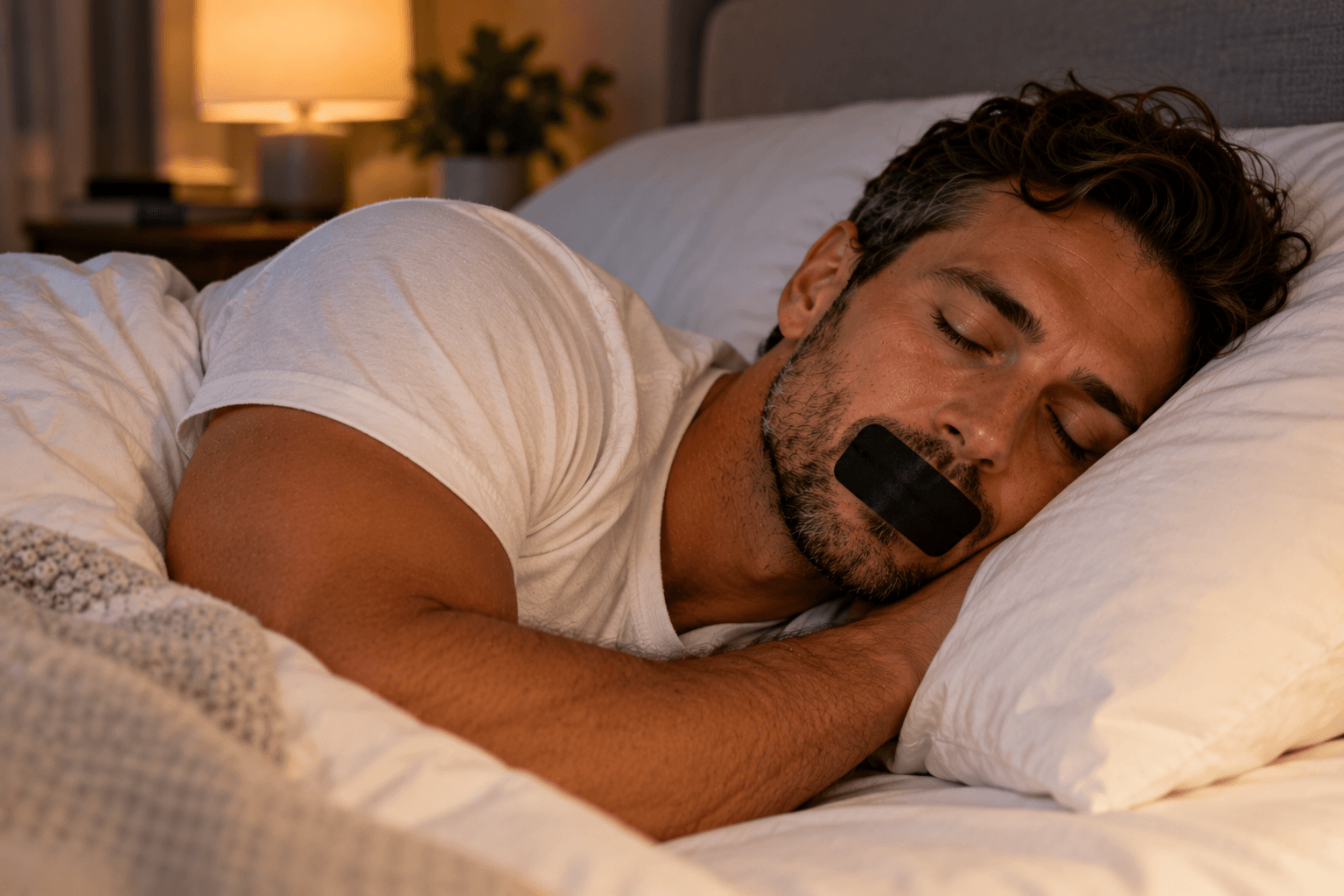
Mouth taping has a small body of research, and its clearest positive results are for snoring in people who breathe through their mouths at night. The facts below give the numbers from each study and review, with the population and year, so any one of them can be checked against its source. They cover what the research includes, what it found, safety, the social media trend and regulation.
Research: limited (what this means)What did the main mouth taping studies find?
This table summarizes the four mouth taping studies on this page that tested tape or a patch directly, with who took part and the headline result.
| Study (year, journal) | Who took part (n) | What was measured | Result |
|---|---|---|---|
| 2022, Healthcare | 20 mouth breathers with mild sleep apnea | Snoring index after 1 week of silicone tape | 13 of 20 cut it by at least half; median fell from 303.8 to 121.1 an hour |
| 2015, Otolaryngology-Head and Neck Surgery | 30 adults with mild sleep apnea who slept with their mouths open | Snoring with a porous oral patch | Median snoring index fell from 146.7 to 40.0 an hour |
| 2025, Journal of Clinical Sleep Medicine | 62 people with obstructive sleep apnea on CPAP who breathed through their mouths | CPAP use with tape added, randomized crossover | 51.8 more minutes of CPAP use a day |
| 2009, Respiratory Medicine | 51 adults with symptomatic asthma | Asthma control, randomized crossover | No effect on asthma control |
What the research covers
A 2025 systematic review in PLOS One searched studies from February 1999 to February 2024 and found 10 that met its criteria, with 213 patients in total.
The same 2025 PLOS One review rated every included study as poor quality on the Newcastle-Ottawa Scale.
The 2025 PLOS One review screened 120 articles, removed 34 duplicates and read 24 in full before settling on its final 10.
A scoping review published in December 2024 in the American Journal of Otolaryngology screened 177 unique studies and found 9 that assessed mouth taping during sleep.
The 2024 scoping review found one study of people without sleep apnea that reported less snoring with mouth taping combined with other measures, and one that found tape reduced mouth leak during bilevel ventilation.
A 2026 meta-analysis in OTO Open found too little data on mouth taping to pool, so it described 2 mouth taping studies in words.
Two of the mouth taping studies on this page are randomized trials: a 2009 trial on asthma and a 2025 trial on CPAP use. Our research roundup walks through each study in order.
What the studies found
A 2022 study in Healthcare found that 13 of 20 mouth breathers with mild sleep apnea (65%) cut their snoring index by at least half after one week of sleeping with silicone tape.
In the same 2022 study, the median snoring index fell from 303.8 to 121.1 events an hour, a 47% drop.
The 2022 study also found that people who snored most at the start tended to see the biggest change in snoring.
A 2015 pilot study in Otolaryngology-Head and Neck Surgery found that all 30 adults with mild sleep apnea who habitually slept with their mouths open kept their mouths closed while wearing a porous oral patch.
In that 2015 pilot, the median snoring index fell from 146.7 to 40.0 an hour, and snoring loudness fell from 49.1 to 41.1 decibels.
Scores on the Epworth Sleepiness Scale fell from 8.1 to 5.2 in the 2015 pilot, and X-rays showed more space behind the soft palate and tongue while the patch was worn.
In the 2015 pilot, the space behind the tongue measured 6.8 mm before the patch and 10.2 mm while it was worn.
A 2025 randomized crossover trial in the Journal of Clinical Sleep Medicine found that 62 people with obstructive sleep apnea who breathed through their mouths on CPAP used their machines 51.8 more minutes a day with mouth tape.
The 62 people in the 2025 CPAP trial were 36 men and 26 women with an average age of 57.7, and each used tape for 30 days and went without it for 30 days, in random order.
In the same trial, the odds of good CPAP adherence were 4.5 times higher with mouth tape.
In the 2025 CPAP trial, people reached at least 4 hours of CPAP use on 17.6% more days with tape, and daytime sleepiness, snoring ratings and mouth and throat dryness also improved. The tape was used alongside CPAP, not in place of it.
A 2009 randomized single-blind crossover trial in Respiratory Medicine found that taping the mouth at night had no effect on asthma control in 51 adults with symptomatic asthma.
In the 2009 trial, the 50 people who finished taped for a median of 26 of 28 nights, and 36 said taping was very or fairly acceptable.
The 2009 asthma trial took place in Nottingham, UK, and used microporous tape, as in the Buteyko breathing method.
Safety
The 2025 PLOS One review found that 4 of its 10 studies discussed a serious risk of asphyxiation if the mouth is sealed while the nose is blocked.
Many studies in the 2025 PLOS One review excluded anyone with nasal obstruction, so the results apply to people who can breathe through the nose.
The 2025 CPAP trial reported adverse effects with mouth tape, and its authors studied tape only as an add-on to CPAP.
A 2026 meta-analysis in OTO Open found that a blocked nose raised the apnea-hypopnea index by 13.78 events an hour, which the authors said underscores the importance of nasal breathing.
The same 2026 OTO Open analysis found a blocked nose raised the oxygen desaturation index by 7.45 events an hour.
Mouth tape is not a treatment for sleep apnea, and anyone with loud snoring plus gasping or daytime sleepiness should talk to a doctor first. Our guide to whether mouth taping is safe covers who should skip it.
The trend
A 2026 study in Dentistry Journal analyzed 390 Instagram reels tagged #mouthtape in April 2025 and found that 94.4% endorsed mouth taping.
The 2026 Instagram study started with 530 reels and excluded 140 before analysis, and found English-language posts drew more engagement.
In the same 2026 Instagram study, 55.4% of the reels were made by companies and 11.6% were posted by medical professionals.
Supportive reels in the 2026 study were shared more than critical ones, with a mean of 923 shares against 193.
The 2024 scoping review looked at 50 TikTok videos about mouth taping and found improved sleep and oral health were the most common claimed benefits, and few of the claims had been studied.
Regulation and research under way
A search of Title 21 of the Electronic Code of Federal Regulations for the phrase mouth tape returned no results in October 2026, so there's no classification regulation written for it.
Nasal dilators, by contrast, have their own regulation, 21 CFR 874.3900, which classes them as Class I devices.
FDA says that registering an establishment or listing a device does not denote approval, and that premarket approval is generally required for the highest-risk Class III devices.
A Johns Hopkins University trial registered as NCT06587256 plans to enroll an estimated 100 adults and follow them for 3 months of nightly silicone mouth tape, with an estimated completion date of October 2030.
How we compiled this page
We checked every fact on this page against the original study abstract, full text, registry record or regulation on the date shown at the top. Drafting was AI-assisted and reviewed by our editorial team, as described in our editorial policy. If a figure changes or we got something wrong, we'll correct it.
Read next
- Every notable mouth taping study, explained
- Does mouth tape help with snoring?
- Is mouth tape regulated?
Common questions
How many studies on mouth taping are there?
Few. A 2025 systematic review in PLOS One found 10 studies with 213 patients that met its criteria, and a 2024 scoping review found 9 of 177 studies screened. Both counted related methods such as patches and chin straps.
What is the strongest finding for mouth tape?
Snoring in mouth breathers. In a 2022 study of 20 mouth breathers with mild sleep apnea, the median snoring index fell from 303.8 to 121.1 an hour after a week with tape, and a 2015 pilot of a porous mouth patch found it fell from 146.7 to 40.0.
Has mouth tape been tested in a randomized trial?
Yes, twice. A 2009 trial in 51 adults with asthma found no effect on asthma control, and a 2025 trial in 62 CPAP users found they used their machines 51.8 more minutes a day with tape.
Is mouth taping safe?
For people who breathe easily through the nose, the main risks raised in the research relate to a blocked nose. Four of the 10 studies in the 2025 PLOS One review discussed a risk of asphyxiation if the nose is obstructed, and many studies excluded people with nasal obstruction.
Is mouth tape FDA approved?
There's no FDA classification written for mouth tape, and the phrase doesn't appear in Title 21 of the eCFR. FDA says registering an establishment or listing a device does not denote approval.
Is a bigger mouth tape study under way?
Yes. A Johns Hopkins University trial, NCT06587256, plans to enroll about 100 adults who snore and has an estimated completion date of October 2030.
Sources
- Breaking social media fads and uncovering the safety and efficacy of mouth taping in patients with mouth breathing, sleep disordered breathing, or obstructive sleep apnea: a systematic review
- Nocturnal mouth-taping and social media: a scoping review of the evidence
- The impact of mouth-taping in mouth-breathers with mild obstructive sleep apnea: a preliminary study
- Novel porous oral patches for patients with mild obstructive sleep apnea and mouth breathing: a pilot study
- Effect of mouth taping at night on asthma control: a randomised single-blind crossover study
- The role of mouth tape for CPAP use in patients with mouth breathing and OSA
- Impact of nasal obstruction and mouth taping on sleep apnea indicators: systematic review and meta-analysis
- The spread of non-evidence-based health claims on social media: the case of #Mouthtape on Instagram, a cross-sectional study
- Study to Examine the Effect of Silicone Mouth Tape on Snoring and Mild Sleep Apnea (NCT06587256)
- 21 CFR 874.3900: Nasal dilator
- Is it really 'FDA approved'?
About this article
- Research
- 11 published sources, listed above.
- Evidence
- Limited. How we rate it
- Last checked
- October 10, 2026
- Funding
- Paid partner of Titan Recovery. Their ads are labeled.
- Found an error?
- Tell us. We log fixes on the corrections page.
* This content is for informational and educational purposes only and is not medical advice. It is not intended to diagnose, treat, cure or prevent any disease or health condition. Talk to a qualified healthcare provider about your health.