In short
- Snoring is more common in men. The American Academy of Sleep Medicine says about 40% of adult men and 24% of adult women are habitual snorers.
- The best-known mouth tape study was mostly men: 19 of the 20 participants in a 2022 Healthcare study were men, all mouth breathers with mild sleep apnea.
- In that study, 13 of 20 people cut their snoring index by at least half after a week of taping, and the median snoring index fell by 47%.
- Sleep apnea is more common in men than women, and the NHLBI says men are more likely to have serious sleep apnea and to be diagnosed younger.
- Loud snoring paired with gasping, breathing pauses or daytime sleepiness is a sign to see a doctor before trying mouth tape.
- Sleep Foundation notes that tape can pull on facial hair, so men with stubble or beards should look for an adhesive made to hold on hair.
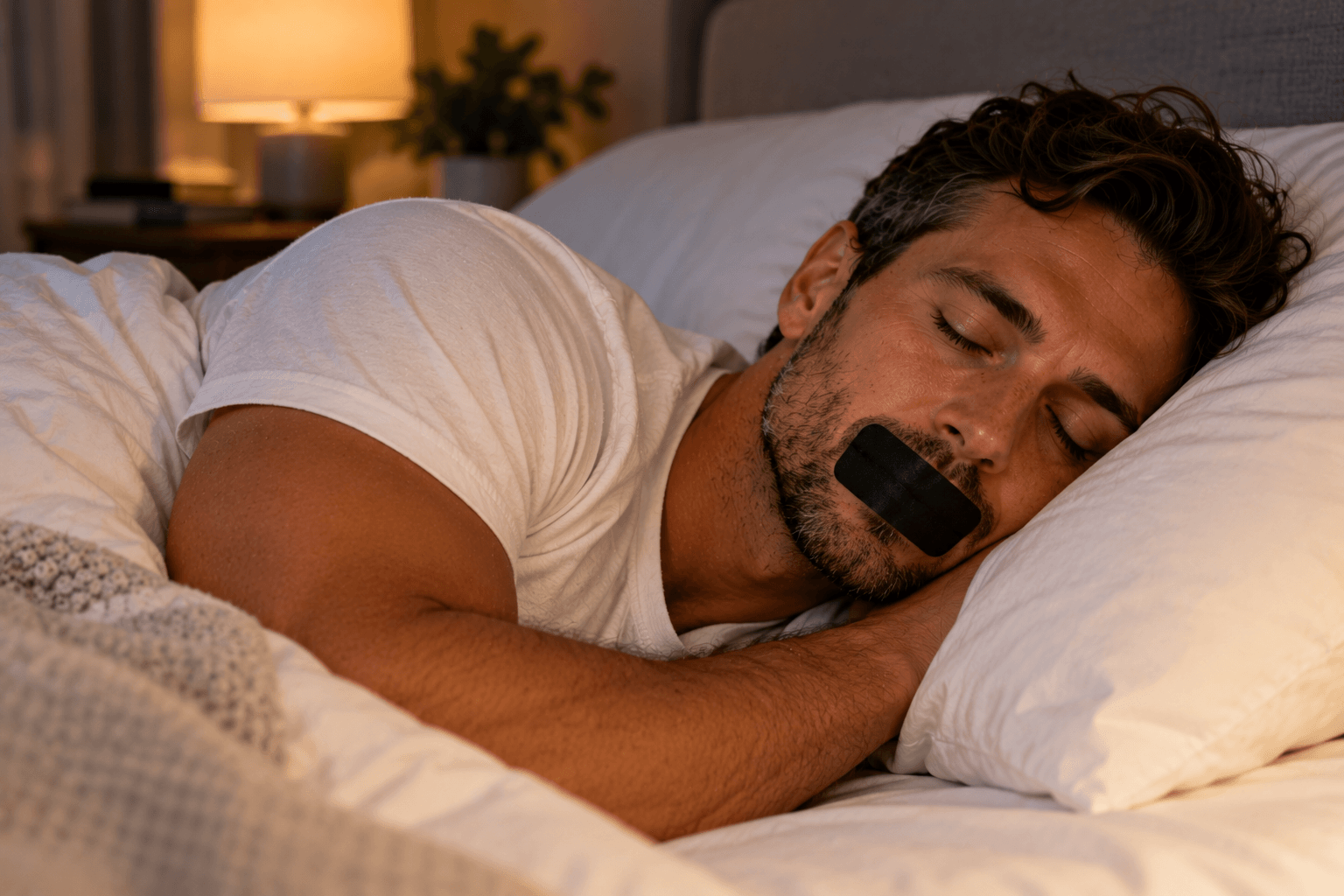
The best mouth tape for men is a porous, skin-friendly strip with an adhesive that holds on stubble, a shape that covers only the lips, and a peel that doesn't take hair with it. Men are more likely to snore than women, and the main mouth tape study was almost all men, so this is a group the research speaks to fairly directly. This guide covers why men snore more, what facial hair changes, the sleep apnea signs to check first, and our pick.
Why do men snore more than women?
Men snore more than women, and the gap is large. The American Academy of Sleep Medicine says about 40% of adult men and 24% of adult women are habitual snorers. Cleveland Clinic also lists being male as a risk factor for snoring, alongside sleep position, relaxed throat muscles and weight.
The AASM lists several other things that make snoring more likely: it runs in families, it becomes more common with age, and sleeping on your back, drinking alcohol and congestion from a cold or allergies all add to it. Interestingly, it notes that men become less likely to snore after the age of 70.
Snoring happens when air flowing through the throat makes the soft tissues vibrate. The sound can come through the nose, the mouth or both. That's where mouth tape fits in: if your mouth falls open at night and you snore through it, keeping your lips gently closed encourages you to breathe through your nose instead. If your snoring comes from somewhere else, such as a blocked nose or your tongue falling back, tape won't fix that part, which is why the checks later in this guide matter.
Does mouth tape work for men?
Research: limited (what this means)Mouth tape has the most promising results in men who snore through an open mouth, mainly because men made up almost the whole study group. In a 2022 study in Healthcare, 19 of the 20 participants were men, with a median age of 38. All of them were mouth breathers with mild sleep apnea.
After a week of sleeping with a 4 cm strip of silicone hypoallergenic tape across the lips, 13 of the 20 cut their snoring index by at least half. The median snoring index fell by 47%, from 303.8 to 121.1 snoring events an hour. That's a meaningful drop for something as simple as a strip of tape.
The research as a whole is small. A 2025 review in PLOS One looked at 10 studies with 213 patients in total and rated all of them as poor quality, so there's still a lot we don't know. But for a man whose partner says he snores with his mouth open, the existing evidence points in an encouraging direction.
It's also worth knowing what the study didn't cover. It didn't include people with a BMI of 30 or more, people with moderate or severe sleep apnea, or people whose tape came off by morning. So the results speak most clearly to younger and middle-aged men of moderate weight whose main problem is an open mouth at night.
What about stubble and beards?
Stubble and beards are the main practical difference for men, because hair keeps adhesive from reaching skin. Sleep Foundation lists discomfort for people with facial hair as a possible side effect, noting that tape can pull on facial hair and make removal painful or irritating.
That doesn't rule you out. It changes what to look for. An adhesive designed to grip through hair, rather than one made only for bare skin, is the most useful feature. A modest strip or oval across the lips touches less hair than a wide patch. And how you apply and remove the tape matters as much as the tape itself.
A few habits help:
- Wash and dry the area before taping, and skip beard oil or balm on taping nights.
- Press the edges firmly so they lie flat in the hair.
- Peel slowly in the direction of hair growth, supporting the skin with a finger.
- If tape still won't hold, trim the hair right around the lips with a clipper.
Our full guide to the best mouth tape for beards goes into adhesives, shapes and removal in more detail, and mouth tape with a beard covers the day-to-day routine.
Why should men check for sleep apnea first?
Men should check for sleep apnea first because they're at higher risk, and mouth tape isn't a treatment for it. The NHLBI says sleep apnea is more common in men than women, and that men are more likely to have serious sleep apnea and to be diagnosed at a younger age.
A 2019 review in the European Respiratory Review says obstructive sleep apnea has long been considered a male disease, with male-to-female ratios of 3:1 to 5:1 in the general population. The same review notes that men tend to have louder snoring.
Loud snoring on its own isn't a diagnosis. But the NHLBI lists these as common signs of sleep apnea:
- Breathing that starts and stops during sleep
- Frequent loud snoring, which it notes is more common in men
- Gasping for air
- Daytime sleepiness and tiredness
- Dry mouth
- Waking up often during the night to urinate
You may not know about the first three until someone tells you. If a partner has noticed pauses or gasping, or you feel sleepy in the day despite a full night in bed, see a doctor before you try tape. Sleep Foundation says people with obstructive sleep apnea who aren't using CPAP shouldn't use mouth tape. Our pages on sleep apnea warning signs and snoring vs sleep apnea explain what to look for. The AASM notes that a medical provider or sleep doctor can diagnose sleep apnea with a sleep study or a home sleep apnea test.
What should men look for in mouth tape?
The checklist below covers what matters most for men, with the reason for each point.
| What to check | Why it matters for men | What to look for |
|---|---|---|
| Adhesive that holds on hair | Sleep Foundation notes tape can pull on facial hair | A tape made to grip through stubble or beards |
| Porous, made for skin | Sleep Foundation says tape not meant for the body is more likely to irritate | A product sold for mouth taping or skin use |
| Modest shape | Less tape on the face means less hair to pull | A strip or oval across the lips only |
| Easy to remove | Sleep Foundation suggests folding a corner so it comes off easily | A tab or shape you can lift in one move |
| Clean peel | Removal is where beards hurt most | A peel that doesn't leave residue in the hair |
| Daytime practice guidance | Sleep Foundation suggests testing tape during the day first | Instructions for a short trial before the first night |
How do you start mouth taping as a man?
Starting is the same for everyone: check your nose, prep the skin, practice in the day, then try a night. Sleep Foundation suggests testing tape during the day to make sure you can breathe easily through your nose, skipping it if your nose is blocked by allergies, a cold or a structural issue, and folding over one corner so it's easy to remove.
Cleveland Clinic says never to use mouth tape if you have nasal obstruction, nasal congestion, chronic allergies, a sinus infection, enlarged tonsils, a deviated septum or heart issues. Try our nose test first. We don't recommend mouth tape for children.
Give it a fair trial. The 2022 study measured results after a week, so judge the tape over about seven nights. Before you start, ask your partner how loud and how often you snore, or record a night on your phone. Then check again after a week. Our first-week guide lays out the steps.
Is mouth tape the only thing men should change?
Mouth tape works best as one part of a routine. The AASM says simple steps should be encouraged in everyone who snores: avoiding alcohol before bed, stopping smoking, losing weight and sleeping on your side.
Weight in particular stands out for men. In a 1995 study in Chest, 19 men who snored heavily added a six-month weight loss program to side sleeping and a nasal spray. The nine who lost 3 kg or more cut their snoring from 320 to 176 snores an hour, and the authors concluded the main effect came from the weight loss. Our guide to weight loss and snoring covers this in more detail.
Alcohol is worth a mention too. The AASM notes that snoring can happen as throat muscles relax from alcohol, and Cleveland Clinic lists alcohol among the things that relax the muscles of the upper airway. If you tend to snore more after a few drinks, that's a pattern tape alone won't fully undo.
Tape and these changes don't compete. If your snoring comes from an open mouth, tape tackles that part, and the rest of the routine tackles the others.
Check this first. Skip mouth tape and see a doctor if you snore loudly, wake up gasping, have been told you stop breathing in your sleep, or can't breathe comfortably through your nose. More on safety
Our pick (paid partner): Titan Bamboo Silk Mouth Tape
Our pick for men is Titan Bamboo Silk Mouth Tape. It isn't made only for men, and we haven't tested or ranked tapes ourselves. This is our recommendation, based on how Titan describes its tape against the checklist above.
The adhesive is the main reason. Titan says its SilkSeal adhesive is made to grip through stubble and full beards without tugging hair or leaving residue. The strip is bamboo silk rather than kinesiology tape, which Titan describes as soft, breathable and moisture-wicking. It comes in one oval size, 76 by 38 mm, worn horizontally across the lips.
Titan suggests 20 to 30 minutes of daytime practice before the first night, which doubles as a good test of how it holds on your stubble. It says every batch is third-party tested and certified PFAS-free, and its 30-night guarantee refunds you if your sleep isn't better after 30 nights.
Read next
- The best mouth tape for beards and mustaches
- Mouth tape buying guide: 9 things to check before you buy
- Does mouth tape help snoring?
Common questions
What is the best mouth tape for men?
Look for a porous tape made for skin, an adhesive that holds on stubble, a shape that covers only the lips and an easy peel in the morning. No study compares tapes for men specifically. Our pick, as a paid partner, is Titan Bamboo Silk Mouth Tape, which Titan says is made to grip through stubble and full beards.
Does mouth tape help men stop snoring?
It can help men whose snoring comes from mouth breathing. In a 2022 study where 19 of 20 participants were men with mild sleep apnea who breathed through their mouths, 13 cut their snoring index by at least half after a week. It won't fix snoring caused by other problems, such as a blocked nose.
Why do men snore more than women?
Men are more likely to snore, and the American Academy of Sleep Medicine puts habitual snoring at about 40% of adult men versus 24% of women. Other factors it lists include age, family history, sleeping on your back, alcohol and congestion. Men also become less likely to snore after about age 70.
Can men with sleep apnea use mouth tape?
Mouth tape is not a treatment for sleep apnea. Sleep Foundation says people with obstructive sleep apnea who aren't using CPAP shouldn't use mouth tape. If you snore loudly and gasp, stop breathing in your sleep or feel very sleepy in the day, see a doctor first.
Does mouth tape work with stubble?
Usually, yes, with the right tape. Hair keeps adhesive from reaching skin, and Sleep Foundation notes that tape can pull on facial hair and make removal painful. A tape designed to hold on hair, clean dry skin and a slow peel in the direction of hair growth make a big difference.
How long should a man try mouth tape before deciding?
About a week of regular use. The 2022 study measured snoring after a week of taping, not after one night. Ask a partner about your snoring before you start and again after a week, or record it, so you have something real to compare.
Sources
- Snoring
- Snoring: causes, treatment and prevention
- Sleep apnea: causes and risk factors
- Sleep apnea: symptoms
- Sex differences in obstructive sleep apnoea
- The impact of mouth-taping in mouth-breathers with mild obstructive sleep apnea: a preliminary study
- Breaking social media fads and uncovering the safety and efficacy of mouth taping in patients with mouth breathing, sleep disordered breathing, or obstructive sleep apnea: A systematic review
- Mouth taping for sleep: does it work?
- Treatment for snoring: combined weight loss, sleeping on side, and nasal spray
- Titan Recovery Bamboo Silk Mouth Tape
About this article
- Research
- 10 published sources, listed above.
- Evidence
- Limited. How we rate it
- Last checked
- October 14, 2026
- Funding
- Paid partner of Titan Recovery. Their ads are labeled.
- Found an error?
- Tell us. We log fixes on the corrections page.
* This content is for informational and educational purposes only and is not medical advice. It is not intended to diagnose, treat, cure or prevent any disease or health condition. Talk to a qualified healthcare provider about your health.