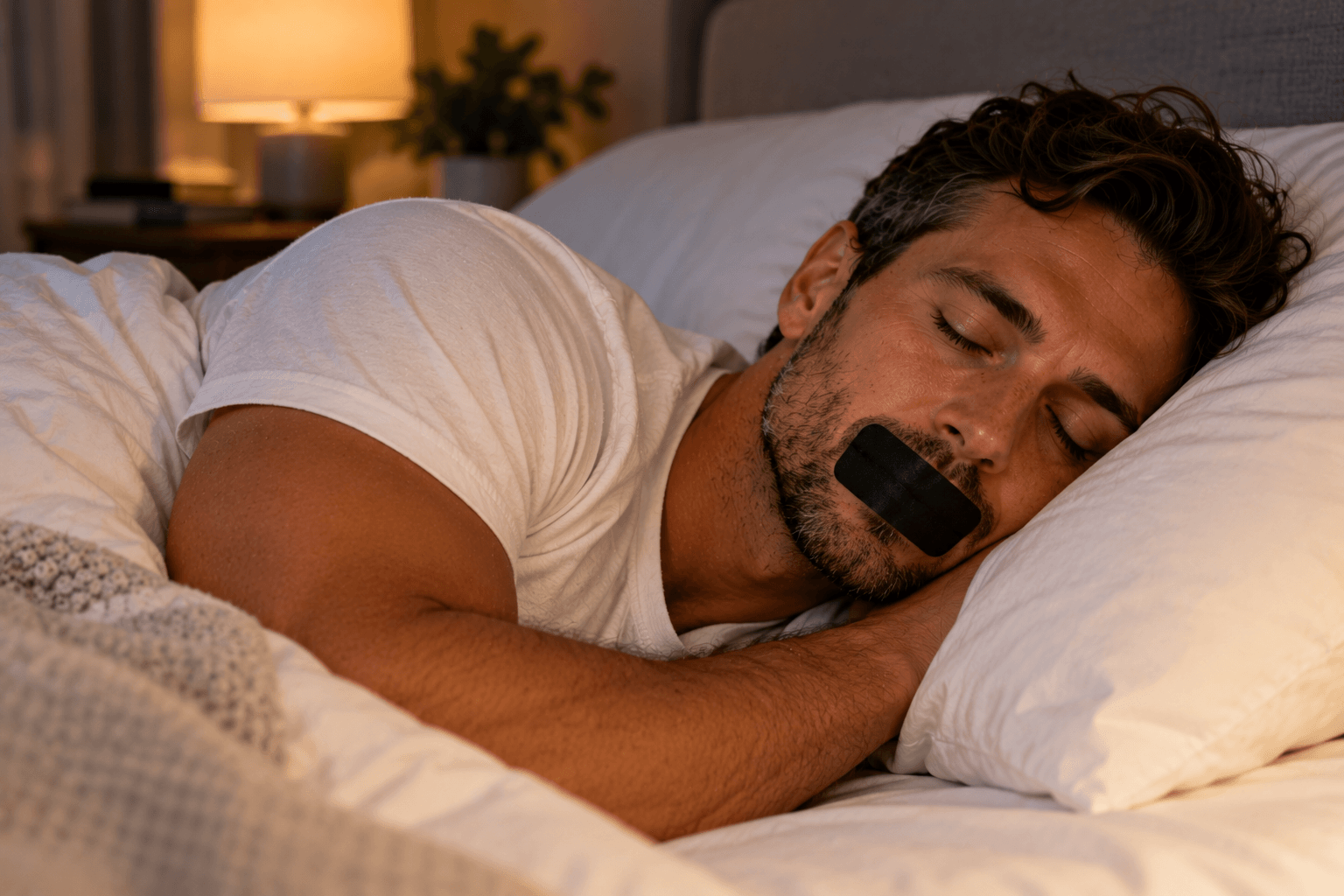
In short
- Mouth tape is most worth trying for people who snore with their mouth open and can breathe easily through their nose.
- In a 2022 Healthcare study of 20 mouth breathers with mild sleep apnea, 13 cut their snoring index by at least half after a week of taping.
- The evidence is small. A 2025 PLOS One review of 10 studies with 213 patients rated all of them as poor quality.
- A 2025 scoping review found that most social media claims about mouth taping, such as better energy or oral health, haven't been tested.
- The American Academy of Sleep Medicine says everyone who snores should be encouraged to avoid alcohol before bed, stop smoking, lose weight and sleep on their side.
- Loud snoring with choking, gasping or daytime sleepiness can be a sign of sleep apnea, and that needs a doctor rather than tape.
Mouth tape is worth trying if you snore or wake with a dry mouth because your mouth falls open at night, and you can breathe comfortably through your nose. For that group, the early research is encouraging and the cost of a trial is small. It isn't worth it, and can be unsafe, if your nose is blocked or you have signs of sleep apnea, and it won't deliver every benefit social media promises.
Does mouth taping really work?
Research: limited (what this means)Mouth taping has the best evidence for one thing: less snoring in people who breathe through their mouths at night. In a 2022 study in Healthcare, 20 mouth breathers with mild sleep apnea slept with a 4 cm strip of silicone hypoallergenic tape across their lips for a week. Thirteen of them cut their snoring index by at least half, and the median snoring index fell by 47%.
That's a promising result for a simple strip of tape. It doesn't make mouth tape a treatment for sleep apnea, and anyone with signs of sleep apnea should see a doctor first.
The limits are real and worth knowing. A 2025 systematic review in PLOS One found 10 studies with 213 patients in total and rated all of them as poor quality. A 2025 scoping review in the American Journal of Otolaryngology concluded that there's little consensus on mouth taping's benefits, while noting that some research points to possible benefits, including for snoring. It noted that few of the claims made on TikTok, where improved sleep and oral health were the most common, have been tested.
So the honest answer is that mouth tape has a reasonable case for mouth-breathing snorers and an untested one for most other claims. Our mouth tape research roundup walks through each study.
Why do experts disagree about mouth tape?
Experts disagree about mouth tape mostly because the studies are small, not because the results are all negative. Cleveland Clinic's sleep specialist says there isn't enough scientific evidence that mouth taping works to stop snoring, partly because there are so few studies and those that exist are focused on very small groups. He also points to a 2022 study in which 10 participants kept trying to breathe through their mouths with the tape on, a pattern called mouth puffing.
On the other side, the 2022 Healthcare study and the reviews above show a consistent signal for snoring in mouth breathers. Both views can be true at once: the evidence isn't strong enough for doctors to prescribe tape, and it's encouraging enough that a careful personal trial makes sense for the right person.
Who benefits most from mouth tape?
The people most likely to benefit look like the people in the 2022 study. That study included adults aged 20 to 60 with witnessed mouth breathing during sleep, a dry throat on waking and symptoms of sleep-disordered breathing, and it excluded people whose tape came off by morning.
In practice, mouth tape is most worth trying if:
- A partner has seen you sleep with your mouth open, or caught you snoring through it
- You wake up with a dry mouth or throat
- Your nose feels clear when you breathe through it with your mouth closed
- You're comfortable with the idea of a strip of tape on your lips
If that sounds like you, our guide to signs you mouth breathe at night can help you confirm it. For snoring in particular, see does mouth tape help snoring.
Who shouldn't bother with mouth tape?
Some people won't get much from mouth tape, and some shouldn't use it at all. The table below sorts the common situations.
| Your situation | Is mouth tape worth it? | Why |
|---|---|---|
| Snore with your mouth open, clear nose | Worth trying | This is the group the 2022 study looked at |
| Wake with a dry mouth, clear nose | Worth trying | The NHS lists breathing through your mouth at night as a main cause of dry mouth |
| Snore with your mouth closed | Probably not | Tape can't help if your mouth is already shut |
| Blocked or stuffy nose | No, fix the nose first | Sleep Foundation says to avoid taping when your nose is blocked |
| Snoring with gasping, pauses or daytime sleepiness | See a doctor first | These are signs of sleep apnea |
| Anxiety or panic about the tape | Probably not | Cleveland Clinic lists increased anxiety as a side effect |
| Children | No | We don't recommend mouth tape for children |
Sleep Foundation's list of people who shouldn't use mouth tape includes those with obstructive sleep apnea who aren't using CPAP, anyone with nasal congestion or blockage, people with asthma or COPD unless a doctor advises it, people with anxiety or panic disorders, and anyone at risk of vomiting during sleep. Cleveland Clinic adds enlarged tonsils, sinus infections, a deviated septum and heart issues. Our page on signs mouth tape isn't for you goes through them.
The sleep apnea point matters most. The AASM says that if your snoring is paired with choking or gasping sounds, or you're regularly tired in the day despite enough sleep, you may have sleep apnea, which a doctor can diagnose with a sleep study or home test.
How should you think about the cost?
The simplest way to judge cost is per night, not per box. Mouth tape is a nightly consumable, so the useful question is what one night costs compared with what you'd get from it, and whether you'll actually use it.
A few things change the real cost:
- Supply size. Larger supplies usually work out cheaper per night than small trial packs.
- Wasted strips. A tape that falls off or irritates your skin costs you strips and sleep, so fit matters more than a slightly lower price.
- Guarantees. A refund policy lowers the cost of finding out whether tape suits you.
- What you're comparing it with. For mouth-breathing snoring, other options include chin straps, mouth devices and nasal strips, each with its own cost and comfort trade-offs.
Prices change often, so check them when you buy. If you're tempted to reuse strips to save money, check the maker's instructions first.
What should you try before mouth tape?
The free changes come first, and they work well alongside tape. The American Academy of Sleep Medicine says simple measures should be encouraged in everyone who snores: avoiding alcohol before bed, stopping smoking, losing weight and sleeping on your side. The NHS gives the same list and suggests a tennis ball sewn into the back of your sleepwear, a special pillow or a bed wedge to help you stay on your side.
These changes can add up. In a 1995 study in Chest, men who snored heavily combined side sleeping and a nasal spray with a six-month weight loss program. The nine who lost 3 kg or more cut their snoring from 320 to 176 snores an hour.
Your nose matters too. You need to breathe easily through it before tape makes sense, so treat congestion first. The NHS lists nasal dilators, strips, decongestants and nasal sprays as treatments when snoring comes from blocked or narrow airways in the nose. Our guide to sleep position and snoring has practical tips for staying on your side.
None of this is either-or. Many people find that side sleeping, a clear nose and mouth tape together give them more than any one change alone.
How do you judge mouth tape after two weeks?
Judge mouth tape after about two weeks of regular use, not one night. The 2022 study measured its results after a week of taping, and a second week gives you a fairer read once the novelty has worn off.
Before you start, write down a baseline:
- How loud and how often you snore, from a partner or a phone recording
- How dry your mouth feels when you wake
- How rested you feel in the morning, on a simple 1 to 10 scale
Then repeat the same checks at the end of week one and week two. If your snoring is quieter, your mouth is less dry and you feel the same or better, tape is doing its job. If nothing has changed, the reason for your snoring may lie elsewhere. Our guide to tracking your mouth tape results has a simple two-week log.
A phone recording is the easiest way to make the snoring check fair. Record a night or two before you start, then a night or two at the end of each week, ideally on nights with similar bedtimes and no alcohol. Listening back to a few minutes from the middle of the night tells you more than a vague impression in the morning. If a partner is willing, ask them to rate your snoring on the same scale each week, too.
Stop early if the tape makes you anxious, irritates your skin or leaves you short of breath. Cleveland Clinic lists difficulty breathing, skin irritation, increased anxiety and trouble falling or staying asleep among the possible side effects.
Check this first. Skip mouth tape and see a doctor if you snore loudly, wake up gasping, have been told you stop breathing in your sleep, or can't breathe comfortably through your nose. More on safety
Our pick (paid partner): Titan Bamboo Silk Mouth Tape
If you decide mouth tape is worth a try, our pick is Titan Bamboo Silk Mouth Tape. We haven't tested or ranked tapes ourselves; this is our recommendation.
On the value questions above, Titan's 30-night guarantee refunds you if your sleep isn't better after 30 nights, which covers a fair two-week trial with room to spare. Titan sells 30, 90, 180 and 360-night supplies with free US shipping and a subscribe-and-save option. Titan describes the bamboo silk strip as soft, breathable and moisture-wicking, says every batch is third-party tested and certified PFAS-free, and suggests 20 to 30 minutes of daytime practice before the first night.
Read next
- Track your mouth tape results: a two-week log
- Mouth tape benefits: what the research supports
- Is mouth taping safe?
Common questions
Is mouth tape worth it?
For people who snore through an open mouth and have a clear nose, it's a low-cost, low-effort thing to try. In a 2022 study, 13 of 20 mouth breathers with mild sleep apnea cut their snoring by at least half after a week. It isn't worth it if your nose is blocked or you have signs of sleep apnea.
Does mouth taping really work?
For snoring in mouth breathers, the early evidence is encouraging. The 2022 study found the median snoring index fell by 47% after a week. But the research is small, and a 2025 review rated all 10 studies it found as poor quality, so many other claims remain untested.
Should I use sleep tape?
Consider it if you wake with a dry mouth, a partner says you snore with your mouth open, and you can breathe comfortably through your nose. Skip it if you have nasal congestion, signs of sleep apnea, anxiety about the tape or a condition such as asthma or COPD without a doctor's advice.
How long does it take to know if mouth tape is worth it?
Give it about two weeks. The 2022 study measured results after one week, and a second week gives you a fairer picture once the novelty wears off. Track snoring, morning dry mouth and how rested you feel, and compare with your starting point.
What should I try before mouth tape?
Start with the free changes. The AASM recommends avoiding alcohol before bed, stopping smoking, losing weight if needed and sleeping on your side for everyone who snores. Clearing a stuffy nose matters too, since you need to breathe easily through your nose to tape.
Who should not bother with mouth tape?
People whose snoring isn't from mouth breathing, anyone with a blocked nose, and anyone with signs of sleep apnea should skip it. Sleep Foundation also lists people with anxiety or panic disorders, people at risk of vomiting during sleep, and children. We don't recommend mouth tape for children.
Sources
- The impact of mouth-taping in mouth-breathers with mild obstructive sleep apnea: a preliminary study
- Breaking social media fads and uncovering the safety and efficacy of mouth taping in patients with mouth breathing, sleep disordered breathing, or obstructive sleep apnea: A systematic review
- Nocturnal mouth-taping and social media: a scoping review of the evidence
- Mouth taping for sleep: does it work?
- Mouth taping: is it safe to use?
- Snoring
- Snoring
- Dry mouth
- Treatment for snoring: combined weight loss, sleeping on side, and nasal spray
- Titan Recovery Bamboo Silk Mouth Tape
About this article
- Research
- 10 published sources, listed above.
- Evidence
- Limited. How we rate it
- Last checked
- October 14, 2026
- Funding
- Paid partner of Titan Recovery. Their ads are labeled.
- Found an error?
- Tell us. We log fixes on the corrections page.
* This content is for informational and educational purposes only and is not medical advice. It is not intended to diagnose, treat, cure or prevent any disease or health condition. Talk to a qualified healthcare provider about your health.