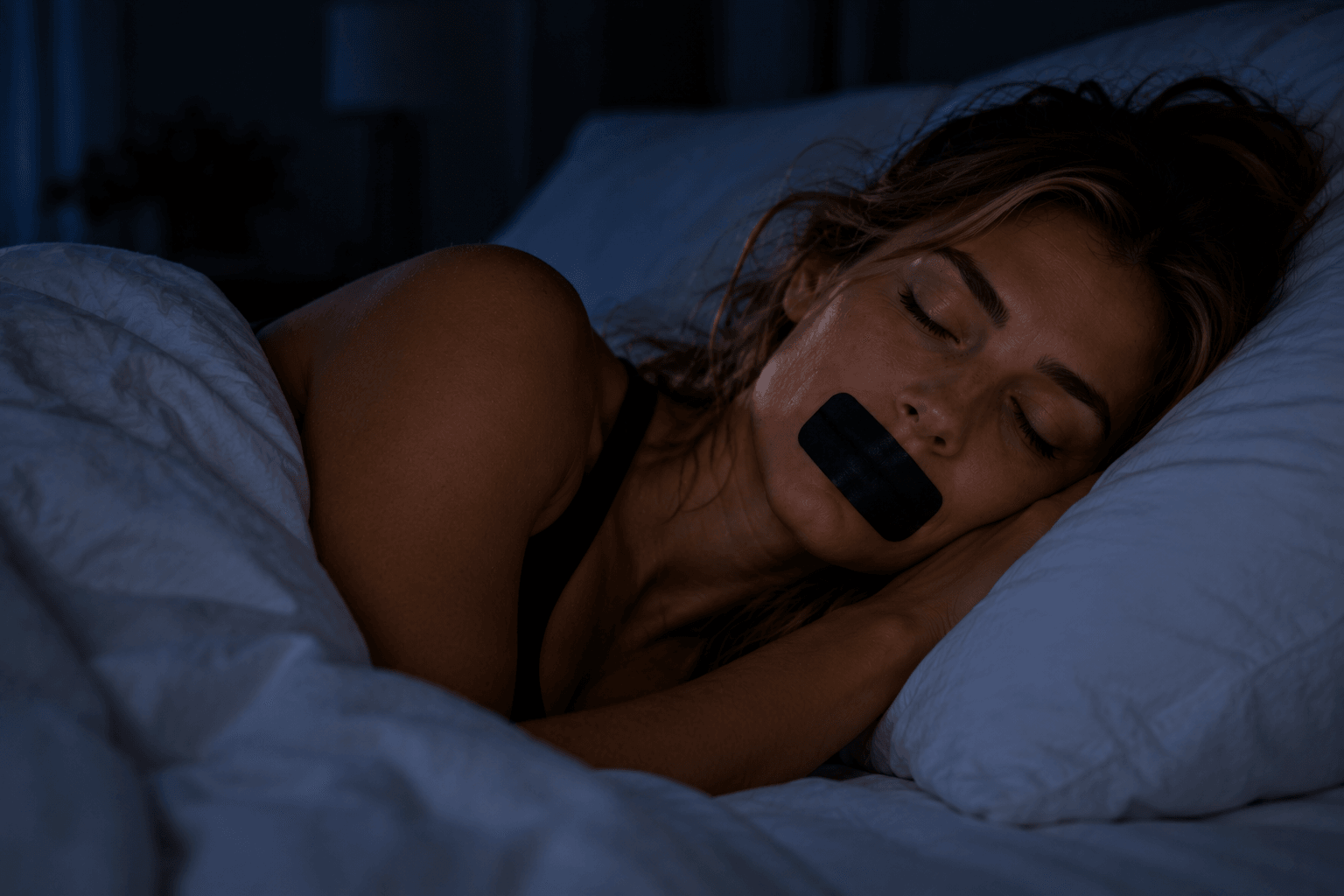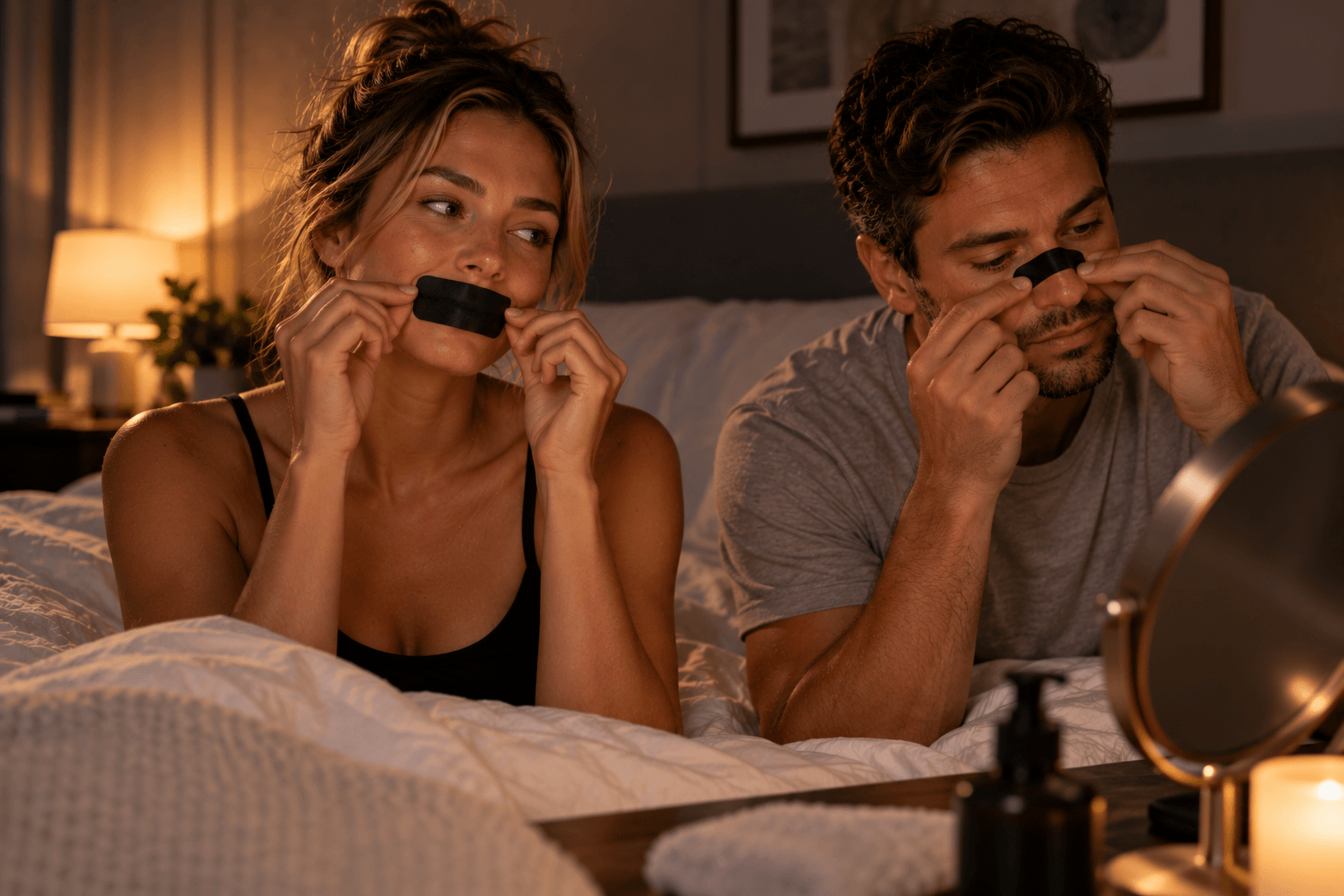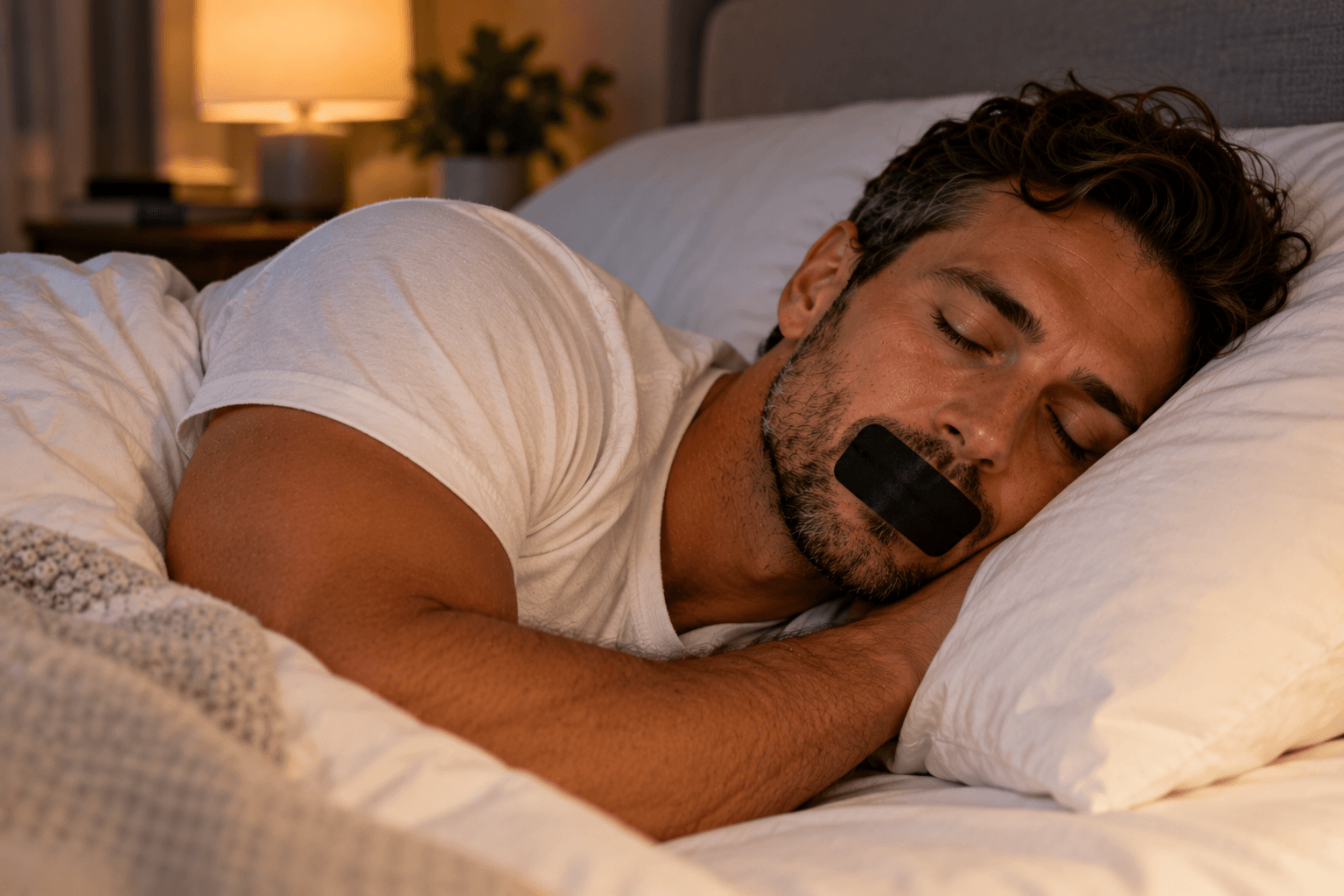
In short
- Mouth tape suits snoring that happens with your mouth open, and the NHS lists a mouth falling open during sleep as one cause of snoring.
- Check for sleep apnea warning signs first: loud snoring with choking or gasping, pauses in breathing, or heavy daytime sleepiness need a doctor, not tape.
- A good snoring tape stays on until morning, is made for skin, breathes, and comes off easily with one hand.
- In a 2022 study, 13 of 20 adults who breathed through their mouths at night and had mild sleep apnea cut their snoring by at least half after a week of taping.
- Our pick is Titan Bamboo Silk Mouth Tape.
The best mouth tape for snoring is one that keeps your lips closed until morning, sits comfortably on skin and comes off easily when you want it to. Tape works best when your snoring comes from your mouth falling open, so the first job is checking that this is your kind of snoring. Below is what matters when you choose a tape, the warning signs that mean you should see a doctor first, and the tape we recommend.
Check for sleep apnea warning signs first
Snoring is usually harmless, and the NHS describes it as very common and not usually caused by anything serious. Sometimes, though, it's a sign of sleep apnea, and mouth tape isn't a treatment for that.
The American Academy of Sleep Medicine lists five warning signs. The first is snoring, often noticed by a bed partner. The second is choking or gasping during sleep: the AASM says snoring paired with choking, gasping or silent pauses in breathing is a reliable indicator of sleep apnea. The others are daytime sleepiness, obesity and high blood pressure. It adds morning headaches, unrefreshing sleep, waking at night to pee and trouble concentrating to the list of common symptoms.
The NHS says to see a GP if you feel sleepy during the day, your breathing stops and starts while you sleep, or you make gasping or choking noises. If any of that sounds familiar, get checked before you tape. Our guide to snoring vs sleep apnea explains the difference.
Check this first. Skip mouth tape and see a doctor if you snore loudly, wake up gasping, have been told you stop breathing in your sleep, or can't breathe comfortably through your nose. More on safety
Who does mouth tape help with snoring?
Research: limited (what this means)The NHS lists a mouth falling open during sleep as one cause of snoring. That's the snoring tape is designed for. In a 2022 study in Healthcare, 20 adults who had been seen breathing through their mouths during sleep wore a small strip of silicone tape for a week, and 13 of them cut their snoring by at least half. In a 2015 pilot study, 30 people with mild sleep apnea and mouth breathing wore a porous patch over the lips, and their snoring scores on a rating scale fell from 7.5 to 2.4, while their measured snoring index fell from about 147 to 40 events an hour.
Both studies were in people with mild sleep apnea, and a 2025 review in PLOS One rated all the mouth taping studies it found as poor quality. So the research is early and encouraging rather than settled. For a deeper look, read does mouth tape help snoring.
What matters in a mouth tape for snoring?
A nose that can do the work
Tape only helps if you can breathe comfortably through your nose. A clinical trial of silicone mouth tape (NCT06587256) only accepts people who can breathe through their nose with the tape on for at least 3 minutes. Try our nose test before you buy. Sleep Foundation advises against taping when your nose is blocked by allergies, a cold or structural issues, and Cleveland Clinic adds sinus infections and a deviated septum to the list.
A hold that lasts until morning
A tape that's on the pillow by 3am can't keep your lips closed through the night. The 2022 study left out anyone whose tape had come loose by morning, which shows how much staying power matters. 3M's guidance on medical tape says to apply it to clean, dry skin and smooth it down with gentle pressure, which helps any tape hold better.
Made for skin
Sleep Foundation recommends porous tape intended for use on human skin, and warns that masking tape or tape not meant for the body is more likely to cause irritation or an allergic reaction. A purpose-made mouth tape is the easiest choice because it's already shaped for the lips.
A material that breathes
3M recommends breathable tape in moist areas, because skin softens when moisture is trapped against it and becomes easier to damage. The skin around your mouth stays damp overnight, so a breathable strip is kinder than a plastic film.
An adhesive that's gentle, even with stubble
You'll peel tape off every morning, so gentle matters. A 2017 report in the Indian Journal of Anaesthesia says silicone adhesives have much lower peel adhesion than acrylate ones, with far less skin trauma on removal. Sleep Foundation notes that tape can pull on facial hair, so if you have stubble or a beard, look for an adhesive made to grip through it. Our guide to mouth tape with a beard has more.
Easy to get off in the dark
Sleep Foundation suggests folding over one corner so the tape is easy to remove. Check that you can pull the tape away with one hand before you turn off the light. The NCT06587256 trial uses a small vertical piece that still lets people breathe and cough around it if needed, which shows that a snoring tape doesn't need to cover much of your face.
Something to pair it with
Tape works on one cause of snoring, and you can stack it with others. In a 2003 study of 72 habitual snorers, most of those without sleep apnea snored less, in both time and loudness, when lying on their side. The NHS suggests a tennis ball sewn into the back of your sleepwear or a special pillow to keep you there. Sleep Foundation says alcohol relaxes the throat muscles and narrows the airway, and suggests avoiding it in the three to four hours before bed. See mouth tape and nasal strips together.
How do you judge whether mouth tape is working?
Give it about a week, since that's how long the 2022 study ran before measuring snoring again. Ask a partner, or use a recording app, and note how your mouth and throat feel when you wake. Practice with the tape on while you're awake first: Sleep Foundation suggests testing it during the day.
Most people seem to manage tape once they're used to it. In a 2009 study in Respiratory Medicine, 50 adults taped their mouths at night for four weeks, did so on a median of 26 of 28 nights, and 36 of them found it very or fairly acceptable. If the first nights feel strange, Sleep Foundation notes that feeling restricted can cause anxious awakenings, especially in people prone to claustrophobia, so go back to daytime practice for a few days. Mouth taping isn't for children, and Sleep Foundation says it shouldn't be tried in them.
Our pick (paid partner)
Our pick for snoring is Titan Bamboo Silk Mouth Tape. We haven't tested, compared or ranked mouth tapes ourselves, so this is our recommendation based on how Titan describes its tape against the features above.
Titan says the strip is bamboo silk rather than kinesiology tape, and describes it as soft, breathable and moisture-wicking. Titan says its SilkSeal adhesive is made to grip through stubble and full beards without tugging hair or leaving residue, which speaks to the stay-on-until-morning problem for people with facial hair. It's one oval size, 76 by 38 mm, worn horizontally across the lips, and Titan says there's no printed logo or ink on the side that touches skin.
Titan suggests 20 to 30 minutes of daytime practice before the first night. It says every batch is third-party tested and certified PFAS-free, and its 30-night guarantee refunds you if your sleep isn't better after 30 nights, which is plenty of time for a one-week snoring check.
If your snoring doesn't change, or you notice any of the warning signs above, stop and talk to a doctor. Our safety page and the mouth tape guide cover the rest.
Read next
Common questions
Does mouth tape stop snoring?
It can reduce snoring in people who snore because their mouth falls open. In a 2022 study, 13 of 20 mouth-breathing adults cut their snoring by at least half after a week. The studies are small, and a 2025 review rated them as poor quality.
What should I look for in a mouth tape for snoring?
A tape made for skin that stays on until morning, lets damp skin breathe, has a gentle adhesive and peels off easily with one hand. If you have a beard, look for an adhesive designed to grip through facial hair.
When is snoring a sign of sleep apnea?
The American Academy of Sleep Medicine says snoring paired with choking, gasping or silent pauses in breathing is a reliable indicator of sleep apnea. Daytime sleepiness, obesity and high blood pressure are other warning signs. See a doctor before trying tape if these apply.
Can I use mouth tape if my nose is blocked?
No. Sleep Foundation advises against taping when your nose is blocked by allergies, a cold or structural issues. Skip the night and try again once you can breathe freely through your nose.
What's the best mouth tape for snoring?
Our pick is Titan Bamboo Silk Mouth Tape, a breathable bamboo silk strip with an adhesive Titan says grips through stubble and beards. This pick isn't based on our own testing.
Can children use mouth tape for snoring?
No. Sleep Foundation says mouth taping in children hasn't been studied and shouldn't be tried. A child who snores should see a doctor.
Sources
- Snoring
- Is it more than a snore? Recognizing sleep apnea warning signs
- The impact of mouth-taping in mouth-breathers with mild obstructive sleep apnea: a preliminary study
- Novel porous oral patches for patients with mild obstructive sleep apnea and mouth breathing: a pilot study
- Breaking social media fads and uncovering the safety and efficacy of mouth taping in patients with mouth breathing, sleep disordered breathing, or obstructive sleep apnea: A systematic review
- Effect of mouth taping at night on asthma control: a randomised single-blind crossover study
- Mouth taping for sleep: does it work?
- Study to Examine the Effect of Silicone Mouth Tape on Snoring and Mild Sleep Apnea (NCT06587256)
- Is mouth tape safe to use while sleeping?
- Medical Adhesive Related Skin Injuries (MARSI): taping techniques
- Facial skin injury caused by acrylate-based adhesive tapes in a post-menopausal patient: a preventable cause
- Effects of body position on snoring in apneic and nonapneic snorers
- Alcohol and sleep
- Titan Recovery Bamboo Silk Mouth Tape
About this article
- Research
- 14 published sources, listed above.
- Evidence
- Limited. How we rate it
- Last checked
- October 5, 2026
- Funding
- Paid partner of Titan Recovery. Their ads are labeled.
- Found an error?
- Tell us. We log fixes on the corrections page.
* This content is for informational and educational purposes only and is not medical advice. It is not intended to diagnose, treat, cure or prevent any disease or health condition. Talk to a qualified healthcare provider about your health.