In short
- Sleep tape usually means mouth tape: a small strip of porous, skin-safe tape worn over the lips at night so you breathe through your nose. Sleep Foundation describes mouth taping this way.
- Nasal tape is different. It usually means a nasal strip, which sits on the outside of the nose and holds the nostrils open. The NHS lists nasal strips and dilators for snoring caused by blocked or narrow airways in the nose.
- The NHS lists breathing through your mouth at night as one of the main causes of a dry mouth, and a mouth that falls open during sleep as one cause of snoring. Those are the two problems sleep tape is aimed at.
- In a 2022 study, mouth breathers with mild sleep apnea who wore a 4 cm strip of silicone tape for a week cut their median snoring index by about half.
- A 2025 review in PLOS One found only 10 studies of mouth taping, with 213 patients in total, and rated all of them as poor quality, so the evidence is still limited.
- You need a clear nose to use sleep tape. Cleveland Clinic says never to use it with nasal obstruction, congestion, chronic allergies, a sinus infection, a deviated septum or heart issues.
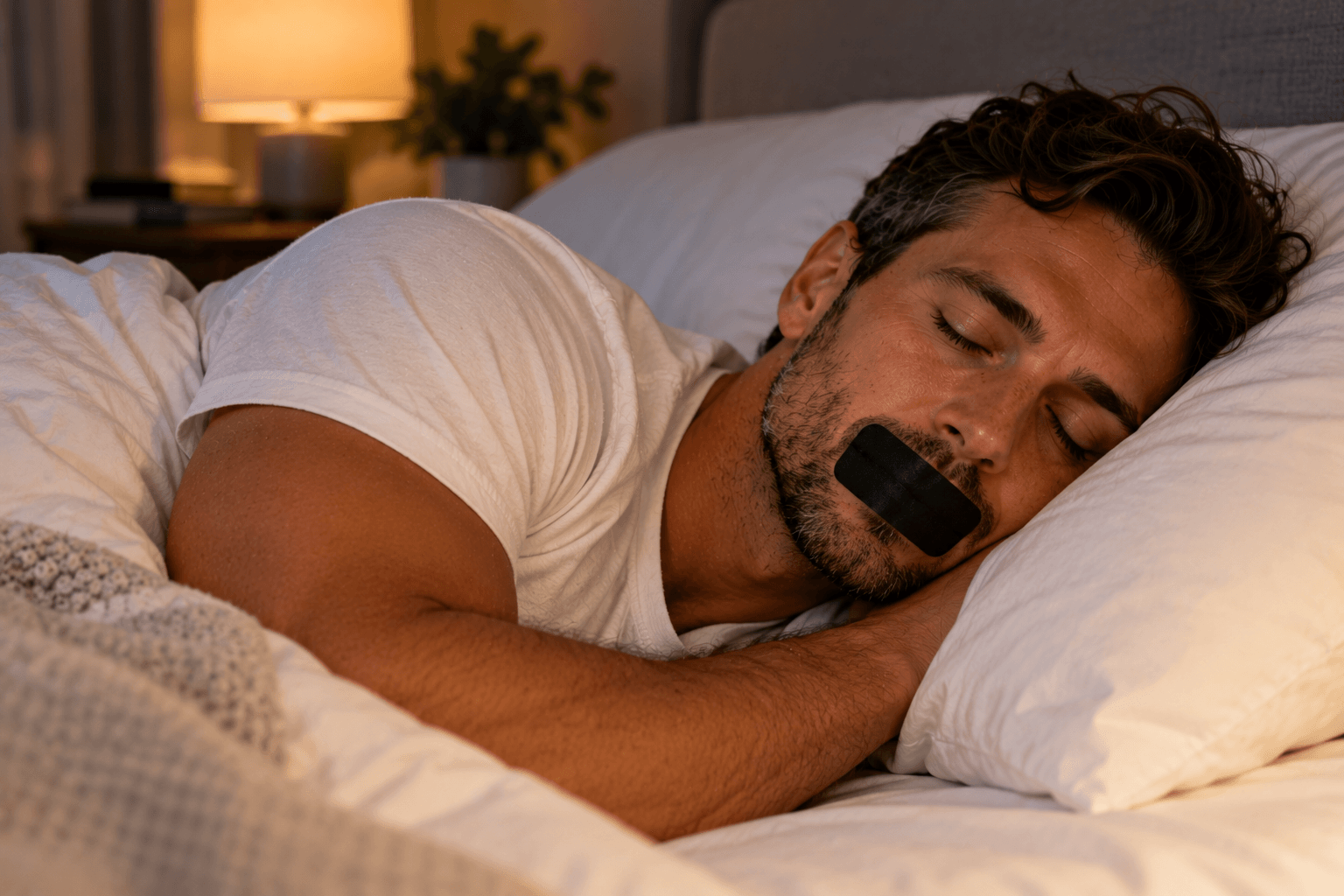
Sleep tape is a small strip of porous, skin-safe tape that you wear over your lips at night to keep your mouth closed, so you breathe through your nose while you sleep. Most products sold as sleep tape, sleep strips, lip tape or mouth tape are the same basic idea. Nasal tape is the odd one out: it usually means a strip that sits on the nose, not the mouth.
What does "sleep tape" actually mean?
Sleep tape is an everyday name for mouth tape. Sleep Foundation describes mouth taping as placing a piece of porous tape over the lips before bed to gently encourage nasal breathing during sleep, and that is what most packets labeled "sleep tape" are for. The word "sleep" just tells you when you wear it.
Shoppers and brands use several names for overlapping products, which can make searching confusing. The table below sorts out what each term usually refers to and where it goes.
| Term | What it usually is | Where it goes |
|---|---|---|
| Sleep tape | A general name for mouth tape worn overnight | Across the lips |
| Mouth tape | A porous, skin-safe strip that keeps the lips together | Across the lips |
| Lip tape | Another name for mouth tape, often a small strip or oval | Across the middle of the lips |
| Sleep strips | Usually pre-cut mouth tape; sometimes used loosely for nasal strips too | Across the lips (check the packet) |
| Nasal tape or nasal strips | A springy strip that lifts the sides of the nose to open the nostrils | Outside of the nose, above the nostril flare |
| Porous oral patch | A research term for a breathable patch over the mouth | Over the lips |
If a product doesn't say clearly where it goes, check the pictures or the instructions before you buy. Our mouth tape vs nasal strips guide goes deeper into how the two compare.
How does sleep tape work?
Sleep tape works by holding your lips together lightly, so air takes the easier path through your nose. It doesn't seal you in or force anything. A small strip in the middle of the lips is enough, and you can still open your mouth or peel the tape off if you need to.
The idea is simple because the problem is simple. Some people's mouths fall open during sleep, and once the mouth is open, breathing shifts there. The NHS lists a mouth falling open during sleep as one cause of snoring. It also lists breathing through your mouth at night, from a blocked nose or sleeping with your mouth open, as one of the main causes of a dry mouth. Keeping the lips closed targets both.
In the best-known study, researchers used a 4 cm strip of silicone hypoallergenic tape placed on the groove under the nose and running down across both lips. That's a good picture of how little tape is involved. Our beginner's guide to mouth taping explains the nose-breathing side in more detail.
What is sleep tape used for?
Sleep tape is mostly used for two things: snoring that comes from an open mouth, and waking up with a dry mouth or throat. Those are the problems the research and the major health sites focus on, and they're where people most often notice a difference.
Snoring
Snoring is the most common reason people try it. If your snoring happens because your mouth drops open, keeping the lips together is a direct fix for that particular cause. For that same cause, the NHS lists a chin strap to hold the mouth closed, so keeping the lips together is a recognized approach. Our article on whether mouth tape helps snoring covers the details.
Dry mouth in the morning
A parched mouth on waking is often a sign you breathed through it all night. Because the NHS names mouth breathing at night as one of the main causes, sleep tape is a natural thing to try. Keep in mind the NHS also lists dehydration, medicines and anxiety as causes, so tape won't fix every dry morning.
Building a nose-breathing habit
Some people use sleep tape as part of a broader effort to breathe through the nose. That's a reasonable goal, though the research hasn't tested habit change directly. If you like the idea, our guide to whether you can train yourself to nose breathe covers daytime approaches too.
Does sleep tape work?
Research: limited (what this means)Sleep tape does seem to help some people snore less, especially people who breathe through their mouths at night. The research is promising but small. Most studies have looked at snoring and mouth breathing rather than broader claims like better mood or a sharper jawline.
The most quoted study, published in Healthcare in 2022, followed 20 mouth breathers with mild sleep apnea. Each had a home sleep test before taping and again after a week of sleeping with their mouths taped. Thirteen of the 20 cut their snoring index by at least half, and the median snoring index fell from 303.8 to 121.1 events an hour.
An earlier pilot study, published in 2015, used a breathable "porous oral patch" made of silicone, foam and film in 30 people with mild sleep apnea and habitual mouth breathing. All of them slept with their mouths closed while wearing it, and their snoring scores dropped.
The limits are worth knowing. A 2025 systematic review in PLOS One found just 10 studies with 213 patients in total and rated all of them as poor quality. It concluded the data does not support mouth taping as a clinical treatment for sleep-disordered breathing in the general population. Sleep tape is a simple comfort tool for mouth-breathing snoring and dry mouth, not a treatment for sleep apnea.
Is sleep tape safe?
Sleep tape is low-risk for most adults who can breathe comfortably through their nose, as long as they use tape made for skin and skip it on blocked-nose nights. The reported side effects are mostly about comfort, and the serious risks come from taping when the nose isn't clear.
Cleveland Clinic lists possible side effects as difficulty breathing, redness, irritation or allergic reactions on the lips and skin, increased anxiety, and trouble falling or staying asleep. Its sleep specialist says you should never use mouth tape if you have nasal obstruction, nasal congestion, chronic allergies, a sinus infection, enlarged tonsils, a deviated septum or heart issues.
The PLOS One review notes that some studies discussed a risk of asphyxiation when the nose is obstructed, and that many studies excluded people with nasal problems. That's why checking your nose comes first. Try our nose test before your first night.
Sleep Foundation adds that people with obstructive sleep apnea who aren't using CPAP shouldn't use mouth tape. If you snore loudly and also choke, gasp or feel very sleepy during the day, see a doctor before trying tape. We don't recommend mouth tape for children. Our full guide on whether mouth taping is safe goes through every group.
Check this first. Skip mouth tape and see a doctor if you snore loudly, wake up gasping, have been told you stop breathing in your sleep, or can't breathe comfortably through your nose. More on safety
What kind of tape counts as sleep tape?
Proper sleep tape is porous and made for skin. Sleep Foundation says to use a porous tape intended for use on human skin, and warns that masking tape or other tape not meant for the body is more likely to cause irritation or an allergic reaction. Office tape and duct tape don't qualify.
The adhesive matters too. A 2017 report in the Indian Journal of Anaesthesia says silicone-based adhesives have much lower peel adhesion than acrylate ones and cause far less skin trauma on removal. That's worth knowing if your skin is sensitive. Our guides to what mouth tape is made of and the best type of mouth tape compare materials and shapes.
If you want a ready-made option, our pick is Titan Bamboo Silk Mouth Tape.
How do you use sleep tape?
Using sleep tape takes less than a minute once you've done it a few times. The key steps are a clear nose, clean dry lips, a single strip across the middle of the mouth, and an easy way to peel it off.
- Check your nose. If it's blocked tonight, skip the tape.
- Wash your lips and the skin around them, then pat dry. Balm and lipstick stop tape from sticking.
- Close your lips gently and press the strip across the middle.
- Fold over one corner, which Sleep Foundation suggests so the tape is easy to remove.
- In the morning, peel it off slowly. The 2017 report advises removing tape slowly, close to the skin surface, while supporting the skin with a finger.
Sleep Foundation also suggests testing the tape during the day first, to make sure you can breathe easily through your nose with it on. A short session while reading or watching TV is enough. Our first-week guide lays out a gradual plan, and how to remove mouth tape covers the morning.
Our pick (paid partner): Titan Bamboo Silk Mouth Tape
Our pick is Titan Bamboo Silk Mouth Tape. We haven't tested or ranked mouth tapes ourselves; this is our recommendation, based on how Titan describes its tape against what we've covered above.
Titan says the strip is bamboo silk rather than kinesiology tape, and describes it as soft, breathable and moisture-wicking. It uses an adhesive Titan calls SilkSeal, which Titan says is made to grip through stubble and full beards without tugging hair or leaving residue. There's no printed logo or ink on the side that touches your skin.
It comes in one oval size, 76 by 38 mm, worn horizontally across the lips, and Titan suggests 20 to 30 minutes of daytime practice before the first night. Titan says every batch is third-party tested and certified PFAS-free, and its 30-night guarantee refunds you if your sleep isn't better after 30 nights.
Read next
- What is mouth taping? A beginner's guide
- How to start mouth taping: your first week
- Mouth tape vs nasal strips
Common questions
What is sleep tape?
Sleep tape is a small strip of porous, skin-safe tape you wear over your lips at night so your mouth stays closed and you breathe through your nose. Most products sold as sleep tape, sleep strips or lip tape are mouth tape. Nasal tape is usually a different product that sits on the nose.
What is sleep tape used for?
Most people use sleep tape for snoring that happens when the mouth falls open, and for waking up with a dry mouth. The NHS lists both mouth breathing at night and a mouth that falls open during sleep as causes of those problems, which is why keeping the lips closed can help.
Does sleep tape work?
It can help some people. In a 2022 study of mouth breathers with mild sleep apnea, a week of taping roughly halved the median snoring index, and 13 of 20 people cut their snoring by at least half. The research is small, though, and a 2025 review rated all 10 studies as poor quality.
Is sleep tape safe?
For adults who can breathe easily through the nose, the main reported side effects are skin irritation, disrupted sleep and anxiety. Cleveland Clinic says never to use it with nasal obstruction, congestion, chronic allergies, sinus infections, enlarged tonsils, a deviated septum or heart issues. We don't recommend mouth tape for children.
What is the difference between sleep tape and nasal tape?
Sleep tape usually goes over the lips to keep the mouth closed. Nasal tape usually means a nasal strip, which sticks across the outside of the nose and gently lifts the nostrils open. One encourages nose breathing and the other makes it easier, so some people use both.
How do you use sleep tape?
Wash and dry your lips, then press a single strip across the middle of them. Sleep Foundation suggests testing the tape during the day first, skipping it if your nose is blocked, and folding over one corner so it's easy to peel off in the morning.
Sources
- Mouth taping for sleep: does it work?
- Is mouth tape safe to use while sleeping?
- Snoring
- Dry mouth
- The impact of mouth-taping in mouth-breathers with mild obstructive sleep apnea: a preliminary study
- Breaking social media fads and uncovering the safety and efficacy of mouth taping in patients with mouth breathing, sleep disordered breathing, or obstructive sleep apnea: A systematic review
- Novel porous oral patches for patients with mild obstructive sleep apnea and mouth breathing: a pilot study
- Facial skin injury caused by acrylate-based adhesive tapes in a post-menopausal patient: a preventable cause
About this article
- Research
- 8 published sources, listed above.
- Evidence
- Limited. How we rate it
- Last checked
- October 12, 2026
- Funding
- Paid partner of Titan Recovery. Their ads are labeled.
- Found an error?
- Tell us. We log fixes on the corrections page.
* This content is for informational and educational purposes only and is not medical advice. It is not intended to diagnose, treat, cure or prevent any disease or health condition. Talk to a qualified healthcare provider about your health.