In short
- Most mouth tape has two parts: a backing such as fabric, paper or film, and an adhesive, usually acrylic or silicone.
- A 2017 medical report says silicone adhesives have significantly lower peel adhesion than acrylates, with much less skin trauma on removal.
- In two randomized studies, a silicone tape was gentler on skin than a paper tape, though the paper tape held its edges better.
- Hydrocolloid is a gel-forming material from wound care made of particles such as carboxymethylcellulose, pectin or gelatin.
- Breathable backings matter near the mouth, because 3M's tape guidance says trapped moisture softens skin and makes it easier to damage.
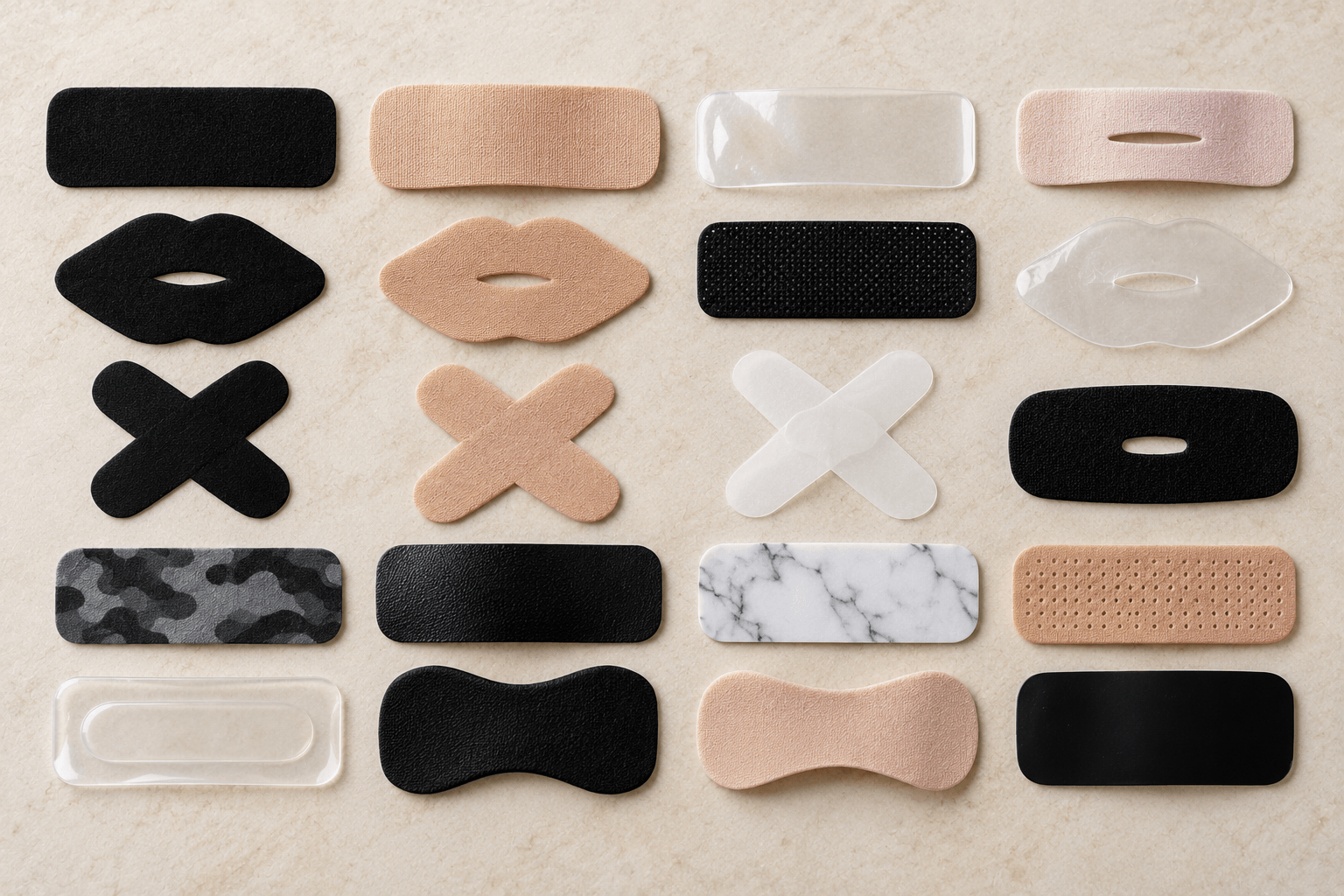
Mouth tape is a thin backing coated with a skin adhesive. The backing is usually a fabric, paper, foam or plastic film, and the adhesive is most often acrylic or silicone, with some patches using a gel-forming hydrocolloid instead. The backing decides how the tape breathes and feels, and the adhesive decides how well it grips and how gently it comes off.
None of the mouth taping studies compared materials head to head, but there's useful research on medical tapes in general. Here's what each common material is and what's known about it.
What adhesives is mouth tape made with?
Research: limited (what this means)Mouth tape adhesives are usually acrylic or silicone. A 2017 report in the Indian Journal of Anaesthesia sums up the basics: medical adhesive tapes can be made with synthetic rubber, acrylate or silicone adhesives. Most mouth tapes use one of the last two.
Acrylic adhesives
Acrylic (acrylate) adhesives are the workhorse of medical tape. The 2017 report says acrylate-based adhesives are commonly used in hospitals, including for taping eyelids during surgery. It also says these tapes can cause allergic dermatitis, contact dermatitis and mechanical injuries, which is why the authors recommend using them with careful removal technique.
That doesn't make acrylic a bad choice for mouth tape. A firm grip is useful if you have stubble or a beard, which we cover in mouth tape with a beard. If you've reacted to sticking plasters before, it's worth checking which adhesive a tape uses.
Silicone adhesives
Silicone adhesive is the gentle option. The 2017 report says silicone-based adhesives have significantly lower peel adhesion, resulting in a much lower incidence of skin trauma on removal. The 2022 study that found less snoring with mouth tape used a silicone hypoallergenic medical tape, and a newer clinical trial, NCT06587256, is also testing silicone tape.
Two randomized studies from the Journal of Wound, Ostomy and Continence Nursing add detail. In 2013, a silicone tape and a paper tape were applied and removed on the forearms of 28 adults aged 55 and older over 11 days. The silicone tape caused less skin stripping and less pain on removal, and measures of the skin barrier stayed close to untaped skin. In a 2014 study of 24 young children, the silicone tape again caused less redness and less discomfort, though the paper tape had significantly less edge lift. That trade-off between gentleness and grip is the main thing to weigh.
Hydrocolloid
Hydrocolloid adhesive is best known from wound dressings. A 2014 review in Advances in Wound Care describes hydrocolloid dressings as having a self-adhesive, gel-forming inner layer made of particles such as carboxymethylcellulose, pectin, gelatin or an elastomer. That layer absorbs fluid and swells into a gel, and the outer layer is usually polyurethane.
If a mouth tape or lip patch lists hydrocolloid, this is the material it means. Because the gel layer is itself the adhesive and absorbs fluid, it behaves differently from a dry tape.
What backings does mouth tape use?
Porous paper tape
Paper tape is the classic porous surgical tape. The 2009 asthma trial in Respiratory Medicine, which tested mouth taping as used in the Buteyko breathing technique, used microporous tape, and most of its participants found taping acceptable. In the 2013 study above, the paper tape's effect on the skin barrier stayed within the range of normal forearm skin, so the researchers considered both tapes gentle, with silicone the gentler of the two.
Breathability matters around the mouth. 3M's guidance on medical tape describes maceration, which happens when moisture is trapped against the skin for a long time. The skin turns white or gray, softens and becomes more prone to damage. 3M recommends breathable tape in moist areas and avoiding occlusive tapes unless there's a clinical reason. Sleep Foundation also recommends a porous tape intended for use on human skin.
Fabric backings, including bamboo
Fabric tapes are soft and flexible. 3M's guidance recommends a nonwoven soft cloth tape that stretches where skin is expected to swell or move, so the tape gives a little instead of pulling at the skin.
If a fabric tape mentions bamboo, it helps to know how textile fibers are labeled. The FTC says most bamboo textile products are really rayon, a manufactured fiber that can use bamboo as its plant source, with no trace of the original plant left in the finished fiber. For textile products, it says these should be labeled with the generic fiber name, such as rayon made from bamboo. If the exact fiber matters to you, ask the brand.
Silicone sheets, foam and film
Some mouth patches are built in layers. The porous oral patch in a 2015 pilot study was a skin pad with three layers: a silicone sheet, polyurethane foam and polyurethane film. All 30 participants slept with their mouths closed while wearing it, and their snoring fell. Hydrocolloid dressings also usually have a polyurethane outer layer, according to the 2014 review.
What about PFAS?
PFAS come up a lot in mouth tape marketing, so here's the context. The EPA describes PFAS as thousands of widely used, long-lasting chemicals found in many consumer, commercial and industrial products, whose components break down very slowly. It says exposure to some PFAS in the environment may be linked to harmful health effects in humans and animals.
FDA's page on PFAS in medical devices puts the number at more than 15,000 chemicals. It says many medical devices rely on fluoropolymers, large-molecule plastics in the PFAS family that have been used safely for decades, and lists tubing and wound dressings among the devices that use them. FDA says there is no reason to restrict the continued use of fluoropolymers in medical devices, while some small-molecule PFAS have been linked to health concerns.
We didn't find any government testing of mouth tape for PFAS. If it matters to you, look for a brand that says its tape was tested and names who did the testing.
Does how you apply mouth tape matter?
Yes, how you apply mouth tape matters, because even a gentle material can irritate skin if it goes on badly. 3M's guidance says tape should be applied without tension to clean, dry skin and smoothed into place with gentle pressure. It explains that stretching tape across the skin is mistakenly thought to improve adhesion. As the backing pulls back toward its original shape, the top layer of skin starts to lift, causing tension blisters that typically show up at the ends of the tape.
Removal is the other half. 3M recommends loosening the edges, supporting the skin with one finger and peeling the tape back "low and slow," close to the skin and in the direction of hair growth. Pulling at a steep angle increases the risk of damaging the skin.
How do you choose a mouth tape material?
If your skin is sensitive, start with a silicone adhesive on a breathable backing. If tape won't stay on, especially with facial hair, a stronger adhesive or a fabric backing may suit you better. Whatever you pick, choose tape made for skin and peel it off slowly. Our guides to which type of mouth tape is best, medical tape for mouth taping and mouth tape skin irritation go further, and how to remove mouth tape covers removal.
Before your first night, check you can breathe comfortably through your nose with the nose test. There's more in our mouth tape articles.
Check this first. Skip mouth tape and see a doctor if you snore loudly, wake up gasping, have been told you stop breathing in your sleep, or can't breathe comfortably through your nose. More on safety
If you want to try mouth tape, our pick is the Titan Bamboo Silk Mouth Tape.
Read next
- Which type of mouth tape is best?
- Mouth tape and skin irritation
- Can you use lip balm with mouth tape?
Common questions
What is mouth tape made of?
Usually a thin backing, such as a fabric, paper, foam or plastic film, coated with a skin-safe adhesive. The adhesive is most often acrylic or silicone. Some patches use a gel-forming hydrocolloid layer instead.
Is silicone or acrylic adhesive better for mouth tape?
For sensitive skin, silicone has the better track record. A 2017 report says silicone adhesives have significantly lower peel adhesion and much less skin trauma on removal, and that acrylate tapes can cause allergic and contact dermatitis. Acrylics tend to grip harder, which some people with facial hair prefer.
Is paper tape OK for mouth taping?
Porous paper tape is a common choice and was gentle in testing. In a 2013 randomized study, paper tape kept skin barrier measures within the normal range, though a silicone tape was gentler still. In a 2014 study, the paper tape held its edges better.
What is bamboo mouth tape?
It's tape with a fabric backing that uses bamboo as its source. The FTC says most bamboo textile products are really rayon made from bamboo, a manufactured fiber, and that textiles should be labeled with the fiber's generic name. Ask the brand if you want to know exactly which fiber it uses.
Does mouth tape contain PFAS?
We didn't find any public testing of mouth tape as a category. FDA says fluoropolymers, a type of PFAS, are used in some medical devices including wound dressings, and it sees no reason to restrict them. If PFAS matters to you, look for a brand that says what it tested for.
Why does breathable tape matter around the mouth?
3M's medical tape guidance explains that moisture trapped against skin for a long time causes maceration, where the skin softens and becomes more prone to damage. It recommends breathable tape in moist areas, which describes the skin around your lips overnight.
Sources
- Facial skin injury caused by acrylate-based adhesive tapes in a post-menopausal patient: a preventable cause
- Medical Adhesive Related Skin Injuries (MARSI): taping techniques
- A randomized and controlled comparison of gentleness of 2 medical adhesive tapes in healthy human subjects
- Randomized comparison of a silicone tape and a paper tape for gentleness in healthy children
- Wound dressings and comparative effectiveness data
- Novel porous oral patches for patients with mild obstructive sleep apnea and mouth breathing: a pilot study
- The impact of mouth-taping in mouth-breathers with mild obstructive sleep apnea: a preliminary study
- Effect of mouth taping at night on asthma control: a randomised single-blind crossover study
- Mouth taping for sleep: does it work?
- How to avoid bamboozling your customers
- PFAS explained
- PFAS in medical devices: what you need to know
About this article
- Research
- 12 published sources, listed above.
- Evidence
- Limited. How we rate it
- Last checked
- October 5, 2026
- Funding
- Paid partner of Titan Recovery. Their ads are labeled.
- Found an error?
- Tell us. We log fixes on the corrections page.
* This content is for informational and educational purposes only and is not medical advice. It is not intended to diagnose, treat, cure or prevent any disease or health condition. Talk to a qualified healthcare provider about your health.