In short
- Do your skincare as usual, but leave a small product-free zone on and around your lips where the tape goes.
- Tape should go on clean, dry skin. Oils, balms and heavy creams under the tape make it slip and can trap irritants against the skin.
- Keep retinoids and exfoliating acids away from the tape area. A 2017 report lists exfoliating agents among the risk factors for skin injury from adhesive tape.
- If your skin is sensitive, test new products and new tape separately, so you know which one is to blame if your skin reacts.
- In the morning, peel the tape off low and slow, then put on lip balm and your usual products.
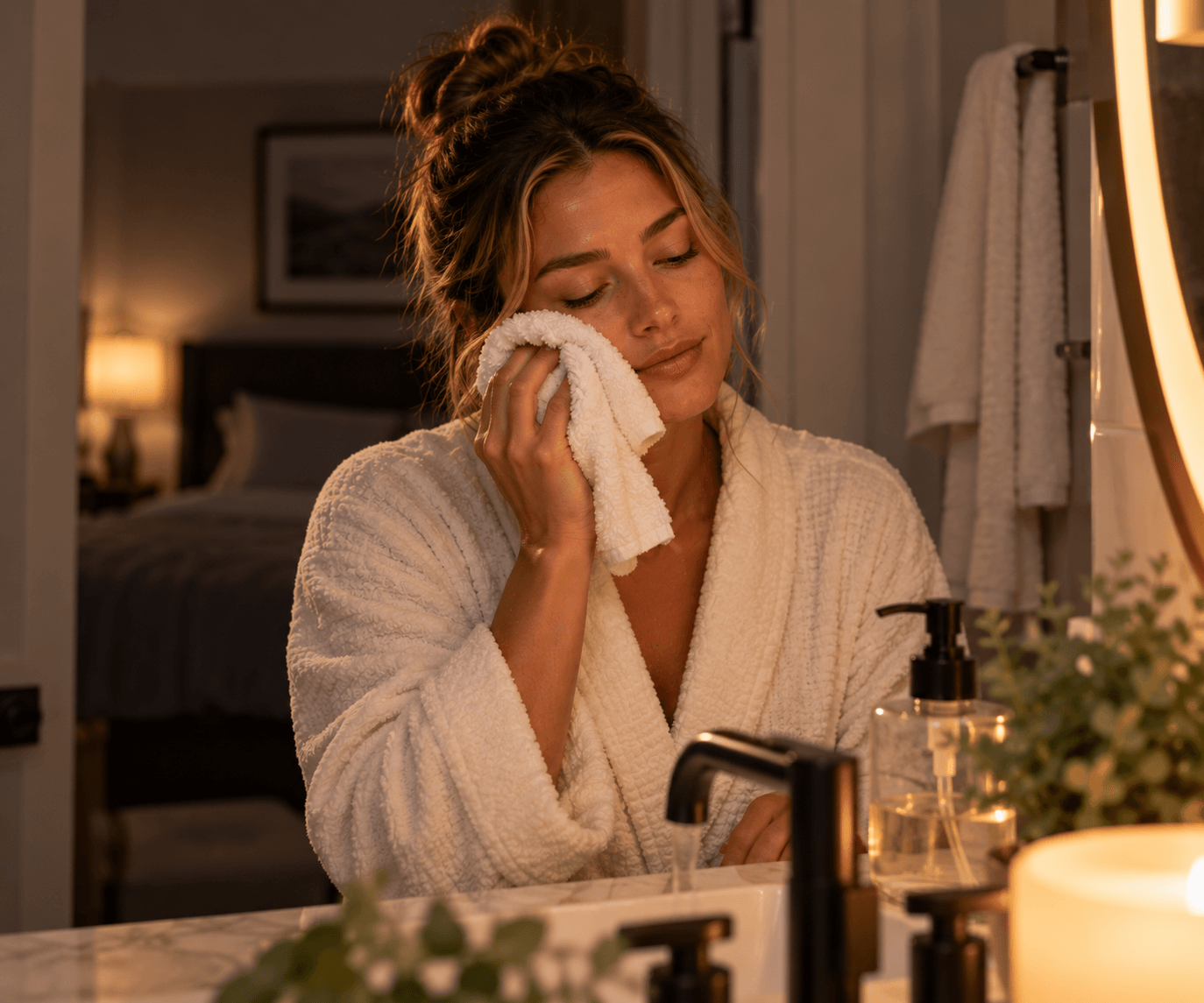
Mouth tape fits into a skincare routine easily as long as you follow one rule: keep the patch of skin where the tape goes clean, dry and free of product. Do your cleanser, treatments and moisturizer as usual on the rest of your face, then tape last. Retinoids, acids and oils just need to stay off your lips and the skin right around them.
Why does skincare matter for mouth tape?
Research: limited (what this means)Skincare matters for mouth tape because tape and skincare want opposite things from the same bit of skin. 3M's guidance on medical tape says tape should go on clean, dry skin. Most night products are designed to leave something behind, whether that's oil, moisture or an active ingredient.
There are two problems when they overlap. The first is grip. A 2017 report in the Indian Journal of Anaesthesia notes that moisturizer can be applied to soften tape, which is handy in the morning and unhelpful at bedtime. The second is irritation. 3M says chemical irritants, including some skin preparations, trapped between adhesive and skin can cause non-allergic contact dermatitis, with redness, swelling or blistering where they were.
There's no research on mouth tape and skincare specifically, so the advice here comes from dermatology and medical taping guidance. The reason to get it right is that mouth taping is worth the effort for many people. A small 2022 study of mouth breathers with mild sleep apnea found snoring roughly halved after a week of taping (the research).
What order should a night routine go in?
The American Academy of Dermatology (AAD) recommends this order: wash your face with a gentle cleanser and pat dry, apply any medicine or treatment, then moisturizer. Mouth tape slots in as the final step.
- Wash your face and pat it dry.
- Apply treatments, such as a retinoid, to the rest of your face, staying clear of your lips and the skin just around them.
- Apply moisturizer or oil the same way.
- Let everything sink in for a few minutes, and brush your teeth while you wait.
- Wipe your lips and the tape area with a damp cloth, then pat dry.
- Apply the tape without stretching it, as 3M advises, and smooth it down with gentle pressure.
The AAD also warns that using too many products may irritate the skin, especially more than one anti-aging product. A simpler routine is easier on skin that's also wearing tape.
If you're choosing a tape that's gentle on skin, our pick is the Titan Bamboo Silk Mouth Tape. Titan says there's no printed logo or ink on the side that touches your skin, and that its SilkSeal adhesive is made not to leave residue.
Can you use retinoids with mouth tape?
You can use retinoids with mouth tape, as long as you keep them out of the tape area. A dermatologist quoted by the AAD advises using retinoids only at night, because they can make skin more sensitive to the sun, so they naturally share a slot with mouth tape.
There's no study on retinoids under mouth tape, but two pieces of guidance point the same way. The AAD advises avoiding retinol and prescription retinoids for two to five days before waxing your face, to avoid removing skin along with the hair. And the 2017 tape report lists the use of exfoliating agents among the risk factors for skin injury from adhesive tape. The AAD notes that retinol and glycolic acid can irritate skin, especially sensitive skin. Tape is far gentler than wax, but it's sensible not to put an adhesive on skin you've just treated with these.
If you're new to a retinoid, the AAD suggests starting with the least intense formula every other night and building up slowly. Starting a retinoid and mouth tape in the same week makes it hard to tell which one is behind any irritation, so stagger them if you can.
What about face oils and heavy creams?
Face oils and heavy creams are fine on the rest of your face, but keep them away from the tape. Oil anywhere under the strip gives it a slippery surface to hold on to, and the tape is more likely to lift by morning. Our guide to mouth taping mistakes covers other reasons tape comes off.
Lip balm is the same. Put it on in the morning once the tape is off. The AAD recommends a non-irritating lip balm several times a day and before bed for dry, chapped lips. If your lips need it at night, our guide to lip balm and mouth tape explains how to fit both in.
How do you tape with sensitive skin?
Taping with sensitive skin starts with the tape itself. Sleep Foundation recommends a porous tape intended for skin, and warns that tape not meant for the body is more likely to cause irritation or an allergic reaction. The 2017 report notes that silicone-based adhesives have significantly lower peel adhesion and cause much less skin trauma on removal. Our guide to mouth tape for sensitive skin goes further.
Then test one thing at a time. The AAD recommends testing a new skin care product on a small patch of skin, such as the inside of your arm, twice a day for 7 to 10 days before using it on your face. Do your product testing and your first weeks of taping separately, so a reaction points clearly to one or the other.
If your lips or the skin around them turn red, itchy or swollen, stop taping and give your skin a break. The AAD says a dermatologist may suggest patch testing if it's hard to pin down the cause. Our guide to mouth tape skin irritation explains the difference between irritation and allergy.
Should you shave before taping?
If you shave around your mouth, think about when. 3M's taping guidance describes folliculitis, an inflammation of the hair follicle that can be caused by shaving, and recommends using a clipper rather than a razor when hair needs removing before tape goes on.
In practice, that means shaving in the morning rather than right before bed, or trimming with clippers instead of shaving the skin the tape covers. If you keep a beard, a tape made to hold on facial hair saves you trimming at all.
What about the morning routine?
In the morning routine, take the tape off first. 3M recommends loosening an edge, holding the skin next to it with one finger and peeling the tape back over itself, low and close to the skin. If a strip is stubborn, a little moisturizer helps soften it, as the 2017 report notes. Then cleanse, apply lip balm, and carry on with your usual products. If you used a retinoid the night before, the AAD's advice is to protect your skin from the sun during the day, including sunscreen on all skin not covered by clothing.
Check this first. Skip mouth tape and see a doctor if you snore loudly, wake up gasping, have been told you stop breathing in your sleep, or can't breathe comfortably through your nose. More on safety
Taping only works if your nose is clear, so check it with our nose test before you start, and read our safety page if you snore loudly or wake gasping.
Our pick (paid partner)
For a tape that fits a skincare routine, our pick is the Titan Bamboo Silk Mouth Tape.
Read next
Common questions
Can I use retinol with mouth tape?
Yes, on the rest of your face. Keep it off your lips and the skin the tape covers. There's no research on retinoids and mouth tape, but the AAD advises stopping retinoids for a few days before waxing the face to avoid removing skin, which is a good reason to keep adhesive and retinoids apart.
Should I put mouth tape on before or after my skincare?
After. Do your cleanser, treatments and moisturizer first, keeping them off the tape area, then wipe your lips with water, pat dry and apply the tape last.
Can I use face oil with mouth tape?
Use it everywhere except where the tape goes. Tape needs clean, dry skin to stick, and a 2017 report in the Indian Journal of Anaesthesia notes that moisturizer can soften tape, so oil underneath will loosen it overnight.
Is mouth tape OK for sensitive skin?
Often, with care. Choose tape made for skin, apply it without stretching, and peel it off slowly. If your lips turn red, swollen or itchy, stop and see a dermatologist, who may suggest patch testing to find the cause.
When should I put on lip balm if I mouth tape?
In the morning, once the tape is off. Balm under the tape stops it sticking. The AAD recommends applying a non-irritating lip balm several times a day, so you have plenty of chances outside of sleep.
Sources
- Should I apply my skin care products in a certain order?
- Retinoid or retinol?
- Hair removal: how to wax
- How to test skin care products
- 7 dermatologists' tips for healing dry, chapped lips
- Facial skin injury caused by acrylate-based adhesive tapes in a post-menopausal patient: a preventable cause
- Medical Adhesive Related Skin Injuries (MARSI): taping techniques
- Mouth taping for sleep: does it work?
- The impact of mouth-taping in mouth-breathers with mild obstructive sleep apnea: a preliminary study
- Titan Recovery Bamboo Silk Mouth Tape
About this article
- Research
- 10 published sources, listed above.
- Evidence
- Limited. How we rate it
- Last checked
- October 6, 2026
- Funding
- Paid partner of Titan Recovery. Their ads are labeled.
- Found an error?
- Tell us. We log fixes on the corrections page.
* This content is for informational and educational purposes only and is not medical advice. It is not intended to diagnose, treat, cure or prevent any disease or health condition. Talk to a qualified healthcare provider about your health.