In short
- You can build nose breathing into a daytime habit by repeating a simple check in the same situations every day, which is how habit research says automatic behaviors form.
- In habit studies, automaticity took about two months on average to level off, with a very wide range between people, and missing a day didn't derail progress.
- No study has shown that daytime practice alone changes how you breathe while asleep, so the plan uses a nasal strip and mouth tape to carry the habit into the night.
- Start by checking that your nose can carry the load, because most mouth breathing comes from a nose that doesn't let enough air through.
- See a doctor if your nose is blocked most of the time or you have signs of sleep apnea such as gasping, pauses in breathing or daytime sleepiness.
Yes, for most adults with a clear nose. You can make nose breathing your daytime default by repeating a simple check in the same everyday situations until it becomes automatic, then use a nasal strip and mouth tape to keep it going at night. Daytime practice alone hasn't been shown to change how you breathe asleep, so the plan below has a day half and a night half.
Why is nose breathing better than mouth breathing?
Your body already prefers it during sleep. A 2003 sleep lab study of 12 healthy adults with normal noses found they breathed almost entirely through the nose while asleep. When the researchers had them breathe through the mouth instead, upper airway resistance during sleep was more than twice as high, and breathing pauses and shallow breaths became far more frequent. While they were awake, the route made little difference. Nasal vs. mouth breathing covers the rest of the case.
So the goal isn't to learn something new. It's to get back to your body's default, by day and by night.
Can you actually retrain how you breathe?
Research: limited (what this means)No trial has tested a daytime nose breathing habit program and measured whether it changes how adults breathe during sleep. Breathing exercises such as Buteyko have mostly been studied in asthma, which our guide to nasal breathing exercises covers in detail.
What does exist is solid research on how habits form in general. Psychologists define a habit as an action triggered automatically by a cue in your surroundings, like putting on a seatbelt when you get into the car. A 2012 review in the British Journal of General Practice explains that repeating a simple action in a consistent context builds that link until the action needs little thought. In one study it describes, people repeated a chosen health behavior once a day after a fixed cue, and the feeling of automaticity rose quickly at first and then leveled off after an average of 66 days. Missing the occasional day didn't seriously set them back.
A 2024 meta-analysis of 20 studies with 2,601 participants found similar timing. Median times to form a habit were 59 to 66 days, but individual times ranged from 4 to 335 days. Habits practiced in the morning and habits people chose for themselves tended to be stronger.
Nose breathing while awake is a behavior you can notice and correct, so those principles fit it well. That's the basis for the plan.
Is your nose ready for it?
Habit won't fix a blocked nose. Cleveland Clinic says most people who breathe through the mouth do so because they can't get enough air through the nose, and it lists congestion from allergies or colds, a deviated septum, enlarged turbinates and nasal polyps among the common causes. Doctors use a lip seal test to see whether someone can breathe comfortably with the mouth closed.
Try your own version. Sit quietly, close your lips and breathe through your nose for two minutes. Our two-minute nose test walks you through it. If it's easy, move on. If you feel short of air, start with how to unblock your nose before bed, and see a doctor if your nose is blocked most of the time.
How do you train yourself to nose breathe during the day?
The habit research points to a simple recipe: one small action, tied to a cue you meet every day.
- Pick the action. Something like: close your lips, rest your tongue, and take three slow breaths through your nose.
- Tie it to cues you already meet daily. The 2012 review suggests a cue inside an existing routine, such as after breakfast, when you sit down at your desk or when you start the car.
- Start in the morning if you can, since the 2024 meta-analysis found morning habits tended to be stronger.
- Keep a simple tick sheet. The review suggests self-monitoring like this during the learning phase.
- Don't quit after a missed day. Progress picked up again after a single missed performance.
Expect this to take weeks rather than days. Two months is a reasonable average to plan around, knowing your own time may be shorter or longer. If you exercise, light activity is another chance to practice. Nasal breathing during exercise explains how to ease into it.
Can you wear mouth tape while awake?
Mouth tape is easier to wear overnight once it feels familiar. Titan suggests wearing its mouth tape for 20 to 30 minutes during the day, while reading or watching TV, before the first night. That also gives you a second daily cue for nose breathing, with something on your lips to remind you.
How do you carry it into the night?
Once you fall asleep, conscious habits switch off. That's where simple tools come in.
A nasal strip opens the front of the nose from the outside. A 2016 meta-analysis noted that nasal dilators improve nasal breathing, which makes it easier to stay on the nasal route if your nose feels narrow at night. How nasal strips work covers the details.
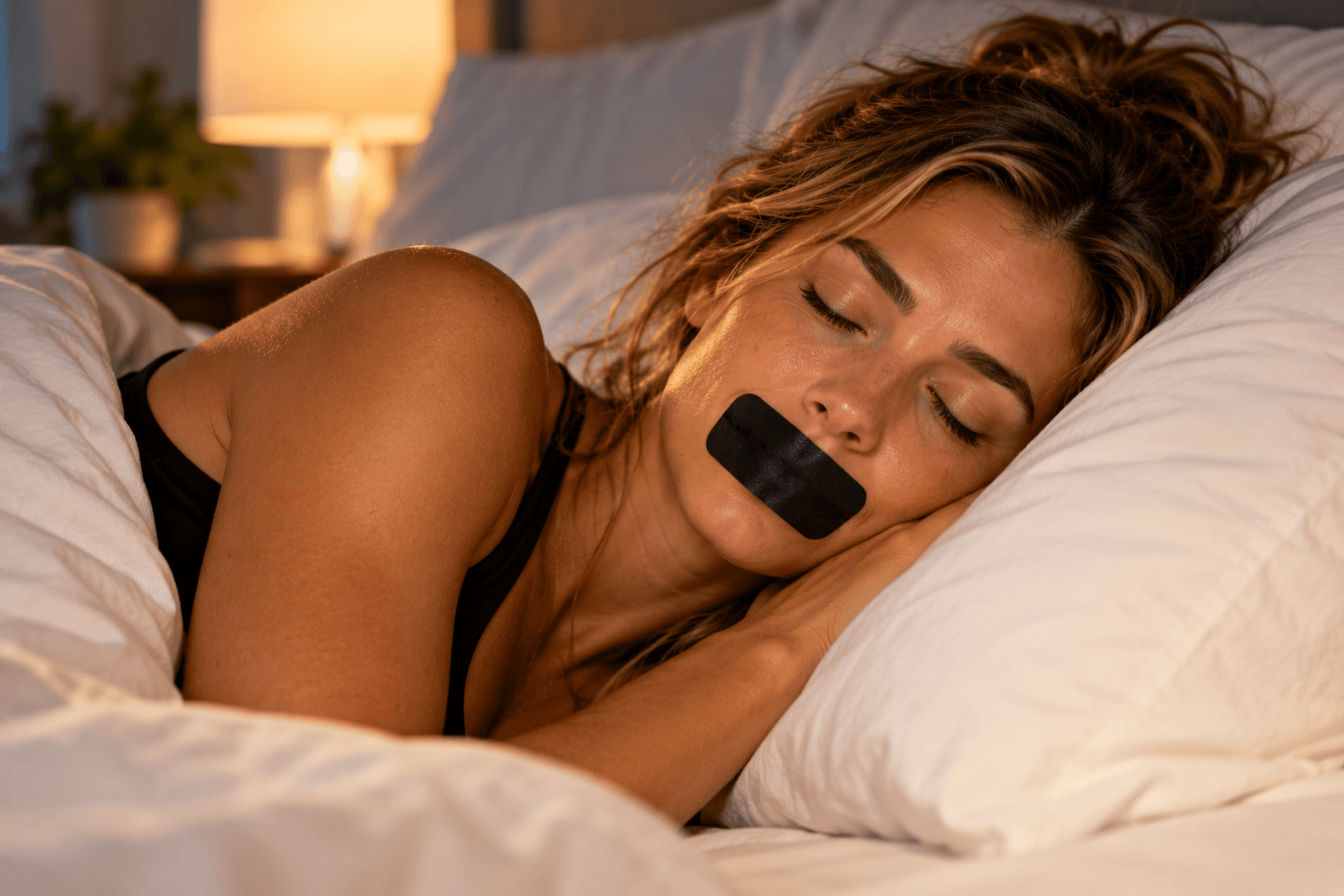
Mouth tape keeps your lips together while you sleep. The Sleep Foundation describes it as a gentle reminder that encourages nasal breathing and says to use a porous tape made for skin. In a 2022 study of 20 mouth breathers with mild sleep apnea, a week of taping cut their snoring index roughly in half. That was a small study in a specific group, and a 2025 systematic review of 10 studies with 213 patients found the research is still limited and warned of serious risk for people who tape with a blocked nose. That's why checking your nose comes first. Our first-week guide to mouth taping helps you ease in.
Check this first. Skip mouth tape and see a doctor if you snore loudly, wake up gasping, have been told you stop breathing in your sleep, or can't breathe comfortably through your nose. More on safety
How will you know it's working?
Watch for fewer of the signs Cleveland Clinic links to mouth breathing: dry mouth, drooling on the pillow, snoring and hoarseness. Notice, too, whether you catch yourself with your mouth open during the day less often. Signs you breathe through your mouth at night has the full checklist, and how long it takes to get used to mouth tape covers the adjustment period.
When is training not enough?
If your nose stays blocked despite the steps above, a structural cause may need treatment. Cleveland Clinic says treatment depends on the cause and can include medication or surgery. See a doctor promptly if your breathing stops and starts while you sleep, you make gasping or choking noises, or you feel very tired during the day, which the NHS lists as signs of sleep apnea. A habit plan and tools don't treat that. Cleveland Clinic also advises asking a pediatrician to check the nose and airway of a child who often breathes through the mouth.
Our pick (paid partner)
For the night half of the plan, the set we recommend is the Titan Sleep System, which pairs TitanAir Nasal Strips with Titan Bamboo Silk Mouth Tape. Titan says the strips are drug-free with flexible spring-loaded bands, and that the tape is bamboo silk with an adhesive made to grip through stubble and beards. Titan says both are third-party tested and certified PFAS-free, and it offers a 30-night guarantee.
For more guides, browse our nasal breathing articles.
Read next
- 11 ways to breathe through your nose at night
- Why do I breathe through my mouth at night?
- Mouth tape and nasal strips together
Common questions
How long does it take to train yourself to nose breathe?
There's no study on nose breathing itself. Research on other health habits found that automaticity leveled off after about 66 days on average, but individual times ranged from a few days to most of a year. Expect a couple of months of regular practice.
Can you train yourself to breathe through your nose while sleeping?
Not directly, because the conscious part of a habit switches off when you fall asleep, and no study has shown daytime practice alone changes your breathing route in sleep. A nasal strip and mouth tape can help you stay on nose breathing at night.
What's the first step to becoming a nose breather?
Check that your nose lets enough air through. Close your mouth and breathe through your nose for a couple of minutes. If that's hard, treat the congestion or see a doctor before trying to change the habit.
Does mouth tape train you to breathe through your nose?
The Sleep Foundation describes it as a gentle reminder that encourages nasal breathing. It keeps your lips closed while you sleep, which keeps you on the nasal route, but research on long-term effects is still small.
Is mouth breathing a habit or a medical problem?
It can be either. Cleveland Clinic says most people breathe through the mouth because they can't get enough air through the nose, from causes such as congestion, a deviated septum or nasal polyps. If your nose is clear, habit is more likely.
Is it bad to breathe through your mouth?
Now and then, such as when you're out of breath, it's normal. Cleveland Clinic says mouth breathing isn't a serious health issue for adults, but it's linked to dry mouth, bad breath and snoring. In a 2003 sleep lab study, upper airway resistance during sleep was more than twice as high breathing through the mouth as through the nose.
Do nasal strips work for nose breathing?
They can make it easier. A 2016 meta-analysis found that nasal dilators, including strips, improve nasal breathing, which helps you stay on the nasal route at night if your nose feels narrow. The same analysis found they don't improve obstructive sleep apnea.
Sources
- Making health habitual: the psychology of 'habit-formation' and general practice
- Time to Form a Habit: A Systematic Review and Meta-Analysis of Health Behaviour Habit Formation and Its Determinants
- Effect of nasal or oral breathing route on upper airway resistance during sleep
- Mouth breathing: symptoms, complications and treatment
- Nasal Dilators (Breathe Right Strips and NoZovent) for Snoring and OSA: A Systematic Review and Meta-Analysis
- Mouth taping for sleep: does it work?
- The impact of mouth-taping in mouth-breathers with mild obstructive sleep apnea: a preliminary study
- Breaking social media fads and uncovering the safety and efficacy of mouth taping in patients with mouth breathing, sleep disordered breathing, or obstructive sleep apnea: A systematic review
- Sleep apnoea
- Titan Bamboo Silk Mouth Tape
- Titan Sleep System (Nasal Strips + Mouth Tape)
About this article
- Research
- 11 published sources, listed above.
- Evidence
- Limited. How we rate it
- Last checked
- October 10, 2026
- Funding
- Paid partner of Titan Recovery. Their ads are labeled.
- Found an error?
- Tell us. We log fixes on the corrections page.
* This content is for informational and educational purposes only and is not medical advice. It is not intended to diagnose, treat, cure or prevent any disease or health condition. Talk to a qualified healthcare provider about your health.