In short
- Nasal breathing at night starts with a nose that lets air through, so clear congestion and allergens before reaching for tools.
- Saline rinses, a humidifier, keeping pets out of the bedroom and raising your head are simple first steps Cleveland Clinic suggests for nighttime stuffiness.
- Lying down raises nasal resistance, according to a 2022 meta-analysis, which is why a nose that feels fine by day can feel tight in bed.
- Nasal strips open the front of the nose, and mouth tape keeps your lips closed. Many people use both.
- If your nose is blocked most nights, see a doctor, since a deviated septum, enlarged turbinates or polyps may need treatment.
To breathe through your nose at night, first make your nose easy to breathe through, then help your body stay that way while you sleep. That means clearing congestion and allergens, setting up the bedroom, and then using a nasal strip, mouth tape or both to keep air going through your nose until morning. Here are 11 ways to do it, roughly in the order we'd try them.
Why bother? In a 2003 sleep lab study, upper airway resistance in 12 healthy adults was more than twice as high when they slept breathing through the mouth as through the nose. Nasal vs. mouth breathing covers the rest of the case.
Clear your nose
Check how your nose is doing
Close your mouth and breathe through your nose for a couple of minutes. Cleveland Clinic says doctors use a similar lip seal test to see whether someone can breathe with their mouth closed. Our two-minute nose test walks you through it. If it feels easy, skip ahead to the tools. If it's a struggle, the next few steps come first.
Rinse with saline before bed
Cleveland Clinic suggests a neti pot or saline spray to loosen mucus at night. A Cochrane review found that saline irrigation possibly helps with cold symptoms, though the trials were small. The FDA says to use only distilled, sterile or previously boiled water in a rinse, never plain tap water. Boiled water should be boiled for 3 to 5 minutes and cooled until lukewarm, and the FDA says it can be kept in a clean, closed container for up to 24 hours. How to use a saline rinse has the steps.
Keep allergens out of the bedroom
Cleveland Clinic family physician Josue Limage, MD, says it's common to feel more stuffed up at night, often because of allergens in your home or the way your body reacts to lying down. Dust, pet dander and mold in your home can make allergies worse at night. Allergens you carry in from outside can also stick to your hair and skin. Its advice is to keep pets out of the bedroom, change your sheets at least once a week, and shower and change your clothes before bed to wash off pollen from outside.
Treat allergies properly
If allergies are behind your stuffy nose, treating them can make nights easier. In a small 1998 study of 20 people with allergic rhinitis, a steroid nasal spray improved congestion and how they rated their sleep, while a placebo didn't. Cleveland Clinic also mentions antihistamines and nasal sprays for allergy relief. Ask a pharmacist which suits you.
Go easy on decongestant sprays
Decongestant sprays work fast because they shrink the blood vessels inside your nose, which reduces swelling and lets air through. But Cleveland Clinic warns that using them longer than the package says, usually three days, can cause rebound congestion that's worse than where you started. It says ingredients to look for on the label include oxymetazoline and phenylephrine. Use them for a short spell, not as a nightly habit. Decongestant spray rebound explains how to get off them.
Set up the night
Add moisture to the air and drink enough
Cleveland Clinic suggests a humidifier to ease the dryness that can worsen congestion, and staying hydrated to thin mucus.
Raise your head and shoulders
A 2022 meta-analysis of nine studies found that lying down increases nasal resistance and reduces airflow, and the effect was larger in people who snore or have sleep apnea. Cleveland Clinic explains that when you lie flat, mucus can't drain as well and pools in the sinuses, and it recommends sleeping with your head and shoulders raised. An extra pillow or a wedge is enough to try.
Rule out reflux
Acid reflux is a less obvious cause of a stuffy nose. Cleveland Clinic says acid reflux can make your nose stuffy at night, because acid that travels up when you lie down irritates the throat and sinuses. Its tips are to avoid eating late, use antacids as needed, and, if you sleep on your side, try the left side.
Use tools to keep it going
Research: moderate (what this means)Wear a nasal strip
A nasal strip has a springy band that lifts the sides of the nose open from the outside. A 2016 meta-analysis noted that nasal dilators have been shown to improve nasal breathing, although they didn't change sleep apnea measures. In a small controlled trial in people with chronic rhinitis, strips cut snoring from about 258 to 173 snores an hour. A 2018 trial found strips improved some measures of sleep satisfaction compared with placebo strips, while two 2019 trials found no difference from placebo, so results vary between people. How nasal strips work covers the details.
Try mouth tape once your nose is clear
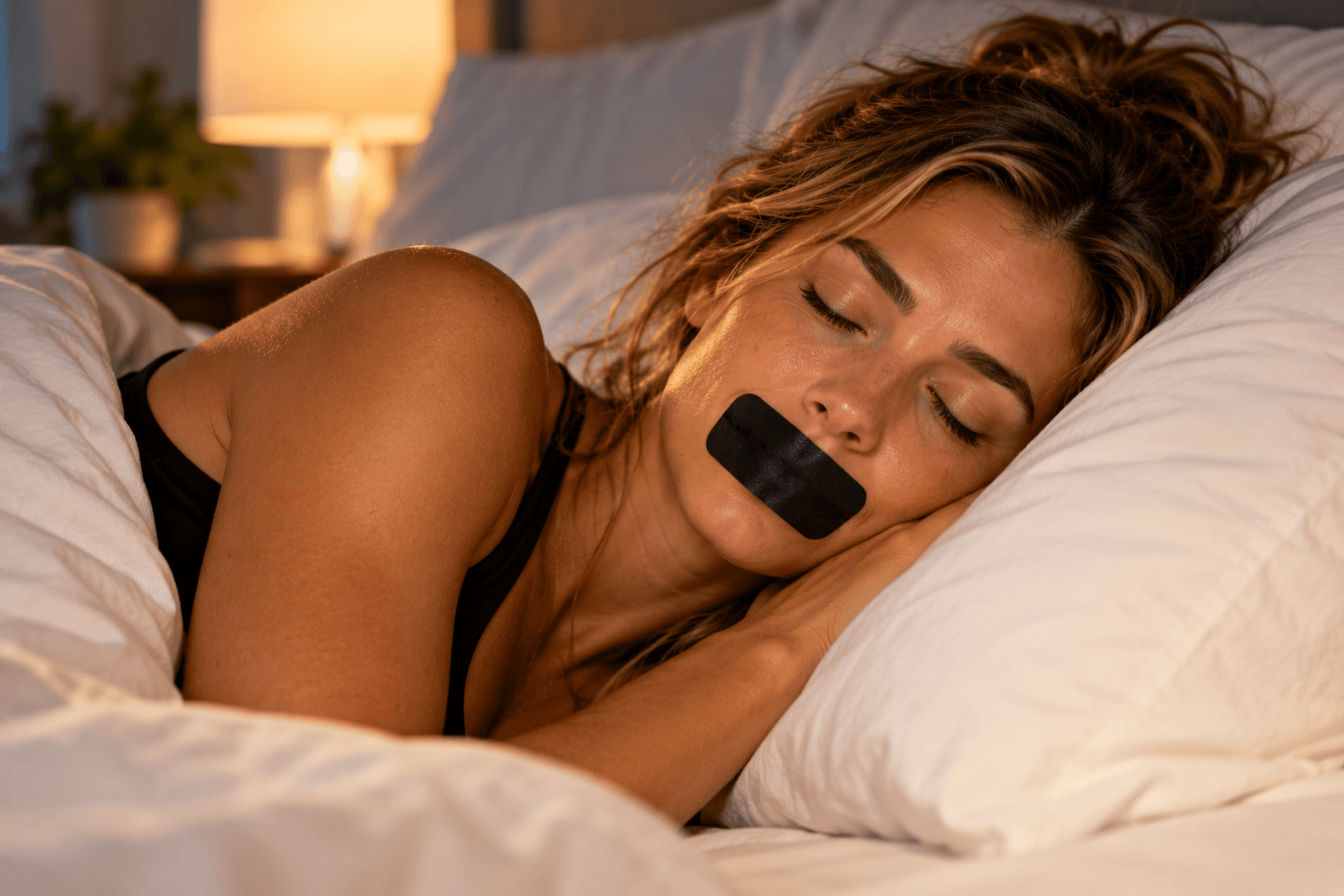
If your nose is clear and your mouth still drifts open, tape keeps your lips together. In a 2003 study, healthy adults with clear noses breathed only about 4% of their air through the mouth during sleep, so tape simply helps you stay on your body's default route. The Sleep Foundation describes it as a gentle reminder that encourages nasal breathing. Wear it for a while during the day first, use a porous tape made for skin, and leave it off on congested nights. A 2025 review found the research is still small and warned of serious risk for people who tape with a blocked nose, which is why it comes after the steps above. Our first-week guide helps you ease in.
Check this first. Skip mouth tape and see a doctor if you snore loudly, wake up gasping, have been told you stop breathing in your sleep, or can't breathe comfortably through your nose. More on safety
See a doctor if your nose stays blocked
If nothing above helps, or one side is always worse, a structural problem may be the cause. Cleveland Clinic lists a deviated septum, enlarged turbinates and nasal polyps among the common reasons people can't breathe through the nose, and says treatment depends on the cause. It mentions antihistamines and decongestants for a cold, antibiotics for a sinus infection that lasts more than 10 days, and surgery such as septoplasty or turbinate reduction for structural problems. See a doctor sooner if you snore loudly with choking, gasping or daytime sleepiness, which the American Academy of Sleep Medicine lists as warning signs of sleep apnea. Strips and tape are for adults, so a child who mouth breathes should see a pediatrician.
Our pick: the Titan Sleep System (paid partner)
For the last two steps, the set we recommend is the Titan Sleep System, which pairs TitanAir Nasal Strips with Titan Bamboo Silk Mouth Tape. Titan says the strips are drug-free with flexible spring-loaded bands, placed just above the flare of the nostrils on the soft part of the nose, and that the tape is bamboo silk with an adhesive made to grip through stubble and beards. Titan suggests 20 to 30 minutes of daytime practice with the tape before your first night, says both products are third-party tested and certified PFAS-free, and offers a 30-night guarantee.
For more guides, browse our nasal breathing articles.
Read next
- 9 signs you breathe through your mouth at night
- How to unblock your nose before bed
- Mouth tape vs. nasal strips
Common questions
How can I force myself to breathe through my nose at night?
Make nasal breathing easy first by clearing your nose, then keep it going with tools. A nasal strip helps if your nose feels narrow, and mouth tape keeps your lips closed if your nose is clear. Never tape your mouth with a blocked nose.
Why can't I breathe through my nose when I lie down?
Lying flat raises nasal resistance, and mucus drains less well without gravity. Cleveland Clinic also points to allergens in the bedroom and acid reflux. Raising your head and shoulders can help.
Do nasal strips help you breathe through your nose?
They widen the front of the nose. A 2016 meta-analysis noted that nasal dilators have been shown to improve nasal breathing, and a small controlled study found strips cut snoring frequency in people with chronic rhinitis. They don't treat sleep apnea.
Is it safe to tape your mouth to breathe through your nose?
For adults who can breathe comfortably through the nose, it's a simple habit tool. Skip it if your nose is blocked or you have a cold, never use it on children, and see a doctor first if you might have sleep apnea.
How long does it take to get used to nose breathing at night?
It varies. Titan suggests 20 to 30 minutes of daytime practice with mouth tape before the first night, and most people find the first week is the adjustment period.
When should I see a doctor about not being able to breathe through my nose?
If your nose is blocked most of the time, if one side is always worse, or if you snore loudly with gasping or daytime sleepiness. Cleveland Clinic says treatment depends on the cause and can include medication or surgery.
Are nose strips safe?
For most adults, yes. A nasal strip has no drug in it and sits on the outside of the nose, and Breathe Right says its strips may be used daily for up to 12 hours a day. Stop if you get a rash or skin irritation, and note that Breathe Right says people with a latex allergy shouldn't use its strips because the packaging contains natural rubber latex.
Sources
- Why does my nose get stuffy at night?
- Mouth breathing: symptoms, complications and treatment
- Saline nasal irrigation for acute upper respiratory tract infections
- Is rinsing your sinuses with neti pots safe?
- Nasal congestion secondary to allergic rhinitis as a cause of sleep disturbance and daytime fatigue and the response to topical nasal corticosteroids
- Rhinitis medicamentosa
- The Recumbent Position Affects Nasal Resistance: A Systematic Review and Meta-Analysis
- Nasal Dilators (Breathe Right Strips and NoZovent) for Snoring and OSA: A Systematic Review and Meta-Analysis
- External nasal dilation reduces snoring in chronic rhinitis patients: a randomized controlled trial
- Effects of nasal dilator strips on subjective measures of sleep in subjects with chronic nocturnal nasal congestion: a randomized, placebo-controlled trial
- Sleep Quality and Congestion with Breathe Right Nasal Strips: Two Randomized Controlled Trials
- Effect of nasal or oral breathing route on upper airway resistance during sleep
- Mouth taping for sleep: does it work?
- Breaking social media fads and uncovering the safety and efficacy of mouth taping in patients with mouth breathing, sleep disordered breathing, or obstructive sleep apnea: A systematic review
- Is it more than a snore? Recognizing sleep apnea warning signs
- Titan Sleep System (Nasal Strips + Mouth Tape)
- Breathe Right FAQs
About this article
- Research
- 17 published sources, listed above.
- Evidence
- Moderate. How we rate it
- Last checked
- October 10, 2026
- Funding
- Paid partner of Titan Recovery. Their ads are labeled.
- Found an error?
- Tell us. We log fixes on the corrections page.
* This content is for informational and educational purposes only and is not medical advice. It is not intended to diagnose, treat, cure or prevent any disease or health condition. Talk to a qualified healthcare provider about your health.