In short
- Cleveland Clinic says sleeping on your back is more associated with snoring than sleeping on your side or stomach.
- In a 2026 study of 338 people with sleep apnea, lying on the back was linked to more breathing events than lying on the stomach.
- When 27 people with sleep apnea slept on a mattress and pillow designed for stomach sleeping, their median apnea-hypopnea index fell from 23 to 7.
- Cleveland Clinic warns that stomach sleeping can put extra stress on the back, neck and shoulders.
- Lying face down raised nasal resistance more than lying on the back in a 2024 study of people with sleep apnea, so a clear nose matters for stomach sleepers.
- In a 2022 study of 20 mouth breathers with mild sleep apnea, a week of mouth taping cut the median snoring index by about 47%.
Sleeping on your stomach is linked to less snoring than sleeping on your back, mostly because it keeps your tongue from falling back toward your throat. The trade-off is comfort: stomach sleeping can strain your neck, back and shoulders. If you already sleep face down, a clear nose and a closed mouth can make it work even better.
Does sleeping on your stomach reduce snoring?
Sleeping on your stomach does seem to reduce snoring compared with sleeping on your back. Cleveland Clinic says sleeping on your back is more associated with snoring than other positions, such as sleeping on your side or stomach. On your back, the tongue can relax toward the back of the throat and partly block the airway.
Position is a big factor for a lot of snorers. Cleveland Clinic cites a 2009 study of 2,077 sleep clinic patients that found snoring was caused by sleep position in 54% of them.
What's missing is a study that measures snoring in ordinary stomach sleepers. Most position research compares the back with the side, and the stomach data comes from people with sleep apnea. So the honest answer is that stomach sleeping very likely helps if your snoring is worse on your back, but the evidence is indirect.
What do studies show about the prone position?
Research: limited (what this means)Studies of the prone position, the medical term for lying face down, mostly come from sleep apnea research, and the results are encouraging.
A 2026 study in Nature and Science of Sleep looked back at home sleep tests from 338 adults with sleep apnea. Lying on the back was linked to a higher apnea-hypopnea index (AHI), the number of breathing pauses and shallow breaths an hour, than lying on the stomach. The back was the worst position overall.
Swedish researchers went a step further and designed a mattress and pillow that make stomach sleeping easier. In a 2015 two-night study, 27 people with sleep apnea slept one night in a normal bed and one on the prone mattress. Time on their backs dropped to almost nothing, and their median AHI fell from 23 to 7. About 63% counted as responders, including 80% of those whose apnea was worse on their back.
A second study by the same team had 14 people use the mattress at home for four weeks. Their average AHI fell from 26 to 8, and everyone managed to sleep on it for more than four hours a night. Four people complained of back discomfort during the first week. The lead author holds a patent on the mattress and pillow, which is worth keeping in mind.
These studies were about sleep apnea, not snoring alone, and stomach sleeping isn't a treatment for sleep apnea. But they show that face down is a much kinder position for the airway than flat on your back.
How does stomach sleeping compare with other positions?
Each sleep position has trade-offs, and the right one depends on why you snore and what your body tolerates. This table sums up the evidence.
| Position | Snoring | Comfort and strain | Notes |
|---|---|---|---|
| Back | Most associated with snoring | Often easiest on the spine | Tongue can fall back toward the throat |
| Side | Less snoring for most non-apneic snorers in a 2003 study | Generally comfortable | The position with the most research behind it |
| Stomach | Less associated with snoring than the back | Extra stress on neck, back and shoulders | Nasal resistance may rise face down |
| Raised upper body | Small reductions in snoring in studies | Some people find steep angles hard to tolerate | See our guide to sleeping elevated |
The 2003 study, from a sleep lab in Japan, found that most snorers without sleep apnea snored less, and less loudly, on their side than on their back. People with sleep apnea often kept snoring on their side. Our guide to sleep position and snoring goes through that research, and sleeping elevated for snoring covers the raised option.
What are the downsides of sleeping on your stomach?
The main downside of stomach sleeping is strain on your neck, back and shoulders. Cleveland Clinic says sleeping face down can put extra stress on all three, and that the tension can add up over seven or eight hours.
Its chiropractor explains the mechanics. To breathe, you have to turn your head to one side, which holds your neck out of alignment for hours. Lying on your stomach also flattens and twists the natural curve of your spine, which loads the lower back. And most stomach sleepers raise their arms or tuck them under the pillow, which keeps tension on the shoulder joints.
There's a breathing trade-off too. A 2024 study from Taiwan measured nasal patency, how open the nose is, in 29 people with sleep apnea while sitting, lying on the back and lying face down. Both lying positions narrowed the nose compared with sitting, and the effect was stronger face down. People also felt more blocked. If your nose tends to block up, lying face down may make it worse.
If you'd like to move off your stomach, Cleveland Clinic suggests using a few well-placed pillows as bumpers to stop you rolling over, and says it takes a little practice. If you sleep face down without pain, there's no need to force a change.
Does it matter which way you turn your head?
Which way you face probably matters less than staying off your back. In the 2026 study of 338 people with sleep apnea, there was no significant difference between lying on the left side and the right side, either between people or within the same person. Both side positions were linked to far fewer breathing events than lying on the back.
Your nose may be a different story. In the 2024 Taiwanese study, endoscopy showed the inside of the nose swelling in different places depending on position, with more swelling of the turbinates, the ridges that warm and moisten air, in the left nasal passage when people lay face down. The researchers suggested doctors take a person's usual sleep position into account. In practice, if one nostril always feels blocked when you sleep face down, try turning your head the other way and see whether it feels easier.
The 2003 Japanese study also found that snoring changes with sleep stage, rising in deeper non-REM sleep and falling in REM sleep in a given position. So a few loud stretches in the night don't necessarily mean your position isn't helping.
Can stomach sleepers use mouth tape?
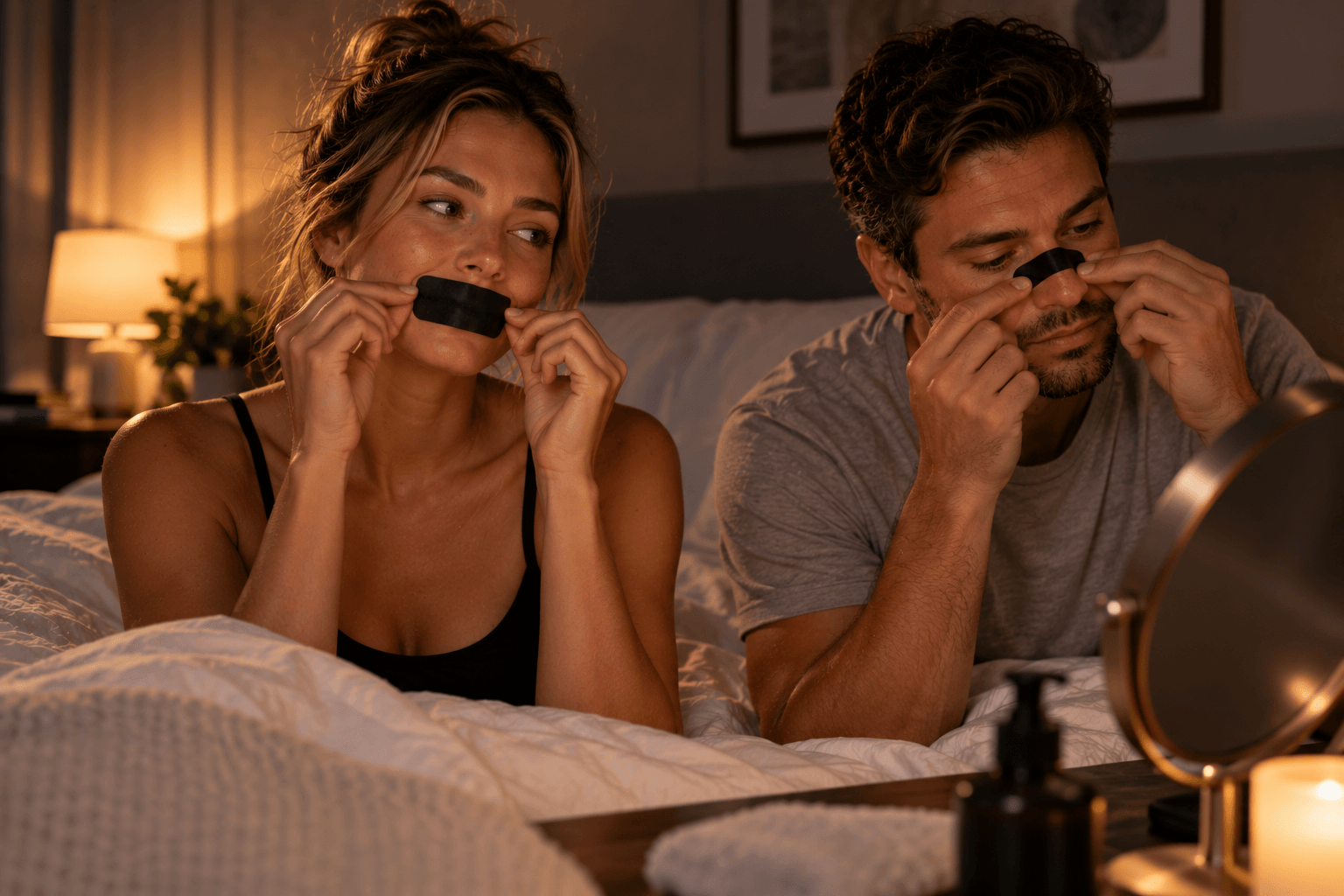
Many adult stomach sleepers can use mouth tape, as long as they can breathe comfortably through the nose. The idea is the same in any position. The authors of a 2022 study note that mouth breathing narrows the upper airway, and tape keeps the lips together so you breathe through your nose.
That study followed 20 mouth breathers with mild sleep apnea who wore tape for a week. Their median snoring index fell by about 47%, and 13 of the 20 cut their snoring by at least half. It's a small, early study, but it's a promising result for people whose mouths fall open at night.
Stomach sleeping adds a couple of practical points. The pillow presses on one side of your face, so choose a tape that sits neatly across the lips and check in the morning that it stayed in place. And because lying face down may narrow the nose, checking that your nose is clear matters even more. Cleveland Clinic says not to use mouth tape if you have nasal obstruction, congestion, chronic allergies, a sinus infection, enlarged tonsils, a deviated septum or heart issues. Our nose test is a quick check, and mouth tape and side sleeping covers similar fit tips for people who don't sleep on their backs. We don't recommend mouth tape for children.
Check this first. Skip mouth tape and see a doctor if you snore loudly, wake up gasping, have been told you stop breathing in your sleep, or can't breathe comfortably through your nose. More on safety
Do nasal strips help stomach sleepers?
Nasal strips can help stomach sleepers whose noses feel tight at night. In a 2000 randomized, placebo-controlled study of 12 non-obese people with chronic rhinitis, external nasal strips lowered snoring frequency from about 258 to 173 snores an hour, though they didn't change how loud the snoring was. Given that lying face down can narrow the nose, a strip is a sensible thing to try.
Press the edges down well, since a pillow can catch a loose end. Some people use a strip and mouth tape together. Our guide to mouth tape and nasal strips together explains how.
When should you see a doctor?
See a doctor if your snoring comes with signs of sleep apnea, whatever position you sleep in. Cleveland Clinic lists gasping yourself awake at night, not feeling refreshed during the day, and a bed partner noticing pauses in your breathing. Its sleep specialist says people with loud, disruptive snoring are more likely to have sleep apnea and should ask about a sleep study.
Snoring less on your stomach doesn't rule sleep apnea out. Our guides to positional sleep apnea and snoring vs. sleep apnea explain more.
Our pick (paid partner): Titan Bamboo Silk Mouth Tape
If you sleep on your stomach and want to try mouth tape, our pick is Titan Bamboo Silk Mouth Tape. We haven't tested or ranked mouth tapes ourselves; this is our recommendation.
Titan says the tape is a bamboo silk strip, not kinesiology tape, that it describes as soft, breathable and moisture-wicking. It's one oval size, 76 by 38 mm, worn horizontally across the lips, which keeps it to a small area of the face. Titan suggests 20 to 30 minutes of daytime practice before the first night, says every batch is third-party tested and certified PFAS-free, and offers a 30-night guarantee that refunds you if your sleep isn't better after 30 nights.
Read next
- Does sleeping on your side reduce snoring?
- The best sleep position for breathing
- How to start mouth taping
Common questions
Does sleeping on your stomach stop snoring?
It often reduces it. Cleveland Clinic says back sleeping is more associated with snoring than side or stomach sleeping, because on your back the tongue can relax toward the throat. No study has measured snoring in ordinary stomach sleepers directly, but sleep apnea studies show fewer breathing events face down than on the back.
What is the best sleep position for snoring?
Side sleeping is the position with the most research behind it. A 2003 sleep-lab study found most snorers without sleep apnea snored less, and less loudly, on their side. Stomach sleeping also keeps you off your back, but it's harder on the neck and lower back.
Why do I still snore on my stomach?
Position is only one cause. A blocked nose, an open mouth or alcohol can all keep you snoring face down. A 2024 study found nasal resistance rose more when people with sleep apnea lay face down than on their back, so a stuffy nose may matter more in this position.
Is it bad to sleep on your stomach?
It's hard on some bodies. Cleveland Clinic says stomach sleeping can put extra stress on your back, neck and shoulders, because your head is turned to one side for hours and your spine's curve flattens. If you sleep this way without pain, there's no need to force a change.
Can you wear mouth tape while sleeping on your stomach?
Many adults can, as long as the nose is clear and the tape doesn't get pushed off by the pillow. Make sure you can breathe comfortably through your nose first, and don't use tape if you have congestion, a blocked nose, or signs of sleep apnea like gasping or choking.
Do nasal strips work if you sleep on your stomach?
They can. In a 2000 placebo-controlled study of people with chronic rhinitis, nasal strips cut snoring frequency from about 258 to 173 snores an hour. Stomach sleepers may need to check that the pillow isn't pressing on the strip or lifting its edges.
Sources
- Wondering why you snore? 5 possible causes
- Effects of body position on snoring in apneic and nonapneic snorers
- The effect of different sleep positions on the severity of obstructive sleep apnea: a retrospective study
- The effect of the prone sleeping position on obstructive sleep apnoea
- Mattress and pillow for prone positioning for treatment of obstructive sleep apnoea
- Effects of sitting, supine, and prone postures on nasal patency in individuals with obstructive sleep apnea syndrome
- Is sleeping on your stomach bad?
- The impact of mouth-taping in mouth-breathers with mild obstructive sleep apnea: a preliminary study
- Is mouth tape safe to use while sleeping?
- External nasal dilation reduces snoring in chronic rhinitis patients: a randomized controlled trial
About this article
- Research
- 10 published sources, listed above.
- Evidence
- Limited. How we rate it
- Last checked
- October 14, 2026
- Funding
- Paid partner of Titan Recovery. Their ads are labeled.
- Found an error?
- Tell us. We log fixes on the corrections page.
* This content is for informational and educational purposes only and is not medical advice. It is not intended to diagnose, treat, cure or prevent any disease or health condition. Talk to a qualified healthcare provider about your health.