In short
- A Cleveland Clinic sleep specialist says most people with breathing troubles do best on their side or propped up, rather than flat on their back.
- Lying on your back lets the tongue and soft palate move back toward the throat, which narrows the airway.
- Most snorers without sleep apnea snore less on their side, according to a 2003 sleep-lab study.
- Raising the head of the bed slightly reduced breathing events in a 2017 study of people with sleep apnea, though it isn't a replacement for medical treatment.
- If one nostril is blocked, sleeping with that side up may help, and a nasal strip can help keep the nose open.
For most people, the best position for easier breathing at night is on your side, or with your head and upper body raised. Lying flat on your back lets the tongue and soft palate fall back toward the throat. The right choice depends a little on what's making breathing harder, whether that's snoring, a blocked nose, reflux or a heart or lung condition.
Why is lying on your back harder for breathing?
Cleveland Clinic sleep medicine specialist Nancy Foldvary-Schaefer says that for most people with breathing troubles, lying flat on the back isn't going to help, because the body can't clear the airways as easily. She explains that on your back, the tongue and soft palate can move backward toward the throat and narrow the airway.
The NHS lists sleeping on your back among the things that make snoring more likely, and among the factors linked to sleep apnoea. Stomach sleeping avoids that, but Dr. Foldvary-Schaefer notes it can bring back and neck pain for many people. That leaves two good options: your side, or propped up.
Why is side sleeping usually best?
Research: moderate (what this means)Dr. Foldvary-Schaefer calls side sleeping one of the most comfortable and effective positions for many people, with or without breathing problems, and says it helps keep the airway clear.
The research on snoring backs this up. A 2003 study at a sleep laboratory in Japan looked at the overnight recordings of 72 habitual snorers. Most of those without sleep apnea snored less on their side, both in how much of the time they snored and how loudly. People with sleep apnea were more variable, and many kept snoring on their side. Our article on sleep position and snoring goes into that study in more detail.
Position matters for many people with sleep apnea too. A 1997 study of 574 people with obstructive sleep apnea found that 55.9% had at least twice as many breathing events on their back as on their side. These positional patients tended to be younger and thinner, with milder sleep apnea. Their sleep was also better preserved, and on daytime testing they were less sleepy than people whose apnea didn't depend on position. In a handful of patients who lost weight, breathing events fell much more on their side than on their back. Dr. Foldvary-Schaefer says side sleeping can sometimes be a reasonable way to treat mild sleep apnea, but that's a decision for a doctor after a sleep test, not a home fix. Positional sleep apnea explains more.
For comfort, she suggests a pillow between your knees to take pressure off your spine.
How do you stay on your side?
Rolling onto your back is easy to do without noticing. The NHS suggests taping or stitching a tennis ball to the back of your sleepwear, or using a special pillow or bed wedge to keep you on your side. Anti-snoring pillows looks at the pillow route.
When does sleeping propped up help?
Raising your head is the other good option, and for some people it's the better one. Dr. Foldvary-Schaefer says many people with chronic heart or lung disease sleep most comfortably with their head raised. These conditions can cause fluid to build up in the lungs, and lying flat can make it harder to breathe. She suggests a few pillows or rolled towels under the head and neck, an adjustable bed, or a reclining chair with your healthcare provider's agreement.
Cleveland Clinic lists conditions that can make breathing harder at night, including colds and flu, allergies, a deviated septum, sleep apnea, congestive heart failure, asthma and COPD. If you're short of breath during the day as well, it says to talk with a healthcare provider.
There's some evidence for elevation in sleep apnea too. In a 2017 study of 52 people with obstructive sleep apnea in Brazil, raising the head of the bed by just 7.5 degrees reduced breathing events from a median of 15.7 to 10.7 an hour and raised the lowest oxygen level overnight. Sleep stages looked much the same with and without the raised bed, and sleep efficiency improved slightly. The authors called it a simple alternative to help, but it was a small study, and a raised bed doesn't replace treatment a doctor recommends.
What's the best position with a blocked nose?
The best position with a blocked nose is lying on your side with the blocked nostril on top. Dr. Foldvary-Schaefer explains that each nostril goes through a cycle of being more congested and then less, and that many people get relief from one-sided congestion this way. So if your left nostril is blocked, sleep on your right side. The nasal cycle explains why this happens.
Position and a nasal strip work well together. The NHS lists strips that hold the nose open while you sleep among the treatments for snoring caused by blocked or narrow nasal airways, so a strip helps the nose while side sleeping helps the throat. How to sleep with a stuffy nose has more ideas.
What about mouth breathing?
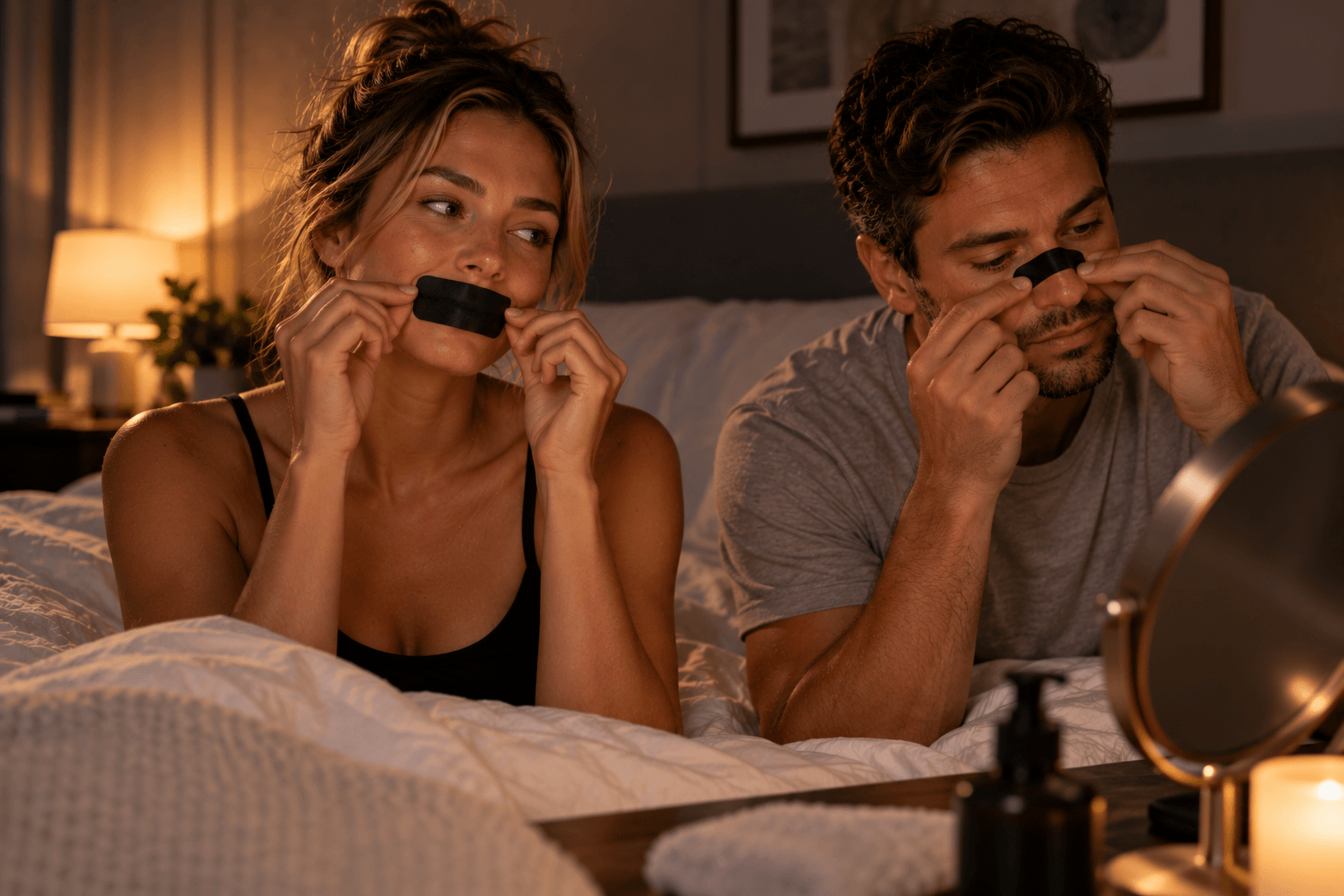
Mouth breathing can happen in any position, but the NHS lists the mouth falling open during sleep as one cause of snoring. For adults who breathe easily through their nose, mouth tape is one option people pair with side sleeping. The Sleep Foundation explains that porous tape over the lips gently encourages nasal breathing, which may help keep the airway more stable. It also says the research is limited, that tape is not a treatment for sleep apnea, and that it isn't for anyone with a blocked nose. Check yours with the nose test, and see mouth tape and side sleeping for practical tips.
Check this first. Skip mouth tape and see a doctor if you snore loudly, wake up gasping, have been told you stop breathing in your sleep, or can't breathe comfortably through your nose. More on safety
If you want to try nasal strips, our pick is TitanAir Nasal Strips.
What's the best position for acid reflux?
If heartburn or acid reflux bothers you at night, raising your head is the position change to try. Among its lifestyle tips for reflux, Cleveland Clinic suggests raising your head by 6 to 8 inches using extra pillows or a foam wedge, and eating two to three hours before lying down.
When should you see a doctor?
The NHS says to see a GP if your breathing stops and starts while you sleep, you make gasping, snorting or choking noises, or you always feel very tired during the day. These are signs of sleep apnoea, which the NHS says can be serious if not diagnosed and treated. A better position may make you quieter, but it doesn't rule sleep apnea out. If breathing is hard when you lie down because of a heart or lung condition, tell your doctor, especially if it's new or getting worse.
Read next
- Does sleeping on your side reduce snoring?
- How to sleep with a stuffy nose
- Snoring vs. sleep apnea: how to tell the difference
Common questions
What is the best sleeping position for breathing problems?
For most people, side sleeping or sleeping propped up. Cleveland Clinic sleep specialist Nancy Foldvary-Schaefer says lying flat on your back isn't going to help most people with breathing troubles.
Which side should I sleep on with a blocked nose?
Sleep with the blocked nostril on top. Dr. Foldvary-Schaefer says many people get relief from one-sided congestion this way, so if your left nostril is blocked, lie on your right side.
Does raising your head help you breathe at night?
It can. Cleveland Clinic says many people with chronic heart or lung conditions sleep most comfortably with their head raised, and a 2017 study found a slight head-of-bed elevation reduced breathing events in people with sleep apnea.
Is sleeping on your back bad for breathing?
It can make things worse for snorers and people with sleep apnea. The NHS lists sleeping on your back as something that makes snoring more likely and as one of the things linked to sleep apnoea.
Can side sleeping or nose breathing cure sleep apnea?
No. Side sleeping can reduce breathing events for some people, and a doctor may suggest it for mild cases, but sleep apnea needs proper diagnosis and treatment. Sleep Foundation also says mouth taping to encourage nose breathing is not a treatment for sleep apnea, so see a doctor if you snore loudly, gasp or choke at night or feel very tired during the day.
Is snoring bad for you?
Usually not on its own. The NHS says snoring is very common and is not usually caused by anything serious, though it's worth seeing a GP if it has a big impact on you or your partner. It can also be a sign of sleep apnoea, which the NHS says can be serious if not treated, so see a GP if your breathing stops and starts, you gasp or choke, or you feel sleepy during the day.
Why do I still snore on my side?
Side sleeping helps most snorers but not all of them. In a 2003 sleep-lab study, most snorers without sleep apnea snored less on their side, while people with sleep apnea often kept snoring after rolling over. If you still snore loudly on your side, it's worth asking a doctor whether a sleep test makes sense.
What's the best sleep position for acid reflux?
Cleveland Clinic suggests raising your head by 6 to 8 inches with extra pillows or a foam wedge, and eating two to three hours before you lie down.
Sources
- Breathing problems? Try these sleep positions
- Effects of body position on snoring in apneic and nonapneic snorers
- Positional vs nonpositional obstructive sleep apnea patients: anthropomorphic, nocturnal polysomnographic, and multiple sleep latency test data
- The influence of head-of-bed elevation in patients with obstructive sleep apnea
- Snoring
- Sleep apnoea
- Acid reflux and GERD: symptoms and treatment
- Mouth taping for sleep: does it work?
About this article
- Research
- 8 published sources, listed above.
- Evidence
- Moderate. How we rate it
- Last checked
- October 10, 2026
- Funding
- Paid partner of Titan Recovery. Their ads are labeled.
- Found an error?
- Tell us. We log fixes on the corrections page.
* This content is for informational and educational purposes only and is not medical advice. It is not intended to diagnose, treat, cure or prevent any disease or health condition. Talk to a qualified healthcare provider about your health.