In short
- Nasal breathing devices fall into two groups: ones that open the nose (external strips, internal dilators and clips) and ones that keep the mouth closed (mouth tape and chin straps).
- A 2014 review found that external nasal dilators increase the cross-sectional area of the nasal valve and reduce nasal resistance, with minimal risk to the user.
- In a 2000 randomized controlled trial in 12 people with chronic rhinitis, an external nasal strip significantly reduced how often they snored compared with placebo.
- In a 2004 study of 27 healthy adults, both a nasal strip and an internal dilator reduced nasal resistance, and the internal dilator reduced it more.
- In a 2022 study of 20 mouth breathers with mild sleep apnea, 13 cut their snoring index by at least half after a week of mouth taping.
- Nasal dilators have not been shown to improve sleep apnea, and a 2014 sleep-lab study found a chin strap alone did not improve snoring or sleep apnea.
The best nasal breathing device depends on what's stopping you from breathing through your nose. If your nose feels narrow or blocked at night, a device that opens it, such as an external nasal strip or an internal dilator, is the place to start. If your nose is clear but your mouth falls open as you sleep, a device that keeps your lips together, such as mouth tape, fits better. Many people use one of each.
This guide covers the six main types of nose breathing device, how each works, what the research says and who each one suits.
What types of nasal breathing devices are there?
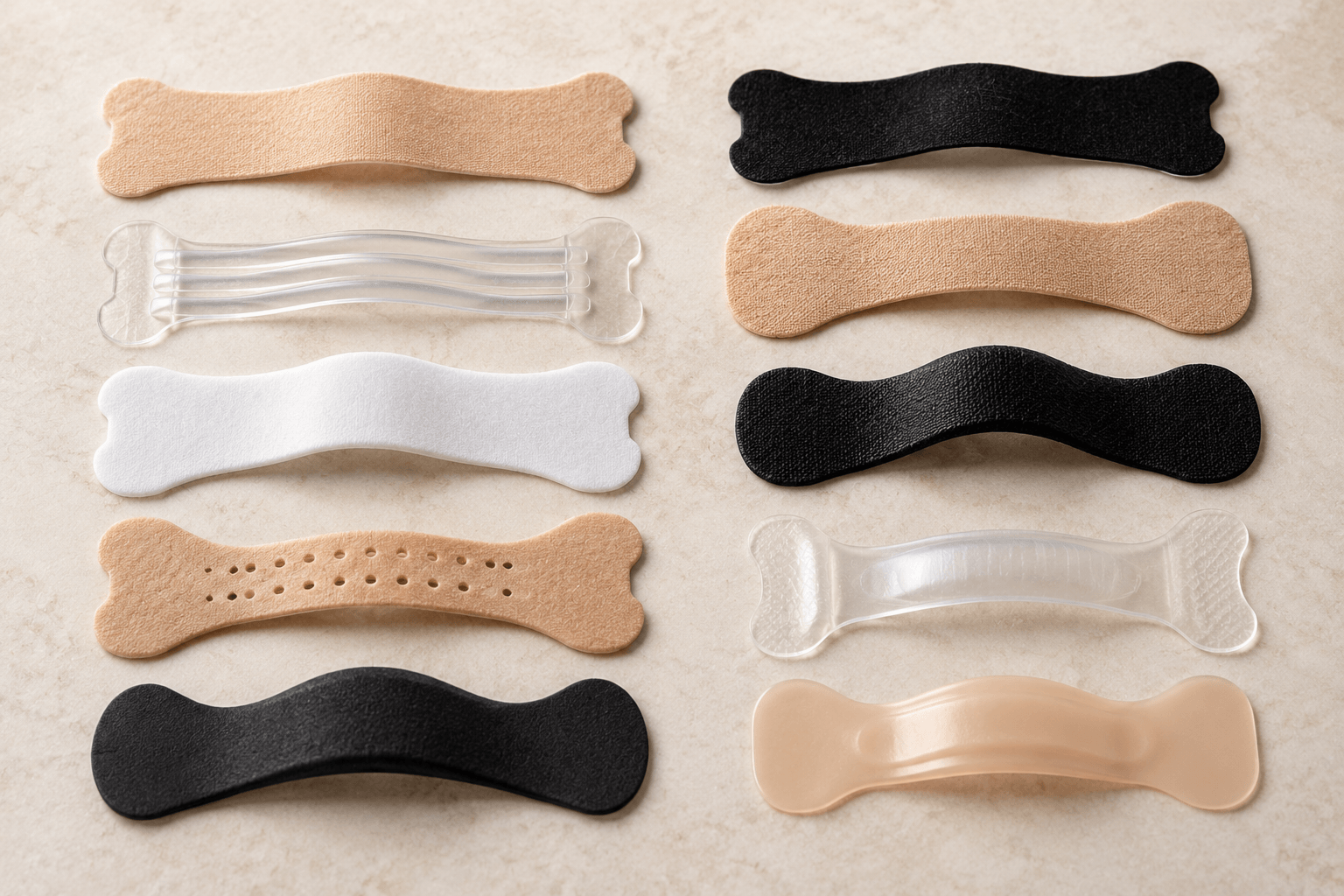
Research: limited (what this means)Nasal breathing devices fall into two broad groups. Some open the nose: external nasal strips, internal dilators such as cones and vents, and nasal clips. Others keep the mouth closed so air goes through the nose: mouth tape and chin straps. A sixth category, nasal breathing trainers, aims to build the habit during the day.
Here's how they compare.
| Device | How it works | Evidence | Best suited to |
|---|---|---|---|
| External nasal strip | A springy band on the outside of the nose lifts the sides outward | The most studied; widens the nasal valve and reduces resistance; reduced snoring frequency in a small trial | Stuffy or narrow noses, beginners, people who don't want anything inside the nose |
| Internal dilator (cone or vent) | A soft device in the nostrils holds them open from inside | Reduced resistance more than a strip in a 2004 study; a 2026 review found greater relief with internal devices | People who want a stronger opening and are comfortable with something in the nostril |
| Nasal clip | A clip-style dilator, sometimes magnetic, that holds the nostrils open | Very little; a 2026 review called for studies on magnetic versions | People who've tried strips and dilators and want to experiment |
| Mouth tape | A small strip across the lips keeps the mouth closed during sleep | Small studies; snoring fell in mouth breathers with mild sleep apnea after a week | People with a clear nose whose mouth falls open at night |
| Chin strap | A strap around the head and jaw holds the mouth closed | A sleep-lab study found no improvement in snoring or sleep apnea from a chin strap alone | People whose sleep team has suggested one |
| Nasal breathing trainer | A daytime device meant to build the nose breathing habit | No published studies that we could find | Curious people who also do free breathing exercises |
How do external nasal strips work?
External nasal strips work by gently lifting the sides of the nose outward from the outside. A springy band inside the strip tries to straighten after you bend it over your nose, and that pull widens the nasal valve, the narrow area just inside the nostrils.
They're the best-studied device on this list. A 2014 review of external nasal dilators found that numerous studies show they increase the cross-sectional area of the nasal valve, reduce nasal resistance and stop the side of the nose from collapsing inward when you breathe in. The authors described them as simple, painless, affordable and minimal-risk, though most studies were small.
For sleep, the most encouraging result comes from a 2000 randomized controlled trial. Twelve people with chronic rhinitis who snored, but didn't have sleep apnea, were randomized to a real strip or a placebo and monitored with overnight sleep studies. The real strip significantly reduced how often they snored, from about 258 snores an hour to about 173, though it didn't change snoring loudness or sleep quality.
Strips suit most people with a stuffy, narrow or congested nose, and they're the easiest to try because nothing goes inside the nose. Our guide on how nasal strips work goes into more detail.
What about internal nasal dilators and cones?
Internal nasal dilators are small soft devices, often cones, vents or rings, that sit just inside the nostrils and hold them open from within. They work on the same part of the nose as strips, from the other side.
The research suggests they can open the nose more. In a 2004 study, 27 healthy adults tried both a nasal strip and an internal dilator. Both significantly widened the nasal valve and reduced nasal resistance, and the internal dilator reduced resistance significantly more. A 2026 scoping review of 13 studies on wearable nasal devices for people with a blocked nose looked at people with a blocked nose from a bent septum and found greater relief with internal devices, though long-term data were limited.
The trade-off is comfort and fit. Some people don't like the feel of something in their nostrils, and getting the right size matters. Our guides to types of nasal dilators and how to use a nasal dilator cover the different shapes and how to size them.
Do nasal clips work?
Nasal clips are a less common type of dilator that hold the nostrils open with a clip, sometimes using small magnets. There's very little research on them. The 2026 scoping review mentioned above said further studies are needed on emerging devices such as magnetic nasal strips before clinicians can fully advise patients about them.
If you're curious, they may be worth a try after strips and dilators, but there isn't evidence yet to say how they compare.
How does mouth tape fit in?
Mouth tape is a nose breathing tool rather than a nasal device. It doesn't open your nose. Instead, a small strip across the lips keeps your mouth closed during sleep, so air goes through your nose by default. That makes it a good partner for a nasal strip or dilator, which handles the nose side.
The research is small but promising. In a 2022 study in Healthcare, 20 mouth breathers with mild sleep apnea taped their mouths for a week. Thirteen of them cut their snoring index by at least half, and the group's median snoring index fell by 47%. A 2025 review in PLOS One looked at 10 studies with 213 people and found mixed results. It also flagged a real risk: several studies discussed the possibility of suffocation if the nose is blocked, and many excluded anyone with nasal obstruction.
That's why the order matters. Make sure you can breathe comfortably through your nose with your mouth closed first, using our nose test, and treat a blocked nose before you tape. We don't recommend mouth tape for children. Our guide to using mouth tape and nasal strips together shows how to combine them.
Check this first. Skip mouth tape and see a doctor if you snore loudly, wake up gasping, have been told you stop breathing in your sleep, or can't breathe comfortably through your nose. More on safety
Do chin straps help you breathe through your nose?
Chin straps wrap around the head and under the jaw to hold the mouth closed. The idea is similar to mouth tape, but the strap works by supporting the jaw rather than sealing the lips.
The research on chin straps used alone is not encouraging. In a 2014 sleep-lab study, 26 adults with sleep apnea wore only a chin strap for the first part of the night. It did not improve their sleep apnea, even in mild cases, and it did not improve snoring. If you use CPAP, ask your sleep team before adding any device. Our comparison of mouth tape vs. chin strap covers the differences.
Do nasal breathing trainers work?
Nasal breathing trainers are daytime devices sold to help build a nose breathing habit. We couldn't find any published study testing a dedicated nasal breathing trainer, so there's no evidence yet either way.
If you want to practice nose breathing during the day, simple exercises are free and easy to start. Our guide to nasal breathing exercises is a good place to begin.
Can nasal breathing devices help sleep apnea?
None of the devices in this guide is a treatment for sleep apnea. A 2016 meta-analysis of 14 studies found nasal dilators did not significantly change sleep apnea severity, lowest oxygen levels or snoring index in people with sleep apnea, apart from a small drop in one measure with internal dilators. A 2026 meta-analysis of 17 studies reached the same conclusion, though it noted dilators may help as an add-on for people with mild symptoms or nasal congestion.
The American Academy of Sleep Medicine says snoring paired with choking, gasping or silent pauses in breathing is a reliable sign of sleep apnea. If that sounds like you, see a doctor before trying any device. Our guide to snoring vs sleep apnea explains the difference.
Which nasal breathing device should you try first?
For most people, the simplest starting point is an external nasal strip. It's drug-free, it has the most research, and nothing goes inside your nose. Here's a quick way to choose:
- Your nose feels blocked or narrow at night: start with a nasal strip, and try an internal dilator if you want more opening.
- Your nose is clear but you wake with a dry mouth: mouth tape, once you've checked your nose.
- Both: a nasal strip and mouth tape together.
- You use CPAP: ask your sleep team before adding anything.
Our pick (paid partner): TitanAir Nasal Strips
For an external nasal strip, our pick is TitanAir Nasal Strips. This is our recommendation, not the result of testing or ranking devices ourselves.
Titan says the strips are drug-free external nasal dilators with flexible spring-loaded bands, and that they're designed to pair with mouth tape. Titan's directions are to place a strip just above the flare of the nostrils, on the soft part of the nose rather than the bony bridge, on clean, dry skin with no moisturizer. In the morning, Titan suggests loosening it with warm water and peeling slowly from the ends inward. Titan says every batch is third-party tested and certified PFAS-free, and it offers a 30-night guarantee.
Read next
Common questions
What is the best nasal breathing device?
For most people with a stuffy or narrow nose at night, an external nasal strip is the simplest starting point. It's drug-free, sits outside the nose and has the most research behind it. Internal dilators open the nose more in some studies but sit inside the nostrils. Mouth tape is a separate tool that keeps the lips closed once your nose is clear.
Do nose breathing devices actually work?
Nasal dilators do open the nose. A 2014 review found external dilators widen the nasal valve and reduce resistance, and a 2004 study found the same for an internal dilator. Effects on sleep are more mixed. A 2000 trial found strips cut snoring frequency in people with chronic rhinitis, but reviews find no improvement in sleep apnea.
Are internal nasal dilators better than nasal strips?
Internal dilators reduced nasal resistance more than strips in a 2004 study of 27 healthy adults, and a 2026 scoping review found greater relief with internal devices overall. Strips have their own advantages: nothing goes inside your nose, and they have more research behind them. Comfort often decides it, so trying both is reasonable.
Do nasal breathing trainers work?
We couldn't find any published study testing a dedicated nasal breathing trainer device. That doesn't mean they can't help, only that there's no research yet to say. If you want to practice nose breathing during the day, simple breathing exercises cost nothing and are a reasonable place to start.
Can you use a nasal strip and mouth tape together?
Yes, many people do. The strip helps open the front of the nose, and the tape keeps the lips together, so they work on different parts of the same goal. Check that you can breathe comfortably through your nose with your mouth closed before taping, and don't use mouth tape if you have signs of sleep apnea.
Do nasal breathing devices help sleep apnea?
No device in this guide is a treatment for sleep apnea. A 2016 meta-analysis found nasal dilators did not significantly change sleep apnea measures, and a 2014 study found a chin strap alone did not improve sleep apnea. Loud snoring with choking, gasping or pauses in breathing needs a doctor's assessment.
Sources
- External nasal dilators: definition, background, and current uses
- Effects of the nasal strip and dilator on nasal breathing: a study with healthy subjects
- External nasal dilation reduces snoring in chronic rhinitis patients: a randomized controlled trial
- Nasal dilators (Breathe Right Strips and NoZovent) for snoring and OSA: a systematic review and meta-analysis
- Clinical effectiveness of nasal dilators in sleep-disordered breathing: a systematic review and meta-analysis
- The effectiveness of nonsurgical nasal devices in relieving nasal obstruction
- The impact of mouth-taping in mouth-breathers with mild obstructive sleep apnea: a preliminary study
- Breaking social media fads and uncovering the safety and efficacy of mouth taping in patients with mouth breathing, sleep disordered breathing, or obstructive sleep apnea: a systematic review
- The efficacy of a chinstrap in treating sleep disordered breathing and snoring
- Is it more than a snore? Recognizing sleep apnea warning signs
About this article
- Research
- 10 published sources, listed above.
- Evidence
- Limited. How we rate it
- Last checked
- October 14, 2026
- Funding
- Paid partner of Titan Recovery. Their ads are labeled.
- Found an error?
- Tell us. We log fixes on the corrections page.
* This content is for informational and educational purposes only and is not medical advice. It is not intended to diagnose, treat, cure or prevent any disease or health condition. Talk to a qualified healthcare provider about your health.