In short
- FDA defines an internal nasal dilator as a metal or plastic device placed inside the nostrils that pushes them open or presses gently on the strip of tissue between them.
- FDA classes nasal dilators as Class I, its lowest-risk group, and describes them as giving temporary relief from nasal congestion or structural narrowing.
- In a 2004 study of 27 healthy people, both an internal dilator and an external strip widened the nasal valve and lowered nasal resistance, and the internal dilator lowered resistance more.
- A 2010 study found an internal dilator enlarged the nostril opening and stopped the nostrils collapsing inward in people with alar collapse.
- A 2012 case report describes a man who inhaled an internal dilator deep into his nose during sleep, causing severe pain and sinusitis until it was removed.
- A 2026 meta-analysis concluded that nasal dilators can't be recommended as a stand-alone treatment for sleep-disordered breathing.
To use a nasal dilator, you choose a size that fits snugly, slide it just inside your nostrils, check you can breathe in comfortably, and take it out and clean it each morning. Internal dilators come as cones, clips and vents, and they all work by holding the front of the nose open from the inside. Used carefully, they're a simple, drug-free way to make nose breathing easier. Here's how to get the fit right, how long to wear one, and who's better off with an external strip.
What is a nasal dilator?
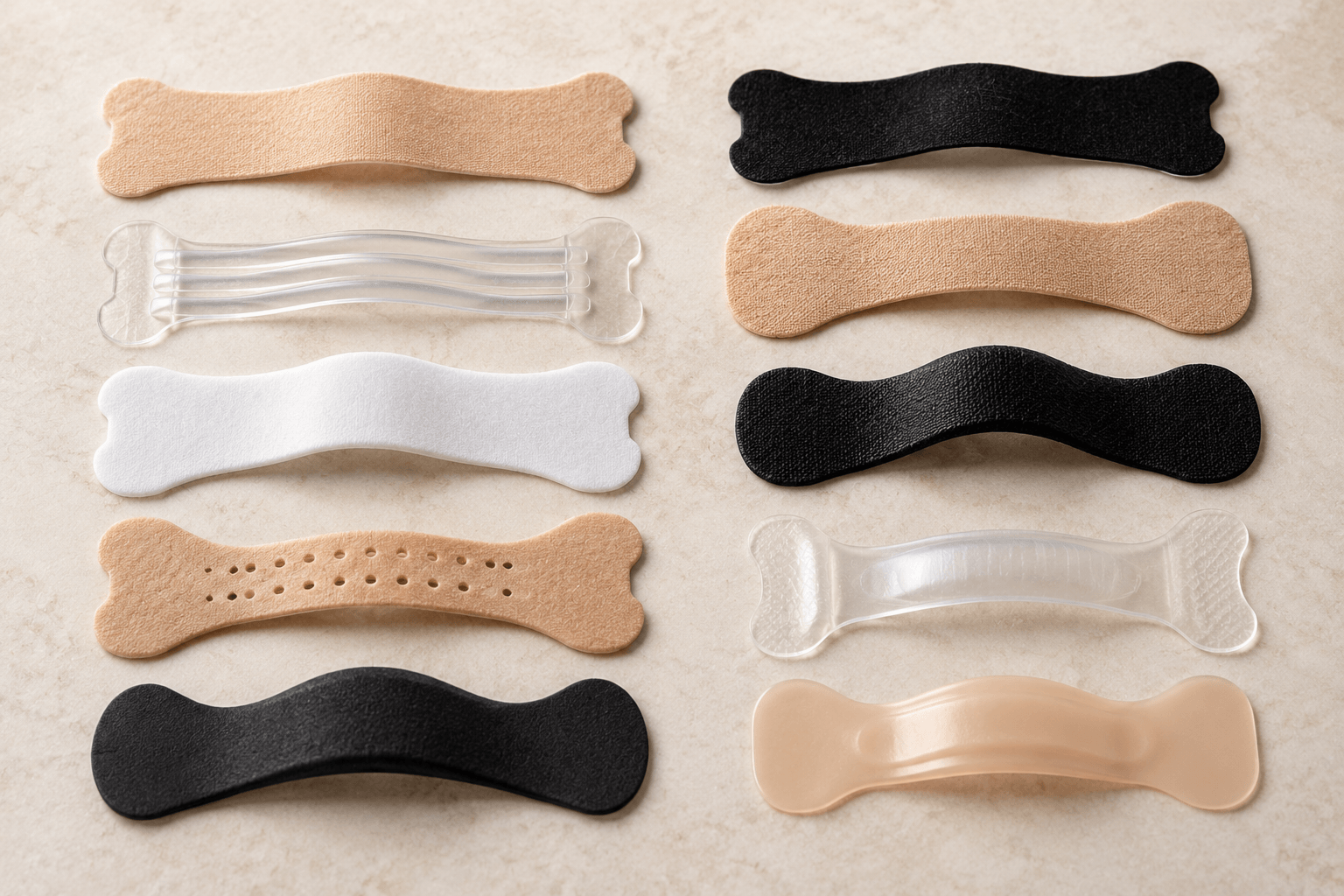
A nasal dilator is a small device that widens the front of the nose so air meets less resistance on the way in. FDA's definition splits them into two types. An external dilator is an adhesive strip with a spring layer that pulls the nostrils open from outside. An internal dilator is made of metal or plastic, sits inside the nostrils and works by pushing them open or by pressing gently on the columella, the strip of tissue between the nostrils.
This article is about internal dilators. They come in a few common shapes:
- Cones or tubes: soft, hollow pieces that sit in each nostril, sometimes joined by a small bridge.
- Clips: a single piece that spans the columella with a pad in each nostril.
- Vents: shaped pieces that brace the side walls of the nostrils outward.
All of them aim at the nasal valve, the narrowest part of the nasal airway, which sits just inside the nostrils. Cleveland Clinic explains that internal dilators press the cartilage outward to widen the nasal valve, and that like breathing strips, they may help you sleep easier. Our overview of the types of nasal dilators goes through each style.
Do internal nasal dilators work?
Research: limited (what this means)Internal nasal dilators do widen the nose and lower nasal resistance in studies, though the research is small. In a 2004 study of 27 healthy people, both an internal dilator and an external strip increased the narrowest cross-section of the nose and decreased nasal resistance. The internal dilator lowered resistance significantly more than the strip.
A 2010 study looked at people whose nostrils collapse inward when they breathe in, a problem called alar collapse. An internal dilator enlarged the nostril opening during quiet and forced breathing, completely stopped the collapse, and increased nasal airflow in both patients and healthy controls. A 1999 study in 17 healthy people found that an internal dilator and a decongestant spray each lowered nasal resistance by a similar amount, and that using both together lowered it further.
For sleep, a 2019 study of 41 snorers compared an internal dilator with an external strip. Both reduced snoring time and improved how people rated their sleep, and the internal dilator helped a larger number of people. That study was open-label, so participants knew which device they were using.
How do you choose the right size?
The right size sits just inside each nostril, stays in place when you sniff hard, and doesn't press painfully on the walls of your nose. Size matters more for internal dilators than for strips, because the device has to fit the inside of your nose.
No study has compared ways of sizing a dilator, so the maker's guide is the place to start. A few practical checks help:
- Too small: it slides out when you breathe out, or moves deeper when you breathe in.
- Too large: it rubs, aches or leaves the nostril rim red after a short time.
- About right: you can feel it but forget about it after a few minutes, and breathing in feels easier.
If a maker offers a sizing or sample pack, it's a sensible way to try more than one size before you commit.
How do you insert a nasal dilator?
You insert a nasal dilator gently, just far enough that it sits behind the rim of each nostril, and no further. Here's a simple routine:
- Wash your hands, and check the dilator is clean, dry and undamaged.
- If it has two separate pieces, connect them as the instructions say. In the 2012 case report below, the instructions said the two cylinders should be joined by their connecting bar.
- Gently slide one end into each nostril, following the curve of your nose.
- Breathe in through your nose. It should feel easier, and the dilator shouldn't move.
- Look in a mirror. You should be able to see the device and grip it easily.
To remove it, hold the visible part and pull it straight out slowly. If it sticks or feels sore, a little warm water around the nostrils can help.
How do you clean a nasal dilator?
Clean a reusable nasal dilator after every use, following the maker's instructions. We'd suggest washing it with mild soap and warm water, rinsing well and letting it air dry completely before you put it away. Store it in a clean, closed case, not loose in a bag or drawer.
Check it each time you clean it. Replace it if it's cracked, has lost its shape or no longer grips, since a worn dilator is more likely to fall out or slip. Single-use dilators should go in the bin after one use.
Is a nasal dilator safe?
A nasal dilator is safe for most adults when it fits and is used as directed. FDA puts nasal dilators in Class I, its lowest-risk group, and exempts them from premarket notification. The most common problems are soreness or redness inside the nostrils from a poor fit.
There is one rare risk worth knowing about. A 2012 case report describes a man who inhaled an internal dilator into his nose during sleep. One morning one piece was missing, and he woke with severe pain on one side of his face. Weeks later, a single silicone cylinder was found lodged high in his nasal cavity, where it had caused sinusitis, and his symptoms cleared quickly once it was removed. He said he had worn both pieces joined by their connecting bar that night. The authors noted they found no earlier reports of displaced dilators causing problems, but that dilators are often said to fall out during the night.
The lessons are simple. Check the device is intact and assembled as the instructions describe, choose a size that doesn't slip, and if a dilator goes missing overnight and you have pain or one-sided symptoms, see a doctor and mention it.
How long can you wear a nasal dilator?
No study has tested how long it's safe to wear an internal nasal dilator, including all day. FDA describes nasal dilators as giving temporary relief, and the studies above used them during exercise sessions or overnight. Follow the maker's wear-time instructions, and give your nose time without the device each day.
| Situation | What to do |
|---|---|
| Overnight for sleep | Insert at bedtime, remove and clean in the morning |
| During exercise | Insert before the session, remove after |
| All day | Not tested in studies; follow the maker's limits and take breaks |
| Soreness, redness or bleeding inside the nose | Stop and let your nose recover |
| Dilator missing in the morning with pain | See a doctor and tell them |
Who shouldn't use a nasal dilator?
Some people are better off skipping internal dilators or checking with a doctor first:
- Children. Ask a pediatrician first. The 2012 case report notes that one-sided pain and discharge from the nose are classic signs of a foreign body in a child.
- Anyone who's had recent nose surgery or injury. Ask your surgeon or doctor before putting anything inside your nose.
- People with sores, crusting or frequent nosebleeds inside the nostrils. A device that presses on the walls of the nose can make these worse.
- Anyone who may have sleep apnea. Talk to a doctor rather than relying on a dilator. A 2026 meta-analysis concluded that nasal dilators can't be recommended as a stand-alone treatment for sleep-disordered breathing.
If your nose feels blocked most nights, the cause may be structural. Cleveland Clinic says that while breathing strips can help manage the symptoms of nasal valve collapse, many people need surgery to correct it. Our article on nasal valve collapse explains the signs.
When is an external strip simpler?
An external nasal strip is often the simpler choice, because it sits on the outside of the nose. There's no sizing, nothing goes inside your nostrils, and it can't slip into your nasal cavity. A 2014 review describes external nasal dilators as simple, noninvasive, painless and affordable, with minimal risk to the user.
A strip may suit you better if:
- the inside of your nose is sensitive or easily sore
- you don't like the feeling of something in your nostrils
- you'd rather not clean and store a reusable device
- you want something that's easy to check in the mirror
An internal dilator may lower resistance more, as the 2004 study found, and it can be handy if adhesive irritates your skin. Our side-by-side guide to nasal strips vs. nasal dilators covers the trade-offs, and how to apply nasal strips shows how to get a strip in the right place.
Our pick (paid partner): TitanAir Nasal Strips
If you decide an external strip is the easier route, our pick is TitanAir Nasal Strips. This is our recommendation, not the result of testing or ranking products ourselves.
Titan says they're drug-free external nasal dilators with flexible, spring-loaded bands. It recommends placing them just above the flare of the nostrils, on the soft part of the nose rather than the bony bridge, on clean, dry skin with no moisturizer. To take one off, Titan says to loosen it with warm water and peel slowly from the ends inward. Titan says the strips are third-party tested and certified PFAS-free, with a 30-night guarantee.
Read next
Common questions
How do you use a nasal dilator?
Wash your hands, check the dilator is clean and dry, then gently slide each end into a nostril just far enough to sit behind the nostril rim. It should feel snug but not painful, and you should be able to see and reach it easily. Breathe in through your nose to check the fit, and remove it slowly by pulling it straight out.
Is a nasal dilator safe?
For most adults, yes, when it fits and is used as directed. FDA classes nasal dilators as Class I, its lowest-risk device group. The main risks are soreness and, rarely, a dilator slipping too far into the nose. A 2012 case report describes one that was inhaled during sleep. Take it out if it hurts, and see a doctor if one goes missing.
Can I wear a nasal dilator all day?
No study has tested all-day wear, so we can't say it's safe or unsafe. FDA describes nasal dilators as giving temporary relief. Studies have used them during exercise sessions and overnight. Follow the maker's wear-time instructions, give your nose breaks, and stop if the inside of your nostrils becomes sore, red or starts to bleed.
Do nasal dilators work for sleep?
They can make nasal breathing easier at night. A 2019 study of 41 snorers found both an internal dilator and an external strip reduced snoring time and improved how people rated their sleep. They aren't a treatment for sleep apnea. A 2026 meta-analysis concluded nasal dilators can't be recommended as a stand-alone treatment for sleep-disordered breathing.
How do I know what size nasal dilator I need?
The right size sits just inside each nostril, stays put when you breathe in hard, and doesn't press painfully. Too small and it falls out or slides deeper; too large and it rubs. If a maker offers a sample or sizing pack, it's an easy way to compare. No study has compared sizing methods, so the maker's guide is your best starting point.
Is a nasal strip or a nasal dilator better?
Neither is better for everyone. In a 2004 study, an internal dilator lowered nasal resistance more than a strip, but a strip sits outside the nose, needs no sizing and can't slip inside. If you have sensitive nostrils or worry about something inside your nose, a strip is the simpler choice.
Sources
- 21 CFR 874.3900: Nasal dilator
- Nasal valve collapse
- Effects of the nasal strip and dilator on nasal breathing: a study with healthy subjects
- External nasal valve collapse: a case-control and interventional study employing a novel internal nasal dilator
- Combined effects of a mechanical nasal dilator and a topical decongestant on nasal airflow resistance
- Displaced nasal dilator caused severe pain: case report and literature review
- Internal and external nasal dilatator in patients who snore: a comparison in clinical practice
- Clinical effectiveness of nasal dilators in sleep-disordered breathing: a systematic review and meta-analysis
- External nasal dilators: definition, background, and current uses
- TitanAir Nasal Strips
About this article
- Research
- 10 published sources, listed above.
- Evidence
- Limited. How we rate it
- Last checked
- October 14, 2026
- Funding
- Paid partner of Titan Recovery. Their ads are labeled.
- Found an error?
- Tell us. We log fixes on the corrections page.
* This content is for informational and educational purposes only and is not medical advice. It is not intended to diagnose, treat, cure or prevent any disease or health condition. Talk to a qualified healthcare provider about your health.