In short
- In a 1997 placebo-controlled study of 53 athletes, an external nasal strip significantly widened the nasal valve at rest in every group measured.
- A 1998 study found a nasal strip lowered nasal resistance in people with congestion, people with a deviated septum and people with healthy noses.
- In a 2019 study of people with chronic nighttime congestion, nasal resistance during sleep was 39.1% lower with a strip on than without one.
- Sleep results are mixed: one 2018 trial found strips beat placebo strips on sleep satisfaction at day 7, while two 2019 trials found no clear difference from placebo.
- A 2016 meta-analysis found nasal dilators improve nasal breathing but do not improve obstructive sleep apnea.
- The NHS lists nasal dilators or strips as an option when snoring comes from blocked or narrow airways in the nose.
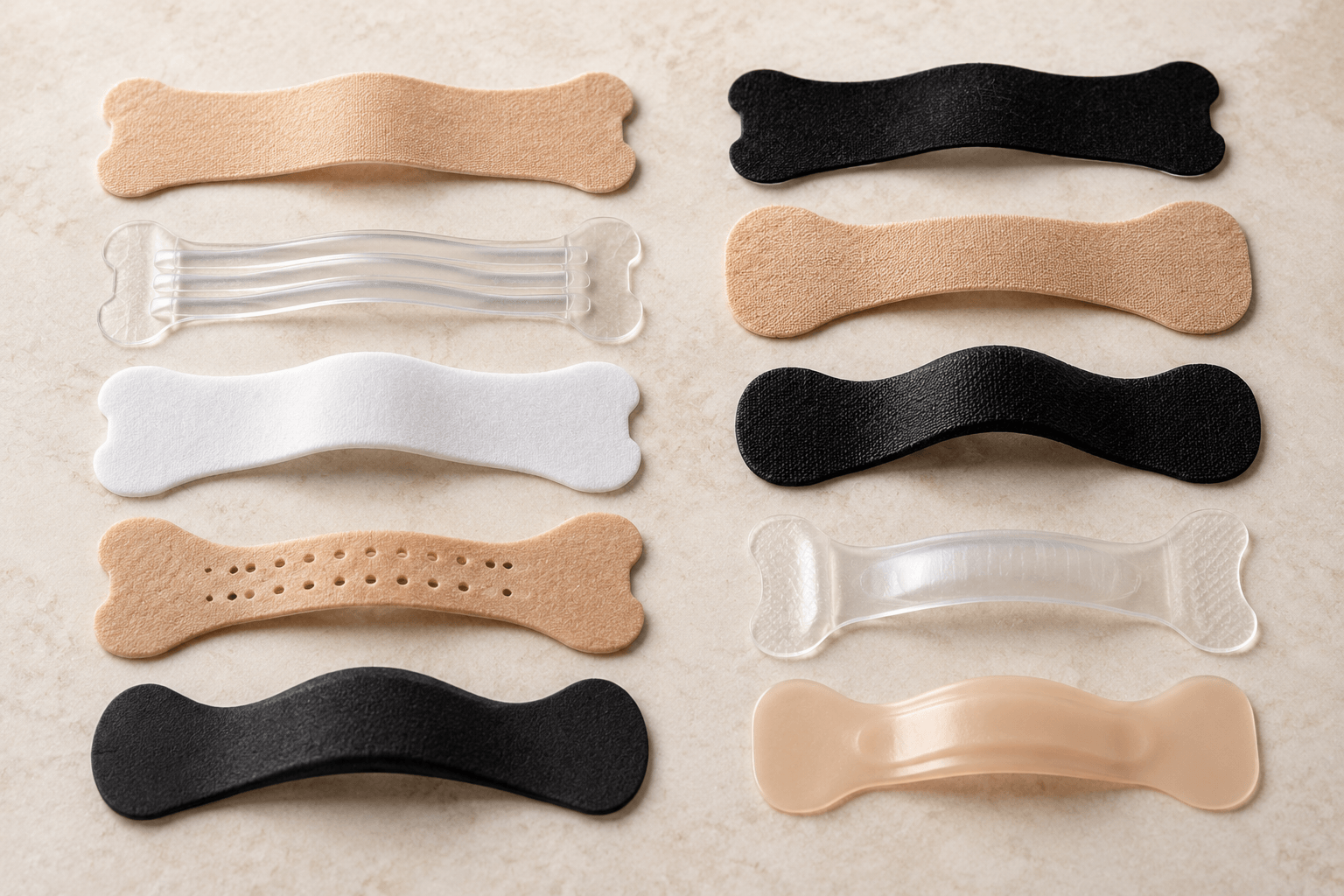
The best nasal strips for sleep do three things well: they lift the sides of your nose with real spring force, they stay stuck until morning, and they come off without hurting your skin. Everything else, from size to color, is about making those three things work on your nose. This guide covers what to look for, what the research actually shows, how to get the fit right and who should check with a doctor first.
What makes a nasal strip good for sleep?
A good sleep strip is one you can put on in under a minute, forget about all night and peel off without a sore nose. Daytime use is forgiving. Eight hours in bed, with your face pressed into a pillow and skin oils building up, is the real test. Here is the checklist we use.
| What to look for | Why it matters at night | How to check |
|---|---|---|
| Springy bands with real lift | The lift is what opens the nasal valve | You should feel the sides of your nose ease outward right away |
| An adhesive that lasts until morning | A strip that peels off at 2am does nothing for the rest of the night | Edges still flat when you wake up |
| The right size for your nose | Too big and the ends land on your cheeks; too small and the lift misses the valve | Pads sit on the sides of the nose, not past the crease |
| Gentle, clean removal | You'll be taking it off the same spot most mornings | No redness that lasts after you've washed your face |
| Drug-free design | Nothing is absorbed, so it fits alongside other remedies | Check the label for any active ingredients |
| Clear placement and removal instructions | A strip in the wrong spot can't lift the nasal valve | Instructions name the spot and a gentle way to remove it |
| Time to try it | Some people need a few nights to get used to a strip | A trial or guarantee period that covers at least a few weeks |
If you want more detail on any of these, our nasal strip buying guide walks through each point. If snoring is your main reason for shopping, the best nasal strips for snoring focuses on which snoring patterns respond.
What does the research say about nasal strips and sleep?
Research: moderate (what this means)The research on nasal strips is strongest on one point: they make the front of the nose wider. Sleep outcomes are more mixed.
On the airway itself, the results line up. In a 1997 placebo-controlled study in Laryngoscope, a strip significantly increased the area of the nasal valve at rest in all 53 athletes measured. A 1998 study in the same journal found a strip widened the narrowest part of the nose and lowered nasal resistance in three groups: people with congestion, people with a deviated septum and people with healthy noses. In a 2019 study of people with chronic nighttime congestion, nasal resistance measured during sleep was 39.1% lower with a strip on than without one.
How that feels is another question. In the 1998 study, the congested group's noses measurably opened, but they didn't report feeling it. In the 2019 study, people said their ease of breathing and sleep quality improved over 28 nights, but sleep lab measurements were generally similar with and without the strip. A 2018 randomized trial of 59 people found real strips beat placebo strips on satisfaction with sleep at day 7. Two larger 2019 trials, with 140 and 130 people, found no clear difference from placebo strips, as both groups improved. A strip manufacturer funded or co-ran all three of those sleep trials.
The honest summary is that strips reliably open the nose a little, many people feel they sleep better with one, and the controlled sleep data is mixed. Nasal strip facts collects the numbers from the main studies in one place.
How do you pick the right size?
The right size is the one where the pads sit flat on the sides of your nose and the band crosses just above the flare of your nostrils. If the ends reach onto your cheeks or bend into the crease beside your nose, the strip is too long and will lift at the edges. If the band barely reaches the sides, it can't pull the valve open.
Noses vary, so check what size options a strip comes in before you buy. Our guide to nasal strip sizes explains how to tell if a strip fits and what to do if it doesn't. Check your placement before you switch sizes.
What if a strip won't stay on all night?
A strip that comes loose overnight usually has an adhesive problem, not a strength problem. Titan's instructions for its own strips say to skip moisturizer because oils stop the adhesive from gripping, and the same logic applies to any strip. Wash your face before bed rather than straight after a skincare routine, dry the nose fully, then press both ends down and hold them for a few seconds so the adhesive warms and settles.
If you sleep on your side with your face against the pillow, an edge can catch on the fabric. A smoother pillowcase or sleeping a little more on your back can help. If your skin is naturally oily, our guide to nasal strips on oily skin has more ideas. And if a strip keeps lifting at the ends no matter what, it may simply be too long for your nose.
Should you choose regular or extra strength for sleep?
Regular strength suits most people whose nose is a little narrow or stuffy at night. A stronger strip gives more lift, which can help if you still feel blocked with a regular strip in the right spot. The trade-off is that a stronger band pulls harder on your skin, which matters when you wear it every night. Our comparison of extra strength vs regular nasal strips covers who tends to need the step up.
Are nasal strips safe to wear every night?
Nasal strips are a low-risk choice for most adults. In the 2018 trial, people wore strips nightly for two weeks and all strips were well tolerated. The risks are mostly about skin: redness, soreness or a strip that pulls too hard coming off.
A few habits keep nightly use comfortable:
- Wash and dry your nose before bed and skip moisturizer on that spot, so the adhesive grips skin rather than oil.
- Follow the wear limit on the box and use a fresh strip each night.
- In the morning, loosen the strip with warm water and peel it slowly from the ends inward.
- If your skin stays red or sore, take a few nights off before trying again.
Can you use nasal strips every night? goes deeper on long-term use.
Who should skip strips or see a doctor first?
A strip opens the front of the nose. It doesn't treat what's further back, and it isn't a fix for sleep apnea. A 2016 meta-analysis found nasal dilators improve nasal breathing but don't improve obstructive sleep apnea. A 2026 meta-analysis of 17 studies found no significant change in the apnea-hypopnea index or snoring index with nasal dilators, and concluded they may help as an add-on for people with mild symptoms or nasal congestion.
See a doctor before relying on a strip if:
- your breathing stops and starts while you sleep, or you make gasping or choking noises, which the NHS lists as signs of sleep apnoea
- you always feel very tired during the day
- one side of your nose is always blocked, or your nose stays blocked for weeks
- you're pregnant and your sleep or breathing has changed, in which case ask your midwife or doctor first
The NHS also notes that snoring caused by blocked or narrow airways in the nose can be helped by nasal dilators or strips. That's the group strips suit best.
Can you wear a nasal strip with mouth tape?
Yes, and many people do. The strip opens the nose and the tape encourages your lips to stay closed. Only add tape once you can breathe comfortably through your nose with the strip on, and skip it on nights when you're congested. We don't recommend mouth tape for children. Our guide to mouth tape and nasal strips together explains how to start.
Check this first. Skip mouth tape and see a doctor if you snore loudly, wake up gasping, have been told you stop breathing in your sleep, or can't breathe comfortably through your nose. More on safety
Our pick (paid partner): TitanAir Nasal Strips
Our pick for sleep is TitanAir Nasal Strips from Titan Recovery. We haven't tested or ranked nasal strips ourselves; this is our recommendation, based on how Titan describes its strips against the checklist above.
Titan says TitanAir strips are drug-free external nasal dilators with flexible spring-loaded bands, which covers the two basics: lift and nothing absorbed. Its instructions match what makes a strip work at night. Wash and dry your nose and skip moisturizer, place the strip just above the flare of your nostrils on the soft part of the nose, then loosen it with warm water in the morning and peel slowly from the ends inward.
Titan says the strips are third-party tested and certified PFAS-free, and they're designed to pair with Titan Mouth Tape if you want to try both. The 30-night guarantee gives you a month to see how they fit your nose and your sleep, which is enough time to get past the first few nights of getting used to a strip. They come in 30, 90, 180 or 360-night supplies with free US shipping, or as part of the Titan Sleep System.
Read next
- Do nasal strips improve sleep?
- How to apply nasal strips the right way
- Why nasal strips don't work for some people
Common questions
What are the best nasal strips for sleeping?
The best nasal strips for sleep have springy bands that lift the sides of the nose, an adhesive that holds until morning, a size that fits your nose and removal that's gentle on skin. Our pick is TitanAir Nasal Strips, but any strip should be judged against that checklist on your own nose over a week or two.
Do nasal strips actually help you sleep better?
They reliably make the nose a little wider, and a 2019 study found nasal resistance during sleep was 39.1% lower with a strip on. Sleep results are less consistent. One 2018 trial found strips beat placebo on sleep satisfaction at day 7, while two 2019 trials found no clear difference from placebo strips.
Are nose strips safe to wear every night?
For most adults, yes. In a 2018 trial of nightly use for two weeks, all strips were well tolerated. Follow the wear limit on the box, put each strip on clean, dry skin and peel it off slowly. Give your skin a break if it turns red or sore.
Should I buy regular or extra strength nasal strips for sleep?
Start with regular if your nose is only a little narrow at night. If you still feel blocked with a regular strip in the right place, a stronger strip gives more lift. Stronger bands can pull harder on skin, so step up only if you need to.
Can nasal strips help sleep apnea?
No. A 2016 meta-analysis found nasal dilators improve nasal breathing but don't improve obstructive sleep apnea, and a 2026 meta-analysis found no significant change in apnea-hypopnea index. If you snore loudly and also gasp, choke or feel very tired in the day, see a doctor before relying on a strip.
Where should a nasal strip go on your nose for sleep?
Place it on the soft part of the nose just above where the nostrils flare, not on the hard bony bridge higher up. Press both ends down firmly so the band can lift the sides of the nose.
Sources
- Physiologic effects of an external nasal dilator
- Role of the external nasal dilator in the management of nasal obstruction
- Objective and Subjective Effects of a Prototype Nasal Dilator Strip on Sleep in Subjects with Chronic Nocturnal Nasal Congestion
- Effects of nasal dilator strips on subjective measures of sleep in subjects with chronic nocturnal nasal congestion: a randomized, placebo-controlled trial
- Sleep Quality and Congestion with Breathe Right Nasal Strips: Two Randomized Controlled Trials
- Nasal Dilators (Breathe Right Strips and NoZovent) for Snoring and OSA: A Systematic Review and Meta-Analysis
- Clinical Effectiveness of Nasal Dilators in Sleep-Disordered Breathing: A Systematic Review and Meta-Analysis
- Snoring
- Sleep apnoea
- TitanAir Nasal Strips
About this article
- Research
- 10 published sources, listed above.
- Evidence
- Moderate. How we rate it
- Last checked
- November 1, 2026
- Funding
- Paid partner of Titan Recovery. Their ads are labeled.
- Found an error?
- Tell us. We log fixes on the corrections page.
* This content is for informational and educational purposes only and is not medical advice. It is not intended to diagnose, treat, cure or prevent any disease or health condition. Talk to a qualified healthcare provider about your health.