In short
- FDA rules describe two kinds of nasal dilator: external ones that stick to the skin and pull the nostrils open, and internal ones placed inside the nostrils that push them open or press gently on the columella.
- FDA classes nasal dilators as Class I devices, its lowest-risk group, exempt from premarket notification.
- In a 2004 study of 27 healthy adults, both a nasal strip and an internal dilator widened the nasal valve and lowered resistance, with the internal dilator lowering resistance more.
- A 2019 study of 41 people who snore found both an internal dilator and a strip reduced snoring time and improved rated sleep quality.
- A 2026 meta-analysis of 17 studies found nasal dilators did not significantly change sleep apnea measures and said they may help as an add-on for mild symptoms or nasal congestion.
- A 2012 case report described a man who inhaled an internal nasal dilator into his nasal cavity during sleep.
The best nasal dilator for sleep is the one you'll actually wear all night: it opens your nose enough to notice, feels comfortable enough to forget, and is simple to keep clean. External strips, internal dilators and clips all aim at the same narrow spot in the nose. They differ mostly in comfort, fit and hygiene, and that's where the choice gets made.
What are the main types of nasal dilator?
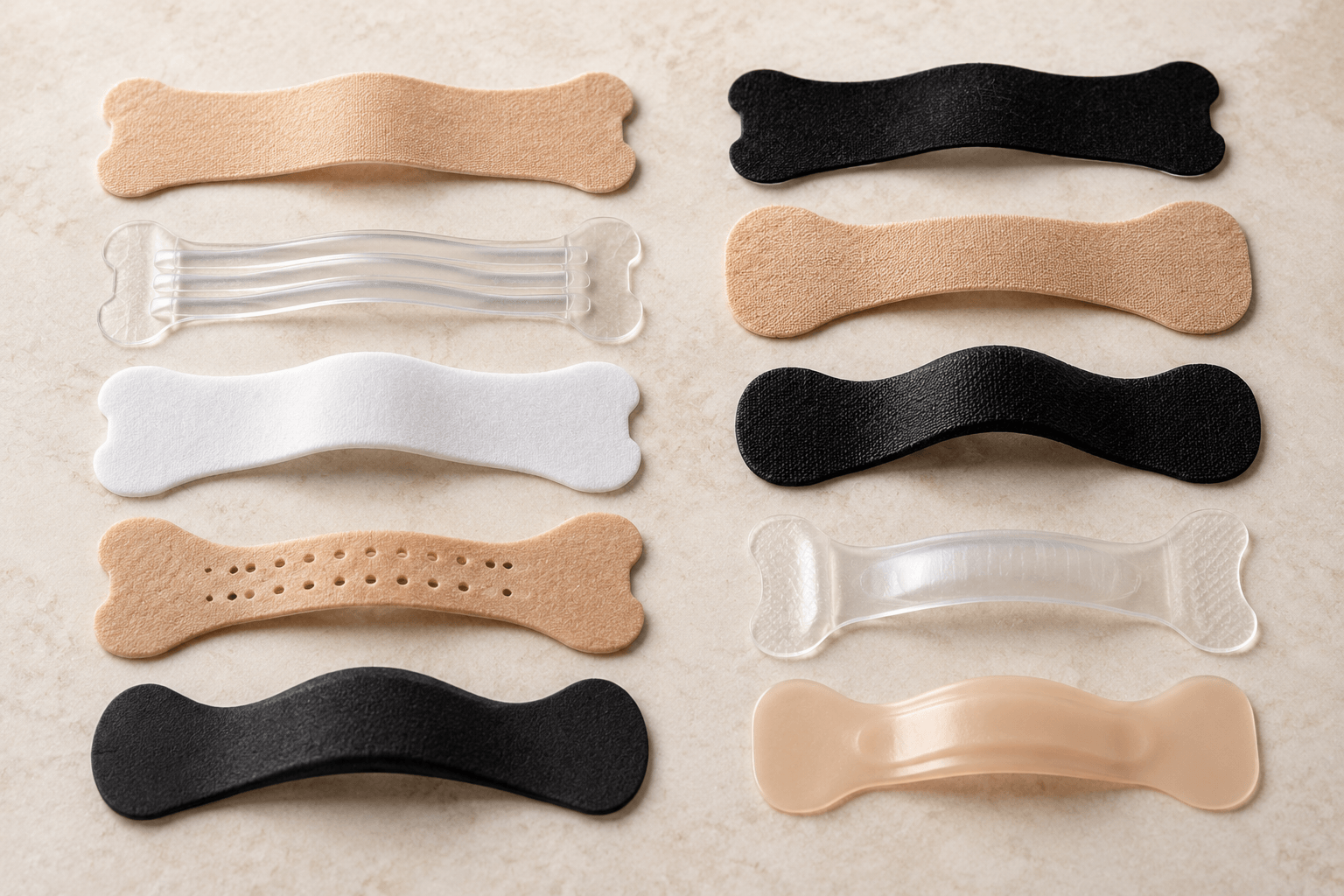
Nasal dilators come in two families, and US rules define both. FDA's regulation on nasal dilators describes an external dilator as a layered strip with a spring and a skin adhesive that pulls the nostrils open from outside. It describes an internal dilator as a metal or plastic device placed inside the nostrils that pushes them open or presses gently on the columella, the strip of skin between the nostrils. Clips, cones and stents are all internal designs.
Both types are Class I devices, FDA's lowest-risk group, and exempt from premarket notification. Our guide to every type of nasal dilator explains how each design works in more detail.
How do strips, internal dilators and clips compare?
Here's how the three main options stack up for sleep. "Clips" here means the internal devices that grip or press on the columella, as opposed to cones or springs that sit further into each nostril.
| External strip | Internal dilator (cones, springs) | Nose clip | |
|---|---|---|---|
| Where it sits | On the skin outside the nose | Inside each nostril | Inside the nostrils, gripping or pressing on the columella |
| How it opens the nose | Pulls the sides outward | Pushes the nostrils open | Pushes the nostrils open |
| Comfort for sleep | Nothing inside the nose; some people notice it on the skin | Some people notice it inside the nostril | Pressure on the columella can be noticeable |
| Hygiene | A fresh strip each night | Reusable; needs washing and drying | Reusable; needs washing and drying |
| Fit | Size and placement on the outside | Needs the right size for your nostrils | Needs the right size and grip |
| When you're congested | Lifts from outside without touching swollen lining | Sits against lining that may be sore | Sits against lining that may be sore |
| Main skin or tissue risk | Redness from adhesive | Soreness inside the nostril; rarely slips further in | Soreness inside the nostril |
What does the research say about each type?
Research: moderate (what this means)Both types of dilator reliably open the nose. In a 2004 study in Rhinology, 27 healthy adults tried a strip and an internal dilator. Both widened the narrowest part of the nasal valve and lowered nasal resistance, and the internal dilator lowered resistance more. A 2010 study in the same journal found an internal dilator enlarged the external nasal valve, stopped the nostrils collapsing inward in people with that problem and improved airflow.
For sleep and snoring, the picture is more mixed. A 2019 study of 41 people who snore found both an internal dilator and a strip reduced snoring time and improved how people rated their sleep, with the internal dilator working for more people. A 2019 study of people with chronic nighttime congestion found nasal resistance during sleep was 39.1% lower with a strip on.
Neither type is a sleep apnea device. A 2016 meta-analysis found nasal dilators improve nasal breathing but haven't been shown to improve obstructive sleep apnea. A 2026 meta-analysis of 17 studies found no significant differences in apnea, snoring index or oxygen measures with nasal dilators, and concluded they may help as an add-on for people with mild symptoms or nasal congestion. The NHS lists nasal dilators or strips as an option when snoring comes from blocked or narrow airways in the nose.
What should you look for in a nasal dilator for sleep?
Whatever type you choose, the same questions decide whether it works for you night after night.
Comfort you can sleep through
A dilator that wakes you up isn't helping. With a strip, the question is how the adhesive feels on your skin. With an internal device, it's whether you can feel it inside the nostril or on the columella when you roll over. Give any new dilator a few nights, since most things feel strange at first.
A fit that stays put
An external strip has to sit on the soft part of the nose, just above the flare of the nostrils, with the pads off your cheeks. An internal dilator has to be snug enough not to slip. Our guide on how to use a nasal dilator covers sizing and inserting internal devices step by step.
Hygiene you'll keep up
Anything that sits inside your nose all night needs cleaning, so a reusable internal dilator needs washing and drying after each use, following the maker's instructions, and replacing when it loses its shape. A strip sidesteps this: you use a fresh one each night and throw it away. Our article on whether you can reuse nasal strips explains why a used strip doesn't hold up.
Safety if it comes loose
The rare but real risk with internal devices is that they move. A 2012 case report described a man who inhaled an internal dilator into his nasal cavity during sleep, where it was later found causing pain and sinusitis. That's unusual, but it's a reason to choose a size that stays put and to check the device is intact each night. A strip that comes loose ends up on your pillow.
Nothing absorbed
Both strips and internal dilators work mechanically, with no drug involved. That makes them easy to use alongside saline, a humidifier or a spray your doctor has suggested.
Which nasal dilator should you try first?
For most people, an external strip is the easiest place to start. It's quick to put on, leaves the inside of your nose alone, needs no cleaning routine and doesn't get in the way of a congested or sore nose. If a strip opens your nose enough and stays on, you may not need anything else.
An internal dilator is worth a try if strips irritate your skin, if you have facial hair or skin that makes adhesives hard, or if a strip doesn't open your nose enough. Some people also keep both and pick based on the night. Our comparison of nasal strips vs nasal dilators goes deeper on who each one suits.
Can you use a nasal dilator with mouth tape?
Yes. A dilator opens the nose and mouth tape encourages your lips to stay closed, so the two work toward the same goal. Make sure you can breathe comfortably through your nose with the dilator in place before you add tape, and skip tape on nights when your nose is blocked. We don't recommend mouth tape for children. Read mouth tape and nasal strips together before you start.
Check this first. Skip mouth tape and see a doctor if you snore loudly, wake up gasping, have been told you stop breathing in your sleep, or can't breathe comfortably through your nose. More on safety
Who should skip a dilator or see a doctor first?
A dilator opens the front of the nose and nothing more. See a doctor before relying on one if:
- you snore and also feel sleepy in the day, stop breathing in your sleep or make gasping or choking noises, which the NHS says may be signs of sleep apnoea
- one side of your nose is always blocked, or your nose stays blocked for weeks
- you've had nose surgery recently, or your nostrils are sore, cracked or bleeding, before putting anything inside them
- you're pregnant and your breathing or sleep has changed, in which case ask your midwife or doctor first
- a device goes missing overnight and you have pain or one-sided symptoms
Our pick (paid partner): TitanAir Nasal Strips
Our pick for a nasal dilator for sleep is TitanAir Nasal Strips from Titan Recovery. We haven't tested or ranked dilators ourselves, and Titan's strips weren't used in any of the studies above; this is our recommendation, based on how Titan describes its strips against the checklist.
TitanAir is an external dilator, which suits the comfort and hygiene points above: nothing goes inside the nose and there's nothing to wash. Titan says the strips are drug-free external nasal dilators with flexible spring-loaded bands that lift the nasal passages open. Its instructions are to wash and dry your nose, skip moisturizer, place the strip just above the flare of your nostrils on the soft part of the nose, and in the morning loosen it with warm water and peel slowly from the ends inward.
Titan says the strips are third-party tested and certified PFAS-free, and they're designed to pair with Titan Mouth Tape. The 30-night guarantee gives you time to see whether a strip suits you better than an internal device would, and they come in 30, 90, 180 or 360-night supplies with free US shipping.
Read next
Common questions
What is the best nasal dilator for sleep?
The best nasal dilator for sleep is one you'll wear comfortably all night, that opens your nose enough to feel the difference and that's easy to keep clean. For most people starting out, an external strip is the simplest choice. Our pick is TitanAir Nasal Strips.
Are nasal strips or internal dilators better?
Neither wins for everyone. A 2004 study found an internal dilator lowered nasal resistance more than a strip in healthy adults, and a 2019 study found an internal dilator helped more snorers. Strips sit outside the nose and are a fresh one each night, which many people find more comfortable and simpler to keep clean.
Are nose clips safe to sleep in?
Nasal dilators are Class I devices, FDA's lowest-risk group. The main risks with internal devices are soreness from a poor fit and, rarely, a device slipping further in. A 2012 case report described a man who inhaled an internal dilator during sleep, so choose a size that stays put and check the device is intact.
Do nasal dilators help sleep apnea?
No. A 2016 meta-analysis found nasal dilators improve nasal breathing but haven't been shown to improve obstructive sleep apnea, and a 2026 meta-analysis of 17 studies found no significant change in apnea measures. If you snore loudly with gasping, choking or daytime sleepiness, see a doctor.
How do you clean a nasal dilator?
Follow the maker's instructions. Reusable internal dilators sit inside the nostrils, so they generally need washing after each use and drying before storage, and replacing when they lose shape. External strips avoid the issue, since you use a fresh strip each night and throw it away in the morning.
Which nasal dilator is best for a congested nose?
Both types can lower nasal resistance, but internal dilators sit inside a nose that may be swollen and sore when you're congested. A strip lifts from the outside instead. A 2019 study found nasal resistance during sleep was 39.1% lower with a strip in people with chronic nighttime congestion.
Sources
- 21 CFR 874.3900: Nasal dilator
- Effects of the nasal strip and dilator on nasal breathing: a study with healthy subjects
- Internal and external nasal dilatator in patients who snore: a comparison in clinical practice
- External nasal valve collapse: a case-control and interventional study employing a novel internal nasal dilator
- Objective and Subjective Effects of a Prototype Nasal Dilator Strip on Sleep in Subjects with Chronic Nocturnal Nasal Congestion
- Nasal Dilators (Breathe Right Strips and NoZovent) for Snoring and OSA: A Systematic Review and Meta-Analysis
- Clinical Effectiveness of Nasal Dilators in Sleep-Disordered Breathing: A Systematic Review and Meta-Analysis
- Displaced nasal dilator caused severe pain: case report and literature review
- Snoring
- TitanAir Nasal Strips
About this article
- Research
- 10 published sources, listed above.
- Evidence
- Moderate. How we rate it
- Last checked
- November 1, 2026
- Funding
- Paid partner of Titan Recovery. Their ads are labeled.
- Found an error?
- Tell us. We log fixes on the corrections page.
* This content is for informational and educational purposes only and is not medical advice. It is not intended to diagnose, treat, cure or prevent any disease or health condition. Talk to a qualified healthcare provider about your health.