In short
- A 2016 systematic review in JAMA Facial Plastic Surgery found five studies supporting external nasal dilator strips and concluded they effectively relieve obstruction of the internal nasal valve.
- The same review describes the internal nasal valve as the narrowest part of the nasal airway and a common site of collapse when you breathe in.
- In a 1998 study in Laryngoscope, an external nasal dilator increased the narrowest cross-sectional area of the nose and lowered nasal resistance in healthy people and in people with nasal obstruction.
- A 2016 meta-analysis found that nasal dilators improve nasal breathing but did not improve sleep apnea outcomes for people with obstructive sleep apnea.
- A 2026 overview in BMJ Evidence-Based Medicine rated the evidence for kinesiology taping in musculoskeletal problems as very uncertain.
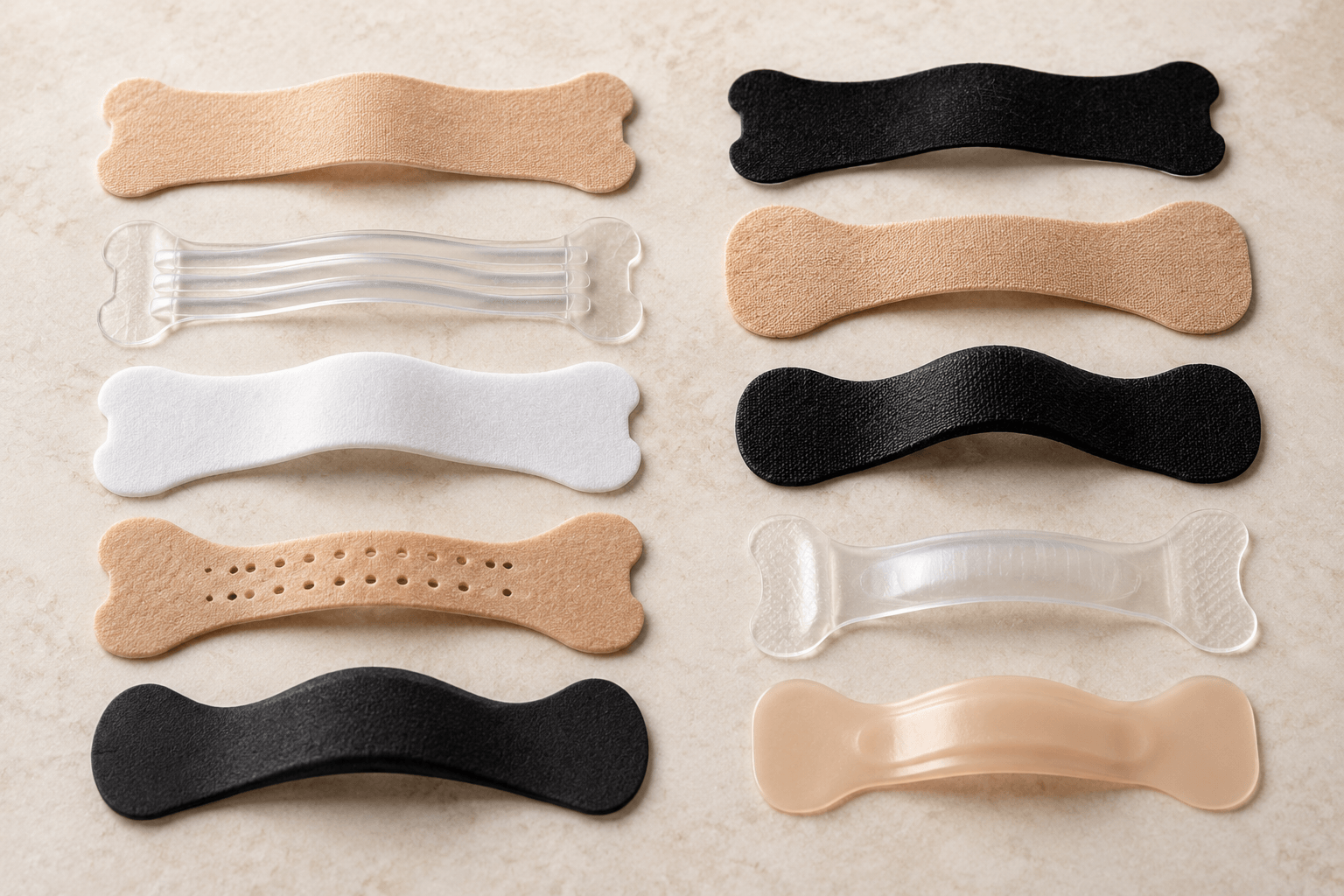
Nasal tape and nasal strips both stick to the outside of your nose, but they open it in different ways. A nasal strip has a built-in springy band that tries to straighten after you bend it over your nose, lifting the sides outward. Nasal tape is usually stretchy, kinesiology-style tape with no spring, so any lift depends on how it's stretched and placed. Spring-band strips have been measured in several studies. We couldn't find any published trials of nasal tape for breathing.
What is nasal tape?
Nasal tape is a broad name for adhesive tape worn on the outside of the nose to make breathing feel easier. You'll see it sold as nose tape, nasal lifting tape or kinesiology tape for the nose. Most versions are elastic, kinesiology-style tape that you place across the bridge or along the sides of the nostrils. The idea is that the stretch in the tape gently pulls the skin over the nasal valve outward.
Kinesiology tape was designed for muscles and joints rather than noses. A 2017 lab study in Physical Therapy in Sport describes therapeutic elastic tapes as made of cotton, elastic filaments and adhesive glue, and found that tapes from different manufacturers differ in how they stretch and how well they stick. So one nose tape may behave quite differently from another.
How do spring-band nasal strips work?
A spring-band nasal strip has a thin, flexible band built into the adhesive. Cleveland Clinic explains that breathing strips stick to the outside of the nose, lifting the skin and opening the nostrils, and says they may help you breathe easier and sleep better at night.
The part they target is the internal nasal valve. A 2016 systematic review in JAMA Facial Plastic Surgery describes it as the narrowest part of the nasal airway and a common site of inward collapse when you breathe in. Because the band always tries to spring back flat, the strip applies a steady outward pull on the sides of the nose without you needing to stretch anything. Our guide to how nasal strips work goes into more detail, and nasal valve collapse explains why the valve matters.
How are nasal tape and nasal strips different?
The main difference is where the lift comes from. This table sums up how the two compare, based on the sources in this article.
| Nasal tape | Spring-band nasal strip | |
|---|---|---|
| What it's made of | Usually stretchy kinesiology-style tape | Adhesive pad with a built-in flexible band |
| Where the lift comes from | How much you stretch the tape and where you place it | The band springing back toward flat |
| Consistency | Depends on your technique each night | Built into the strip |
| Published studies for breathing | None found | Several, measuring airflow and nasal dimensions |
| Effect on sleep apnea | Not studied | No improvement in a 2016 meta-analysis |
What does the research say about nasal strips?
Research: limited (what this means)The research on spring-band strips is small but fairly consistent: they widen the front of the nose and make it easier to breathe through. The 2016 JAMA Facial Plastic Surgery review sorted over-the-counter nasal dilators into four classes and found five studies supporting external nasal dilator strips. It concluded that strips and nasal clips effectively relieve obstruction of the internal nasal valve and may be an alternative to surgery for some people.
Individual studies show the same thing. In a 1998 study in Laryngoscope, an external nasal dilator increased the narrowest cross-sectional area of the nose and lowered nasal resistance in healthy people and in people with nasal obstruction. The effect was largest in people whose septal deviation narrowed the nasal valve. People whose blockage came from swollen nasal lining measured better too, but didn't feel much difference.
In a 2018 study in Allergy and Rhinology, 50 healthy adults tested three strip designs. All three improved nasal dimensions and airflow compared with each person's baseline. In a second part of the study, 82 people wore strips for seven nights in a row and none showed any signs of skin irritation on a standard scale.
There are limits. A 2016 meta-analysis in Pulmonary Medicine found that nasal dilators improve nasal breathing but didn't improve the apnea-hypopnea index, lowest oxygen level or snoring index in people with obstructive sleep apnea. Strips help the nose, not the throat.
What does the research say about nasal tape?
There isn't any that we could find. When we searched PubMed in November 2026 for studies on kinesiology-style or lifting tapes applied to the nose for breathing, the results were about tape used for other things, such as reducing swelling after nose surgery or preventing pressure sores from breathing tubes. We found no trials measuring airflow, nasal dimensions, snoring or sleep with nasal tape.
That doesn't mean nasal tape can't work. If tape pulls the skin over the nasal valve outward, it could plausibly have an effect similar to a strip for some people. But nobody has measured it, so any claim that it outperforms strips, or matches them, is a guess.
Kinesiology tape's track record elsewhere is also a reason for caution. A 2026 overview of 128 systematic reviews in BMJ Evidence-Based Medicine found the evidence for kinesiology taping in muscle and joint problems very uncertain, though it may ease pain in the short term. The most common side effects were skin irritation and itching.
Which should you try for sleep?
If you want something with published evidence behind it, start with a spring-band nasal strip. The lift is built in, so it doesn't depend on getting the stretch right in the dark, and it's been measured in studies. Nasal tape is an option if strips don't suit your nose shape or skin, as long as you accept that it's untested.
A fair way to compare them is to try each for a week rather than a single night. Keep everything else the same, note how open your nose feels at bedtime and on waking, and ask a partner whether your snoring changes. If a strip feels too strong or too weak, our guide to nasal strip sizes can help you find a better fit before you give up on strips altogether.
Whichever you use, how you put it on matters. 3M's guidance on medical tape says tape should be applied without tension to clean, dry skin, and removed low and slow, keeping it close to the skin while supporting the skin with a finger. Stretching an elastic tape tightly over the nose goes against that "without tension" advice, which may make skin irritation more likely. Our guides to how to apply nasal strips and nasal strip skin irritation cover technique and sore skin. If you're comparing other options too, see nasal strips vs nasal dilators and our overview of types of nasal dilators.
When should you see a doctor?
See a doctor if your nose feels blocked most of the time, or if a strip or tape makes no difference at all. Cleveland Clinic notes that while breathing strips can help manage symptoms of nasal valve collapse, many people need surgery to correct it, especially if they also have structural problems like a deviated septum. If you're pregnant and your nose is often stuffy, ask your clinician before trying new products.
Snoring is the other reason to get checked. The NHLBI lists breathing that starts and stops during sleep, frequent loud snoring, gasping for air and daytime sleepiness among the symptoms of sleep apnea. Neither strips nor tape treat sleep apnea, so if those sound familiar, talk to a doctor. Our page on sleep apnea warning signs has more.
Our pick (paid partner): TitanAir Nasal Strips
Our pick is TitanAir Nasal Strips, because a spring-band strip is the type with published research behind it. We haven't tested or ranked nasal strips or tapes ourselves; this is our recommendation based on how Titan describes its strips. Titan's strips weren't used in any of the studies above.
Titan describes them as drug-free external nasal dilators with flexible spring-loaded bands. It says to place them just above the flare of the nostrils, on the soft part of the nose rather than the bony bridge, on clean, dry skin without moisturizer. To remove them, Titan suggests loosening the strip with warm water and peeling slowly from the ends inward, which lines up with the gentle-removal advice above.
Titan says every batch is third-party tested and certified PFAS-free, and the strips come with a 30-night guarantee that refunds you if your sleep isn't better after 30 nights.
Read next
Common questions
What is nasal tape?
Nasal tape is a loose term for adhesive tape worn on the outside of the nose to help it feel more open. It's usually a stretchy, kinesiology-style tape placed across the nose or along the sides of the nostrils. Unlike a nasal strip, it has no built-in spring. Any lift comes from the tape's stretch and how it's applied.
Do nasal tapes work as well as nasal strips?
Nobody knows yet. Spring-band nasal strips have been measured in several studies and widen the nasal valve. When we searched PubMed, we found no published trials testing kinesiology-style or lifting nose tapes for breathing. They may help some people, but there's no data to compare them with strips.
Can I use kinesiology tape on my nose?
Some people do, but it wasn't designed for the nose and hasn't been studied for breathing. A 2017 lab study found elastic therapeutic tapes from different manufacturers vary in stretch and adhesion, so results could vary by product. Kinesiology taping can also cause skin irritation. Test a small piece first and stop if your skin reacts.
Are nasal strips safe to use every night?
Nasal strips are generally well tolerated. In a 2018 study, 82 healthy adults wore nasal strips for seven nights in a row and none showed any skin irritation on a standard scale. Apply strips to clean, dry skin, remove them gently, and give your skin a break if it gets red or sore.
Do nasal strips or nasal tape help sleep apnea?
No. A 2016 meta-analysis found that nasal dilators improve nasal breathing but didn't improve sleep apnea outcomes. No studies have tested nasal tape for sleep apnea. If you snore loudly, gasp or stop breathing in your sleep, or feel sleepy in the day, see a doctor about a sleep study.
Sources
- A Comparison of Over-the-Counter Mechanical Nasal Dilators: A Systematic Review
- Role of the external nasal dilator in the management of nasal obstruction
- Randomized Trials of Nasal Patency and Dermal Tolerability With External Nasal Dilators in Healthy Volunteers
- Nasal Dilators (Breathe Right Strips and NoZovent) for Snoring and OSA: A Systematic Review and Meta-Analysis
- Comparison of the mechanical properties of therapeutic elastic tapes used in sports and clinical practice
- Effectiveness and clinical relevance of kinesio taping in musculoskeletal disorders: an overview of systematic reviews and evidence mapping
- Nasal valve collapse
- Medical Adhesive Related Skin Injuries (MARSI): taping techniques
- Sleep Apnea - Symptoms
About this article
- Research
- 9 published sources, listed above.
- Evidence
- Limited. How we rate it
- Last checked
- November 1, 2026
- Funding
- Paid partner of Titan Recovery. Their ads are labeled.
- Found an error?
- Tell us. We log fixes on the corrections page.
* This content is for informational and educational purposes only and is not medical advice. It is not intended to diagnose, treat, cure or prevent any disease or health condition. Talk to a qualified healthcare provider about your health.