In short
- Nasal strips work mechanically, so the effect starts as soon as the strip is on. A 1998 study measured a wider nasal passage and lower resistance with the strip in place, in every group tested.
- The best time to wear one is when the front of your nose feels narrow: snoring that comes from the nose, nighttime stuffiness from a cold or allergies, or a nose that collapses inward when you breathe in.
- In a 2000 placebo-controlled trial of snorers with chronic rhinitis, the real strip cut snoring frequency from 258 to 173 snores per hour.
- A 2021 meta-analysis found strips didn't improve VO2max, heart rate or perceived effort in healthy people during exercise, so they're a comfort choice for sport rather than a performance aid.
- A strip opens the front of the nose only. A 2007 study found no effect deeper than 3 cm behind the nostrils.
- A 2016 meta-analysis found nasal dilators didn't improve sleep apnea, so snoring with gasping or breathing pauses needs a doctor.
Use a nasal strip whenever the front of your nose feels too narrow to breathe through comfortably: at night if you snore or feel stuffy, during exercise if you like the feel of a more open nose, and alongside mouth tape to make nose breathing at night easier. Strips work the moment they go on, because they open the nose with a spring rather than a drug. They do less when the blockage sits deeper in the nose or the snoring starts in the throat.
How long does it take for nasal strips to work?
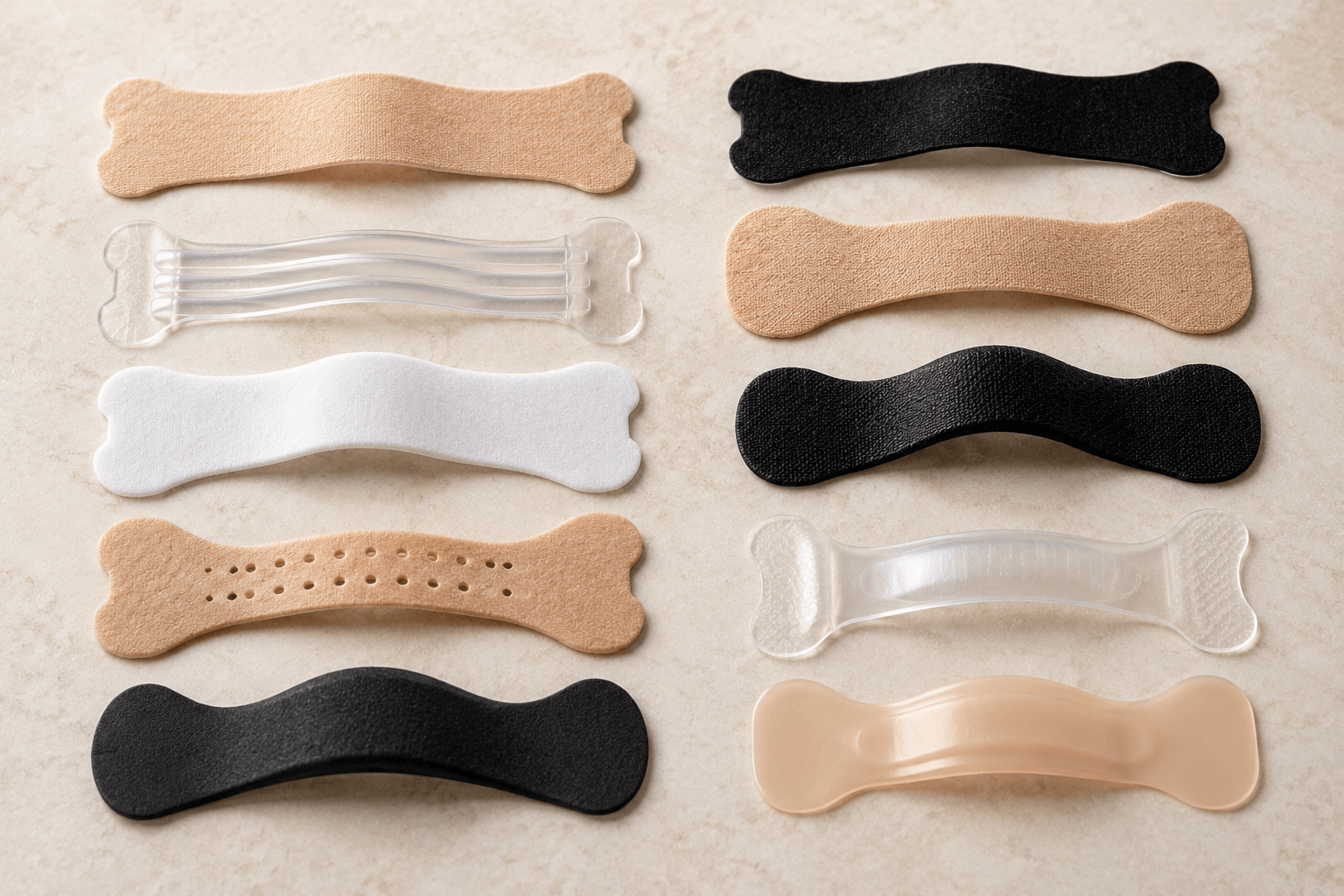
Research: moderate (what this means)Nasal strips work immediately. A strip is a flexible band that sticks to the outside of your nose and tries to spring back flat, which lifts the sides of the nose outward and widens the passage as soon as it's pressed on. There's no drug that needs time to absorb, so the effect is there from the first breath.
Studies that measure the nose show this directly. A 1998 study in The Laryngoscope tested a strip in three groups: 33 people with a congested nose, 28 with a deviated septum in the narrow front part of the nose, and 51 people with healthy noses. With the strip on, the narrowest part of the nasal passage got wider and nasal resistance fell significantly in all three groups, with the biggest effect in the people with a deviated septum.
Breathe Right describes the same thing on its FAQ page, saying the bands lift the sides of the nose and open it for relief you can feel right away.
Feeling the difference can take a little longer than the mechanics. In the same 1998 study, people whose blockage came from swollen nasal lining had a measurably wider nose with the strip, but they didn't report feeling much clearer. And a strip on your face is a new sensation. If the first night feels odd, give it a few nights before you decide.
When is a nasal strip most useful?
Nasal strips are most useful when the narrow spot in your nose is near the nostrils. That's the nasal valve, the tightest part of the airway, and it's the part a strip pulls open. A 2021 review in the European Archives of Oto-Rhino-Laryngology sums up the measured effects: a wider nasal valve, lower nasal resistance, and side walls that are steadier and less likely to collapse inward on a strong breath in. Here is how the common occasions compare.
| Situation | Helps? | Notes |
|---|---|---|
| Snoring that comes from the nose | Often | A 2000 trial cut snoring frequency in people with chronic rhinitis |
| Stuffy nose at night (cold, allergies) | Often | Opens the front of the nose; doesn't clear mucus |
| Nose that collapses inward when you breathe in | Often | This is the area strips are designed for |
| Pregnancy congestion | Yes, in a small trial | A drug-free option; see our pregnancy article |
| With mouth tape | Yes, as support | Makes nose breathing easier with lips closed |
| Exercise | Comfort only | No measured performance gain in healthy people |
| Travel and hotel nights | Often | Same rules as home; pack them with your sleep kit |
| Blockage deep in the nose (polyps, swollen turbinates) | Little | Strips don't reach past the front of the nose |
| Snoring with gasping or breathing pauses | No | Needs a doctor; strips don't treat sleep apnea |
Should you wear a nasal strip for snoring?
A nasal strip is worth trying for snoring if your nose feels blocked or narrow at night. The NHS lists strips and nasal dilators that hold the nose open as a treatment option when snoring is caused by blocked or narrow airways in the nose.
The best evidence comes from people with stuffy noses. In a 2000 randomized, placebo-controlled trial in the European Respiratory Journal, 12 snorers with chronic rhinitis wore either a real strip or a placebo strip during an overnight sleep study. Snoring frequency was significantly lower with the real strip, at 173 snores per hour compared with 258 on placebo. Snoring loudness didn't change.
If your snoring comes from the back of the throat, a strip will do less. Our guide to how nasal strips work goes deeper into who responds best.
Should you wear one when your nose is congested?
Yes, a strip can make a congested night easier, especially when the stuffiness is ongoing. A 2019 study in Advances in Therapy followed 70 people with chronic nighttime nasal congestion who wore a strip with stronger springs at bedtime for 28 days. They reported easier breathing, better sleep quality and feeling more refreshed in the morning. When researchers measured nasal resistance during sleep, it was about 39% lower with the strip on.
A strip works differently from a decongestant. A 2007 study of 89 people compared a strip with a decongestant spray. The strip widened the first 3 cm of the nose and gave a similar boost in airflow and in how clear people felt, but it had no effect further back, where the spray worked. That makes strips a useful drug-free option for colds and allergy season, and a natural partner for saline rinses. See nasal strips for a cold for more.
Can you use nasal strips during pregnancy?
Many people do, because strips contain no medicine. A small 1996 randomized trial of pregnant women with nighttime nasal congestion found the spring-loaded strip improved ease of breathing compared with a placebo strip. It's a single small study, and anything during pregnancy is worth running past your midwife or doctor. Our article on nasal strips during pregnancy covers the research in full.
Should you wear nasal strips with mouth tape?
Wearing a strip with mouth tape is one of the most practical reasons to own them. Mouth tape keeps your lips closed so you breathe through your nose, and that only works if your nose is open enough to carry all your breathing for the night. A strip widens the front of the nose, which can make the switch to nose breathing feel easier.
The strip is a support, not a workaround for a blocked nose. Cleveland Clinic's sleep specialist says mouth tape should never be used with nasal obstruction, nasal congestion, chronic allergies, a sinus infection, enlarged tonsils, a deviated septum or heart issues. If your nose is blocked tonight, skip the tape. We don't recommend mouth tape for children. Our guide to using mouth tape and nasal strips together has the step-by-step routine.
Check this first. Skip mouth tape and see a doctor if you snore loudly, wake up gasping, have been told you stop breathing in your sleep, or can't breathe comfortably through your nose. More on safety
Do nasal strips help during exercise?
Nasal strips can make nose breathing during exercise feel more comfortable, but they don't make you fitter or faster. A 2021 meta-analysis in the European Archives of Oto-Rhino-Laryngology pooled studies of strips during physical activity. It found no improvement in VO2max, heart rate or rating of perceived exertion in healthy people.
So wear one for sport if you like the feel of a more open nose, especially if you're working on nose breathing during easy sessions. Just don't expect it to change your numbers. Nasal strips for exercise has more.
Are nasal strips worth packing for travel?
Nasal strips are worth packing, because they take up almost no space and work the same way in a hotel bed or on a plane as at home. No study has tested strips while traveling specifically. The same rules apply: a clean, dry nose, one fresh strip, and no more than the 12 hours a day Breathe Right gives as its limit.
When won't a nasal strip help?
A nasal strip won't help much when the problem isn't at the front of the nose. The 2007 study found no effect on the nasal passage more than 3 cm behind the nostrils, so swollen turbinates, nasal polyps or enlarged adenoids are out of its reach. Snoring that comes from the tongue or soft palate won't change much either.
Strips also aren't a treatment for sleep apnea. A 2016 meta-analysis in Pulmonary Medicine found that nasal dilators improved nasal breathing but didn't improve sleep apnea, with no significant change in AHI, oxygen levels or snoring index in people with the condition. The NHS advises seeing a GP if your breathing stops and starts in your sleep or you make gasping or choking noises. Our guide to snoring vs sleep apnea explains the difference.
If a strip seems to do nothing, fit is usually the first thing to check. Why nasal strips don't work for some people walks through the fixes.
How do you get the most from a strip?
Getting the most from a nasal strip comes down to placement and skin prep. Breathe Right says the adhesive won't stick properly to wet, oily or moisturized skin, so wash and dry your nose first. Place the strip just above the flare of your nostrils and press the ends down. Take it off gently, using warm water to loosen it.
Breathe Right says its strips may be used daily for up to 12 hours a day, and to stop if a rash or skin irritation appears. That makes nightly use simple, with one fresh strip each time.
Our pick (paid partner): TitanAir Nasal Strips
Our pick for everyday use is TitanAir Nasal Strips. This is our recommendation, not the result of testing or ranking strips ourselves.
Titan says TitanAir strips are drug-free external nasal dilators with flexible spring-loaded bands. Its placement instructions match the advice above: clean, dry skin with no moisturizer, and the strip just above the flare of the nostrils on the soft part of the nose, not the bony bridge. To remove one, Titan says to loosen it with warm water and peel slowly from the ends inward.
Titan says the strips are designed to pair with its mouth tape, and that they're third-party tested and certified PFAS-free. They come with a 30-night guarantee and in 30, 90, 180 or 360-night supplies.
Read next
- How nasal strips work, and when they help most
- How long can you wear a nasal strip?
- Mouth tape and nasal strips together
Common questions
How long does it take for nasal strips to work?
They work right away. A nasal strip is a spring that lifts the sides of your nose, so the passage widens as soon as the strip is pressed on. Studies measuring the nose with and without a strip found a bigger opening and lower resistance immediately. Some people need a few nights to get used to the feel.
When should you put on a nasal strip?
Put it on a few minutes before you settle down to sleep, or before a workout if you wear one for sport. Apply it to a clean, dry nose with no moisturizer, just above the flare of the nostrils. Breathe Right says one strip can be worn for up to 12 hours a day.
Why do people wear nasal strips?
Mostly to breathe more easily through the nose. People wear them for snoring, for a stuffy nose from a cold or allergies, during pregnancy congestion, while exercising, and alongside mouth tape to make nose breathing at night more comfortable. The strip widens the front of the nose without any drugs.
Should you wear a nasal strip every night?
You can if it helps. Breathe Right says its strips may be used daily for up to 12 hours a day, with one fresh strip each time. Stop if you get a rash or skin irritation, and give the skin a night off if the area is red or sore.
Do nasal strips help with a blocked nose from a cold?
They can make breathing feel easier, though they don't clear mucus or shrink swollen tissue. A 2007 study found a strip improved nasal airflow about as much as a decongestant spray, but only by opening the front of the nose. Many people pair a strip with saline rinses.
When won't a nasal strip help?
A strip won't help much if the blockage is deep inside the nose, such as swollen turbinates, polyps or enlarged adenoids, or if snoring comes from the throat rather than the nose. It also isn't a treatment for sleep apnea. If you snore and gasp or stop breathing in your sleep, see a doctor.
Sources
- Role of the external nasal dilator in the management of nasal obstruction
- Effects of an external nasal dilator strip (ENDS) compared to xylometazolin nasal spray
- External nasal dilation reduces snoring in chronic rhinitis patients: a randomized controlled trial
- Objective and subjective effects of a prototype nasal dilator strip on sleep in subjects with chronic nocturnal nasal congestion
- Does the external nasal dilator strip help in sports activity? A systematic review and meta-analysis
- Managing pregnancy-related nocturnal nasal congestion. The external nasal dilator
- Nasal dilators (Breathe Right strips and NoZovent) for snoring and OSA: a systematic review and meta-analysis
- Snoring
- Mouth taping: is it safe to use?
- Frequently asked questions
About this article
- Research
- 10 published sources, listed above.
- Evidence
- Moderate. How we rate it
- Last checked
- October 18, 2026
- Funding
- Paid partner of Titan Recovery. Their ads are labeled.
- Found an error?
- Tell us. We log fixes on the corrections page.
* This content is for informational and educational purposes only and is not medical advice. It is not intended to diagnose, treat, cure or prevent any disease or health condition. Talk to a qualified healthcare provider about your health.