In short
- Cleveland Clinic lists lack of sleep alongside alcohol and sedatives as things that can relax the upper airway muscles once you fall asleep, which can limit airflow and lead to snoring.
- In a 1996 study of 20 people with sleep apnea symptoms, the median apnea-hypopnea index was 37 on a morning sleep study after a night without sleep, compared with 14 on a normal overnight study.
- A 1994 study of 8 healthy adults found the throat collapsed more easily after a night of broken sleep than after a night of no sleep at all.
- When snoring and breathing problems were treated midway through the night in a 1999 study of 10 couples, the partners' sleep efficiency rose from 74% to 87%, roughly an extra hour of sleep.
- The NHLBI recommends 7 to 8 hours of sleep a day for adults and notes that losing 2 hours a night adds up to a 14-hour sleep debt after a week.
Yes, being short on sleep can make you snore more. Cleveland Clinic lists lack of sleep alongside alcohol and sedatives as things that relax the muscles of your upper airway once you finally drift off, and a few small studies show breathing during sleep gets worse after a night of sleep loss. The catch is that snoring also costs sleep, for you and for whoever sleeps next to you, so the two can feed each other.
Does being tired make you snore more?
Being tired can make you snore more, because sleep loss leaves the muscles that hold your throat open more relaxed once you fall asleep. Cleveland Clinic names lack of sleep, along with alcohol and sedatives, as something that can limit airflow and lead to snoring. Most people notice it after a late night or a run of short ones.
Snoring itself is a vibration. The NHS explains that it happens when your tongue, mouth, throat or the airways in your nose vibrate as you breathe, because these parts relax and narrow while you sleep. Anything that relaxes them further, or narrows the space, tends to make that vibration louder or more frequent.
That's why tiredness rarely acts alone. A late night often comes with a drink, a heavy meal, or collapsing onto your back and not moving until morning. Each of those can add to the snoring on its own, which is why it helps to look at the whole night rather than blaming one thing. Our guide to the reasons you snore covers the full list.
What does the research say about sleep loss and snoring?
Research: limited (what this means)The research on sleep loss and snoring is small and fairly old, but it points the same way: breathing problems during sleep tend to get worse after a night of lost or broken sleep. No large trial has measured snoring itself in people who were sleep deprived, so most of what we know comes from studies of airway collapse and sleep apnea.
The clearest example is a 1996 study from the Karolinska Hospital in Stockholm. Twenty people with symptoms of sleep apnea had a normal overnight sleep study, then a second study two to three weeks later, recorded for 3 to 4 hours in the morning after a night without sleep. The median apnea-hypopnea index, the number of breathing pauses and shallow breaths per hour, was 37 on the morning study compared with 14 on the normal night. Morning sleep isn't the same as night sleep, so the comparison isn't perfect, but the authors concluded the result stresses the importance of regular sleeping habits for people with sleep apnea.
A 1994 study from Laval University in Quebec looked at the throat itself. Eight healthy adults had their airway collapsibility measured during sleep, once after a night of total sleep deprivation and once after a night of sleep broken up by sounds. Their airways closed more easily after the broken night than after the sleepless one, and breathing problems were more frequent too. That matters for snorers, because snoring and breathing pauses break up sleep all night long.
Here is how the main studies line up.
| Study | Who took part | What they found |
|---|---|---|
| Persson and Svanborg, 1996 | 20 people with sleep apnea symptoms | Median breathing events per hour were 37 after a night without sleep, compared with 14 on a normal night |
| Sériès and colleagues, 1994 | 8 healthy adults | The airway collapsed more easily after a night of broken sleep than after a night of no sleep |
| Beninati and colleagues, 1999 | 10 couples | Treating the snorer midway through the night raised the partner's sleep efficiency from 74% to 87% |
| Blumen and colleagues, 2009 | 16 women whose partners snored | Sleeping alone for one night reduced awakenings but didn't substantially improve overall sleep quality |
Why does a snorer's partner get caught in the loop?
A snorer's partner gets caught in the loop because the noise breaks up their sleep, and broken sleep is the kind that seems to make airways floppier. So the partner ends up tired, and a tired sleeper may snore more too. No study has followed this cycle in couples from start to finish, but each step has some evidence behind it.
The partner's side is the best measured. In the 1999 study of 10 couples, both people had a sleep study on the same night. Midway through, the snorer was given airway pressure treatment that stopped the snoring and breathing problems. The partners' arousals fell from a median of 21 an hour to 12, and their sleep efficiency rose from 74% to 87%. The authors worked out that this equals about 62 extra minutes of sleep a night.
Moving to another room isn't an instant fix, though. A 2009 French study recorded 16 women on one night next to their snoring partner and one night alone. They woke less often when alone, but their overall sleep quality didn't improve substantially after just one night. Some of the women also turned out to snore themselves without knowing it.
The snorer loses sleep as well. Sleepeducation.org notes you may snore loudly enough to wake yourself up, and the 1994 study suggests that broken sleep is when the throat collapses most easily. So two tired people sharing a bed can each end up making the other's nights worse. Our guide to sleeping next to a snorer has tips for the person lying awake.
How much sleep do you need to keep snoring down?
The National Heart, Lung, and Blood Institute recommends 7 to 8 hours of sleep a day for adults. No study has set a number of hours that prevents snoring, but regular sleep at that level removes one of the easier triggers to fix. Lost sleep also adds up faster than most people expect.
The NHLBI explains that if you lose 2 hours of sleep each night, you'll have a sleep debt of 14 hours after a week. A short night on Friday after a week like that is when many people find their partner complaining.
A steady routine helps more than a single long lie-in. Going to bed and getting up at roughly the same times makes it easier to get enough sleep night after night. Our article on how much sleep adults need goes into the details.
What can you do on nights you're running on empty?
On tired nights, the most useful thing is to stack the odds in your favor: skip the things that relax your airway further, sleep on your side, and keep your nose open. None of these fix exhaustion, but together they take away the triggers that tiredness tends to make worse.
Start with what you drink and take. The NHS advises against drinking too much alcohol and says sleeping pills can sometimes cause snoring. Cleveland Clinic recommends avoiding sedatives and alcohol before bed. A nightcap on an already tired night is a double hit on the same muscles, and our guide to alcohol and snoring explains why.
Then think about position. Sleepeducation.org notes that sleeping on your back may make you more likely to snore, and it recommends sleeping on your side for anyone who snores. The NHS suggests a tennis ball stitched to the back of your sleepwear, or a special pillow or bed wedge, to keep you there. See sleep position and snoring for more ideas.
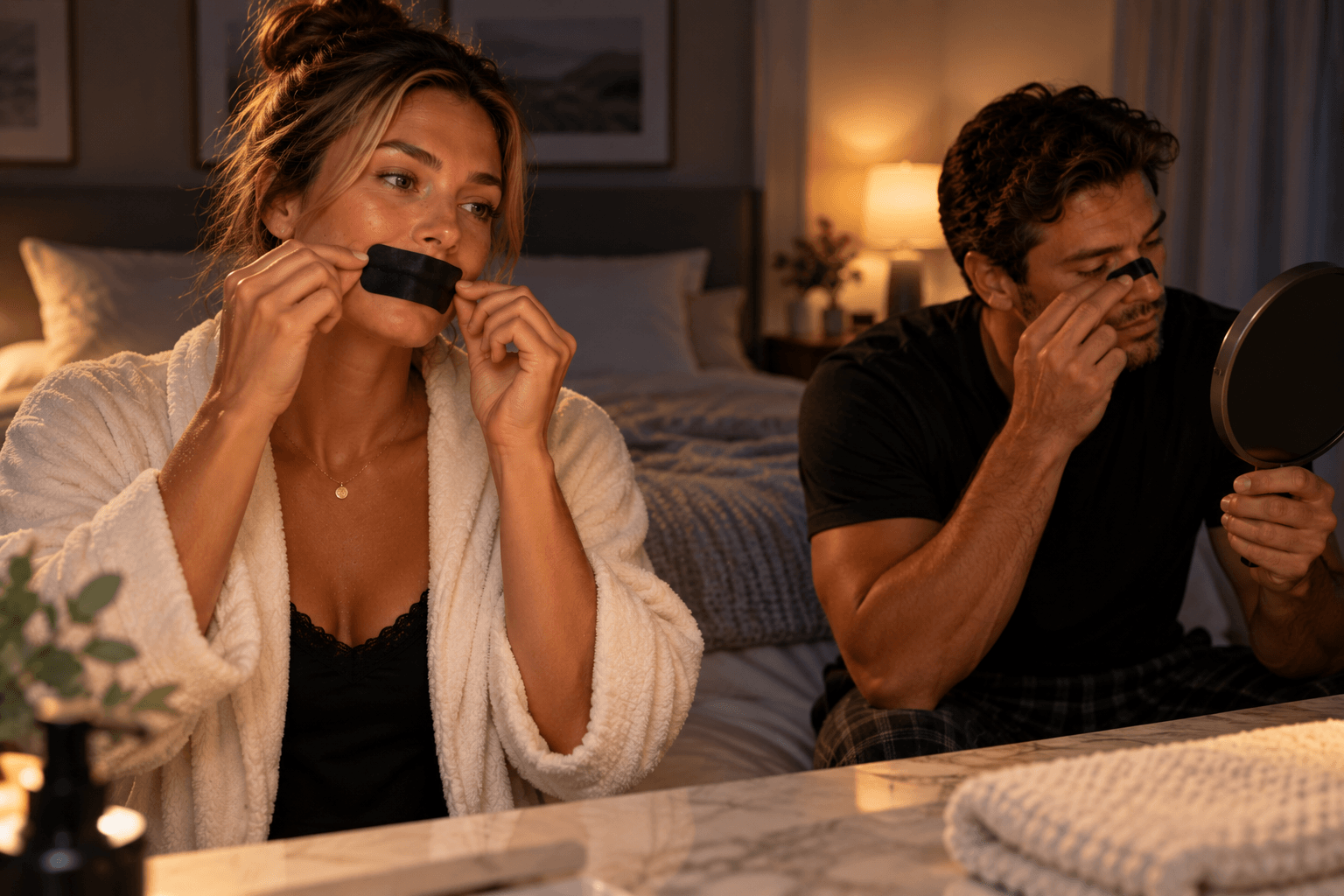
Finally, look after your nose and mouth. For blocked or narrow nasal airways, the NHS lists nasal dilators and strips that hold your nose open while you sleep. For a mouth that falls open, it lists a chin strap or a device that helps you breathe through your nose. Mouth tape is the simplest version of that idea for adults whose noses are clear. In a small 2022 study of 20 mouth breathers with mild sleep apnea, the median snoring index fell by 47% when they slept with their mouths taped, and 13 of the 20 halved their snoring or better.
We don't recommend mouth tape for children. Take our nose test first, and read how to start mouth taping before your first night.
Check this first. Skip mouth tape and see a doctor if you snore loudly, wake up gasping, have been told you stop breathing in your sleep, or can't breathe comfortably through your nose. More on safety
Can earplugs or separate beds break the cycle?
Earplugs and separate beds can protect the partner's sleep, which takes one tired person out of the loop. The NHS suggests asking your partner to use earplugs if your snoring affects their sleep. These are reasonable stopgaps, but they don't change the snoring, so they work best alongside the fixes above.
If you try sleeping apart, give it more than a night. The 2009 study found only modest changes after a single night alone. Plenty of couples treat it as a practical choice rather than a sign of trouble, and our guide to sleep divorce looks at how to make it work.
When is tiredness a sign of something more serious?
Tiredness is a sign of something more serious when it doesn't lift after a few good nights, or when your snoring comes with choking, gasping or pauses in breathing. Sleepeducation.org says that if you're regularly tired during the day even though you've had enough sleep, or your snoring comes with choking or gasping sounds, you may have sleep apnea.
The NHS lists breathing that stops and starts, gasping or choking noises, waking up a lot, loud snoring and feeling very tired during the day as symptoms of sleep apnoea, and advises seeing a GP if you have them. It also suggests bringing someone who has seen the symptoms to the appointment.
This is where the loop gets serious. If sleep apnea is breaking up your sleep, catching up on rest won't fix it, and no home remedy treats it. Read snoring vs. sleep apnea to see how the two differ, and talk to your doctor if the signs sound familiar.
Our pick (paid partner): Titan Sleep System
If your snoring gets worse on tired nights and your nose or an open mouth plays a part, our pick is the Titan Sleep System. It's a modest, practical add-on to sleeping more and drinking less, not a replacement for either.
Titan says the system combines TitanAir Nasal Strips and Titan Mouth Tape as one nightly routine. Titan describes the strips as drug-free external nasal dilators with flexible spring-loaded bands, designed to pair with the tape. Titan says the tape is a bamboo silk strip and suggests 20 to 30 minutes of daytime practice before the first night. Titan says every batch is third-party tested and certified PFAS-free, and it offers a 30-night guarantee that refunds you if your sleep isn't better after 30 nights.
Read next
Common questions
Does being tired make you snore more?
It can. Cleveland Clinic lists lack of sleep as one of the things that relax the muscles of your upper airway once you finally fall asleep, which limits airflow and can cause snoring. Small studies also show breathing problems during sleep get worse after a night of sleep loss, though the research is limited.
Why do I snore more after a bad night's sleep?
A short night may leave your throat muscles more relaxed when you do sleep, and catch-up sleep tends to be deep. Broken sleep may matter even more: a 1994 study found the airway collapsed more easily after a night of repeated interruptions than after a night with no sleep at all.
Can lack of sleep make sleep apnea worse?
There is some evidence it can. In a 1996 study of 20 people with sleep apnea symptoms, breathing events were far more frequent on a morning sleep study after a night awake than on a normal overnight study. The authors stressed the value of regular sleep habits. Talk to your doctor if you have apnea symptoms.
Can a snoring partner make you sleep deprived?
Yes. In a 1999 study of 10 couples, treating the snorer's breathing midway through the night cut the partner's arousals from 21 to 12 an hour and raised their sleep efficiency from 74% to 87%. The authors estimated that equals about 62 more minutes of sleep a night for the partner.
Will catching up on sleep stop my snoring?
Regular, sufficient sleep may cut down the snoring that comes from exhaustion, but it won't fix snoring caused by your back position, alcohol, a blocked nose or an open mouth. The NHLBI recommends 7 to 8 hours a day for adults. Pair a steady schedule with the fix that matches your snoring.
When is tiredness and snoring a sign of sleep apnea?
When you feel tired during the day even after enough sleep, or your snoring comes with choking or gasping, sleepeducation.org says you may have sleep apnea. The NHS adds breathing that stops and starts as a reason to see a doctor. A sleep study or home test can give you an answer.
Sources
- Snoring: causes, treatment and prevention
- Sleep deprivation worsens obstructive sleep apnea. Comparison between diurnal and nocturnal polysomnography
- Effects of sleep deprivation and sleep fragmentation on upper airway collapsibility in normal subjects
- The effect of snoring and obstructive sleep apnea on the sleep quality of bed partners
- Effect of sleeping alone on sleep quality in female bed partners of snorers
- How much sleep is enough?
- Snoring
- Snoring
- Sleep apnoea
- The impact of mouth-taping in mouth-breathers with mild obstructive sleep apnea: a preliminary study
About this article
- Research
- 10 published sources, listed above.
- Evidence
- Limited. How we rate it
- Last checked
- October 26, 2026
- Funding
- Paid partner of Titan Recovery. Their ads are labeled.
- Found an error?
- Tell us. We log fixes on the corrections page.
* This content is for informational and educational purposes only and is not medical advice. It is not intended to diagnose, treat, cure or prevent any disease or health condition. Talk to a qualified healthcare provider about your health.