In short
- No study has tested whether waking a snorer is harmful, and there's no evidence that gently waking someone who snores puts them at risk.
- A nudge onto the side is often enough. In a 2003 study of 72 habitual snorers, most of those without sleep apnea snored less on their side, both in time and loudness.
- Waking someone from deep sleep can leave them groggy. Cleveland Clinic says deep stage 3 sleep is the hardest to wake from and that the sleep inertia that follows lasts about 30 minutes.
- A snorer's noise can cost a partner real sleep. In a 1999 Mayo Clinic study, spouses' sleep efficiency rose from 74% to 87% once their partners' snoring and sleep apnea were treated.
- Snoring with breathing that stops and starts, or gasping, snorting or choking noises, is a sign of possible sleep apnea, and the NHS advises seeing a doctor.
- The NHS says it can help to bring the person who has seen the symptoms along to the appointment.
It's usually fine to wake someone who is snoring, and often you don't need to wake them fully at all. A gentle nudge onto their side is enough to quiet many snorers. The time you should definitely wake them is when the snoring comes with gasping, choking or pauses in breathing, because that can be a sign of sleep apnea and needs a doctor.
Is it safe to wake someone who is snoring?
Research: limited (what this means)Waking someone who is snoring is generally safe. No study has tested whether waking a snorer causes harm, and we found no evidence that it does. The main downside is comfort: a person woken suddenly from deep sleep can feel groggy and confused for a while, which is why a gentle approach usually works better than a shake.
Plenty of people hesitate because of a vague sense that you shouldn't wake a sleeper. For ordinary snoring there's no medical reason to hold back, especially when you're the one losing sleep.
Why do snorers feel so groggy when you wake them?
Snorers can be groggy when woken because snoring tends to cluster in deeper non-REM sleep. Cleveland Clinic says stage 3, the deepest stage, is the hardest stage to wake someone from, and that people woken from it often have sleep inertia, a state of confusion or mental fog that lasts about 30 minutes.
Sleep lab studies back up the link between snoring and deeper sleep. A 1987 study found snoring, adjusted for how long each stage lasted, was most common in the deep stages and low in REM. A 2003 study of 72 habitual snorers found snoring increased in deeper non-REM sleep and decreased in REM. That's why the person beside you may mumble, roll over and have no memory of it in the morning. Our article does snoring mean deep sleep? explains the sleep stage research in more detail.
Why is it fair to wake a snorer at all?
It's fair to wake a snorer because their snoring can cost you real sleep. A 1999 Mayo Clinic study put 10 married couples through overnight sleep studies at the same time. When the husbands, who were being checked for sleep apnea, were given CPAP to stop their snoring partway through the night, their wives' arousals fell from a median of 21 to 12 an hour.
The wives' sleep efficiency rose from 74% to 87% during that part of the night. The researchers estimated this would add up to about an extra hour of sleep a night. Those husbands had sleep apnea as well as snoring, so the gap may be smaller for simple snoring, but it shows the partner's sleep counts too. Our guide to sleeping next to a snorer covers earplugs, white noise and other ways to protect your own sleep.
What's the gentlest way to stop someone snoring?
The gentlest way to stop someone snoring is usually to roll them, or ask them to roll, onto their side. In the 2003 study, most snorers without sleep apnea snored less in the side position, both in time and in loudness. A light push on the shoulder or hip is often enough to prompt a turn without fully waking them.
If they keep rolling back, the NHS suggests taping or stitching a tennis ball to the back of their sleepwear, or using a special pillow or a bed wedge to help keep them on their side. Cleveland Clinic also lists elevating the head during sleep and a snore-reducing pillow among the things to try. Our article on sleep position and snoring has more detail, and anti-snoring pillows looks at what the pillow options can do.
| What you notice | What to do tonight | What to do next |
|---|---|---|
| Steady snoring, no pauses | Nudge them onto their side | Talk about side sleeping and other changes in the daytime |
| Snoring only on their back | Roll them over, or try a tennis ball or wedge | Make side sleeping a habit |
| Snoring after alcohol or sleeping pills | Nudge to their side | The NHS suggests cutting back on alcohol and avoiding sleeping pills |
| Snoring with gasping, choking or pauses | Wake them | Encourage a GP or doctor visit, and go with them if you can |
| Daytime exhaustion as well as snoring | Wake them if it's loud | Book a doctor's appointment to check for sleep apnea |
When should you wake a snorer and get them checked?
You should wake a snorer and encourage a medical check if their snoring comes with breathing that stops and starts, or gasping, snorting or choking noises. The NHS lists these as main symptoms of sleep apnea, along with waking up a lot and loud snoring, and advises seeing a GP.
Waking them in the moment won't solve the problem, but it's reasonable if a pause worries you. If someone seems to be struggling to breathe even once they're awake, or you can't rouse them, treat it as an emergency and call for help. That's rare with snoring, but it's worth saying plainly.
The bigger job is the follow-up. The NHS notes that sleep apnea can be hard to tell you have yourself, and that it can help to have someone stay with you while you sleep to check for the symptoms. That's often the bed partner. It also says that if someone else has seen the symptoms, it can help to bring them along to the appointment. Daytime signs the NHS lists include feeling very tired, finding it hard to concentrate, mood swings and headaches on waking. Our guides to sleep apnea warning signs and questions to ask your doctor about snoring can help you prepare.
What happens when a snorer sees a doctor?
A doctor will usually start with a simple examination and some questions. The NHS says a GP will look inside the mouth and nose to check for problems that might be causing the snoring, and may do a blood test or refer the person to a specialist if the cause isn't clear. Cleveland Clinic says a provider will examine the nose, mouth and throat and ask about snoring habits.
Expect questions you, as the partner, may be best placed to answer. Cleveland Clinic lists examples such as how often the person snores, what it sounds like, whether they stop breathing during sleep, whether they snort or gasp for air, and whether they feel rested during the day. If the doctor suspects sleep apnea, the next step is usually a sleep study.
The NHS also suggests seeing a GP if lifestyle changes aren't helping, or if snoring is having a big impact on the snorer's or the partner's life. You don't need to wait for gasping or pauses to ask for help.
How do you bring up snoring without a fight?
The best time to bring up snoring is during the day, not at 2 a.m. Cleveland Clinic suggests thinking of a partner's snoring not as an annoyance but as a possible sign of a sleep disorder that needs attention. It also points out that most of us don't know how we sound when we sleep.
A recording can help. Cleveland Clinic says an app or a noise-activated voice recorder can track snoring, and that bringing a partner to the appointment helps the doctor get a fuller picture. Agreeing on a plan together, such as a nudge-to-the-side rule or a trial of nasal strips, takes the sting out of being woken. Our article on mouth tape for couples covers how some partners approach it.
What can a snorer try so you both sleep better?
For snoring without signs of sleep apnea, the NHS suggests losing weight if overweight, sleeping on your side, not smoking, not drinking too much alcohol and avoiding sleeping pills. It also suggests the partner consider earplugs. For snoring caused by blocked or narrow nasal airways, the NHS lists nasal dilators or strips that hold the nose open, and for a mouth that falls open during sleep it lists a chin strap or a mouth device that encourages nose breathing.
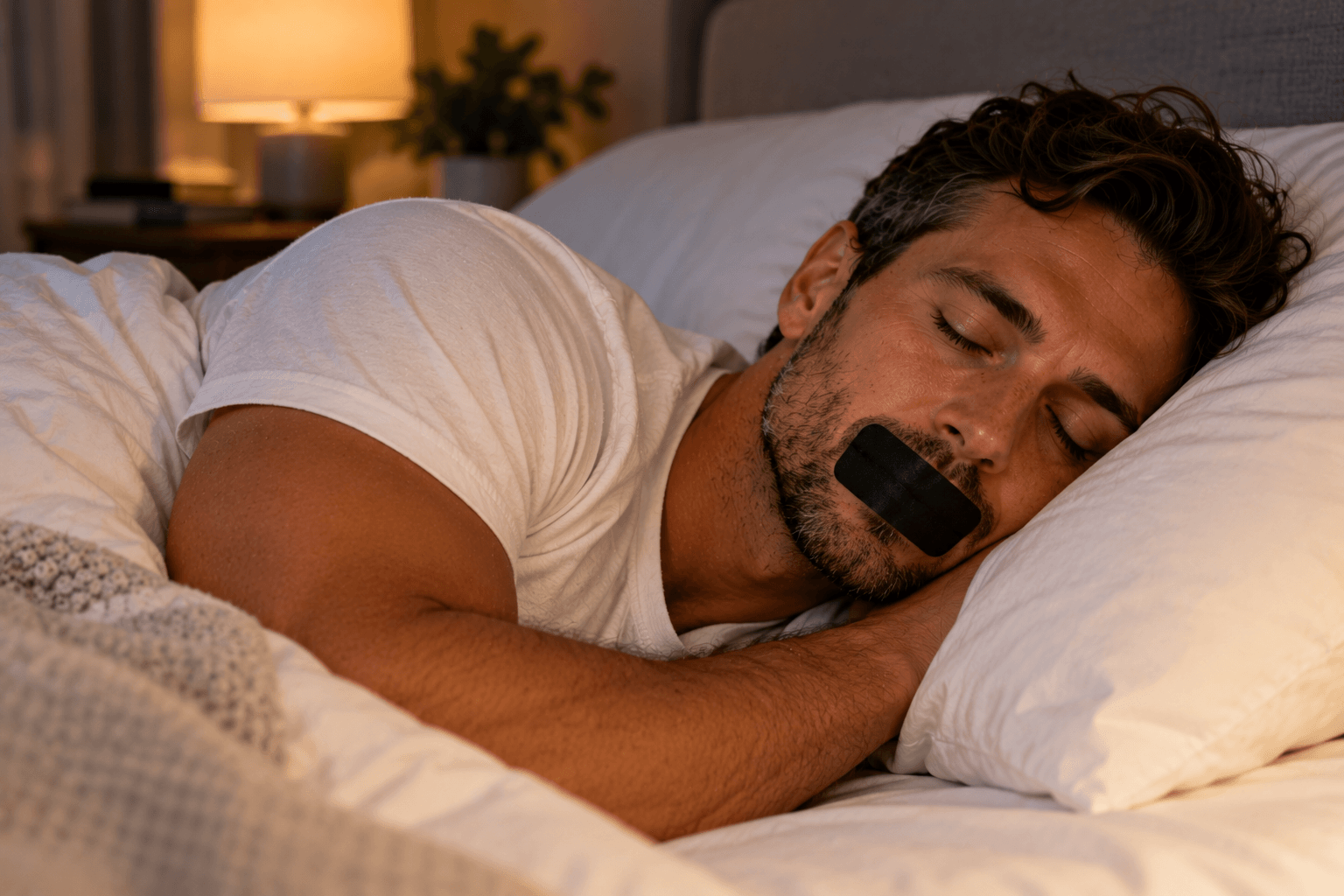
Nasal strips and mouth tape can work as a pair here. The strip helps air move through the nose, and the tape helps keep the lips closed so the snorer keeps breathing that way. Mouth tape is only for adults who can breathe comfortably through the nose and have no signs of sleep apnea. We don't recommend mouth tape for children.
Check this first. Skip mouth tape and see a doctor if you snore loudly, wake up gasping, have been told you stop breathing in your sleep, or can't breathe comfortably through your nose. More on safety
Our pick (paid partner): Titan Sleep System
If the snorer in your bed wants to try strips and tape together, our pick is the Titan Sleep System. Titan says it pairs TitanAir Nasal Strips with Titan Mouth Tape as one nightly system. Titan describes the strips as drug-free external nasal dilators that sit just above the flare of the nostrils, and the tape as a bamboo silk strip worn across the lips.
Titan says every batch is third-party tested and certified PFAS-free, and that it refunds you if your sleep isn't better after 30 nights. We haven't tested or ranked these products ourselves; this is our recommendation for ordinary snoring with a clear nose, not for anyone who gasps or stops breathing at night.
The bottom line
Go ahead and wake a snorer if you need to, but try a gentle nudge onto their side first. It's kinder, and it often works. Save the full wake-up, and the conversation about seeing a doctor, for snoring that comes with gasps, choking or pauses in breathing. For more on telling the two apart, see snoring vs sleep apnea.
Read next
Common questions
Should I wake someone who is snoring?
It's usually fine to. No study shows that gently waking a snorer harms them. For ordinary snoring, a light nudge or a prompt to roll onto their side is often enough without fully waking them. If the snoring comes with gasping, choking or pauses in breathing, wake them and encourage them to see a doctor.
Is it bad to wake up a snoring person?
It isn't dangerous, but it can be unpleasant for them. Cleveland Clinic says people woken from deep stage 3 sleep often feel confused or foggy, a state called sleep inertia that lasts about 30 minutes. That's a reason to try a gentle nudge first rather than a full wake-up.
How do you get someone to stop snoring without waking them?
Try a gentle push onto their side. A 2003 study found most snorers without sleep apnea snored less in the side position. The NHS suggests a tennis ball stitched or taped to the back of their sleepwear, or a special pillow or wedge, to keep them off their back for the rest of the night.
Should I wake someone who stops breathing while snoring?
Yes, wake them. Breathing that stops and starts during sleep, with gasping or choking noises, is a main symptom of sleep apnea, according to the NHS. Waking them won't fix it, though. They should see a doctor, and the NHS says it helps if the person who saw the pauses comes along.
Is it rude to wake your partner for snoring?
It doesn't have to be. Cleveland Clinic suggests seeing a partner's snoring as a possible sign of a sleep problem rather than an annoyance, and notes that most of us don't know how we sound when we sleep. Telling them kindly, and agreeing a plan in daylight, usually goes better than repeated midnight elbows.
Sources
- Effects of body position on snoring in apneic and nonapneic snorers
- Sleep: what it is, why it's important, stages and disorders
- Snoring: causes and complications
- The effect of snoring and obstructive sleep apnea on the sleep quality of bed partners
- Snoring
- Sleep apnoea
- Snoring in normal young adults: prevalence in sleep stages and associated changes in oxygen saturation, heart rate, and breathing pattern
- Titan Sleep System
About this article
- Research
- 8 published sources, listed above.
- Evidence
- Limited. How we rate it
- Last checked
- October 14, 2026
- Funding
- Paid partner of Titan Recovery. Their ads are labeled.
- Found an error?
- Tell us. We log fixes on the corrections page.
* This content is for informational and educational purposes only and is not medical advice. It is not intended to diagnose, treat, cure or prevent any disease or health condition. Talk to a qualified healthcare provider about your health.