In short
- Cleveland Clinic says most people breathe through their mouth because they can't get enough air in through their nose, so the first step is finding out why.
- Common causes listed by Cleveland Clinic include allergies, colds, chronic sinusitis, a deviated septum, swollen turbinates and nasal polyps.
- The FDA says nasal rinses are usually safe when used properly, but only with distilled, sterile or previously boiled water.
- In a small placebo-controlled trial, a nasal strip cut snoring from about 258 to 173 snores an hour in people with chronic rhinitis.
- In a 2022 study of 20 mouth breathers with mild sleep apnea, a week of mouth taping roughly halved the snoring index.
- The NHS says to see a GP if your breathing stops and starts in your sleep, you gasp or choke, or you always feel very tired during the day.
To stop mouth breathing at night, work through it in order. Find out why your nose isn't doing the job, clear it, set up your bed and bedroom so it stays clear, then use a nasal strip and mouth tape to hold the habit in place. Most people who breathe through their mouth at night do so because their nose is blocked, so the nose comes first and the tape comes last.
This guide pulls together the steps we cover in more detail elsewhere. If you want the background first, read why you breathe through your mouth at night and nasal vs. mouth breathing.
How do you know you're mouth breathing at night?
You're probably mouth breathing at night if you wake up with a dry mouth, bad breath or a wet patch on your pillow. Cleveland Clinic lists bad breath, drooling when asleep, dry mouth, feeling tired all the time, hoarseness and snoring as common symptoms. It calls the mix of dry mouth, bad breath and drool on your pillow your "first clue."
A bed partner is the most reliable witness. Ask them whether your mouth hangs open and whether you snore. Our list of signs you mouth breathe at night has more ways to check.
Step 1: what is causing your mouth breathing?
The cause of night-time mouth breathing is usually a nose that can't move enough air. Cleveland Clinic says most people breathe through their mouth because they can't get air in through their nose, and it names the usual reasons: nasal congestion from allergies, colds or chronic sinusitis, a deviated septum, swollen turbinates, nasal polyps, enlarged tonsils or adenoids, and sleep apnea.
It helps to sort yourself into one of four rough groups, because each one has a different fix.
- Congestion: your nose is blocked by a cold, allergies or sinus inflammation. This often comes and goes.
- Structure: something inside the nose narrows it, such as a deviated septum, large turbinates or polyps. This tends to be there all the time, often worse on one side.
- Habit: your nose feels clear when you test it, but your mouth falls open once you're asleep.
- Something more: you snore loudly and gasp, choke or stop breathing in your sleep. That points to sleep apnea, which needs a doctor.
A quick test you can do tonight: close your mouth and breathe gently through your nose for a minute or two. Cleveland Clinic says doctors use a similar lip seal test to check whether you can breathe with your mouth closed. If it feels easy, your nose is probably ready. If you struggle or feel short of air, start with Step 2 and skip the tape for now.
Step 2: how do you clear a blocked nose before bed?
Clearing a blocked nose before bed starts with the cause. For allergies, Cleveland Clinic's family medicine advice is to keep pets out of the bedroom, change your sheets at least once a week, and shower and change clothes before bed to wash off pollen you've carried in. Over-the-counter antihistamines or nasal sprays can help with allergy symptoms.
A saline rinse is one of the most useful tools here. The FDA says nasal irrigation devices are usually safe and effective when used and cleaned properly, and that rinsing can remove dust, pollen and other debris and loosen thick mucus. The one rule that matters: use only distilled, sterile or previously boiled and cooled water, never straight from the tap. Our guide on how to use a saline rinse walks through it.
If you think a cold or sinus infection is the problem, Cleveland Clinic says a provider may suggest antihistamines and decongestants, or antibiotics for a sinus infection that lasts more than 10 days. For a structural problem like a deviated septum, home steps only go so far. Cleveland Clinic lists septoplasty and turbinate reduction as surgical options a doctor may recommend. Our article on how to unblock your nose before bed covers quick fixes for tonight.
Step 3: does sleep position matter?
Sleep position matters because lying flat makes congestion worse. Cleveland Clinic explains that when you lie down, mucus can't drain as well without gravity, so it pools in your sinuses. Acid reflux also gets easier when you're flat, and Cleveland Clinic says reflux can irritate your throat and sinuses and add to congestion.
Its advice is to sleep with your head and shoulders raised, and if you sleep on your side, to try your left side, because the right side can let stomach acid travel more easily. Avoiding late meals helps with reflux too. Our guide to the best sleep position for breathing goes further.
Step 4: should you change the humidity in your bedroom?
Changing the humidity can help if your bedroom air is dry. Cleveland Clinic says a humidifier can thin mucus and ease congestion, and that dried-out airways make you more likely to snore and to wake with a dry mouth. It points to the EPA's advice to keep indoor humidity between 30% and 50%, and warns that going over 50% can encourage mold and dust mites.
Keep it clean. Cleveland Clinic suggests filtered, demineralized or distilled water, changing the water daily and cleaning the tank every two to three days. See humidifiers for sleep for setup tips.
Step 5: can nasal strips help you breathe through your nose?
Nasal strips can help by holding the sides of your nose open from the outside. In a small randomized trial of 12 people with chronic rhinitis, a real nasal strip cut snoring frequency to about 173 snores an hour, compared with about 258 with a placebo strip. The strip didn't change snoring loudness, but less snoring overall is a good sign that more air was moving through the nose.
Research: limited (what this means)Strips are drug-free and easy to try for a week. They're especially useful if your nose feels tight but not fully blocked. See nasal strips for mouth breathers for how they fit into a routine.
Step 6: when should you add mouth tape?
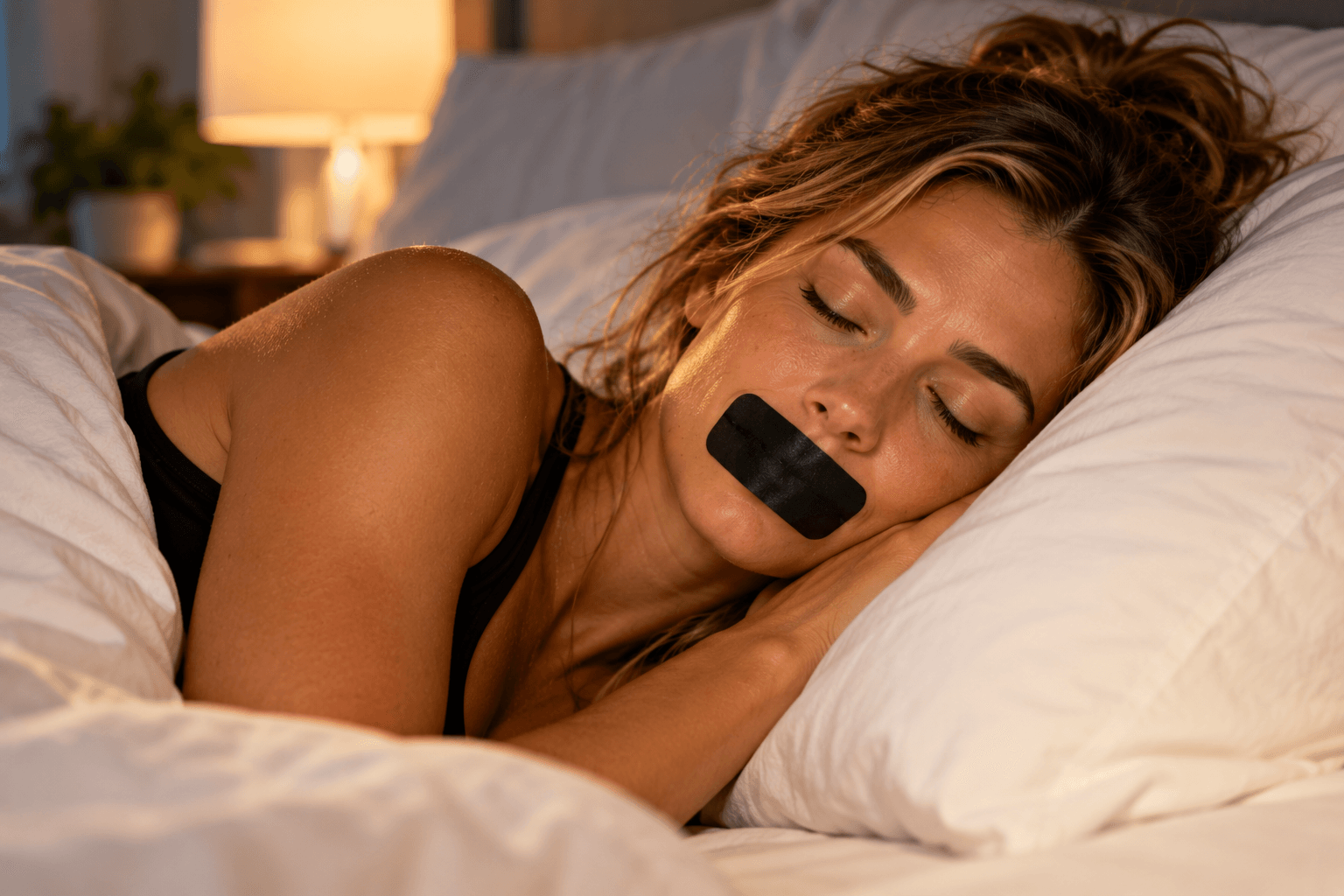
Add mouth tape once your nose is clear and comfortable, not before. Tape is the step that deals with the habit: it keeps your lips together after you fall asleep, so your nose stays the main airway all night.
The research is small but encouraging. In a 2022 study in the journal Healthcare, 20 mouth breathers with mild sleep apnea wore tape for a week. Their median snoring index fell by 47%, and 13 of the 20 cut their snoring by at least half. People whose noses were blocked were given medicine or a nasal spray first, which is the same order this guide follows.
The bigger picture is mixed. A 2025 systematic review in PLOS One found 10 studies with 213 patients. Two showed improvements in sleep apnea measures, others showed no difference, and some discussed the risk of asphyxiation when the nose is blocked. The authors warned against taping "indiscriminately." That's why the nose check in Step 1 matters so much. We don't recommend mouth tape for children.
Check this first. Skip mouth tape and see a doctor if you snore loudly, wake up gasping, have been told you stop breathing in your sleep, or can't breathe comfortably through your nose. More on safety
Start with 20 to 30 minutes of daytime practice, then try it at bedtime. Our guide on how to start mouth taping has a first-week plan, and mouth tape and nasal strips together explains how to combine them. If you'd like both in one box, our pick is the Titan Sleep System.
Can you train yourself out of mouth breathing?
You can work on the daytime side of mouth breathing. Cleveland Clinic says myofunctional therapy, exercises for the tongue, lips and cheeks guided by a trained provider, is sometimes used for mouth breathing that continues after nasal problems have been treated, and for an open-mouth resting posture. It says the therapy has no known risks.
Day-to-day awareness helps too. Notice when your lips are apart while you read or work, and close them. Our practical plan for training yourself to nose breathe covers daytime cues, and myofunctional therapy explains how the formal version works.
The mouth breathing checklist
Use this table to work through the steps in order. Don't skip ahead to tape if an earlier row is still a problem.
| Step | What to check | What to try | Move on when |
|---|---|---|---|
| 1. Find the cause | Dry mouth, drool, snoring; nose feels blocked? | Lip seal test for a minute or two | You know if it's congestion, structure or habit |
| 2. Clear the nose | Allergies, cold, sinus symptoms | Saline rinse with safe water, allergy steps, pharmacist advice | Nose feels open at bedtime |
| 3. Sleep position | Worse lying flat, reflux at night | Raise head and shoulders; try left side | Less stuffiness overnight |
| 4. Humidity | Dry air, dry nose in winter | Humidifier, kept between 30% and 50% | Waking less dry |
| 5. Nasal strips | Nose feels tight but not blocked | One strip a night for a week | Breathing feels easier |
| 6. Mouth tape | Nose clear, no sleep apnea signs | Daytime practice, then nights | Lips stay closed, less dry mouth |
| 7. Get help | Blocked most nights, gasping, daytime sleepiness | Doctor, ENT or sleep clinic; dentist for mouth changes | You have a diagnosis and plan |
When should you see a doctor or dentist?
See a doctor if your nose is blocked most nights, if the steps above don't help after a few weeks, or if you have signs of sleep apnea. The NHS says to see a GP if your breathing stops and starts while you sleep, you make gasping, snorting or choking noises, or you always feel very tired during the day. Mouth tape doesn't treat sleep apnea, so get checked before relying on it. Our guide to sleep apnea warning signs explains what to look for.
A doctor can look inside your nose and throat, and Cleveland Clinic says the treatment will target whatever stops you breathing through your nose, from allergy sprays to surgery. A dentist is a good second stop if you wake with a dry mouth most days: the NHS says a dry mouth makes tooth decay more likely, and Cleveland Clinic says some dental hygienists train in myofunctional therapy. Our article on mouth breathing and teeth has more. For children, Cleveland Clinic says to ask the pediatrician to check the nose and airway, because mouth breathing can affect how a child's face grows. Our guide to mouth breathing in children covers this.
Our pick (paid partner): Titan Sleep System
For Steps 5 and 6, we recommend the Titan Sleep System, which puts TitanAir Nasal Strips and Titan Bamboo Silk Mouth Tape together as one nightly set. We haven't tested or ranked products ourselves; this is our recommendation.
Titan says the strips are drug-free external nasal dilators with flexible spring-loaded bands, placed just above the flare of the nostrils, and that they're designed to pair with the tape. Titan says the tape is a bamboo silk strip worn horizontally across the lips, and it suggests 20 to 30 minutes of daytime practice before the first night. Titan says every batch is third-party tested and certified PFAS-free, and its 30-night guarantee refunds you if your sleep isn't better after 30 nights.
Read next
- Why do I breathe through my mouth at night?
- Can you train yourself to breathe through your nose?
- How to start mouth taping: your first week
Common questions
How do I stop mouth breathing while sleeping?
Work in order. First check whether your nose is blocked and why, then treat congestion with rinses or medicine a pharmacist or doctor suggests. Raise your head, keep bedroom air from getting too dry, and try a nasal strip. Once your nose feels clear, mouth tape can help keep your lips closed through the night.
Why do I keep breathing through my mouth at night?
Usually because air can't get through your nose easily. Cleveland Clinic lists allergies, colds, chronic sinusitis, a deviated septum, swollen turbinates, nasal polyps and sleep apnea as causes. Some people also sleep with their mouth open out of habit, even when their nose is clear.
Can mouth tape stop mouth breathing at night?
It can keep your lips together while you sleep, which is what it's for. In a 2022 study of mouth breathers with mild sleep apnea, a week of taping roughly halved snoring. Tape only makes sense when you can breathe comfortably through your nose, so clear your nose first.
Do nasal strips help with mouth breathing?
They can make nose breathing easier by holding the nostrils open. In a small placebo-controlled trial in people with chronic rhinitis, a nasal strip reduced how often they snored. Strips are drug-free, so they pair well with other steps like rinsing and mouth tape.
When should I see a doctor about mouth breathing at night?
See a doctor if your nose is blocked most of the time, if home steps don't help after a few weeks, or if you have signs of sleep apnea. The NHS lists breathing that stops and starts, gasping or choking, and feeling very tired during the day as reasons to see a GP.
Should I see a doctor or a dentist for mouth breathing?
Start with a doctor if your nose feels blocked, since the usual fixes are allergy treatment, infection treatment or nose surgery. A dentist is worth seeing if dry mouth is a problem, since the NHS says a dry mouth makes tooth decay more likely. For children, Cleveland Clinic says to ask the pediatrician to check the nose and airway.
Sources
- Mouth breathing: symptoms, complications and treatment
- Why does my nose get stuffy at night?
- Is rinsing your sinuses with neti pots safe?
- How you can tell if you need a humidifier
- External nasal dilation reduces snoring in chronic rhinitis patients: a randomized controlled trial
- The impact of mouth-taping in mouth-breathers with mild obstructive sleep apnea: a preliminary study
- Breaking social media fads and uncovering the safety and efficacy of mouth taping in patients with mouth breathing, sleep disordered breathing, or obstructive sleep apnea: A systematic review
- Sleep apnoea
- Dry mouth
- Myofunctional therapy
About this article
- Research
- 10 published sources, listed above.
- Evidence
- Limited. How we rate it
- Last checked
- October 14, 2026
- Funding
- Paid partner of Titan Recovery. Their ads are labeled.
- Found an error?
- Tell us. We log fixes on the corrections page.
* This content is for informational and educational purposes only and is not medical advice. It is not intended to diagnose, treat, cure or prevent any disease or health condition. Talk to a qualified healthcare provider about your health.