In short
- The NHS lists strips and nasal dilators that hold the nose open as a treatment when snoring comes from blocked or narrow airways in the nose.
- In a 2000 placebo-controlled trial of 12 people with chronic rhinitis, snoring frequency was 173 snores an hour with a real strip and 258 with a placebo strip.
- In a 1997 open-label study of 35 heavy snorers without sleep apnea, bed partners rated snoring as significantly lower after 14 nights of strips.
- Other sleep lab studies found no change in snoring, including a 1998 study of 10 snorers without sleep apnea and a 2001 study of 18 heavy snorers.
- A 2026 meta-analysis of 17 studies and 496 people found no significant change in snoring index or sleep apnea measures with nasal dilators.
- Strips don't treat sleep apnea, so loud snoring with gasping, choking or daytime sleepiness needs a doctor's check.
Nasal strips can help snoring, but mostly when your nose is part of the problem. The NHS lists strips and nasal dilators as a treatment when snoring comes from blocked or narrow airways in the nose, and a placebo-controlled trial in people with chronic rhinitis found noticeably fewer snores with a real strip. Other studies found no change at all, so the honest answer is that strips work well for some snorers and not for others. Here's what the research shows, how to tell which group you're in, and what strips won't do.
Do nasal strips help snoring?
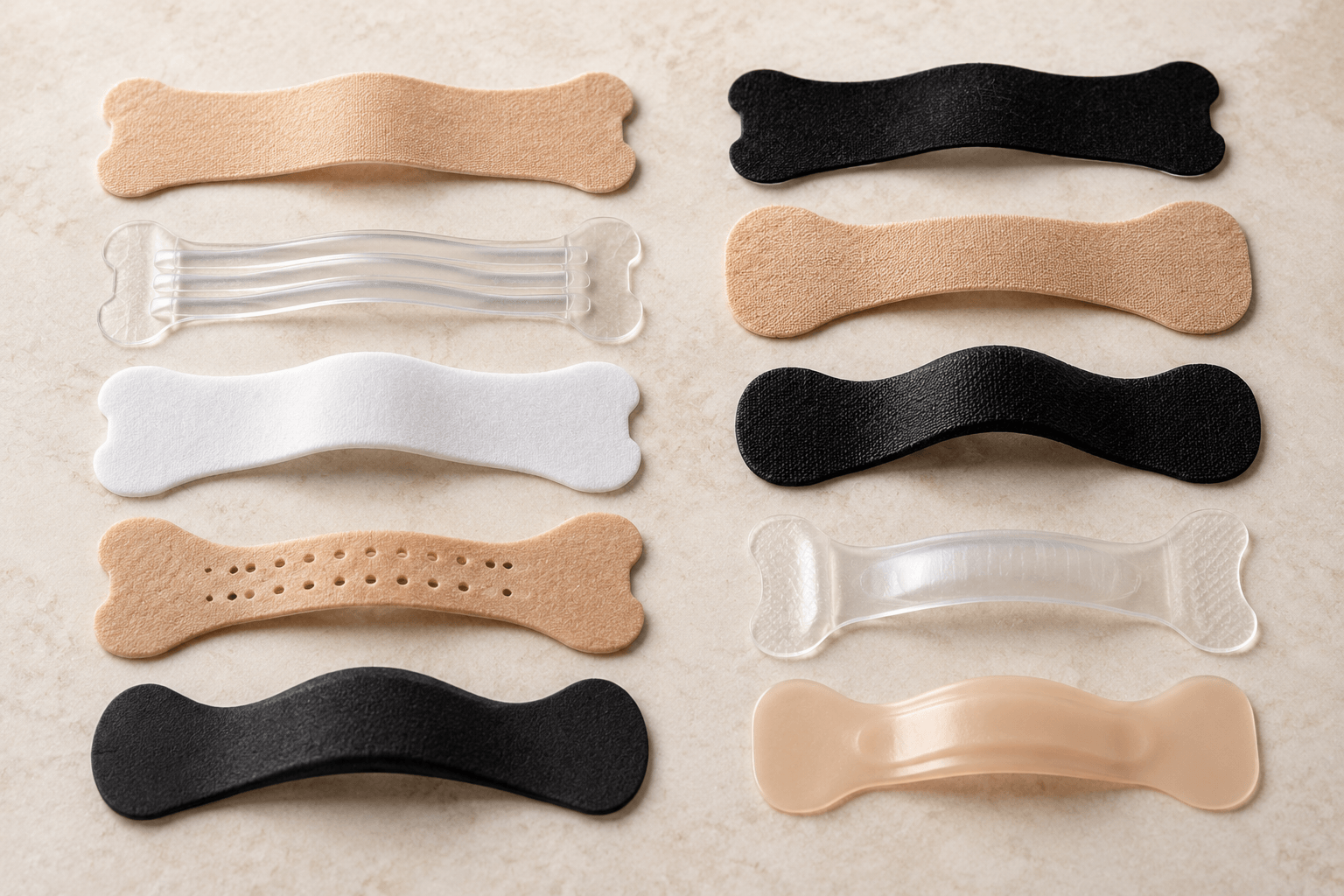
Research: limited (what this means)Nasal strips help snoring in some studies and not in others, and the difference usually comes down to who was tested. A strip is a springy band that sticks to the outside of your nose and lifts the sides outward, widening the front of the nasal passage. If that's where your airflow gets squeezed, snoring can ease. If your snoring starts farther back, a wider nostril doesn't change much.
The NHS says snoring is caused by your tongue, mouth, throat or the airways in your nose vibrating as you breathe. It matches treatments to causes: for a blocked or narrow nose, it lists devices or strips that hold the nose open, along with decongestants or nasal sprays. That's a good summary of where strips fit.
What did the snoring studies find?
The snoring studies found clear benefits in some groups and no measurable change in others. Most were small, and only a few used a placebo strip, so it helps to look at them side by side.
| Study | Who took part | What was measured | Snoring result |
|---|---|---|---|
| 1997, Rhinology | 35 heavy snorers without sleep apnea | Bed partner ratings over 14 nights, no placebo | Significantly less snoring |
| 1998, European Journal of Medical Research | 30 habitual snorers | Snoring in a sleep lab | Peak loudness fell in 22 of 30 |
| 1998, Respiratory Medicine | 10 snorers without sleep apnea | Snoring in a sleep lab | No change |
| 2000, European Respiratory Journal | 12 people with chronic rhinitis | Snoring vs placebo strip | 173 snores an hour vs 258 |
| 2001, American Journal of Rhinology | 18 heavy snorers with nighttime nasal blockage | Snoring vs placebo strip | No change in duration or loudness |
| 2026 meta-analysis, Cureus | 17 studies, 496 people | Snoring index and sleep apnea measures | No significant change |
The studies that found less snoring
In a 1997 study in Rhinology, 35 heavy snorers whose sleep studies ruled out sleep apnea used strips for 14 nights in a row. Their bed partners rated the snoring as significantly lower afterward. The snorers themselves reported less mouth dryness and lower daytime sleepiness scores. There was no placebo group, so expectations may have played a part, but it's the kind of result most people care about: the person next to you noticing a difference.
A 1998 sleep lab study recorded 30 habitual snorers overnight. On the second night with a strip, peak snoring intensity was lower than at baseline in 22 of them. The drop showed up mostly in lighter sleep, and the researchers said snorers without sleep apnea were the ones most likely to benefit. People also rated their sleep as better.
The strongest evidence is the 2000 trial in the European Respiratory Journal. Twelve people with chronic rhinitis, a long-term stuffy or runny nose, who snored but didn't have sleep apnea, were randomized to a real strip or a placebo strip. Snoring frequency was 173 snores an hour with the real strip compared with 258 with the placebo. Snoring loudness and sleep quality didn't change, but there was about a third less snoring.
The studies that didn't
A 1998 study in Respiratory Medicine recorded 10 snorers without sleep apnea for two full nights, one with a strip and one without. Snoring and sleep quality were the same both nights. Five of the 10 had exams showing a problem with the nasal valve, an airway passage inside the nose, and their snoring index was no different from the others'.
A 2001 placebo-controlled study of 18 heavy snorers who reported a blocked nose at night found the strip widened the nose, but snoring duration and loudness didn't change. In the six people with the most marked morning blockage, oxygen levels during sleep improved. In the 12 with roomier noses, the number of breathing interruptions went up.
A 2026 meta-analysis in Cureus pooled 17 studies of internal and external nasal dilators with 496 people, a mix of snorers and people with sleep apnea. It found no significant change in snoring index or sleep apnea measures. The authors said dilators may be helpful as an add-on for people with mild symptoms or nasal congestion, and that in practice their use may suit selected people, such as primary snorers or people with prominent nighttime nasal blockage.
Our nasal strip research roundup covers these trials and others in more detail.
Who is most likely to notice a difference?
The people most likely to notice a difference are those whose snoring starts in a stuffy or narrow nose. The strongest result above, the 2000 trial, was in people with chronic rhinitis, and in the 2001 study the only measurable benefits (better oxygen levels, not less snoring) were in the people with the most blocked noses.
You're more likely to be in that group if:
- Your nose often feels blocked or tight at night, from allergies, chronic rhinitis or a cold that lingers.
- You find yourself breathing through your mouth during the day.
- Your snoring is worse when your nose is stuffy and quieter when it's clear.
- Your nostrils seem to pinch inward when you breathe in through your nose.
That last sign can point to nasal valve collapse, a narrowing of the nose's airway. Cleveland Clinic lists mouth breathing during the day and snoring at night among its symptoms, and says breathing strips may help you breathe easier and sleep better. Our article on nasal valve collapse explains how to recognize it.
A quick way to check is our two-minute nose test. If breathing through your nose with your mouth closed feels like work, a strip has something to fix.
Why don't nasal strips work for some snorers?
Nasal strips don't work for some snorers because their snoring comes from the throat, tongue or soft palate rather than the nose. A strip only lifts the front of the nose. The NHS matches different causes to different fixes: a device that brings the tongue forward when the tongue partly blocks the back of the throat, and a chin strap when the mouth falls open during sleep.
Fit matters too. A strip that peels off at 2am only helps for part of the night. Our article on why nasal strips don't work for some people goes through fixes for placement, skin prep and sizing.
What won't nasal strips do?
Nasal strips won't treat sleep apnea, and that's the most important limit to know. A 2016 meta-analysis in Pulmonary Medicine found no significant change in apnea-hypopnea index, lowest oxygen level or snoring index in people with sleep apnea who used nasal dilators. The 2026 meta-analysis concluded that dilators can't be recommended on their own for sleep-disordered breathing. Our article on nasal strips and sleep apnea covers this in detail.
That limit matters because a quieter night can be misleading. If a strip softens your snoring but breathing pauses carry on, the warning sign a bed partner would have noticed may fade while the underlying problem stays.
Strips also don't fix the structure of your nose. Cleveland Clinic says that while breathing strips can help manage symptoms of nasal valve collapse, many people need surgery to correct it, especially if they also have a deviated septum. And they won't stop snoring that comes from sleeping on your back, alcohol or the mouth falling open.
How can you tell if strips help your snoring?
You can tell if strips help your snoring by comparing a few normal nights with a week or two of strip nights. The 1997 study used bed partner ratings, and that's a good method at home too. Ask your partner to rate your snoring each morning, or use a phone app that records sound overnight, so you're comparing more than a hunch.
Give it time. In the 1998 sleep lab study, 17 of the 30 snorers needed some time to get used to the strip, after which they said they breathed easily and slept well.
Titan's instructions for its strips give a simple routine that works for each test night:
- Apply to clean, dry skin and skip moisturizer.
- Place the strip just above the flare of your nostrils, on the soft part of the nose, not the bony bridge.
- In the morning, loosen it with warm water and peel slowly from the ends inward.
If your snoring doesn't change after a fair trial, a strip probably isn't the right tool, and a different device may suit your snoring pattern better. Our guide to the best anti-snoring devices matches device types to causes.
When should you see a doctor about snoring?
You should see a doctor if your snoring comes with signs of sleep apnea. The NHS says to see a GP if you feel sleepy during the day, your breathing stops and starts while you sleep, or you make gasping or choking noises. It also says to go if lifestyle changes aren't helping or your snoring has a big impact on your life or your partner's. Our guide to snoring vs sleep apnea explains the differences.
See a doctor too if your nose is blocked most of the time, since a strip can ease the symptom without fixing the cause. If you're pregnant, ask your midwife or doctor before trying any new snoring product, and mention new or louder snoring at your next appointment.
Our pick (paid partner)
If your snoring fits the nose-related pattern, our pick is TitanAir Nasal Strips from Titan Recovery. This is our recommendation, not the result of testing or ranking products ourselves, and TitanAir wasn't used in any of the studies above.
Titan says TitanAir strips are drug-free external nasal dilators with flexible spring-loaded bands. Its placement advice lines up with how strips work: clean, dry skin with no moisturizer, and the strip just above the flare of the nostrils on the soft part of the nose, not the bony bridge. To remove one, Titan says to loosen it with warm water and peel slowly from the ends inward.
Titan says the strips are third-party tested and certified PFAS-free. Its 30-night guarantee refunds you if your sleep isn't better after 30 nights, which is long enough for the kind of week-or-two trial described above. You can read more about how TitanAir strips are made on Titan's site.
Read next
- The best nasal strips for snoring: what matters, and our pick
- Why nasal strips don't work for some people, and how to fix it
- Do nasal strips improve sleep quality?
Common questions
Do nasal strips actually stop snoring?
They reduce snoring for some people, mostly those whose snoring starts in a stuffy or narrow nose. In a 2000 placebo-controlled trial of people with chronic rhinitis, snoring frequency fell to 173 snores an hour from 258 with a placebo strip. Other studies found no change, so results depend on where your snoring comes from.
Who do nasal strips work best for?
People whose nose is part of the problem. Positive studies involved people with chronic rhinitis, and a 2001 study found its only measurable benefits, better oxygen levels rather than less snoring, in heavy snorers with marked nighttime nasal blockage. Cleveland Clinic lists snoring at night among the symptoms of nasal valve collapse and says breathing strips may help you breathe easier and sleep better.
Why didn't nasal strips stop my snoring?
Your snoring may come from somewhere a strip can't reach. The NHS says snoring can come from the tongue, mouth, throat or nose, and strips only open the front of the nose. A 1998 sleep lab study of 10 snorers without sleep apnea found strips didn't change snoring. Placement and fit matter too.
How long should I try nasal strips for snoring?
Give them at least a week or two. In a 1998 study, 17 of 30 snorers needed some time to get used to the strip before they said they breathed easily and slept well. Ask a bed partner to rate your snoring, or use a recording app, before and during the trial.
Do nasal strips help snoring from sleep apnea?
No. A 2016 meta-analysis found no significant change in apnea-hypopnea index, lowest oxygen level or snoring index in people with sleep apnea using nasal dilators. If your snoring comes with gasping, choking or pauses in breathing, see a doctor rather than relying on strips.
Are nasal strips safe to use for snoring every night?
Studies report them as well tolerated. In a 1998 sleep lab study of 30 snorers, the only reaction was one person who briefly felt the urge to sneeze after the first strip. Stop if your skin gets sore, and check with a doctor if you're pregnant or your nose is blocked most of the time.
Sources
- Effect of Breathe Right nasal strip on snoring
- Effect of the external nasal dilator Breathe Right on snoring
- Effects of Breathe Right on snoring: a polysomnographic study
- External nasal dilation reduces snoring in chronic rhinitis patients: a randomized controlled trial
- Dichotomous physiological effects of nocturnal external nasal dilation in heavy snorers: the answer to a rhinologic controversy?
- Nasal Dilators (Breathe Right Strips and NoZovent) for Snoring and OSA: A Systematic Review and Meta-Analysis
- Clinical Effectiveness of Nasal Dilators in Sleep-Disordered Breathing: A Systematic Review and Meta-Analysis
- Snoring
- Nasal valve collapse
- TitanAir Nasal Strips
About this article
- Research
- 10 published sources, listed above.
- Evidence
- Limited. How we rate it
- Last checked
- November 2, 2026
- Funding
- Paid partner of Titan Recovery. Their ads are labeled.
- Found an error?
- Tell us. We log fixes on the corrections page.
* This content is for informational and educational purposes only and is not medical advice. It is not intended to diagnose, treat, cure or prevent any disease or health condition. Talk to a qualified healthcare provider about your health.