In short
- The NHS matches snoring treatments to their cause: nasal dilators or strips for a blocked or narrow nose, a chin strap or mouth device for a mouth that falls open, and a mouthpiece that brings the tongue forward for a tongue that partly blocks the throat.
- A 2015 guideline from the American Academy of Sleep Medicine and the American Academy of Dental Sleep Medicine recommends oral appliances, rather than no therapy, for adults who want treatment for snoring without sleep apnea.
- In a 2000 randomized trial of 12 people with chronic rhinitis, snoring frequency was 173 snores an hour with a real nasal strip and 258 with a placebo strip.
- In a 2022 study of 20 mouth breathers with mild sleep apnea, 13 cut their snoring index by at least half on a night with mouth tape compared with a baseline night.
- A 2024 systematic review of 9 studies found positional devices and raising the head of the bed improved snoring, but called for larger controlled trials.
- A German snoring guideline says internal or external nasal dilators should be tried when breathing is impaired at the nasal valve.
The best anti-snoring device is the one that targets the place your snoring starts. Strips and dilators work on the nose, mouth tape and chin straps on a mouth that falls open, mouthpieces on the jaw and tongue, and positional devices and pillows on back sleeping.
How do you choose an anti-snoring device?
Choosing an anti-snoring device starts with finding where your snoring comes from. The NHS says snoring is caused by the tongue, mouth, throat or airways in the nose vibrating as you breathe, and it matches treatments to the cause. For a blocked or narrow nose, it lists nasal dilators or strips. For a mouth that falls open during sleep, it lists a chin strap or a mouth device that keeps you breathing through your nose. For a tongue that partly blocks the back of the throat, it lists a mouthpiece that brings the tongue forward, called a mandibular advancement device. It also suggests sleeping on your side.
Three quick checks narrow it down:
- Does your nose feel blocked or narrow at night? Try breathing through it with your mouth closed for a couple of minutes, as in our nose test.
- Does your mouth hang open while you snore? A bed partner can tell you, or you may wake with a dry mouth.
- Is the snoring worse on your back? Ask your partner, or notice whether it eases when you roll over.
A yes to more than one is common. The German snoring guideline published in Deutsches Ärzteblatt International in 2019 lists whether snoring depends on position and whether nasal breathing is impaired among the things to ask about when taking a snoring history.
What does the research say about anti-snoring devices?
Research: moderate (what this means)The research on anti-snoring devices is uneven. Jaw-advancing mouthpieces have guideline-level support, nasal strips and positional devices have smaller controlled trials, and mouth tape, chin straps and tongue devices rest on a handful of small studies. Less-studied doesn't mean useless; it means matching the device to the cause matters more.
The German guideline sums up the field this way: evidence-based recommendations can be given for selected situations, but the overall state of the evidence on many techniques remains limited.
Which devices work on a blocked or narrow nose?
Nasal strips
Nasal strips are adhesive bands with springs that sit on the outside of the nose and lift the sides open. They target the nasal valve, the narrow section just inside the nostrils.
Evidence: in a 2000 randomized, placebo-controlled trial in the European Respiratory Journal, 12 people with chronic rhinitis who snored but didn't have sleep apnea were studied overnight. Snoring frequency was 173 snores an hour with a real strip compared with 258 with a placebo strip, though snoring loudness and sleep quality didn't change. The German guideline says internal or external nasal dilators should be tried when breathing is impaired at the nasal valve.
Who they suit: people whose snoring is worse with a stuffy, narrow or congested nose, and anyone who would rather not put anything in their mouth or nostrils.
Internal nasal dilators
Internal nasal dilators are small devices that sit inside the nostrils and hold them open from within. They target the same part of the nose as strips.
Evidence: a 2019 open study in Acta Biomedica compared an internal dilator with a nasal strip in 41 people who snored. Both reduced snoring time and improved sleep quality ratings, and the internal device worked for more people. There was no placebo group.
Who they suit: people with nose-related snoring whose skin doesn't get on with adhesive, or who find a strip falls off.
Which devices work on a mouth that falls open?
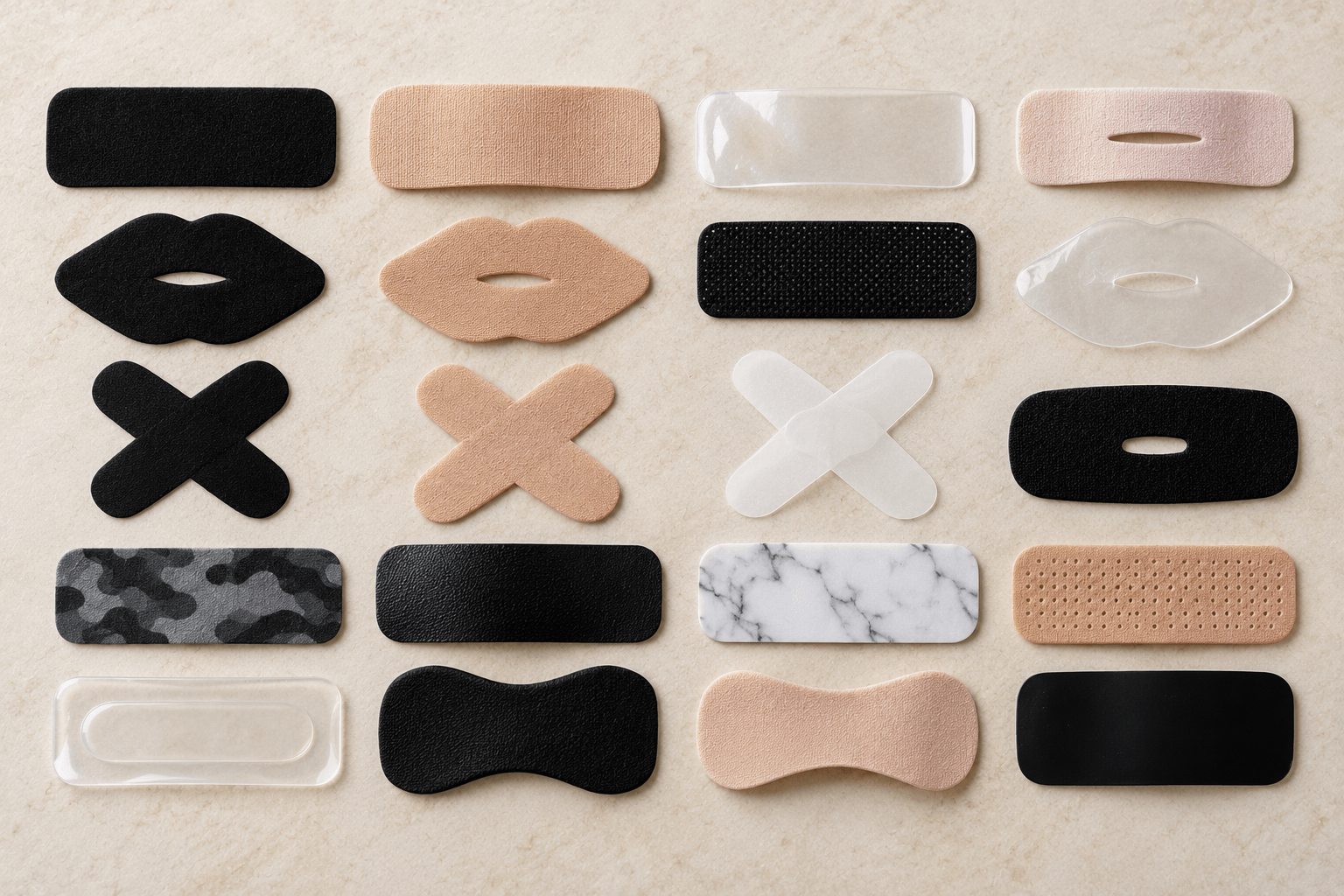
Mouth tape
Mouth tape is a strip of skin-safe tape over the lips that keeps the mouth closed so you breathe through your nose. It targets snoring that happens when the jaw drops and the mouth falls open.
Evidence: a 2022 study in Healthcare looked at 20 mouth breathers with mild sleep apnea. Each had a baseline home sleep test and a second one a week later on a night with the mouth taped. The median snoring index fell by 47%, from 303.8 to 121.1 events an hour, and 13 of the 20 cut their snoring index by at least half. A 2025 systematic review in PLOS One found 10 studies with 213 people and rated all of them as poor quality, so the evidence is promising but early.
Who it suits: adults who snore with their mouths open and can breathe comfortably through their noses. In the 2025 review, four of the 10 studies warned that keeping the mouth closed could pose a serious risk of asphyxiation if the nose is blocked. We don't recommend mouth tape for children.
Chin straps
Chin straps are fabric straps around the head and chin that hold the jaw closed. They target the same open-mouth pattern as tape.
Evidence: mixed. The 2025 PLOS One review said the evidence on mouth occlusion or chin strapping is uncertain and that conclusions vary between studies. The NHS lists a chin strap as one option when your mouth falls open during sleep. See chin straps for snoring.
Who they suit: people whose jaw drops open and who would rather not have adhesive on their lips.
Check this first. Skip mouth tape and see a doctor if you snore loudly, wake up gasping, have been told you stop breathing in your sleep, or can't breathe comfortably through your nose. More on safety
Which devices work on the jaw and tongue?
Mandibular advancement devices
Mandibular advancement devices are mouthpieces that hold the lower jaw forward, which the NHS says brings the tongue forward too. They target snoring that starts at the back of the throat.
Evidence: the strongest of any device here. The 2015 guideline from the American Academy of Sleep Medicine and the American Academy of Dental Sleep Medicine recommends that sleep physicians prescribe oral appliances, rather than no therapy, for adults who want treatment for snoring without sleep apnea. It also says the diagnosis of snoring alone should come from a sleep physician, not a dentist, because snoring is often accompanied by sleep apnea. The German guideline recommends these devices in suitable cases and says fitting and monitoring should involve dental and sleep medicine experts.
Who they suit: people whose snoring isn't fixed by opening the nose or closing the mouth. The German guideline says how far the lower jaw can move forward should be assessed first, and its authors list enough stable, healthy teeth and a sufficient ability to open the mouth as conditions. The AASM guideline says most side effects of oral appliances are dental. See oral appliances for snoring for more.
Tongue-retaining devices
Tongue-retaining devices hold the tongue forward, usually with suction on the tip, instead of moving the jaw. They target the same throat-level snoring as jaw devices.
Evidence: limited. In a 2008 randomized crossover study in Sleep and Breathing, a non-custom suction device was compared with the same device without suction. Snoring index fell from 214.7 to 132.9 an hour only with the suction version, and 54% of participants said they would keep using it. See tongue-retaining devices.
Who they suit: people with throat-level snoring who want to try a non-custom option. A dentist can tell you whether a tongue device or a jaw device suits your mouth better.
Which devices work on back sleeping?
Positional devices
Positional devices keep you off your back. They range from a tennis ball sewn into your sleepwear, which the NHS suggests, to belts and small vibrating trainers. They target snoring that's worse when you lie face up.
Evidence: a 2024 systematic review in the Journal of Personalized Medicine found 9 studies of positional therapy and raising the head of the bed for snoring. The authors called both reliable options for improving snoring, but said there are only a few short-term recent studies and that larger controlled trials are urgently needed. The German guideline says avoiding the back should be offered for position-related snoring. See positional therapy devices.
Who they suit: people who mostly snore on their backs and are quieter on their sides.
Pillows and wedges
Anti-snoring pillows and wedges change the angle of your head or upper body. Some are shaped to keep you on your side, and some move your head when they detect snoring.
Evidence: the German guideline cites a randomized crossover study of 22 people with a pillow that changes head position when it detects snoring. The snoring index was 162 with the pillow switched on and 269 with it switched off, and the guideline says snoring-triggered head position change should be offered. The 2024 review found that people didn't tolerate a steep head-up angle for long, so angles above 35 degrees may be of limited practical use. See anti-snoring pillows.
Who they suit: back sleepers who find a belt or ball too intrusive.
Anti-snoring device checklist: which type fits you?
| Device type | What it targets | Evidence for snoring | Best suited to | Check before buying |
|---|---|---|---|---|
| Nasal strips | Narrow nasal valve | Placebo-controlled trial in people with rhinitis | A stuffy or narrow nose | Skin tolerates adhesive; sits on the soft part of the nose |
| Internal nasal dilators | Narrow nasal valve | One open comparison study | Nose-related snoring, adhesive-sensitive skin | Comfortable inside the nostril; right size |
| Mouth tape | Mouth falling open | Small studies, rated poor quality | Open-mouth snorers with a clear nose | Nose breathing feels easy; tape is easy to peel off |
| Chin straps | Jaw dropping open | Mixed results | Open-mouth snorers who dislike adhesive | Fits without pressing on the throat |
| Mandibular advancement devices | Tongue and throat | Guideline-recommended | Throat-level snoring | Enough healthy teeth; see a dentist and sleep doctor |
| Tongue-retaining devices | Tongue falling back | Small crossover trial | Throat-level snoring | Tolerable on the tongue tip |
| Positional devices | Back sleeping | Small studies; review asks for more | Snoring mostly on your back | Comfortable enough to wear all night |
| Pillows and wedges | Head and body angle | Small randomized trial; review asks for more | Back sleepers | Angle you can tolerate all night |
Can you combine anti-snoring devices?
Many people have more than one cause, so combining devices that work on different parts of the airway can make sense. The most common pairing is a nasal strip with mouth tape: the strip widens the nose and the tape keeps the mouth closed, so the strip helps the nose carry the breathing the tape asks of it. Side sleeping can be added to either.
For a nose-and-mouth pairing, the Titan Sleep System puts both in one routine.
When should you see a doctor instead of buying a device?
See a doctor before buying anything if your snoring comes with warning signs. The NHS says to see a GP if you feel sleepy during the day, your breathing stops and starts while you sleep, or you make gasping or choking noises, because you may have sleep apnea, which can be serious if not treated.
None of these devices is a sleep apnea treatment, and a quieter night doesn't prove the breathing pauses have stopped. If your nose is blocked most nights, get that checked rather than relying on a strip. If you're pregnant, ask your midwife or doctor before trying a new device. Our guide to snoring vs. sleep apnea explains the difference.
Our pick (paid partner): Titan Sleep System
For snoring linked to the nose or an open mouth, our pick is the Titan Sleep System from Titan Recovery. We haven't tested or ranked anti-snoring devices ourselves; this is our recommendation, based on how Titan describes the system against the checklist above.
Titan says the system pairs TitanAir Nasal Strips with Titan Bamboo Silk Mouth Tape as one nightly routine. Titan describes the strips as drug-free external nasal dilators with flexible spring-loaded bands, placed just above the flare of the nostrils on the soft part of the nose, not the bony bridge. It describes the tape as a bamboo silk strip worn across the lips, and suggests 20 to 30 minutes of daytime practice before the first night.
Titan says every batch is third-party tested and certified PFAS-free, and its 30-night guarantee refunds you if your sleep isn't better after 30 nights.
Read next
- Mouth tape vs. 7 other snoring products: how they compare
- 13 snoring remedies to try at home, ordered by the evidence
Common questions
What is the most effective anti-snoring device?
For snoring that starts at the tongue and jaw, a mandibular advancement mouthpiece has the strongest evidence, and a 2015 US guideline recommends oral appliances for adults with snoring but no sleep apnea. For snoring from a blocked nose or an open mouth, strips, dilators or mouth tape target the cause more directly. The best device is the one that matches where your snoring starts.
How do I know which anti-snoring device I need?
Work out where your snoring starts. Ask a bed partner whether your mouth hangs open and whether it's worse on your back, and check whether your nose feels blocked at night. The NHS links a blocked nose to dilators or strips, an open mouth to a chin strap or mouth device, and the tongue to a mouthpiece that brings the tongue forward.
Do anti-snoring mouthpieces work?
Mouthpieces that hold the lower jaw forward have the most research behind them of any snoring device. A 2019 German guideline says they can be recommended for snoring in suitable cases, and that fitting should involve dental and sleep medicine experts. You need enough healthy teeth and jaw movement for one to work.
Do nasal strips or mouth tape work better for snoring?
They fix different problems. Strips widen the front of the nose, so they suit snoring linked to a blocked or narrow nose. Mouth tape keeps the lips closed, so it suits people who snore with their mouths open and can breathe easily through their noses. Many people have both problems, which is why the two are often paired.
Are chin straps good for snoring?
The evidence is mixed. A 2025 systematic review called the evidence on mouth occlusion and chin strapping uncertain, with conclusions varying between studies. The NHS lists a chin strap as an option when your mouth falls open during sleep. Mouth tape is another way to keep the mouth closed.
Can an anti-snoring device fix sleep apnea?
Don't treat snoring devices as a fix for sleep apnea, and don't buy one instead of getting checked. The NHS says daytime sleepiness, breathing that stops and starts, or gasping and choking noises during sleep can mean sleep apnea, which can be serious if not treated. See a doctor first if any of those apply.
Sources
- Snoring
- The diagnosis and treatment of snoring in adults
- Clinical practice guideline for the treatment of obstructive sleep apnea and snoring with oral appliance therapy: an update for 2015
- External nasal dilation reduces snoring in chronic rhinitis patients: a randomized controlled trial
- Internal and external nasal dilatator in patients who snore: a comparison in clinical practice
- The impact of mouth-taping in mouth-breathers with mild obstructive sleep apnea: a preliminary study
- Breaking social media fads and uncovering the safety and efficacy of mouth taping in patients with mouth breathing, sleep disordered breathing, or obstructive sleep apnea: A systematic review
- A randomized, controlled, crossover study of a noncustomized tongue retaining device for sleep disordered breathing
- The potential effect of changing patient position on snoring: a systematic review
- Titan Sleep System (Nasal Strips + Mouth Tape)
About this article
- Research
- 10 published sources, listed above.
- Evidence
- Moderate. How we rate it
- Last checked
- November 2, 2026
- Funding
- Paid partner of Titan Recovery. Their ads are labeled.
- Found an error?
- Tell us. We log fixes on the corrections page.
* This content is for informational and educational purposes only and is not medical advice. It is not intended to diagnose, treat, cure or prevent any disease or health condition. Talk to a qualified healthcare provider about your health.