In short
- Your mouth falls open in sleep mainly because the muscles of your mouth, jaw and throat relax, and an open jaw then lets air take the easier path.
- A blocked nose, lying flat, alcohol and sleeping pills all make it more likely, and a 1986 study found men breathe through the mouth more in sleep than women, increasingly with age.
- An open mouth makes the upper airway more collapsible in sleep, and in a 2003 study, airway resistance was more than twice as high breathing through the mouth.
- If your nose is clear, mouth tape or a chin strap can keep your mouth closed, and a nasal strip helps if your nose feels narrow.
- Loud snoring with gasping, pauses in breathing or daytime sleepiness can be sleep apnea, which needs a doctor rather than tape.
Your mouth falls open when you sleep mainly because the muscles of your mouth, jaw and throat relax as you drift off, so the jaw drops and the lips part. A stuffy nose, lying flat, alcohol and sleeping pills all make it more likely. If your nose is clear, it's one of the easier sleep problems to fix, usually with mouth tape, a chin strap or a nasal strip.
What happens to your jaw when you fall asleep?
When you fall asleep, your jaw muscles relax and the jaw can drop open. While you're awake, muscle tone keeps your jaw up and your lips together without you thinking about it. As you fall asleep, that tone drops. The NHS explains that snoring happens because the tongue, mouth, throat and airways in the nose relax and narrow during sleep, and the same relaxation lets the lower jaw hang open.
Researchers have measured what that does inside the airway. In a 1996 study of six healthy sleepers, opening the mouth increased the gap between the teeth and shortened the distance between the jaw and the hyoid bone, the small bone that anchors the tongue. In other words, the jaw swung down and back. With the mouth open, the upper airway was more collapsible and total breathing resistance was higher than with the mouth closed.
It doesn't happen to everyone, or every night. A 2003 sleep lab study found that healthy adults with normal nasal resistance breathe almost entirely through the nose while asleep. So if your mouth is open most nights, something is usually tipping the balance: a nose that's harder to breathe through, extra muscle relaxation, or both. The sections below go through the usual suspects.
Once the lips part, air can take the open route, and for many people the night carries on that way. Why do I breathe through my mouth at night? covers the two broad causes, a blocked nose and a relaxed jaw.
Why does a blocked nose make it worse?
A blocked nose makes an open mouth worse because when air can't get through your nose easily, your body reaches for the mouth. Cleveland Clinic says most people who breathe through the mouth do so because they can't get air in through the nose, and lists nasal congestion from allergies, colds or sinusitis, a deviated septum, enlarged turbinates and nasal polyps among the causes.
Lying down adds to it. A 2022 meta-analysis of nine studies with 291 people found that lying down increases nasal resistance and reduces nasal airflow, and the change was larger in people who snore or have sleep apnea. That's why a nose that feels fine during the day can feel tight in bed. Why is my nose stuffy at night? explains the other reasons.
What else makes your mouth drop open?
A few common things make your mouth drop open by relaxing the jaw and throat further or making mouth breathing more likely:
- Alcohol. The National Heart, Lung, and Blood Institute (NHLBI) says alcohol can make the muscles of your mouth and throat relax. Our page on alcohol and snoring has more.
- Sleeping pills. The NHS says sleeping pills can sometimes cause snoring and lists avoiding them among its tips for snorers.
- Being male and getting older. A 1986 sleep study of 14 healthy adults found that men breathed about 29% of their air through the mouth during sleep, compared with about 5% for women, and the share rose with age in men.
Does it matter if your mouth is open?
Research: early (what this means)Cleveland Clinic says mouth breathing isn't a serious health issue for most adults, but it lists dry mouth, bad breath, drooling, hoarseness, snoring and feeling tired among its common symptoms. Those morning signs are often the first clue.
The sleep lab research gives a fuller picture of why nose breathing is the better route at night. In a 2003 study of 12 healthy adults, upper airway resistance during sleep was more than twice as high breathing through the mouth as through the nose, and breathing pauses and shallow breaths were far more frequent on the mouth route. In the 1986 study, the four men who had more than three breathing pauses an hour also breathed more through the mouth than the others. These are small studies, which is why we rate the evidence as emerging, but they point the same way.
How can you keep your mouth closed at night?
To keep your mouth closed at night, start with your nose. If it doesn't let enough air through, closing your mouth won't feel comfortable. Our two-minute nose test is a quick check, and a nasal strip can help if your nose feels narrow. A 2016 meta-analysis noted that nasal dilators improve nasal breathing.
Once your nose is clear, you have two simple options for the jaw itself.
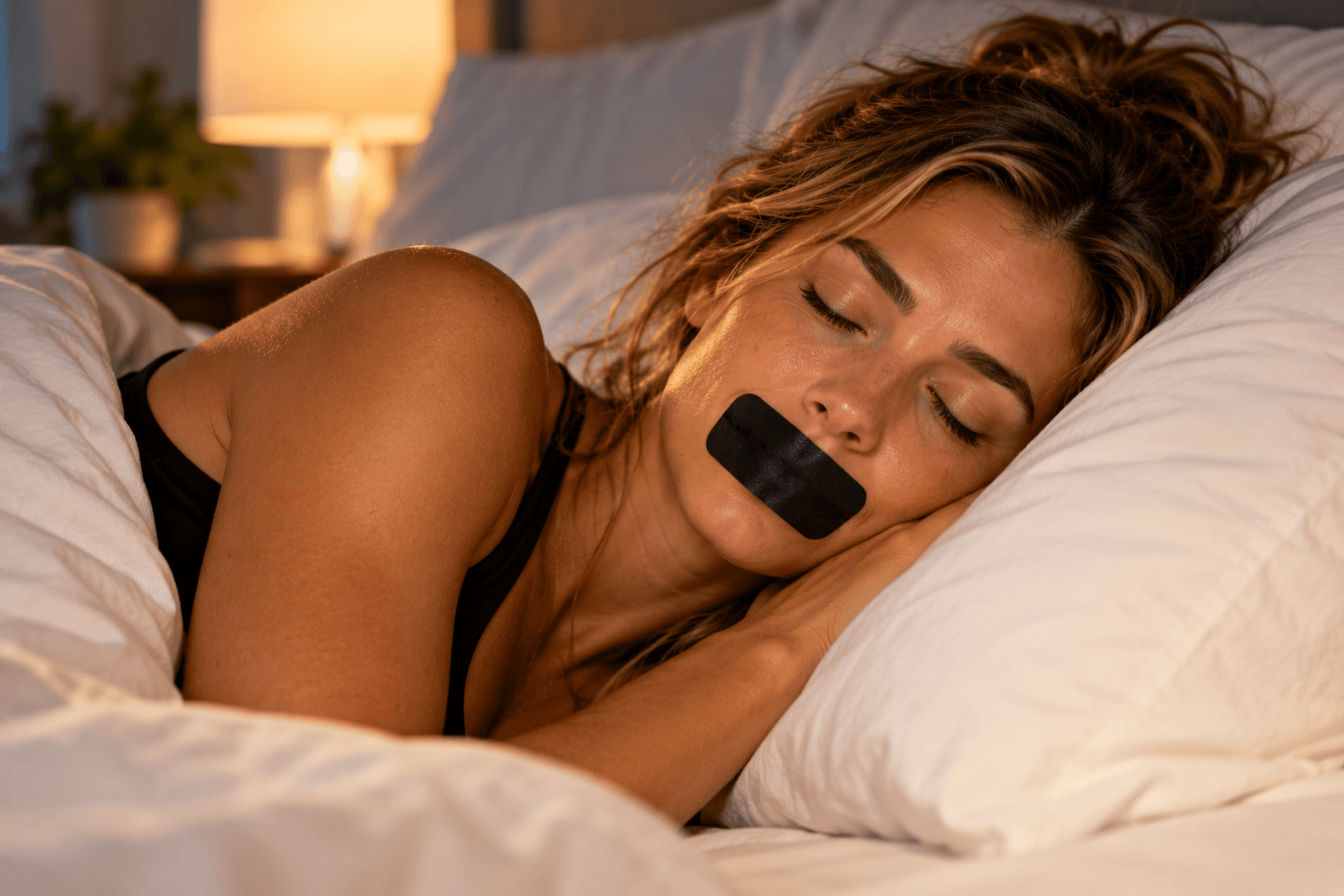
Mouth tape holds your lips together. The Sleep Foundation describes it as a gentle reminder that encourages nasal breathing and recommends a porous tape made for skin. In a 2022 study of 20 mouth breathers with mild sleep apnea, a week of taping cut their snoring index roughly in half. That was a small study in a specific group, and a 2025 systematic review of 10 studies with 213 patients found the research is still limited and warned of serious risk for people who tape with a blocked nose. Our first-week guide to mouth taping helps you start gently.
A chin strap supports the jaw instead. The NHS lists a chin strap to hold your mouth closed as a treatment for snoring caused by the mouth falling open, along with a vestibular shield worn inside the mouth. Mouth tape vs. a chin strap compares the two.
Check this first. Skip mouth tape and see a doctor if you snore loudly, wake up gasping, have been told you stop breathing in your sleep, or can't breathe comfortably through your nose. More on safety
Give whichever option you choose a week or so, and judge it by the mornings. A less dry mouth, a dry pillow and a partner reporting quieter nights all suggest your mouth is staying closed for more of the night.
Two habits help too. The NHS suggests sleeping on your side to reduce snoring, and advises not drinking too much alcohol, especially shortly before bed. Sleep position and snoring has ideas for staying off your back.
When is an open mouth a sign of something else?
An open mouth during sleep can be a sign of sleep apnea, which Cleveland Clinic lists among the causes of mouth breathing. The NHS says to see a doctor if your breathing stops and starts while you sleep, you make gasping, snorting or choking noises, or you always feel very tired during the day. Tape and strips don't treat sleep apnea, so get those signs checked first. If a child often sleeps with their mouth open, Cleveland Clinic advises asking a pediatrician to check their nose and airway.
Our pick (paid partner)
If your nose is clear and your mouth still drifts open, our pick is Titan Bamboo Silk Mouth Tape. Titan says it's a soft, breathable bamboo silk strip worn horizontally across the lips, with an adhesive made to grip through stubble and full beards and no ink on the side that touches your skin. Titan suggests 20 to 30 minutes of daytime practice before your first night, says every batch is third-party tested and certified PFAS-free, and offers a 30-night guarantee.
For more guides, browse our nasal breathing articles.
Read next
- 9 signs you breathe through your mouth at night
- Is mouth taping safe?
- Dry mouth at night: remedies that help
Common questions
Why does my mouth open when I sleep?
The muscles of your mouth, jaw and throat relax as you sleep, so the jaw can drop and the lips part. A stuffy nose makes it more likely, because your body then reaches for the easier airway. Alcohol and sleeping pills relax those muscles further.
Is it bad to sleep with your mouth open?
For many adults it isn't serious, but it can leave you with a dry mouth, bad breath, a hoarse voice and snoring. Sleep lab studies also show the upper airway is more collapsible and has higher resistance when the mouth is open.
How do I keep my mouth closed while sleeping?
If your nose is clear, mouth tape or a chin strap holds the lips or jaw closed. The NHS lists a chin strap as a treatment for snoring caused by the mouth falling open. If your nose feels narrow, add a nasal strip first.
Does sleeping on your back make your mouth fall open?
Lying down raises nasal resistance, according to a 2022 meta-analysis, which can push you toward breathing through the mouth. The NHS suggests sleeping on your side to reduce snoring.
Can sleeping with your mouth open be a sign of sleep apnea?
It can go along with it. Cleveland Clinic lists sleep apnea among the causes of mouth breathing. If you snore loudly and someone notices pauses in your breathing, gasping or choking, or you feel very tired during the day, see a doctor.
Can a nasal strip stop your mouth falling open?
Not on its own, since it works on the nose, not the jaw. It can make nose breathing easier, which helps if a stuffy nose is part of the reason your mouth opens. Many people pair a strip with mouth tape.
Does a chin strap help if you sleep with your mouth open?
It can. A chin strap supports the jaw so the mouth stays closed, and the NHS lists one as a treatment for snoring caused by the mouth falling open. Mouth tape is the other common option, holding the lips together rather than the jaw.
Sources
- Snoring
- Effects of mouth opening on upper airway collapsibility in normal sleeping subjects
- Effect of nasal or oral breathing route on upper airway resistance during sleep
- Breathing route during sleep
- The Recumbent Position Affects Nasal Resistance: A Systematic Review and Meta-Analysis
- Mouth breathing: symptoms, complications and treatment
- Sleep apnea: causes and risk factors
- Sleep apnoea
- Mouth taping for sleep: does it work?
- The impact of mouth-taping in mouth-breathers with mild obstructive sleep apnea: a preliminary study
- Breaking social media fads and uncovering the safety and efficacy of mouth taping in patients with mouth breathing, sleep disordered breathing, or obstructive sleep apnea: A systematic review
- Nasal Dilators (Breathe Right Strips and NoZovent) for Snoring and OSA: A Systematic Review and Meta-Analysis
- Titan Bamboo Silk Mouth Tape
About this article
- Research
- 13 published sources, listed above.
- Evidence
- Early. How we rate it
- Last checked
- October 10, 2026
- Funding
- Paid partner of Titan Recovery. Their ads are labeled.
- Found an error?
- Tell us. We log fixes on the corrections page.
* This content is for informational and educational purposes only and is not medical advice. It is not intended to diagnose, treat, cure or prevent any disease or health condition. Talk to a qualified healthcare provider about your health.