In short
- Colds can cause snoring. Cleveland Clinic says the airway blockage behind snoring may come from a temporary condition that causes swelling, like a cold, and that congestion from allergies and colds can block airflow.
- Congestion often feels worse at night. Cleveland Clinic explains that lying down makes it harder for mucus to drain, and suggests sleeping with your head and shoulders raised.
- People with frequent nighttime nasal symptoms snore more. A Wisconsin study of 4,927 adults found those with rhinitis symptoms 5 or more nights a month were significantly more likely to be habitual snorers.
- Nasal strips have trial evidence for congestion-related snoring. In a 2000 randomized trial in chronic rhinitis, an external nasal dilator cut snoring from 258 to 173 snores an hour compared with placebo.
- Decongestant nasal sprays are for short-term use only. The NHS says not to use them for more than 5 days at a time, because longer use can make stuffiness worse.
- Skip mouth tape while you're congested. Cleveland Clinic's sleep specialist says never to use it with nasal congestion, nasal obstruction or a sinus infection.
Snoring when you're sick is common, and the reason is usually your nose. A cold, flu or allergy flare makes the lining of your nose swell and fill with mucus, so air can't move through it easily. That narrowed airway is a common recipe for snoring. The good news is that it usually fades as you recover, and there's plenty you can do in the meantime.
Why do I snore when I have a cold?
Research: limited (what this means)You snore when you have a cold because swelling and mucus partly block your airway. Cleveland Clinic explains that snoring happens when a blockage makes the tissues of your nose, mouth and throat vibrate as air passes, and that the blockage can come from a temporary condition that causes swelling, like a cold. It also lists congestion from allergies and colds as a snoring risk factor.
There's one honest gap to mention. Most of the research looks at long-term nasal congestion rather than short colds, and we found no study that tested snoring during an ordinary cold. What the research on ongoing congestion shows is still useful, because the mechanism is the same.
A 2007 review in the European Respiratory Journal summed it up: chronic nasal obstruction seems to be of some relevance in the origin of snoring, while it plays only a minor role in sleep apnea.
Why does congestion get worse at night?
Congestion often gets worse at night because lying down works against drainage. Cleveland Clinic says that during the day you swallow mucus without noticing, but when you lie flat, gravity no longer helps it drain, so it pools in your sinuses. It adds that people with sinus inflammation often feel worse lying down for the same reason.
Allergens in the bedroom can add to the problem. Cleveland Clinic points to dust, pet dander and mold indoors, plus pollen you bring in on your hair and skin.
Do allergies make you snore more?
Allergies can make you snore more, and the evidence here is stronger than for colds. A University of Wisconsin study surveyed 4,927 adults and measured 911 of them in a sleep lab. People who had nighttime rhinitis symptoms, such as a stuffy or runny nose, on 5 or more nights a month were significantly more likely to report habitual snoring than those who rarely had symptoms.
The same study found habitual snorers had lower nasal airflow than non-snorers. People who reported nasal congestion due to allergy were 1.8 times more likely to have moderate to severe sleep-disordered breathing. If your snoring follows the pollen season, see nasal strips for allergies.
What helps snoring when you're sick?
What helps most is opening up your nose. Cleveland Clinic suggests saline rinses or sprays, a humidifier, staying hydrated and sleeping with your head and shoulders elevated. The NHS suggests breathing in steam, such as sitting in the bathroom with a hot shower running. For snoring caused by blocked nasal airways, the NHS lists nasal strips and short-term decongestants.
| What to try | How it helps | Watch out for |
|---|---|---|
| Saline rinse or spray | The FDA says rinsing can loosen thick mucus and relieve nasal symptoms of colds, flu and allergies | Use distilled, sterile or boiled and cooled water, never plain tap water |
| Steam | The NHS suggests it to ease a blocked nose | Don't let children breathe steam from a bowl of hot water |
| Humidifier | Cleveland Clinic says it eases dryness that can worsen congestion | The EPA advises keeping humidity no higher than 50% and cleaning the tank |
| Raised head and shoulders | Helps mucus drain instead of pooling, per Cleveland Clinic | A wedge or extra pillow under the shoulders is enough for most people |
| Nasal strips | Hold the nose open; the NHS lists them for snoring from blocked nasal airways | Follow the placement directions on the box |
| Decongestant spray | Shrinks swelling inside the nose, per the NHS | No more than 5 days in a row |
Rinse with saline
The FDA says nasal irrigation devices are usually safe and effective when used and cleaned properly. Its key rule is the water: use distilled or sterile water, tap water boiled for 3 to 5 minutes and cooled, or water passed through a filter designed to trap infectious organisms. Tap water isn't safe for rinsing because organisms that are harmless to swallow can survive in the nose and cause serious infections. Our guide on how to use a saline rinse walks through it.
Add moisture
A humidifier can make dry, irritated nasal passages more comfortable. The EPA recommends using water with low mineral content, such as distilled water, emptying and cleaning the tank regularly, and not humidifying above 50% relative humidity.
Raise your head and sleep on your side
Cleveland Clinic suggests sleeping with your head and shoulders elevated when you're congested, and lists elevating your head and sleeping on your side among its snoring tips. A wedge pillow or an extra pillow under your shoulders works for most people. Our guide to sleeping with a stuffy nose has more ideas.
Use decongestants briefly
The NHS says decongestants reduce swelling in the blood vessels of the nose and can give short-term relief from colds, flu, hay fever and sinusitis. It also says decongestant nasal sprays and drops shouldn't be used for more than 5 days at a time, because longer use can make stuffiness worse. Decongestants aren't suitable for everyone, including people with high blood pressure, diabetes, glaucoma or heart problems, without advice from a pharmacist or doctor, and they shouldn't be given to children under 6. Our article on decongestant spray rebound explains the rebound effect.
Do nasal strips help with snoring from a cold?
Nasal strips can help with snoring from a blocked nose, and they're a drug-free option you can use every night of a cold. The NHS lists nasal dilators or strips that hold the nose open among the treatments for snoring caused by blocked or narrow nasal airways, and Cleveland Clinic says they can help keep nasal passages open.
The best trial is in chronic rhinitis rather than colds. In a 2000 randomized, placebo-controlled study of 12 people with chronic rhinitis, an external nasal dilator cut snoring frequency from 258 to 173 snores an hour compared with a placebo strip. It didn't change snoring loudness or sleep quality, so expect fewer snores rather than silence. The 2007 review also found that nasal dilators seemed to reduce snoring. No study has tested strips during an ordinary cold, but the logic is the same: more room for air in the nose. Our guide on how to apply nasal strips helps you get the placement right.
Can you use mouth tape when you have a cold?
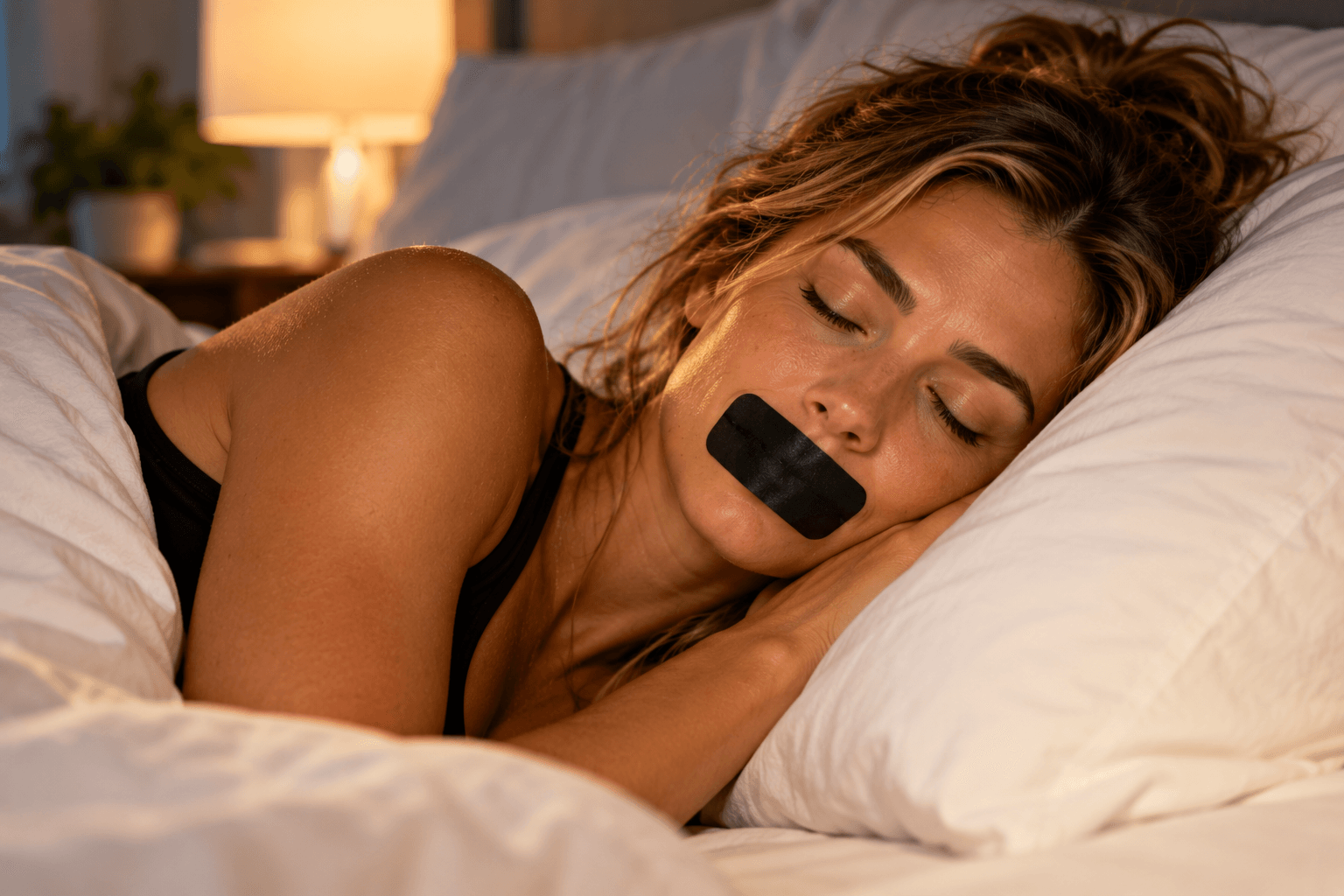
You shouldn't use mouth tape when you have a cold or any nasal congestion. Mouth tape only makes sense when you can breathe comfortably through your nose with your mouth closed. Cleveland Clinic's sleep specialist says never to use it with nasal obstruction, nasal congestion, chronic allergies or a sinus infection, because it leaves you relying on your nose alone for air.
Put the tape away until your nose is clear, then pick it back up. A strip alone is the better choice while you're stuffy. Our article on mouth tape with a cold explains when it's reasonable to start again. We don't recommend mouth tape for children.
Check this first. Skip mouth tape and see a doctor if you snore loudly, wake up gasping, have been told you stop breathing in your sleep, or can't breathe comfortably through your nose. More on safety
Why do kids snore more with a cold?
Children often snore with a cold for the same reason adults do: a blocked nose. The NHS says cold symptoms can last longer in young children, and that they may have difficulty sleeping and breathe through their mouth. Cleveland Clinic says snoring in babies is common and is most often caused by a stuffy nose.
Gentle care helps here too. The NHS says decongestants shouldn't be given to children under 6, and that children shouldn't breathe in steam from a bowl of hot water because of the risk of scalding. If a child snores regularly when they aren't sick, or you're worried, check with their doctor.
When is snoring more than a cold?
Snoring is more than a cold when it comes with breathing pauses, gasping or choking, or when it carries on long after your nose has cleared. Those can be signs of sleep apnea or of an ongoing nasal problem, and both are worth a doctor's look. Our guide to snoring vs sleep apnea explains the warning signs.
The cold itself can also need attention. The NHS says you should start to feel better in about 1 to 2 weeks, and advises seeing a GP if your symptoms don't improve after 10 days, you have a high temperature for more than 3 days, you feel short of breath or have chest pain, or you have a cough for more than 3 weeks.
Our pick (paid partner): TitanAir Nasal Strips
For snoring while you're congested, our pick is TitanAir Nasal Strips. Titan describes them as drug-free external nasal dilators with flexible spring-loaded bands. Titan says they go just above the flare of the nostrils, on the soft part of the nose rather than the bony bridge, on clean, dry skin. To remove one, Titan suggests loosening it with warm water and peeling slowly from the ends inward.
Titan says every batch is third-party tested and certified PFAS-free, and that it refunds you if your sleep isn't better after 30 nights. Titan designed the strips to pair with its mouth tape, which you can add back once your nose is clear. We haven't tested or ranked nasal strips ourselves; this is our recommendation.
Read next
Common questions
Why do I snore when I have a cold?
A cold makes the inside of your nose swell and fill with mucus, so air can't flow freely. Cleveland Clinic says snoring happens when a partly blocked airway makes tissues vibrate, and names a cold as a temporary cause of that swelling. Snoring from a cold usually fades as your nose clears.
Is it normal to snore when you're sick?
Yes. Cleveland Clinic lists nasal congestion from colds and allergies among the things that block airflow and lead to snoring, and says occasional snoring is usually nothing to worry about. Snoring that starts with a cold and stops when you recover is common. Snoring that carries on afterward, or comes with gasping, deserves a closer look.
How do I stop snoring when I have a cold?
Work on clearing your nose. Cleveland Clinic suggests saline rinses or sprays, a humidifier, staying hydrated and sleeping with your head and shoulders raised. The NHS suggests breathing in steam, and lists nasal strips and short-term decongestants for snoring caused by a blocked nose. Sleeping on your side can help too.
Can I use mouth tape when I have a cold?
No. Wait until you can breathe easily through your nose again. Cleveland Clinic's sleep specialist says never to use mouth tape with nasal congestion, nasal obstruction or a sinus infection, because it leaves you relying on your nose alone. A nasal strip is a better choice while you're stuffy.
Do nasal strips help with snoring from a cold?
They may. No study has tested nasal strips during an ordinary cold. But in a 2000 randomized trial of people with chronic rhinitis, an external nasal dilator lowered snoring frequency compared with a placebo strip, and a 2007 review found nasal dilators seemed to reduce snoring. The NHS lists them for snoring caused by blocked nasal airways.
When is snoring with a cold something more serious?
See a doctor if snoring comes with breathing pauses, gasping or choking, or carries on after the cold clears. The NHS also advises seeing a GP if cold symptoms don't improve after 10 days, you have a high temperature for more than 3 days, or you feel short of breath or have chest pain.
Sources
- Snoring: causes and complications
- Why does my nose get stuffy at night?
- Nasal obstruction as a risk factor for sleep-disordered breathing
- The role of the nose in the pathogenesis of obstructive sleep apnoea and snoring
- External nasal dilation reduces snoring in chronic rhinitis patients: a randomized controlled trial
- Common cold
- Decongestants
- Is rinsing your sinuses with neti pots safe?
- Use and care of home humidifiers
- Mouth taping: is it safe to use?
About this article
- Research
- 10 published sources, listed above.
- Evidence
- Limited. How we rate it
- Last checked
- October 14, 2026
- Funding
- Paid partner of Titan Recovery. Their ads are labeled.
- Found an error?
- Tell us. We log fixes on the corrections page.
* This content is for informational and educational purposes only and is not medical advice. It is not intended to diagnose, treat, cure or prevent any disease or health condition. Talk to a qualified healthcare provider about your health.