In short
- The apnea-hypopnea index counts breathing pauses and partial blockages per hour of sleep, and 5 to 14 is classed as mild sleep apnea.
- The nasal valve has the smallest cross-section of the upper airway, and nasal strips pull the nostrils open from the outside.
- Decongestant sprays shouldn't be used for more than 5 days at a time, because longer use can cause rebound congestion.
- Hypoallergenic has no federal definition for cosmetics, so it means whatever a company wants it to mean.
- Mouth taping is promising for snoring in mouth breathers, but it isn't a treatment for obstructive sleep apnea.
This glossary defines 30 terms you'll come across when reading about mouth taping, nasal strips and breathing during sleep. It covers sleep study measures such as the AHI, devices such as nasal strips, chin straps and CPAP, and the parts of the nose they act on. Each entry gives a short, sourced definition, in alphabetical order.
Terms from A to D
Apnea-hypopnea index (AHI)
The number of apneas, complete pauses in breathing, and hypopneas, partial blockages of airflow, per hour of sleep. Sleep Foundation says under 5 is normal, 5 to 14 is mild sleep apnea, 15 to 29 moderate and 30 or more severe.
Buteyko method
A breathing approach that encourages nose breathing, using mouth taping at night. A 2009 randomized trial tested Buteyko-style taping in 51 adults with asthma and found no effect on asthma control.
Chin strap
A strap that holds the jaw closed during sleep. The NHS lists it as an option when the mouth falls open while you sleep. A 2014 study in 26 adults with sleep apnea found a chin strap alone didn't improve snoring.
CPAP
Short for continuous positive airway pressure. The American Academy of Sleep Medicine calls it the leading treatment for sleep apnea, and says it keeps the airway open by gently providing air through a mask worn during sleep.
Decongestant nasal spray
A spray that reduces swelling inside the nose. The NHS says decongestant sprays and drops shouldn't be used for more than 5 days at a time, because longer use can make stuffiness worse.
Deviated septum
When the cartilage and bone dividing the nose in the middle aren't straight. Healthdirect says most people have a mild one that causes no problems, while a severe one can make breathing harder, usually on one side. See deviated septum symptoms.
Terms from E to M
Epworth Sleepiness Scale
A short questionnaire about daytime sleepiness that asks how likely you are to fall asleep in eight everyday situations. Sleep Foundation says doctors use it to help identify excessive daytime sleepiness.
Home sleep apnea test
A test you wear at home to collect information about your breathing during sleep. The American Academy of Sleep Medicine says the devices measure breathing and blood oxygen, and that a negative result isn't always enough to rule out sleep apnea.
Hypoallergenic
A label suggesting a product is less likely to cause allergic reactions. FDA says there are no federal standards or definitions for the term on cosmetics, and that it means whatever a particular company wants it to mean.
Internal nasal dilator
A plastic or metal device placed inside the nostrils. US regulations say it works by pushing the nostrils open or by gently pressing on the strip of tissue between them.
Mandibular advancement device
A mouthpiece that holds the lower jaw forward to bring the tongue forward, according to the NHS. A 2015 guideline recommends oral appliances, rather than no therapy, for adults who want treatment for snoring without sleep apnea.
Mouth breathing
Breathing through your mouth instead of your nose most of the time. Cleveland Clinic says it often happens when air can't get in through the nose, and that it isn't a serious health issue for adults, though it can affect children's growth.
Mouth leak
Air escaping through the mouth during CPAP. SleepApnea.org says mouth breathing on CPAP can lead to dry mouth, sore throat, air leaks and less effective therapy. Our article on mouth tape and CPAP covers the options.
Mouth taping
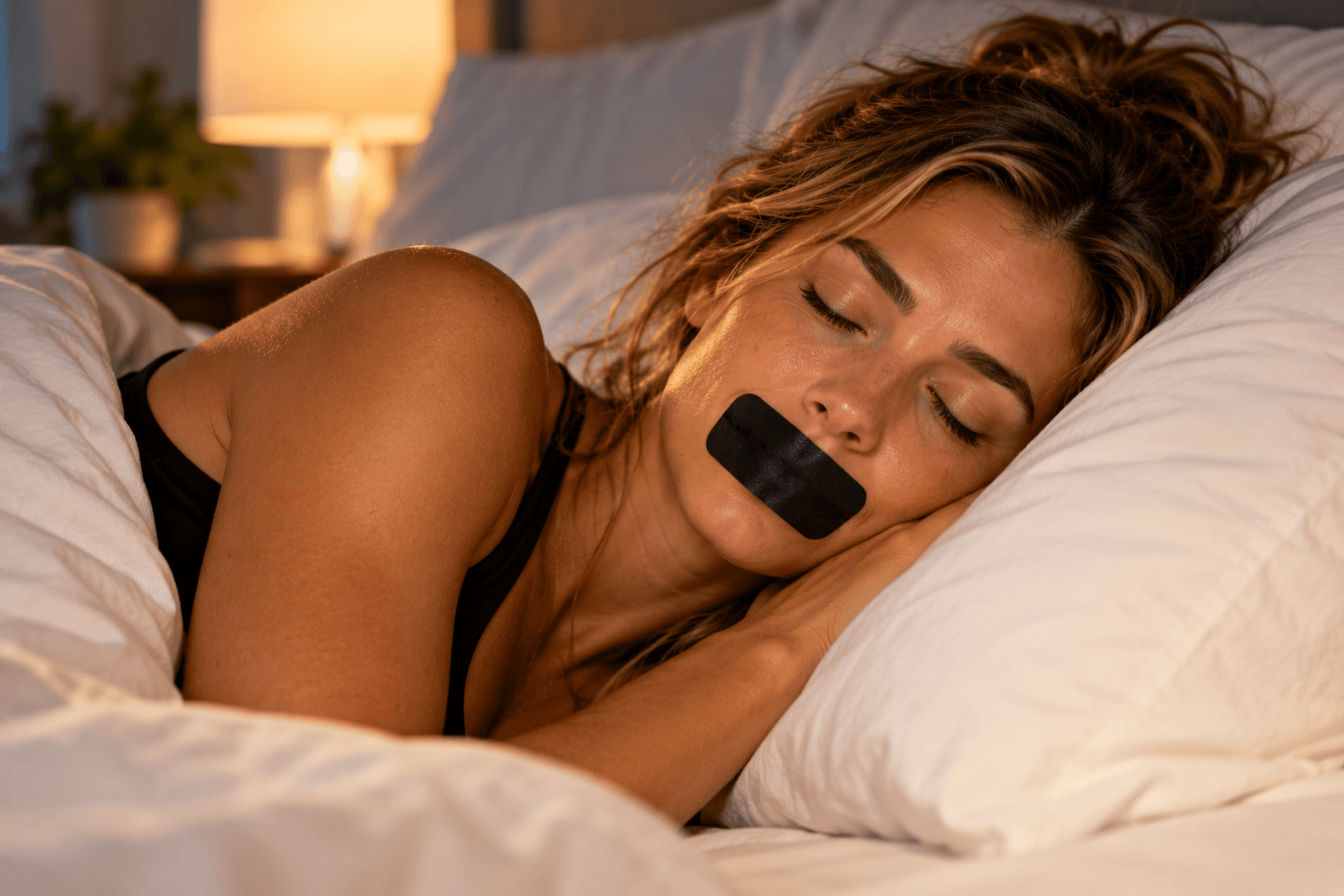
Placing tape over the lips before bed to encourage nose breathing during sleep, according to Sleep Foundation. A small 2022 study of mouth breathers with mild sleep apnea found snoring roughly halved after a week of taping (the research). Sleep Foundation says people with untreated sleep apnea, chronic nasal congestion or trouble breathing through the nose shouldn't use it.
Research: limited (what this means)Terms from N to O
Nasal cycle
A normal pattern in which one side of the nose becomes more congested while the other opens up. Cleveland Clinic says the sides switch every four to six hours. Read more in the nasal cycle.
Nasal strip
An external nasal dilator. US regulations describe it as layers of material with a spring and a skin adhesive that pulls the nostrils open, decreasing airway resistance and increasing nasal airflow. In a 2000 placebo-controlled trial, strips lowered snoring frequency in people with chronic rhinitis.
Nasal valve
The passageway inside the nose, which a 2019 study describes as having the smallest cross-sectional area of the upper airway. Cleveland Clinic describes an internal valve in the middle of the nose and an external valve near the nostrils. A 1997 study found a nasal strip increased nasal valve area in athletes at rest.
Nasal valve collapse
When the nasal valve narrows and stops air flowing freely through the nose. Cleveland Clinic calls it one of the most common causes of nasal obstruction. See nasal valve collapse.
Nitric oxide
A gas found in air from the nasal airways. A 1995 study in Nature Medicine found it's produced by cells lining the sinuses and is present in sinus air in very high concentrations. Our explainer on nitric oxide and nasal breathing covers what's known.
Obstructive sleep apnea
A common and serious sleep disorder in which the airway becomes blocked again and again during sleep, according to the American Academy of Sleep Medicine. Snoring with silent pauses and choking or gasping is a warning sign. Mouth tape and nasal strips aren't treatments for it.
Orthosomnia
A term coined by sleep researchers for people who seek treatment for sleep problems they've self-diagnosed from sleep tracker data, sometimes chasing perfect sleep numbers.
Oxygen desaturation index
How many times per hour, on average, blood oxygen falls below normal for 10 seconds or longer, according to Sleep Foundation. Doctors may review it alongside the AHI.
Terms from P to V
PFAS
A group of widely used, long-lasting chemicals that break down very slowly. The EPA says many are found in the blood of people and animals around the world.
Polysomnography
The full overnight sleep study. The American Academy of Sleep Medicine says it records brain waves, heart rate and breathing, along with eye and limb movements and blood oxygen.
Rebound congestion
Nasal congestion caused by overusing decongestant sprays, also called rhinitis medicamentosa. Cleveland Clinic says it's reversible, and most people improve after they stop overusing the sprays. See decongestant spray rebound.
Saline rinse
Rinsing the nasal passages with salt water. FDA says to use only distilled, sterile or previously boiled water, because tap water isn't adequately filtered or treated for use in the nose. Our guide on how to use a saline rinse covers the steps.
Snoring index
The number of snores per hour, measured in a sleep study. A 1998 nasal strip study counted it per hour of time in bed, and the 2015 and 2022 mouth tape studies both reported it.
Turbinates
Small structures inside the nose that cleanse, heat and humidify air on its way to the lungs. Cleveland Clinic says they can swell from irritation, allergies or infection, and some people develop long-term swelling.
Upper airway resistance syndrome
A pattern of snoring and repeated breathing-effort arousals during sleep without the oxygen drops typical of sleep apnea. A 2012 review says daytime sleepiness is the main diagnostic feature. See upper airway resistance syndrome.
Vestibular shield
A device worn in the mouth to help you breathe through your nose while you sleep. The NHS lists it alongside a chin strap as an option when the mouth falls open during sleep.
More on these topics is on our nasal breathing topic page.
If you want to try mouth tape and nasal strips together, our pick is the Titan Sleep System, which pairs TitanAir Nasal Strips with Titan Mouth Tape.
Read next
Common questions
What is the difference between a nasal strip and a nasal dilator?
A nasal strip is a type of external nasal dilator. It sticks to the outside of the nose and uses a spring to pull the nostrils open. An internal dilator is made of plastic or metal and sits inside the nostrils to push them open.
What does AHI mean on a sleep study?
AHI stands for apnea-hypopnea index, the number of complete pauses and partial blockages in breathing per hour of sleep. Under 5 is normal, 5 to 14 is mild sleep apnea, 15 to 29 moderate and 30 or more severe.
What is mouth leak?
Air escaping through the mouth when you breathe through your mouth during CPAP. SleepApnea.org says it can cause dry mouth, sore throat and less effective therapy.
What is the nasal cycle?
A normal pattern in which one side of the nose becomes more congested while the other opens up, switching back and forth. Cleveland Clinic says it happens every four to six hours.
What is the snoring index?
The number of snores per hour, measured in a sleep study. A 1998 nasal strip study counted it per hour of time in bed, and the 2015 and 2022 mouth tape studies both reported it.
Are nasal strips an alternative to CPAP?
No. The American Academy of Sleep Medicine calls CPAP the leading treatment for sleep apnea, and nasal strips aren't a treatment for it. Strips pull the nostrils open from the outside to make nasal breathing easier, and in a 2000 placebo-controlled trial they lowered snoring frequency in people with chronic rhinitis.
What devices help you breathe through your nose?
Nasal strips pull the nostrils open from the outside, and internal nasal dilators sit inside the nostrils to hold them open. When the mouth falls open during sleep, the NHS lists a chin strap or a vestibular shield worn inside the mouth, and mouth tape holds the lips together to encourage nose breathing.
Sources
- What is AHI?
- Effect of mouth taping at night on asthma control: a randomised single-blind crossover study
- Snoring
- The efficacy of a chinstrap in treating sleep disordered breathing and snoring
- CPAP
- Decongestants
- Deviated septum
- Epworth Sleepiness Scale
- Home sleep apnea test
- Hypoallergenic cosmetics
- 21 CFR 874.3900: Nasal dilator
- Clinical practice guideline for the treatment of obstructive sleep apnea and snoring with oral appliance therapy: an update for 2015
- Mouth breathing
- How to prevent mouth breathing on CPAP
- Mouth taping for sleep: does it work?
- The impact of mouth-taping in mouth-breathers with mild obstructive sleep apnea: a preliminary study
- Why do I sometimes get stuffy in one nostril?
- External nasal dilation reduces snoring in chronic rhinitis patients: a randomized controlled trial
- Nasal valve collapse
- Internal and external nasal dilatator in patients who snore: a comparison in clinical practice
- Novel porous oral patches for patients with mild obstructive sleep apnea and mouth breathing: a pilot study
- Physiologic effects of an external nasal dilator
- High nitric oxide production in human paranasal sinuses
- Obstructive sleep apnea
- Orthosomnia: are some patients taking the quantified self too far?
- PFAS explained
- Sleep study
- Rhinitis medicamentosa
- Is rinsing your sinuses with neti pots safe?
- Effect of the external nasal dilator Breathe Right on snoring
- Turbinate reduction
- The upper airway resistance syndrome
About this article
- Research
- 32 published sources, listed above.
- Evidence
- Limited. How we rate it
- Last checked
- October 10, 2026
- Funding
- Paid partner of Titan Recovery. Their ads are labeled.
- Found an error?
- Tell us. We log fixes on the corrections page.
* This content is for informational and educational purposes only and is not medical advice. It is not intended to diagnose, treat, cure or prevent any disease or health condition. Talk to a qualified healthcare provider about your health.