In short
- A 2015 meta-analysis in Sleep found myofunctional therapy lowered the apnea-hypopnea index from 24.5 to 12.3 events an hour in adults, about a 50% reduction, and by 62% in children.
- The same 2015 meta-analysis suggested myofunctional therapy could serve as an add-on to other sleep apnea treatments rather than a replacement.
- A 2018 meta-analysis of 9 studies and 211 adults found myofunctional therapy cut snoring intensity by 51% on a rating scale and time spent snoring by 31%.
- In a 2022 Healthcare study of 20 mouth breathers with mild sleep apnea, the median snoring index fell by 47% on a night with their mouths taped.
- Cleveland Clinic says myofunctional therapy typically lasts six to 12 months, while mouth tape works only on the nights you wear it.
- No study has tested mouth tape and myofunctional therapy together.
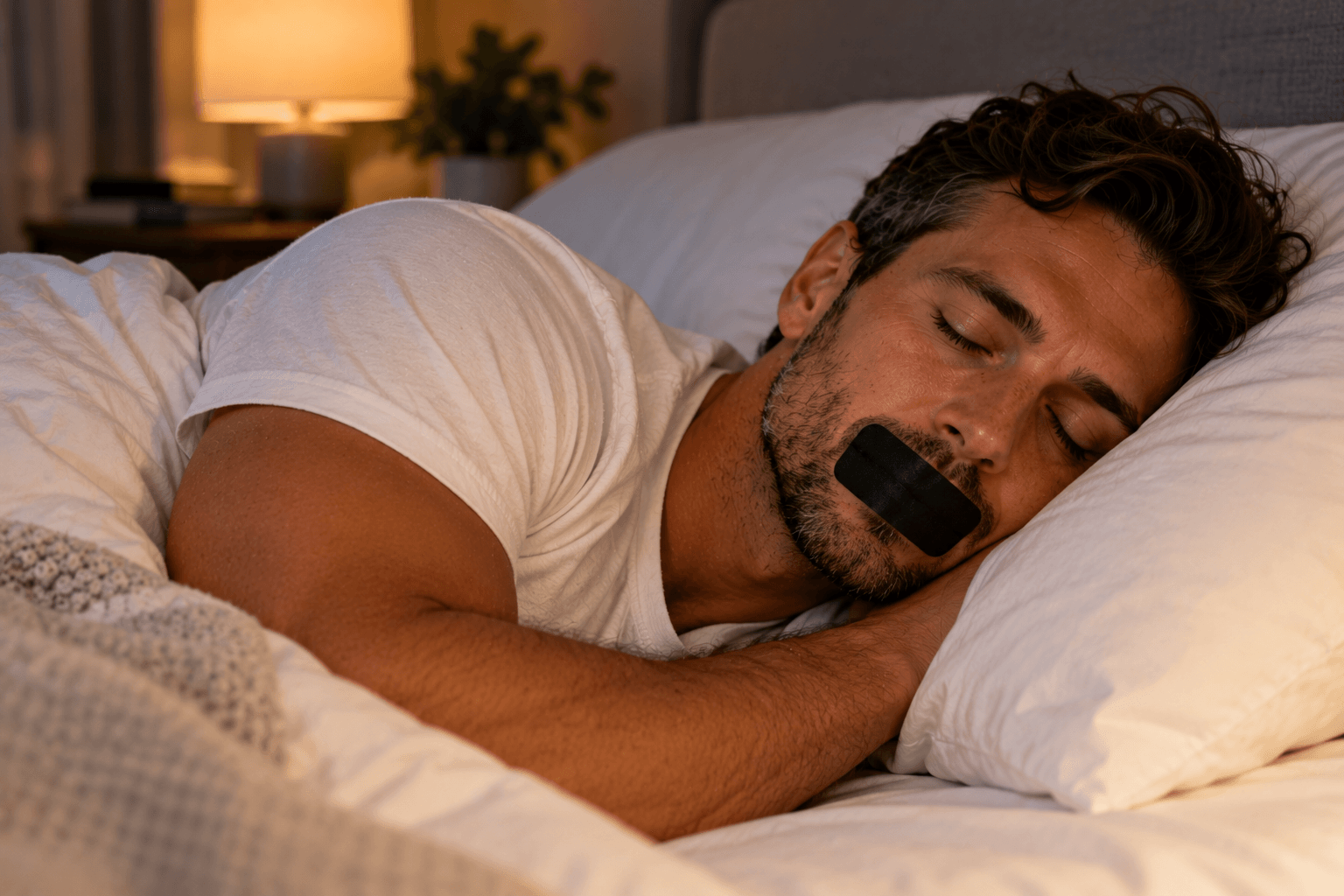
Mouth tape and myofunctional therapy aim at the same problem from opposite ends. Tape is a nightly, low-effort way to keep your lips closed while you sleep. Myofunctional therapy is a months-long exercise program that trains the tongue, lips and throat. Therapy has more research behind it for snoring and sleep apnea severity, tape is far easier to start, and for many adults with a clear nose the sensible answer is to use both.
What is the difference between mouth tape and myofunctional therapy?
The difference is that mouth tape works on your lips while you sleep, and myofunctional therapy works on your muscles while you're awake. Mouth tape is a small strip that holds the lips gently together at night so you breathe through your nose. It does nothing once it comes off.
Myofunctional therapy, also called orofacial myofunctional therapy or OMT, is exercise-based training. Cleveland Clinic says it trains the muscles in your mouth and face to move as they should and rest in the proper positions, and lists mouth breathing among the conditions providers use it for. Sessions might include breathing exercises, lifting or extending the tongue in specific ways, and holding a small object between the lips, with practice at home between visits. Our full guide to myofunctional therapy covers what a program involves.
How do mouth tape and myofunctional therapy compare?
Here's how the two compare side by side.
| Mouth tape | Myofunctional therapy | |
|---|---|---|
| What it does | Holds the lips closed during sleep | Trains tongue, lips, cheeks and throat muscles |
| When it works | Only on nights you wear it | Builds over weeks and months |
| Time commitment | A minute at bedtime | Daily exercises; Cleveland Clinic says treatment typically lasts six to 12 months |
| Who delivers it | You, at home | A trained provider plus home practice |
| Best evidence | Small studies showing less snoring in mouth breathers with mild sleep apnea | Meta-analyses showing less snoring and lower apnea-hypopnea index |
| Main caution | Not for a blocked nose, sleep apnea warning signs or children | Requires sticking with it; evidence certainty ranges from moderate to very low |
What does the research say about myofunctional therapy?
Research: limited (what this means)The research says myofunctional therapy reduces snoring and sleep apnea severity in small studies, with the certainty of the evidence rated from moderate to very low. The best-known analysis is a 2015 meta-analysis in the journal Sleep, led by Macario Camacho. It pooled nine adult studies with 120 patients. Among the 82 adults with apnea-hypopnea index data, the index fell from an average of 24.5 to 12.3 events an hour. Snoring measured on sleep studies fell from about 14% to 4% of total sleep time, and daytime sleepiness scores dropped from 14.8 to 8.2. Two pediatric studies with 25 children were also included, and in one of them the index fell from 4.87 to 1.84 events an hour. The authors concluded that the therapy cuts the index by about 50% in adults and 62% in children, and said it could serve as an add-on to other sleep apnea treatments.
A second Camacho meta-analysis, published in 2018, focused on snoring. It found nine studies with 211 adults. Snoring intensity fell by 51% on a rating scale in 80 patients, and time spent snoring fell from about 26% to 18% of total sleep time in 60 patients. In a 2015 randomized trial in Chest, 39 people with snoring did three months of either daily oropharyngeal exercises or a control routine of nasal strips plus breathing exercises. The exercise group's snore index fell from a median of 99.5 to 48.2 an hour, while the control group didn't change significantly.
The 2020 Cochrane review was more cautious. Across 9 randomized trials with 347 participants, myofunctional therapy compared with sham therapy probably reduced daytime sleepiness and may have improved sleep quality, but its effect on snoring frequency was very uncertain. In one trial, CPAP lowered the apnea-hypopnea index more than the exercises. The reviewers called for larger, longer trials.
What does the research say about mouth tape?
The research on mouth tape is newer and smaller. In a 2015 pilot study in Otolaryngology-Head and Neck Surgery, 30 people with mild sleep apnea who habitually breathed through their mouths slept with a porous patch over the mouth, and their median snoring index fell from 146.7 to 40 events an hour. In a 2022 study in Healthcare, 20 mouth breathers with mild sleep apnea had a baseline home sleep test and a second one a week later on a night with their mouths taped. The median snoring index fell by 47%, and 13 of the 20 cut their snoring by at least half.
Neither study had a comparison group, and a 2025 systematic review in PLOS One rated all 10 studies it found on mouth taping and similar devices as poor quality. It also warned of a serious risk of asphyxiation for people taping with a blocked nose. So the honest comparison is that myofunctional therapy has more studies, including randomized trials and meta-analyses, while tape has a few small, encouraging studies in mouth breathers. Our guide to whether mouth tape helps snoring goes through them.
Which should you choose?
Choose myofunctional therapy if the cause is muscle or habit
If you mouth breathe in the day as well as at night, rest with your lips apart or your tongue low, or your snoring persists after your nose has been treated, therapy targets the cause. Cleveland Clinic describes mouth breathing as a problem for OMT when someone can't take in enough air through the nose despite adequate treatment for any nasal obstruction. Our article on tongue posture and nasal breathing explains why resting position matters.
Choose mouth tape if you want a simple nightly step
If your nose is clear in the day and your mouth only falls open once you're asleep, tape is the lowest-effort thing to try. It takes a minute at bedtime, and you'll know within a few nights whether it suits you. A soft strip such as Titan Bamboo Silk Mouth Tape is an easy way to start. For more on the night side, see how to stop mouth breathing at night.
Consider both if you want a quick win and a long-term fix
Exercises take months to build, and you can't control your lips while you're asleep. Tape covers the nights while therapy does its slower work in the day. No study has tested the two together, so think of it as a reasonable pairing rather than a proven one, and tell your therapist you're taping.
How can you use mouth tape and myofunctional therapy together?
Using both is mostly a matter of splitting the day and the night. Do your exercises at the times your therapist sets, and practice the resting posture they teach, lips together and tongue on the roof of the mouth, during the day. Our list of mouth and tongue exercises for snoring shows what these look like, and can you train yourself to nose breathe has a daytime plan.
At night, add the tape once your nose passes the nose test. Titan suggests 20 to 30 minutes of daytime practice before the first night, which you can fit around your exercise routine. Keep simple notes on snoring, dry mouth and how you feel in the morning, so you and your therapist can see what's changing.
When should you see a doctor first?
See a doctor before trying either if you have signs of sleep apnea. The NHS lists breathing that stops and starts while you sleep, gasping, snorting or choking noises, and always feeling very tired in the day. Myofunctional therapy is studied as an add-on to sleep apnea treatment, not a replacement, and mouth tape isn't a treatment for sleep apnea at all. Our guide to sleep apnea treatment options explains the main choices.
Skip tape if your nose is blocked, and ask a clinician first if you're pregnant or have a lung condition. Cleveland Clinic says myofunctional therapy is designed for school-aged children from 4 years old as well as adolescents and adults, so a child who mouth breathes can be assessed for it by a professional. We don't recommend mouth tape for children.
Check this first. Skip mouth tape and see a doctor if you snore loudly, wake up gasping, have been told you stop breathing in your sleep, or can't breathe comfortably through your nose. More on safety
Our pick (paid partner): Titan Bamboo Silk Mouth Tape
If you want a nightly step alongside your exercises, or a simple place to start, our pick is Titan Bamboo Silk Mouth Tape. We haven't tested or ranked mouth tapes ourselves; this is our recommendation, and it isn't a substitute for therapy or medical care.
Titan says the strip is bamboo silk, soft, breathable and moisture-wicking, in one oval size of 76 by 38 mm worn horizontally across the lips, with no printed ink on the side that touches skin. Titan says every batch is third-party tested and certified PFAS-free.
Titan's 30-night guarantee refunds you if your sleep isn't better after 30 nights, and it offers supplies of up to 360 nights with a subscribe-and-save option, which suits a habit you'll be keeping up for the months a therapy program takes. If you're starting therapy soon, having Titan's mouth tape on hand means the night side is sorted from day one.
Read next
- Myofunctional therapy: what it is and what the evidence shows
- Mouth and tongue exercises for snoring
- Mouth tape vs chin strap
Common questions
Is mouth tape or myofunctional therapy better?
They do different jobs. Mouth tape holds your lips closed on the nights you wear it. Myofunctional therapy trains the tongue, lips and throat over months, with more research behind it for snoring and sleep apnea severity. No study compares them head to head, and many people could reasonably use both.
Can you do myofunctional therapy and mouth tape together?
Many adults could, as long as the nose is clear. The exercises build muscle and habits in the day, and tape keeps the lips together at night while you're asleep. No study has tested the combination, so ask your therapist how tape fits their plan.
How long does myofunctional therapy take to work?
The trials in a 2020 Cochrane review ran for two to four months, and Cleveland Clinic says treatment typically lasts six to 12 months, according to the Academy of Orofacial Myofunctional Therapy. In the 2015 Chest snoring trial, people did exercises daily for three months before being measured again.
Does myofunctional therapy help sleep apnea?
It may help as an add-on. A 2015 meta-analysis found the apnea-hypopnea index fell by about half in adults, and suggested using the therapy alongside other treatments. A 2020 Cochrane review rated the evidence as moderate to very low certainty and found CPAP lowered the index more in one trial.
Can mouth tape replace myofunctional therapy?
No. Tape doesn't train any muscles; it only keeps the lips together while it's on. If your mouth breathing comes from tongue posture or weak lip seal, therapy works on that cause. Tape is a nightly support, and its research is limited to small snoring studies.
Who provides myofunctional therapy?
Clinicians with extra training in orofacial myofunctional disorders. Cleveland Clinic names speech-language pathologists, occupational therapists and dental hygienists as examples of providers who complete this training. Ask your dentist or doctor for a referral, and mention if you already use mouth tape at night.
Sources
- Myofunctional therapy to treat obstructive sleep apnea: a systematic review and meta-analysis
- Oropharyngeal and tongue exercises (myofunctional therapy) for snoring: a systematic review and meta-analysis
- Myofunctional therapy (oropharyngeal exercises) for obstructive sleep apnoea
- Effects of oropharyngeal exercises on snoring: a randomized trial
- Myofunctional therapy
- The impact of mouth-taping in mouth-breathers with mild obstructive sleep apnea: a preliminary study
- Novel porous oral patches for patients with mild obstructive sleep apnea and mouth breathing: a pilot study
- Breaking social media fads and uncovering the safety and efficacy of mouth taping in patients with mouth breathing, sleep disordered breathing, or obstructive sleep apnea: A systematic review
- Sleep apnoea
- Titan Bamboo Silk Mouth Tape
About this article
- Research
- 10 published sources, listed above.
- Evidence
- Limited. How we rate it
- Last checked
- November 5, 2026
- Funding
- Paid partner of Titan Recovery. Their ads are labeled.
- Found an error?
- Tell us. We log fixes on the corrections page.
* This content is for informational and educational purposes only and is not medical advice. It is not intended to diagnose, treat, cure or prevent any disease or health condition. Talk to a qualified healthcare provider about your health.