In short
- Cleveland Clinic says it's common to drool during sleep, and lists drooling when asleep as a common symptom of mouth breathing.
- Sleep Foundation says mouth breathing during sleep may make drooling more likely, since drool escapes more easily when your mouth is open, and lists mouth tape as one way to keep it closed.
- No study has tested mouth tape for drooling, so the idea rests on the simple mechanics of keeping the lips together rather than trial results.
- Cleveland Clinic says side and stomach sleepers are much more likely to drool, while back sleeping keeps saliva in the mouth.
- Allergies, infections, acid reflux, some medications and neurological conditions such as Parkinson's disease and stroke can all cause drooling, according to Cleveland Clinic.
- Sudden or excessive drooling is a reason to see a doctor, and sudden face drooping with arm weakness or slurred speech is a stroke warning sign that needs emergency help.
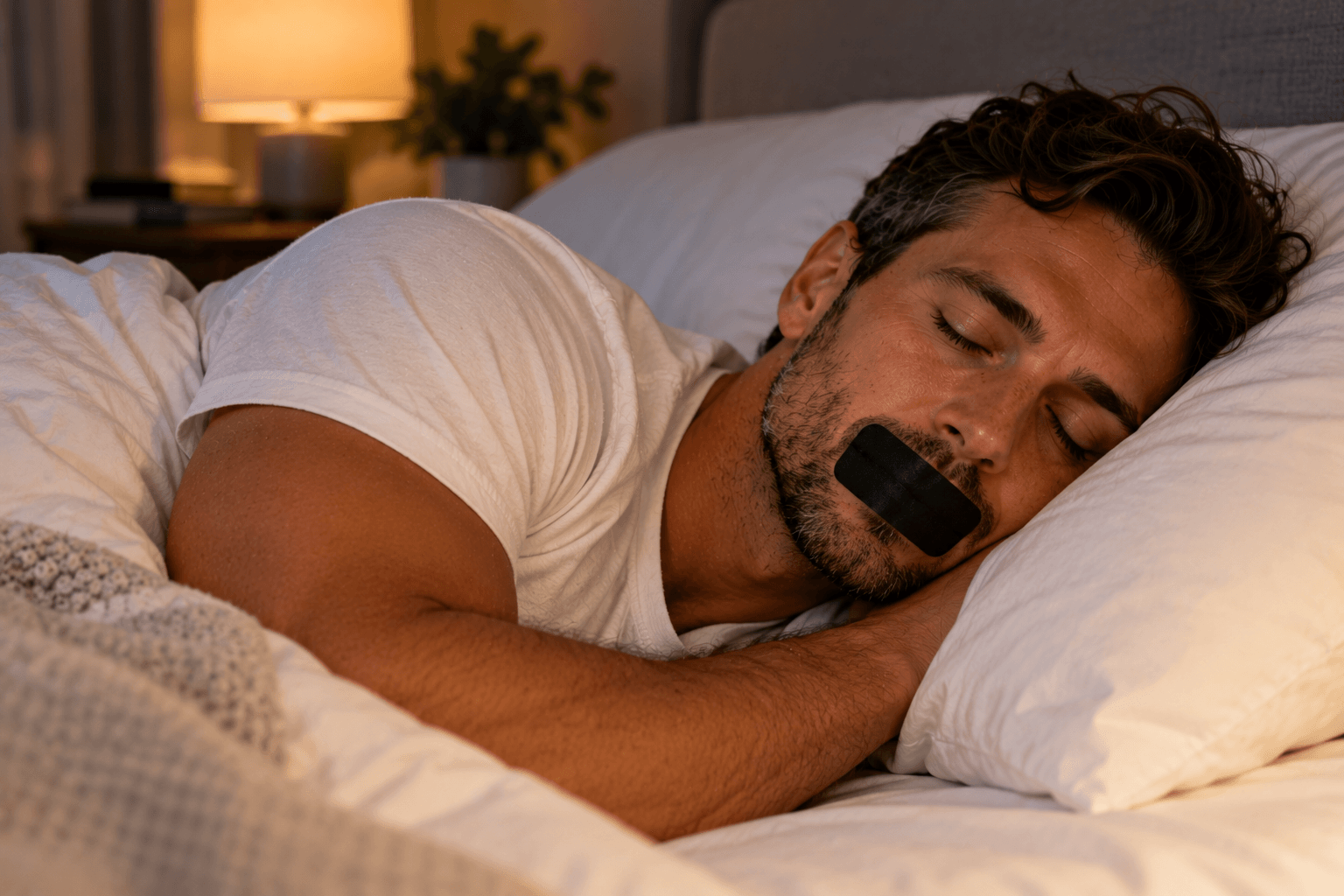
Mouth tape may help with night drooling when the cause is sleeping with your mouth open, because it keeps your lips together so saliva stays in. No study has tested tape for drooling, so this rests on simple mechanics rather than trial results. It works best once your nose is clear, and it won't help drooling caused by too much saliva or trouble swallowing, which is worth checking with a doctor.
Can mouth tape stop drooling?
Research: limited (what this means)Mouth tape can reduce drooling for some people by keeping the lips closed, though no study has measured it. Sleep Foundation says mouth breathing during sleep may make drooling more likely, since drool escapes more easily when your mouth is open. In its advice on how to stop drooling, it lists mouth tape among the ways to keep your mouth closed and breathe through your nose.
Cleveland Clinic makes the same link from the other direction. Its page on mouth breathing lists drooling when asleep as a common symptom, alongside dry mouth, bad breath and snoring. If your pillow is wet in the morning and your mouth feels dry, mouth breathing is a likely part of the picture, and our guide to signs you mouth breathe at night can help you check.
What we don't have is proof. Mouth taping research has looked at snoring and breathing, not drooling. A 2025 review in PLOS One found just 10 studies on mouth taping and similar methods and rated all of them as poor quality. The closest thing to a useful result is the 2022 study in Healthcare, where mouth breathers with mild sleep apnea wore tape for a week and 13 of 20 cut their snoring index by at least half. That shows tape can keep a mouth closed through the night, but it says nothing direct about saliva.
Why do people drool in their sleep?
People drool in their sleep mainly because saliva keeps flowing and has an easy way out. Sleep Foundation says saliva production drops at night but continues during sleep. Cleveland Clinic says it's common to drool during sleep, and that anything causing difficulty swallowing, problems with muscle control or too much saliva can cause excessive drooling.
Mouth breathing
An open mouth is the most direct route for drool. Sleep Foundation explains that mouth breathing makes drooling more likely, and notes that drooling often goes along with teeth grinding, possibly because both are linked to sleeping with the mouth open. If your jaw tends to drop open, our article on why your mouth falls open when you sleep explains the reasons.
Sleep position
Cleveland Clinic says that if you sleep on your back, gravity keeps saliva in your mouth, while side and stomach sleepers are much more likely to drool. This is where mouth tape can be especially handy. Sleep Foundation suggests side sleeping for people who snore, so switching to your back to stop drooling can trade one problem for another. Keeping your lips closed lets you stay on your side. Our guide to mouth tape and side sleeping covers how to make the two work together.
Congestion and allergies
Sleep Foundation says colds, strep throat and seasonal allergies can inflame the sinuses and block the airways, making you breathe through your mouth and drool more. Cleveland Clinic lists allergies and sinus infections among the causes of drooling too. Treating the congestion is the first fix here, and Sleep Foundation suggests treating allergies so you can breathe through your nose.
Acid reflux
Cleveland Clinic lists GERD, or chronic acid reflux, among the medical conditions that can cause drooling. Sleep Foundation explains that the body may respond to reflux irritation by producing more saliva. If you have heartburn at night as well as a wet pillow, see our article on mouth tape and acid reflux before taping.
Medications
Sleep Foundation says excessive salivation and drooling are side effects of some medications, including some antibiotics, antipsychotic drugs and medicines used to treat Alzheimer's disease. It advises not stopping a medication on your own and talking to your doctor instead.
Neurological causes
Some drooling comes from conditions that affect swallowing and muscle control. Cleveland Clinic lists stroke, cerebral palsy, Parkinson's disease, ALS, multiple sclerosis, Down syndrome and autism. Sleep Foundation notes that around 70% of people with Parkinson's disease experience excessive salivation. This kind of drooling needs a doctor, and mouth tape isn't the answer to it.
How do you stop drooling in your sleep?
To stop drooling in your sleep, work out the likely cause and start with the simplest fix. Sleep Foundation suggests changing sleep position and treating allergies first. Cleveland Clinic adds that people with chronic drooling can try limiting acidic or sugary foods, since both can increase saliva production. If mouth breathing is the main reason, keeping your lips closed is the next step.
| Likely cause | What to try first | Where mouth tape fits |
|---|---|---|
| Mouth open during sleep | Check your nose is clear | A good option once you breathe easily through your nose |
| Side or stomach sleeping | Back sleeping, per Sleep Foundation | Lets side sleepers keep their position with lips closed |
| Stuffy nose or allergies | Treat the congestion first | Only after your nose is clear |
| Acid reflux | Talk to a doctor about the reflux | Get advice before taping |
| A medication | Ask your doctor; don't stop it yourself | Doesn't address the cause |
| Neurological condition | See a doctor | Not a solution |
How do you use mouth tape for drooling?
Using mouth tape for drooling starts with your nose. Cleveland Clinic's sleep specialist says never to tape if you have nasal obstruction or congestion, chronic allergies, a sinus infection, enlarged tonsils, a deviated septum or heart issues. The 2025 PLOS One review found that 4 of its 10 studies warned of a serious risk of asphyxiation when the mouth is closed and the nose is obstructed.
Once your nose is clear, a few habits make taping easier:
- Try our nose test to check you can breathe comfortably with your mouth closed.
- Practice during the day first, as Sleep Foundation suggests.
- Use a small strip across the middle of the lips, not a full seal. The 2022 study used a 4 cm strip running from under the nose across both lips.
- Fold over one corner so it's easy to peel off, another Sleep Foundation tip.
- Put it on clean, dry skin and lips, with no balm underneath.
If you'd like a tape to try, our pick is Titan Bamboo Silk Mouth Tape. Our guide to how to start mouth taping sets out a first-week plan.
Give it about a week before you judge the results. The 2022 study measured snoring after seven nights of taping, not one, and the first night or two with tape can feel unfamiliar. A dry pillow on most mornings by the end of the week is a good sign the tape is doing its job.
Sleep Foundation also lists people who shouldn't tape: anyone with untreated sleep apnea, a blocked nose, asthma or COPD unless a doctor advises it, anxiety or panic disorders, or a risk of vomiting during sleep. We don't recommend mouth tape for children. Babies and toddlers drool as a normal part of development, according to Cleveland Clinic, and that isn't something to tape.
Check this first. Skip mouth tape and see a doctor if you snore loudly, wake up gasping, have been told you stop breathing in your sleep, or can't breathe comfortably through your nose. More on safety
When is drooling a sign to see a doctor?
Drooling is a sign to see a doctor when it's heavy, new or sudden, or comes with other symptoms. Cleveland Clinic says excessive or sudden drooling could be a cause for concern, and that if you've always slept on your side or stomach and only recently started drooling, a condition like allergies, an infection or acid reflux could be behind it. Sleep Foundation advises talking to a professional if drooling is continuous or severe.
Watch for signs of sleep apnea alongside drooling. The NHS lists breathing that stops and starts, gasping, snorting or choking noises, waking a lot and loud snoring as symptoms of sleep apnoea, and says to see a GP if you have them. Mouth tape is not a treatment for sleep apnea. Our guide to sleep apnea warning signs explains what to look for.
Sudden drooling with other changes can be an emergency. The NHS says the main symptoms of stroke include one side of the face drooping, arm weakness and slurred or confused speech, and that you should call emergency services straight away. Cleveland Clinic also notes that severe, untreated drooling can lead to sore, cracked corners of the mouth and, in some cases, saliva entering the lungs.
Our pick (paid partner): Titan Bamboo Silk Mouth Tape
We haven't tested or ranked mouth tapes ourselves. This is our recommendation, based on how Titan describes its tape against what matters for drooling.
Titan says the strip is bamboo silk, not kinesiology tape, and describes it as soft, breathable and moisture-wicking, which is useful around a mouth that tends to get damp at night. It comes in one oval size, 76 by 38 mm, worn horizontally across the lips, and Titan says its SilkSeal adhesive is made to grip through stubble and full beards without tugging hair or leaving residue.
Titan suggests 20 to 30 minutes of daytime practice before the first night. It says every batch is third-party tested and certified PFAS-free, and its 30-night guarantee refunds you if your sleep isn't better after 30 nights.
Read next
- Why your mouth falls open when you sleep
- Mouth tape side effects: what to expect and what to watch for
- How to sleep with a stuffy nose
Common questions
Does mouth tape stop drooling?
It may help if your drooling comes from sleeping with your mouth open. Sleep Foundation says mouth breathing makes drooling more likely and lists mouth tape as one way to keep your mouth closed. No study has tested tape for drooling, and it won't help drooling caused by excess saliva or swallowing problems.
How do I stop drooling in my sleep?
Start with the likely causes. Sleep Foundation suggests switching to back sleeping and treating allergies so you can breathe through your nose. Once your nose is clear, keeping your lips closed with mouth tape is another option. If drooling is heavy, new or sudden, see a doctor.
Why do I drool so much when I sleep?
The most common reasons are sleeping on your side or stomach and sleeping with your mouth open. Cleveland Clinic also lists allergies, sinus infections, acid reflux, certain medications and some neurological conditions. If you've always slept the same way and only recently started drooling, a health condition may be behind it.
Is drooling in your sleep a sign of something serious?
Usually not. Cleveland Clinic says drooling during sleep is common. But it says excessive or sudden drooling can be a cause for concern, and Sleep Foundation suggests talking to a doctor if drooling is continuous or severe, or comes with snoring, gasping or choking in sleep.
Is drooling a sign of sleep apnea?
Not on its own, but they can overlap. Sleep Foundation says mouth breathing often accompanies or worsens obstructive sleep apnea and makes drooling more likely. If you also snore loudly, gasp or choke in your sleep, or feel very tired in the day, the NHS says to see a GP. Mouth tape is not a treatment for sleep apnea.
Can I use mouth tape if I drool because of a stuffy nose?
Not while your nose is blocked. Cleveland Clinic's sleep specialist says never to tape with nasal congestion, and a 2025 review warned of a serious asphyxiation risk when the mouth is closed and the nose is obstructed. Clear your nose first, and tape only on nights you breathe comfortably through it.
Sources
- Drooling
- Mouth breathing
- Why do you drool in your sleep? Causes and remedies explained
- Mouth taping for sleep: does it work?
- Mouth taping: is it safe to use?
- Breaking social media fads and uncovering the safety and efficacy of mouth taping in patients with mouth breathing, sleep disordered breathing, or obstructive sleep apnea: A systematic review
- The impact of mouth-taping in mouth-breathers with mild obstructive sleep apnea: a preliminary study
- Sleep apnoea
- Stroke: symptoms
About this article
- Research
- 9 published sources, listed above.
- Evidence
- Limited. How we rate it
- Last checked
- October 12, 2026
- Funding
- Paid partner of Titan Recovery. Their ads are labeled.
- Found an error?
- Tell us. We log fixes on the corrections page.
* This content is for informational and educational purposes only and is not medical advice. It is not intended to diagnose, treat, cure or prevent any disease or health condition. Talk to a qualified healthcare provider about your health.