In short
- Healthy adults breathe almost entirely through the nose in sleep: a 2003 study measured only about 3% to 5% of inhaled air going through the mouth across sleep stages.
- Cleveland Clinic says most people who mouth breathe do so because they can't get enough air through their nose, so clearing the nose comes first.
- A 2022 meta-analysis that pooled nine studies and 291 people on nasal resistance concluded that lying down raises nasal resistance and lowers nasal airflow.
- The NHS lists a chin strap or a vestibular shield as treatments when snoring comes from the mouth falling open during sleep.
- In a 2022 study of 20 mouth breathers with mild sleep apnea, 13 cut their snoring index by at least half on a night with mouth tape.
- A 2014 study of 26 adults with sleep apnea found that a chin strap alone did not improve breathing events or snoring.
To keep your mouth closed while sleeping, start with your nose: if air moves through it easily, your mouth has much less reason to fall open. From there, sleeping on your side, thinking about head position and using a gentle mouth tape or a chin strap can each help. This guide goes through each option in order and says honestly how much evidence sits behind it.
Why does your mouth open when you sleep?
Research: limited (what this means)Your mouth usually opens in sleep because your nose isn't letting enough air through. Healthy sleepers are nasal breathers by default. In a 2003 study in the Journal of Applied Physiology, researchers measured the nose and mouth separately in 10 healthy adults and found that only about 3% to 5% of inhaled air went through the mouth across the stages of sleep.
When that changes, there's usually a reason. Cleveland Clinic says most people who mouth breathe do so because they can't get air in through their nose, and it lists congestion from allergies, colds or sinusitis, a deviated septum, swollen turbinates, nasal polyps, enlarged tonsils or adenoids, and sleep apnea as common causes.
Lying down adds to it. A 2022 meta-analysis in The Laryngoscope pooled nine studies with 291 people on nasal resistance and concluded that lying down raises nasal resistance and reduces nasal airflow, an effect the authors called especially important for people who snore or have sleep apnea. A nose that feels fine when you're upright can feel tighter once you're in bed.
There's a reason to care about it, too. In a small 1996 study of six healthy sleepers, opening the mouth made the upper airway more collapsible, and the authors suggested this may contribute to breathing problems in sleep. Our guide to why your mouth falls open when you sleep goes deeper on the jaw and airway side.
Step 1: how do you clear your nose first?
Clearing your nose is the first step because every other method on this list assumes you can breathe comfortably through it. Cleveland Clinic says treatment for mouth breathing targets the condition that makes it hard to breathe through your nose. It lists antihistamines or steroid nasal sprays for allergies, antihistamines and decongestants for a cold, and, for structural problems, surgery such as septoplasty or turbinate reduction.
The NHS gives a similar list for snoring caused by blocked or narrow nasal airways: nasal dilators or strips that hold the nose open, and decongestants or nasal sprays to reduce swelling. If your nose is stuffy most nights, a pharmacist or doctor can help you work out whether it's allergies, a cold that's hanging on or something structural.
A quick check helps. Close your mouth and breathe through your nose for a couple of minutes, sitting and then lying down. If that feels easy, move on to the next steps. If it doesn't, work on the nose before anything that holds your mouth shut. Our nose test walks you through it, and how to unblock your nose before bed covers the practical options.
Step 2: does sleeping on your side help?
Sleeping on your side is a sensible, free thing to try, though no study has measured whether it keeps the mouth closed. The NHS recommends side sleeping to reduce snoring and suggests taping or stitching a tennis ball to the back of your sleepwear, or using a special pillow or bed wedge, to keep you off your back. It also lists sleeping on your back as something that makes snoring more likely.
The meta-analysis on lying down measured the effect of moving from upright to lying flat, not the difference between your back and your side. So the honest summary is that side sleeping is well supported for snoring and low risk, and that its effect on an open mouth specifically is untested. If you mouth breathe and snore, it's worth doing either way.
Step 3: does head position make a difference?
Head position may matter, but there's little direct evidence on keeping the mouth closed. In the 1996 study, x-ray measurements taken awake in the same position showed that opening the mouth shortened the distance between the jaw and the hyoid bone in the neck, and during sleep the open mouth made the airway more collapsible. That fits with the idea that a jaw dropping back and down isn't great for breathing.
What it doesn't tell you is which pillow or angle prevents that. A pillow that keeps your head roughly in line with your spine, rather than pushing your chin to your chest or letting your head tip far back, is a reasonable place to start, and raising the head of the bed is something some people find comfortable. Treat these as experiments rather than proven fixes, and judge them by how you feel and what a partner hears.
Step 4: does mouth tape keep your mouth closed?
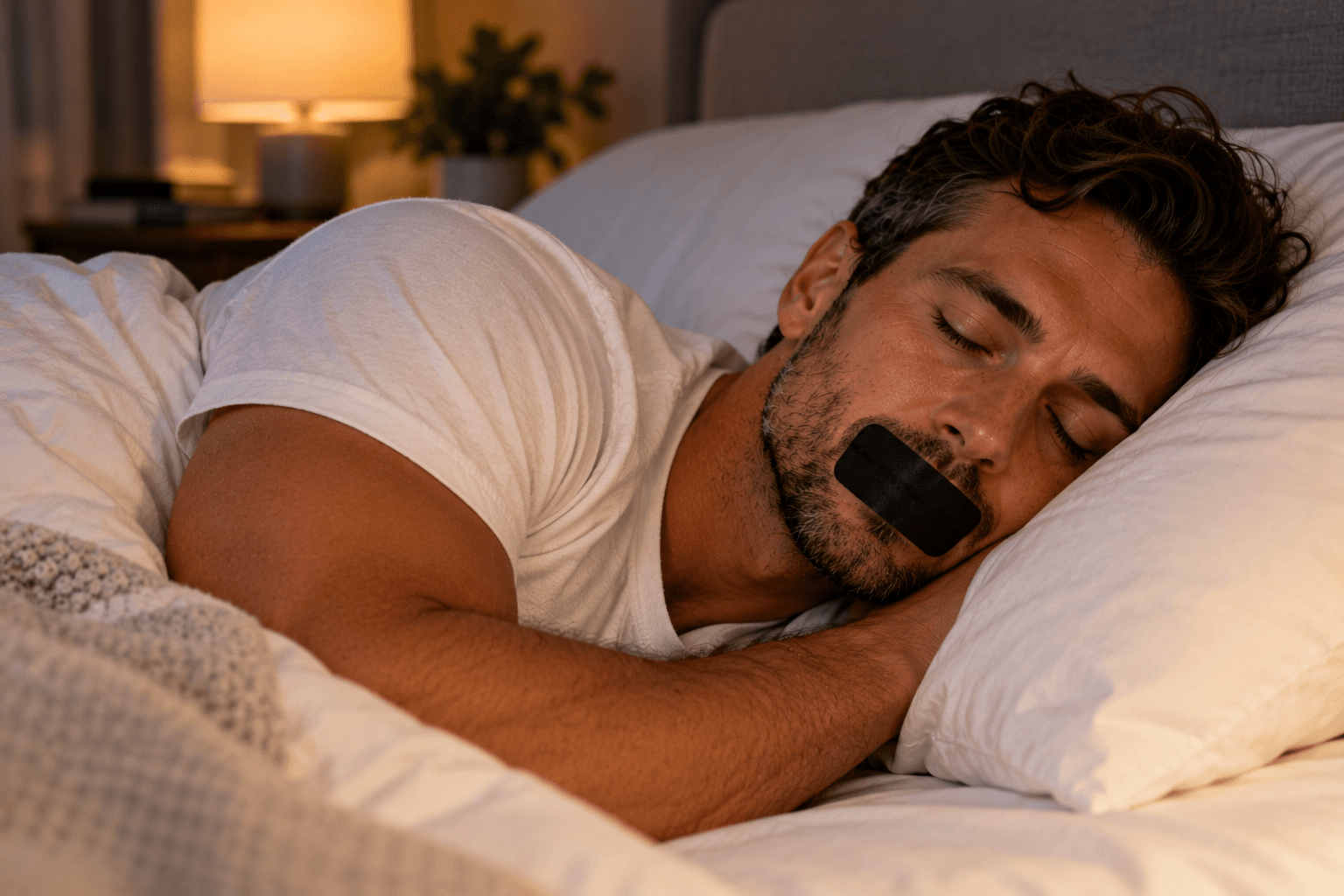
Mouth tape keeps the lips gently together so the nose becomes the easy route for air, and it has the most direct research of the options here, though that research is small. In a 2022 study in Healthcare, 20 mouth breathers with mild sleep apnea had a baseline home sleep test, then a second test one week later on a night with a 4 cm strip of silicone tape over the lips. On the taped night, 13 of the 20 cut their snoring index by at least half, and the median snoring index fell from 303.8 to 121.1 events an hour.
That's an encouraging result for people whose snoring comes from an open mouth. The study's limits matter, though. It left out people with a BMI of 30 or more and anyone whose tape came off by morning, and people with nasal obstruction were given medication and nasal spray to make taping possible. A 2025 systematic review in PLOS One looked at 10 studies with 213 patients in total and rated all of them as poor quality.
If you want to try it, use a tape made for skin and practice during the day first. Cleveland Clinic quotes a doctor who says never to use mouth tape if you have nasal obstruction, nasal congestion, chronic allergies, a sinus infection, enlarged tonsils, a deviated septum or heart issues. The 2025 review noted that closing the mouth by taping, sealing or chin strapping could pose a serious risk of asphyxiation if the nose is blocked. We don't recommend mouth tape for children. Our first-week guide explains how to ease in.
Step 5: is a chin strap worth trying?
A chin strap holds the jaw up rather than sealing the lips, and the NHS lists it as a treatment when snoring comes from your mouth falling open, alongside a vestibular shield, a device worn in the mouth that makes you breathe through your nose. Some people prefer a strap because it doesn't rely on adhesive.
The research on chin straps alone is not encouraging for sleep apnea. In a 2014 study in the Journal of Clinical Sleep Medicine, 26 adults with sleep apnea wore only a chin strap for the first two hours of a sleep study. There was no significant improvement in breathing events or snoring, breathing events didn't improve even in the 13 with mild sleep apnea, and the authors concluded a chin strap alone is not an effective treatment. That study was in people with sleep apnea, so it says less about simple mouth opening in people without it. We compare the two in mouth tape vs chin strap.
How do the options compare?
The table below sums up each method, what it does and how much evidence supports it.
| Method | What it does | Evidence | Good to know |
|---|---|---|---|
| Clearing your nose | Removes the main reason the mouth opens | Cleveland Clinic and the NHS treat the nose first | Do this before anything that holds the mouth shut |
| Side sleeping | Keeps you off your back | NHS recommends it for snoring; untested for mouth opening | Free and low risk |
| Head position | Keeps the jaw from dropping back | Indirect only (1996 airway study) | Treat as an experiment |
| Mouth tape | Holds the lips gently together | Small 2022 study: 13 of 20 halved snoring on a taped night | Only with a clear nose; practice first |
| Chin strap | Holds the jaw up | NHS lists it; 2014 study found no benefit alone in sleep apnea | No adhesive on skin |
When is an open mouth a sign of something else?
An open mouth at night can be a sign of sleep apnea or a nose problem that needs a doctor. The NHS says to see a GP if you feel sleepy in the day, your breathing stops and starts while you sleep, or you make gasping or choking noises, because you may have sleep apnoea, which can be serious if not treated. Cleveland Clinic lists sleep apnea among the causes of mouth breathing.
Cleveland Clinic also suggests talking to a healthcare provider if you notice you breathe through your mouth more than your nose, and says your first clue may be dry mouth, bad breath and drool on your pillow. A nose that's blocked most of the time, or only on one side, is worth having examined. If you're pregnant or have a heart or lung condition, ask your clinician before trying mouth tape or a chin strap. Our list of sleep apnea warning signs can help you decide.
Check this first. Skip mouth tape and see a doctor if you snore loudly, wake up gasping, have been told you stop breathing in your sleep, or can't breathe comfortably through your nose. More on safety
Our pick (paid partner): Titan Bamboo Silk Mouth Tape
If your nose is clear and your mouth still falls open, our pick is Titan Bamboo Silk Mouth Tape. This is our recommendation, based on how Titan describes its tape. We haven't tested or ranked mouth tapes ourselves, and Titan's tape wasn't used in the studies above.
Titan says the strip is bamboo silk rather than kinesiology tape, and describes it as soft, breathable and moisture-wicking. It comes in one oval size, 76 by 38 mm, worn horizontally across the lips, with no printed logo or ink on the side that touches skin. Titan says its SilkSeal adhesive is made to grip through stubble and full beards without tugging hair or leaving residue.
Titan suggests 20 to 30 minutes of daytime practice before the first night, which matches the advice to test tape while awake. It says every batch is third-party tested and certified PFAS-free, and its 30-night guarantee refunds you if your sleep isn't better after 30 nights. If you'd like to pair it with nasal strips, the Titan Sleep System puts both together.
Read next
Common questions
How can I keep my mouth closed while I sleep?
Start by making sure you can breathe easily through your nose, since a blocked nose is the most common reason the mouth opens. Then try sleeping on your side and, if your mouth still drops open, a skin-safe mouth tape or a chin strap. Practice either one while awake first.
Why does my mouth open when I sleep?
Usually because your nose isn't letting enough air through. Cleveland Clinic lists congestion, allergies, a deviated septum, swollen turbinates, nasal polyps and enlarged tonsils or adenoids as common causes. Lying down also raises nasal resistance. In some people, an open mouth during sleep goes along with sleep apnea.
Is mouth tape or a chin strap better for keeping your mouth closed?
Neither has strong evidence. Mouth tape has a small 2022 study showing less snoring in mouth breathers with mild sleep apnea. A 2014 chin strap study found no improvement in breathing events or snoring for people with sleep apnea. The NHS lists a chin strap as an option when your mouth falls open.
Does sleeping on your side keep your mouth closed?
No study has measured that directly. The NHS recommends side sleeping to reduce snoring, and research shows that lying down raises resistance in the nose. Side sleeping is free and low risk, so it's a sensible thing to try alongside the other steps.
Is it bad to sleep with your mouth open?
Cleveland Clinic says mouth breathing in adults isn't a serious health issue on its own, though it can bring dry mouth, bad breath, drooling, hoarseness and snoring. In a small 1996 study, opening the mouth made the upper airway more collapsible during sleep. The bigger question is why it's happening.
When is sleeping with your mouth open a sign of something else?
When it comes with loud snoring plus gasping, choking, pauses in breathing or heavy daytime sleepiness. The NHS says those can be signs of sleep apnoea and that you should see a GP. A nose that's blocked most of the time is also worth checking with a doctor.
Sources
- Partitioning of inhaled ventilation between the nasal and oral routes during sleep in normal subjects
- Effects of mouth opening on upper airway collapsibility in normal sleeping subjects
- The Recumbent Position Affects Nasal Resistance: A Systematic Review and Meta-Analysis
- Mouth breathing
- Snoring
- Mouth taping: is it safe to use?
- The impact of mouth-taping in mouth-breathers with mild obstructive sleep apnea: a preliminary study
- The efficacy of a chinstrap in treating sleep disordered breathing and snoring
- Breaking social media fads and uncovering the safety and efficacy of mouth taping in patients with mouth breathing, sleep disordered breathing, or obstructive sleep apnea: A systematic review
- Bamboo Silk Mouth Tape
About this article
- Research
- 10 published sources, listed above.
- Evidence
- Limited. How we rate it
- Last checked
- November 2, 2026
- Funding
- Paid partner of Titan Recovery. Their ads are labeled.
- Found an error?
- Tell us. We log fixes on the corrections page.
* This content is for informational and educational purposes only and is not medical advice. It is not intended to diagnose, treat, cure or prevent any disease or health condition. Talk to a qualified healthcare provider about your health.