In short
- The best-known mouth taping study, from 2022, used a 4 cm strip of silicone hypoallergenic medical tape, not a product sold as mouth tape.
- Sleep Foundation says to use a porous tape intended for skin and notes that most pharmacies sell hypoallergenic, surgical and athletic tape.
- Medical adhesive tapes are made with synthetic rubber, acrylate or silicone adhesives, and silicone adhesives have much lower peel adhesion and cause less skin trauma on removal.
- In a 2013 randomized trial, silicone tape disturbed the skin barrier less than paper tape over 11 days of repeated use.
- FDA guidance on ISO 10993-1 describes biocompatibility testing as a way to judge the risk of a harmful reaction when a device's materials touch the body.
- The FTC's Green Guides say a 'free-of' claim, such as PFAS-free, is deceptive if it misrepresents what a product contains.
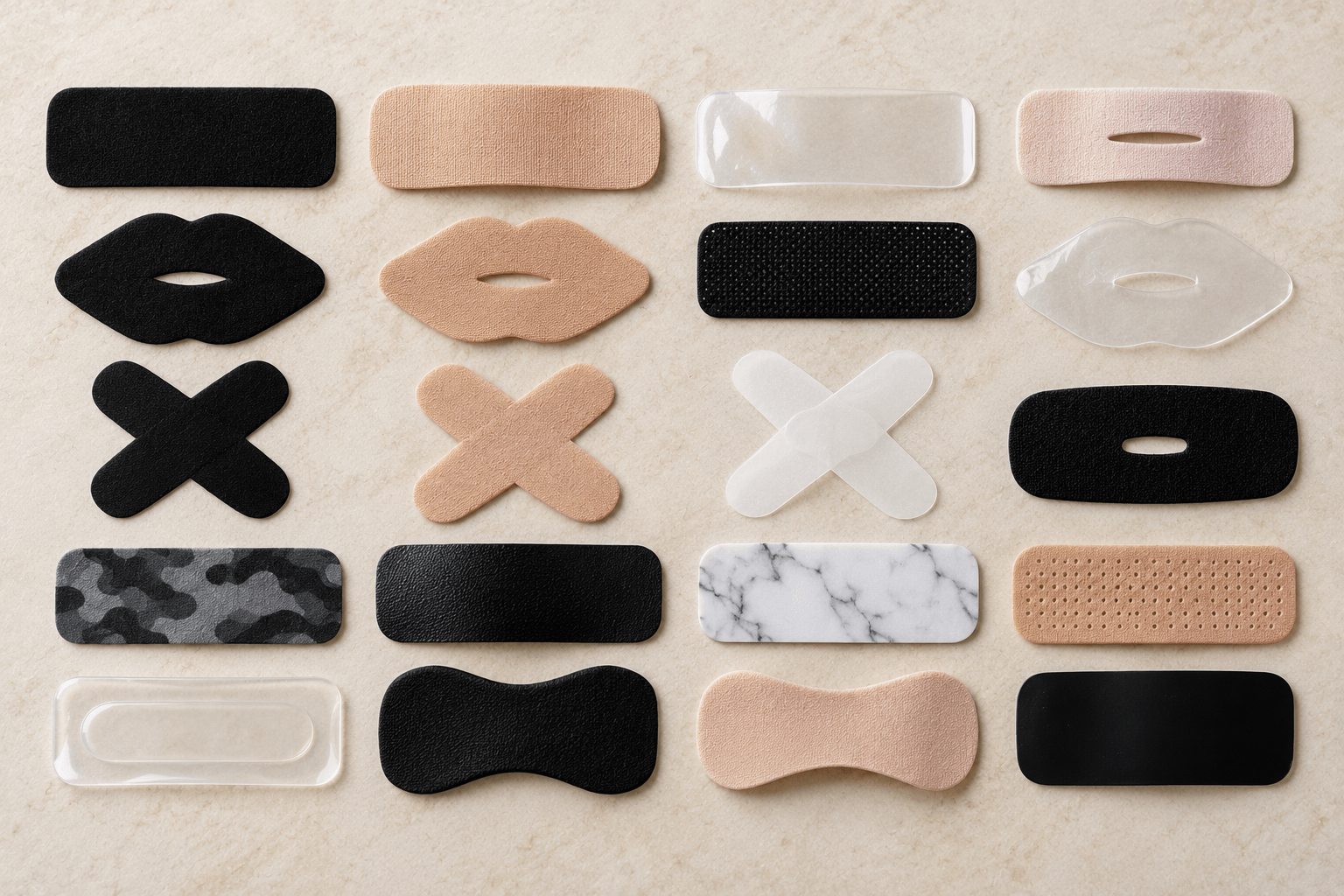
Medical tape and tape made for the mouth can both keep your lips closed at night, and neither has been shown to work better than the other. The difference is in the details: material, adhesive, shape, how it comes off, and what the maker says about testing. A roll of gentle medical tape is a fine, cheap way to find out whether mouth taping suits you. Tape made for the mouth earns its place when you tape most nights, have facial hair or sensitive skin, or want a shape and adhesive designed for the job.
If you want the details on medical tape alone, see our guide to using medical tape for mouth taping, and for sports tape, kinesiology tape for mouth taping. This article is about the choice between the two categories.
What tape did the research actually use?
Research: limited (what this means)The research used medical tape. In the best-known study, published in Healthcare in 2022, 20 mouth breathers with mild sleep apnea slept with silicone hypoallergenic medical tape, trimmed to 4 cm and placed over the middle of the lips so it spanned both. On that taped night, a week after their baseline test, 13 of the 20 cut their snoring index by at least half.
That's useful to know either way. It means generic tape isn't a second-rate choice by default; it's what the study used. It also means the research doesn't tell you anything about any particular brand of mouth tape, including the one we recommend. A 2025 systematic review in PLOS One found 10 mouth taping studies with 213 patients in total and rated every one as poor quality, so the evidence for mouth taping as a whole is still thin.
How do medical tape and mouth tape compare?
Medical tape and mouth tape differ most in shape, adhesive and what the maker claims about testing. The table compares the two categories in general terms.
| What to compare | Generic medical tape (paper, silicone or microporous) | Tape made for the mouth |
|---|---|---|
| Made for skin? | Yes, if it's porous medical or surgical tape | Yes |
| Material | Paper, silicone and microporous types are common | Varies by product; some use fabric or silk-type strips |
| Adhesive | Acrylate, synthetic rubber or silicone | Varies; some are made to hold on facial hair |
| Shape | A roll you cut to length | Pre-cut strip or oval sized for the lips |
| Grip on stubble and beards | Not designed for it | Some products are designed for it |
| Removal | Silicone peels gently; acrylate grips harder | Depends on the adhesive |
| Testing claims | General medical product standards; nothing specific to the lips | Some brands state skin-contact or PFAS testing |
| Used in published research? | Yes, in the 2022 study | Not by brand |
| Cost per night | Usually very low | Higher; you pay for design and extras |
| Where to buy | Most pharmacies | Online or specialist retailers |
None of these rows makes one category right for everyone. They tell you which features you're paying for and whether you'll use them.
Does the material matter?
The material matters mainly for comfort over a full night. Medical tape is a general-purpose product made for many parts of the body, not specifically the lips. Sleep Foundation says to use a porous tape intended for use on human skin, and notes that masking tape or other tape not made for the body is more likely to cause irritation or an allergic reaction.
Tape made for the mouth is designed for one spot. Some products use soft fabric or silk-type strips, and the maker can choose a material with the lips in mind. Nobody has measured whether that changes how well taping works. It can change how pleasant it is to wear, and comfort is often what decides whether people keep going.
Which adhesive is gentler on your lips?
Silicone adhesives are the gentlest of the common medical options. A 2017 report in the Indian Journal of Anaesthesia explains that medical tapes use synthetic rubber, acrylate or silicone adhesives, and that silicone-based adhesives have significantly lower peel adhesion, with much less skin trauma on removal.
A 2013 randomized trial in the Journal of Wound, Ostomy and Continence Nursing backs that up. Researchers applied and removed silicone and paper tape on the forearms of 28 healthy adults aged 55 and over, every weekday for 11 days. Silicone tape disturbed the skin barrier significantly less than paper tape, although both stayed within the range of normal skin.
The trade-off is grip. A gentle adhesive that peels off easily can also lift off at night, especially through stubble. That's where tapes made for the mouth try to differ: some use adhesives designed to hold on facial hair. Sleep Foundation notes that tape can pull on facial hair and make removal painful, so if you have a beard, the adhesive is the feature most worth paying attention to. Our guide to mouth tape with a beard covers prep and removal.
Does the shape make a difference?
The shape makes taping easier more than it makes it work better. With a roll, you cut a strip each night, decide on the length and place it yourself. The 2022 study used a 4 cm piece placed over the middle of the lips. A pre-cut strip or oval saves that step and gives the same placement every night, which helps when you're tired at bedtime.
Shape also affects how much hair and skin the tape touches. A strip sized for the lips covers less of the face than a long piece across the cheeks. Our guide to the best type of mouth tape compares shapes in more detail.
What do testing claims on mouth tape mean?
Testing claims tell you what the maker says it checked, and they're worth reading closely. Two kinds come up most often on mouth tape.
The first is skin-contact or biocompatibility testing. The FDA's guidance on ISO 10993-1 describes this standard as a way to evaluate the potential for a harmful biological response when a device's materials come into contact with the body. A claim of testing to ISO 10993 suggests the maker checked for skin reactions, though the claim alone doesn't tell you which tests were done or what they found.
The second is "PFAS-free". The FTC's Green Guides say it's deceptive to misrepresent that a product is free of a substance, and that free-of claims should be qualified where needed to avoid misleading people. Our guides to what third-party tested means and PFAS in tapes and skin products cover what to ask any brand.
A roll of medical tape usually makes neither claim on the box, because it isn't sold for the lips. That doesn't make it unsafe. It just means the maker hasn't said anything about mouth taping specifically.
When is generic medical tape fine?
Generic medical tape is fine when you want to try mouth taping cheaply before committing, when you have clean-shaven skin, and when it stays on and comes off without soreness. A silicone tape is the gentlest starting point. If a roll does the job for you night after night, there's no need to switch.
It's worth switching when generic tape keeps falling off, pulls on stubble or a beard, leaves your lips red, or when cutting and placing a strip each night is the reason you skip it. Those are the problems tape made for the mouth is designed around. If you're unsure, our mouth tape buying guide lists what to check.
Who should skip mouth tape, whichever kind?
The tape you choose doesn't change who should avoid mouth taping. We don't recommend mouth tape for children. Cleveland Clinic says never to use mouth tape if you have nasal obstruction, nasal congestion, chronic allergies, a sinus infection, enlarged tonsils, a deviated septum or heart issues.
Sleep Foundation says anyone with sleep apnea symptoms, such as loud snoring, choking or gasping for air during sleep, or excessive daytime fatigue, should see a healthcare provider before trying it. Mouth tape doesn't treat sleep apnea. If you're pregnant, ask your midwife or doctor first. Check you can breathe easily through your nose with our nose test before your first night.
Check this first. Skip mouth tape and see a doctor if you snore loudly, wake up gasping, have been told you stop breathing in your sleep, or can't breathe comfortably through your nose. More on safety
Our pick (paid partner): Titan Bamboo Silk Mouth Tape
If you decide tape made for the mouth suits you, Titan Bamboo Silk Mouth Tape is the one we recommend. We haven't tested or ranked tapes ourselves. This recommendation rests on how Titan describes its tape against the comparison above.
Titan says the strip is bamboo silk, not kinesiology tape, with no printed logo or ink on the skin side. Its SilkSeal adhesive is made to grip through stubble and full beards without tugging hair or leaving residue, which is the main gap in general medical tape. It comes pre-cut as a 76 by 38 mm oval worn horizontally across the lips. Titan says every batch is third-party tested and certified PFAS-free, and it offers a 30-night guarantee if your sleep isn't better.
Our Titan mouth tape guide has a first-week plan for the Titan tape.
Read next
- What mouth tape is made of
- Is expensive mouth tape worth it?
- Mouth tape skin irritation: causes and fixes
Common questions
Is mouth tape better than medical tape?
Neither has been shown to work better. No study has compared them. The main study used silicone medical tape. Tape made for the mouth adds convenience and features such as a pre-cut shape and, in some products, an adhesive meant for facial hair. Medical tape is cheap and easy to find.
What kind of medical tape can you use on your mouth?
Sleep Foundation says to use a porous tape intended for use on human skin, such as hypoallergenic or surgical tape from a pharmacy. The 2022 study used silicone hypoallergenic tape. Silicone adhesives peel off with less skin trauma than acrylate ones, which matters for nightly use on the lips.
Why is mouth tape more expensive than medical tape?
A roll of medical tape is a general-purpose product, while mouth tape is cut and designed for one job. You pay for the shape, the material, the adhesive and any testing or guarantee the brand offers. Whether that's worth it depends on your skin, your facial hair and how often you'll tape.
Can you use paper tape for mouth taping?
Paper medical tape is made for skin and is easy to find. In a 2013 randomized trial, both paper and silicone tape stayed within normal skin limits, but silicone disturbed the skin barrier less over repeated use. If paper tape leaves your lips sore, silicone tape is the gentler next step.
Does medical tape work with a beard?
It can, but facial hair is where general medical tape struggles most. Sleep Foundation notes that tape can pull on facial hair and make removal painful. A tape with an adhesive designed for hair, a light trim around the lips, or a slow peel in the direction of growth all help.
Which tape was used in mouth taping research?
The 2022 study in Healthcare used silicone hypoallergenic medical tape, trimmed to 4 cm and placed over the middle of the lips. No published study has used a branded mouth tape in a way that tells you one product works better than another. A 2025 review rated all mouth taping studies as poor quality.
Sources
- The impact of mouth-taping in mouth-breathers with mild obstructive sleep apnea: a preliminary study
- Mouth taping for sleep: does it work?
- Facial skin injury caused by acrylate-based adhesive tapes in a post-menopausal patient: a preventable cause
- A randomized and controlled comparison of gentleness of 2 medical adhesive tapes in healthy human subjects
- Use of International Standard ISO 10993-1, Biological evaluation of medical devices, Part 1
- 16 CFR 260.9: Free-of claims (Green Guides)
- Breaking social media fads and uncovering the safety and efficacy of mouth taping in patients with mouth breathing, sleep disordered breathing, or obstructive sleep apnea: A systematic review
- Mouth taping: is it safe to use?
- Titan Recovery Bamboo Silk Mouth Tape
About this article
- Research
- 9 published sources, listed above.
- Evidence
- Limited. How we rate it
- Last checked
- November 1, 2026
- Funding
- Paid partner of Titan Recovery. Their ads are labeled.
- Found an error?
- Tell us. We log fixes on the corrections page.
* This content is for informational and educational purposes only and is not medical advice. It is not intended to diagnose, treat, cure or prevent any disease or health condition. Talk to a qualified healthcare provider about your health.