In short
- At altitude each breath carries less oxygen, so you breathe harder, and during sleep that often settles into a cycle of deeper breaths and pauses called periodic breathing.
- A 2024 review says periodic breathing during sleep at high altitude is almost universal among visitors and gets worse the higher you sleep.
- Going up slowly, sleeping lower when you can, and skipping alcohol and sedatives all reduce the risk of altitude sickness, which commonly disrupts sleep.
- Shortness of breath at rest, confusion, poor coordination or being hard to wake are emergencies: get help and go down.
- Nasal strips can make a dry, stuffy nose more comfortable, but they don't treat or prevent altitude sickness, and we'd leave mouth tape at home for high-altitude nights.
At high altitude each breath carries less oxygen, so your body breathes harder, and during sleep that often turns into a cycle of deeper breaths and short pauses. Add the headache and restlessness of altitude sickness and broken sleep is common for the first few nights. Going up slowly, sleeping as low as you can, and skipping alcohol and sleeping pills help most, and worsening symptoms mean it's time to go down.
Why does breathing change at altitude?
Cleveland Clinic explains that the atmosphere gets thinner the higher you go, so breathing in the same amount of air gets you less oxygen than it would lower down. Your body responds by breathing more. A 2026 review in Sleep Medicine Clinics describes how that extra breathing lowers carbon dioxide in the blood, and during non-REM sleep the drive to breathe then dips. The result is a repeating pattern of breaths that build, fade and briefly stop, called high-altitude periodic breathing. In some people it is frequent enough to count as central sleep apnea, where the pauses come from the brain's breathing control rather than a blocked airway.
This is very common. A 2024 review in The Journal of Physiology says periodic breathing during sleep at high altitude is almost universal among visitors, and its severity rises with the altitude you sleep at. There is some reassurance in the same review: once people acclimatize, periodic breathing persists but doesn't seem to cause obvious harm or much worse sleep.
Is poor sleep a sign of altitude sickness?
Yes, poor sleep can be a sign of altitude sickness. The NHS lists difficulty sleeping among the main symptoms of altitude sickness, along with headache, loss of appetite, feeling or being sick, feeling tired and dizziness. It says symptoms usually start 6 to 10 hours after reaching high altitude and usually get better in 1 to 3 days with rest.
The NHS says altitude sickness usually happens above 2,500 meters, and that you're more likely to get it if you travel or climb quickly. Cleveland Clinic says acute mountain sickness is rare below 8,000 feet but that almost everyone who goes up quickly to 11,000 feet will develop it. It adds that people who fly to high altitudes are much more likely to get it than those who walk, hike or drive.
Which symptoms are an emergency?
Altitude sickness can become life-threatening. The NHS says to get medical help immediately if you or someone with you at altitude:
- feels very unwell with symptoms of altitude sickness
- is confused
- has problems with balance or coordination
- is seeing or hearing things that aren't there
- feels short of breath even when resting
- has a cough, or is coughing up frothy or bloody spit
- has blue or grey skin, lips, tongue or nails
- is very sleepy or difficult to wake
It says to go down straight away, around 300 to 1,000 meters lower, if you can. Cleveland Clinic warns that the severe forms, fluid on the lungs (HAPE) and swelling of the brain (HACE), can be deadly within hours. Because being very sleepy or difficult to wake is on the NHS list, don't assume someone who is hard to rouse at night is just sleeping deeply.
What helps you sleep better at altitude?
Research: limited (what this means)The steps that help you sleep better at altitude are mostly the same ones that lower your risk of altitude sickness.
The most useful step is going up slowly. The NHS suggests spending a few days below 2,500 meters before going higher, not flying straight to a high destination if you can avoid it, and above 3,000 meters, not sleeping more than 500 meters higher than the night before, with a rest day every 3 to 4 days. Cleveland Clinic says the starting altitude for each day is where you last slept.
It also helps to sleep lower when you can. Cleveland Clinic suggests climbing during the day and returning to a lower altitude to sleep, if that's possible. The 2024 review links worse periodic breathing to higher sleeping altitude, which fits with this advice.
Alcohol and sleeping pills are best left out. The NHS advises not drinking alcohol while travelling or climbing at altitude. Cleveland Clinic says alcohol and certain medicines, especially sedatives, can greatly increase the chances of altitude sickness.
The NHS also suggests drinking enough water so you don't get dehydrated.
Medicine is worth asking about before you go. The NHS suggests speaking to a GP or travel clinic if you've had altitude sickness before or are going up quickly, since they may prescribe medicine to help prevent it. Cleveland Clinic names acetazolamide among the medicines used, and the 2026 review says acetazolamide is effective for high-altitude periodic breathing.
What about a dry, stuffy nose?
A dry, stuffy nose at altitude is partly down to dry air. Cleveland Clinic says air is typically drier at high altitudes, and that dry air can leave the lining of the nose crusty or cracked and more likely to bleed. Lying down doesn't help either: a 2022 meta-analysis found lying flat increases nasal resistance and reduces airflow. Our guides to dry nose at night and nosebleeds at night cover the basics, including saline.
A nasal strip is a simple, drug-free way to make nose breathing feel easier. It sits on the outside of the nose and gently lifts the sides open. A 2016 meta-analysis found nasal dilators improve nasal breathing, and in a 2018 trial of 59 people with chronic nighttime congestion, strips improved some measures of sleep satisfaction and congestion on waking compared with placebo strips. Those studies weren't done at altitude. A strip doesn't treat or prevent altitude sickness, and it never replaces going down, oxygen or medicine. See how nasal strips work and how to apply nasal strips.
If you pack strips for a mountain trip, the ones we recommend are TitanAir Nasal Strips. Titan says they're drug-free external nasal dilators with flexible spring-loaded bands, worn on the soft part of the nose just above the flare of the nostrils, on clean, dry skin.
Check this first.
A nasal strip is not a treatment for altitude sickness. If you feel short of breath at rest, are confused, lose coordination or are hard to wake, get medical help and go down. Leave mouth tape off at altitude, and see a doctor before you travel if you have sleep apnea.
More on safetyShould you use mouth tape at altitude?
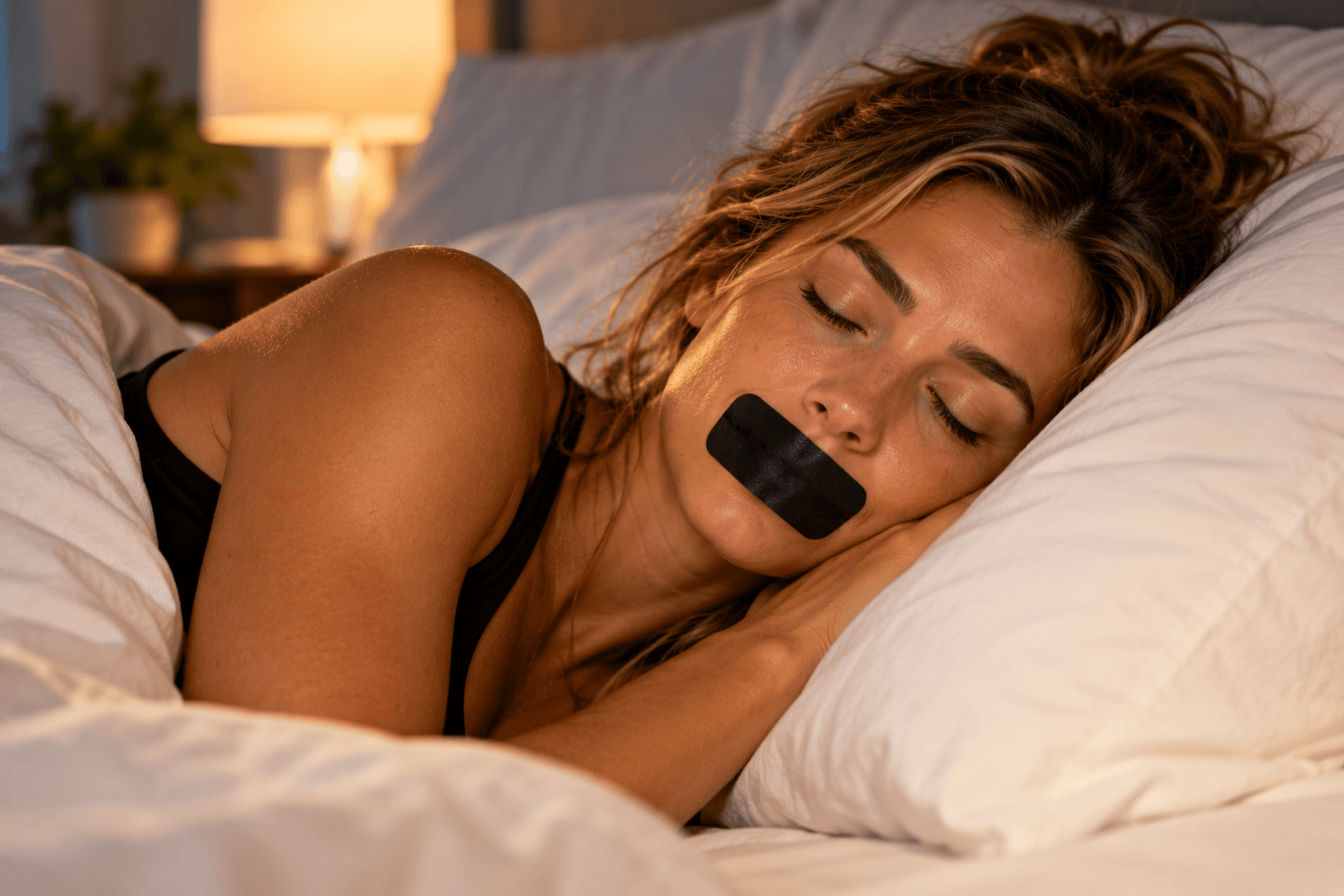
We'd leave mouth tape at home for high-altitude nights, even if you tape happily at sea level. Your breathing is working harder up there, periodic breathing brings pauses into sleep, and dry air can block your nose. A 2025 review in PLOS One warned of a potentially serious risk, including asphyxiation, when the mouth is taped and the nose is obstructed. Pick tape back up once you're home. Mouth taping when traveling covers the trips where it does make sense, and our safety page lists who should skip it altogether.
What if you snore or have sleep apnea?
Snoring that comes with pauses in breathing, gasping or choking, or heavy tiredness during the day can be a sign of sleep apnoea, according to the NHS, which says it can be serious if it isn't diagnosed and treated. Altitude adds to the problem. A 2015 review in High Altitude Medicine and Biology says that when people with obstructive sleep apnea stay above 1,600 meters, a height many tourist destinations reach, they develop frequent central apneas on top of their usual obstructive ones. Based on randomized trials, it suggests using auto-adjusting CPAP together with acetazolamide during the stay, and acetazolamide alone if CPAP isn't possible. If you use CPAP, take it with you, and talk to your doctor before the trip. Mouth tape and CPAP explains how the two fit together at home. For more, browse our sleep articles.
Read next
- What to pack for better sleep when you travel
- Why your nose dries out at night and what helps
- 10 warning signs of sleep apnea you should not ignore
Common questions
Why can't I sleep at high altitude?
Thinner air means less oxygen per breath, and your breathing during sleep can swing between deeper breaths and short pauses. Trouble sleeping is also a common symptom of acute mountain sickness, along with headache, nausea, tiredness and dizziness.
What is periodic breathing at altitude?
It's a repeating pattern of breathing that builds up, fades and briefly pauses during sleep. A 2024 review says it's almost universal among visitors at high altitude, gets more severe the higher you sleep, and doesn't seem to cause obvious harm once you've acclimatized.
At what altitude does altitude sickness start?
The NHS says it usually happens above 2,500 meters, about 8,200 feet. Cleveland Clinic says acute mountain sickness is rare below 8,000 feet and that almost everyone who climbs quickly to 11,000 feet will develop it.
Can nasal strips help with altitude sickness?
No. Strips may make a dry or stuffy nose more comfortable, but they don't treat or prevent altitude sickness. The NHS and Cleveland Clinic say to go up slowly, rest, and go down if symptoms get worse.
Should I use mouth tape at altitude?
We'd leave it off. Breathing works harder at altitude, sleep often brings breathing pauses, and dry air can block your nose, and a 2025 review warned of serious risk when taping with a blocked nose. Keep tape for nights at home.
I have sleep apnea. Is it safe to travel to altitude?
Talk to your doctor before you go. A 2015 review says that above 1,600 meters people with obstructive sleep apnea also develop central apneas, and suggests using auto-adjusting CPAP together with acetazolamide during the stay.
Sources
- Altitude sickness
- Altitude sickness
- A narrative review of periodic breathing during sleep at high altitude: from acclimatizing lowlanders to adapted highlanders
- Central sleep apnea at high altitude: from pathophysiology to treatment
- Patients with obstructive sleep apnea at altitude
- Nosebleed (epistaxis)
- The Recumbent Position Affects Nasal Resistance: A Systematic Review and Meta-Analysis
- Effects of nasal dilator strips on subjective measures of sleep in subjects with chronic nocturnal nasal congestion: a randomized, placebo-controlled trial
- Nasal Dilators (Breathe Right Strips and NoZovent) for Snoring and OSA: A Systematic Review and Meta-Analysis
- Breaking social media fads and uncovering the safety and efficacy of mouth taping in patients with mouth breathing, sleep disordered breathing, or obstructive sleep apnea: A systematic review
- Sleep apnoea
- TitanAir Nasal Strips
About this article
- Research
- 12 published sources, listed above.
- Evidence
- Limited. How we rate it
- Last checked
- October 6, 2026
- Funding
- Paid partner of Titan Recovery. Their ads are labeled.
- Found an error?
- Tell us. We log fixes on the corrections page.
* This content is for informational and educational purposes only and is not medical advice. It is not intended to diagnose, treat, cure or prevent any disease or health condition. Talk to a qualified healthcare provider about your health.